Larry Bird and the Power of Repetition

59e8ccbb63ad4ff3a1b66252a5b83ccb

Snark MeterrealMID.003

How the Daily Office will change your life (Part 1)

Like most American Christians I have spent significant time looking for “fresh” Jesus experiences. Several years ago I decided that looking for “new” things was an unhelpful exercise in missing the point. That conviction struck me as I reflected on an experience I had years ago with Larry Bird…

My part-time job teenage job was Phoenix Suns ball-boy. While my friends worked the usual food service and retail gigs, I worked the visitor’s team bench and locker room. I wasn’t just paid better than my friends, I watched games from the floor and had the opportunity to rub shoulders with NBA Hall of Fame greats like Kareem, Dr. J, Magic Johnson, Larry Bird, and Michael Jordan. Well, maybe “rub shoulders” is overstating it. I tossed them towels and put their jerseys on their shoulders when they came out of the game. During those years I noticed something: The very best players, the really great ones, all had a consistent warm-up routine they followed identically, even superstitiously, before each game.

Game nights for me involved arriving three and a half hours before tipoff to set up the visitor’s locker room with towels and soda before the team bus pulled up an hour later. One afternoon in February of 1980 I entered the bowels of Veterans Memorial Coliseum to hear the echo of a basketball being dribbled. I craned my head toward the court and saw the arena lights already on through the tunnel.  The security guard, seeing my confused look informed, “Some Celtics rookie showed up early.” I set up the locker room and walked into to the court to see this curiosity for myself. Larry Bird had finished his layup cycle and was shooting his way “around the world.” I guess Larry had paid for a cab to arrive early and go through his routine. Seeing my ball boy jersey, he asked if I would shag balls as he shot his way farther and farther away from the basket. Fans of professional basketball may know that 1979-80 was not only Bird’s rookie season, it was also the first year of the three-point line, which at 23’9’’ is quite a distance to hurl a basketball with either form or accuracy. Larry continued to shoot his way further from the basket until he was at the 3-point line. Larry Bird was a forward. I had not seen a forward shoot from the still new and rarely used three-point line. What Larry did next I had never seen any player do: He continued to move beyond the arc until he was shooting a full 10’ behind it. I grew impatient chasing balls shot from a distance one could not possibly use in a game. I asked him why he was wasting his time. Larry responded in his Indiana drawl, “You never know,” he said winding up a shot from 12’ past the line on the right side of the arc near the scorer’s table sideline, “when I might need this shot to win a game.” I almost laughed out loud – an NBA coach was not going to give a game-winning shot to a rookie.

Five hours later, with time running out and the Suns holding a two-point lead, the Celtics broke their huddle and inbounded the ball to Larry Bird. The rookie dribbled into the front court where he launched a 30’ shot from within three feet of the spot he had told me he might need to shoot from in warmups. His shot caromed off the backboard and dropped through the net giving the Celtics a one-point lead over the Suns with half a minute left. How did Larry make impossible shots look easy? The answer: repetition – the thousands of shots Larry had launched in his practice routine.

By the time a basketball player reaches the NBA they have practiced tens of thousands of shots, but they still start their warmups with layups. Why do men who can dunk still practice layups? They know how to do a layup. Layups are boring. The truth is that greatness in both sports and the Christian walk is not about information, it is about formation. There is a difference. Information is knowledge. A good Jr. high player knows the mechanics of a proper jump shot. But it was the two decades of repetitive discipline, honed on an outdoor court in Indiana winters, shooting until his hands bled, that gave Larry Bird the freedom to do things others could not on a basketball court. The principle Larry Bird knew is that Repetition leads to transformation. We see this at work in scripture: Romans 12 opens with, “I appeal to you therefore, brothers, by the mercies of God, to present your bodies as a living sacrifice, holy and acceptable to God….” Then Paul explains how to present our bodies to God, “Do not be conformed to this world, but be transformed by the renewal of your mind.” The Phillips translation phrases it like this, “Don’t let the world squeeze you into it’s mold, but let God remold you from within.”

(Next Up: Part 2 How does God “remold us” spiritually, and the basis of Anglican spirituality.)


Holy Week for Newbies (Rebroadcast from last year)

Holy Week.001

Snark Meter.005

A primer for those wondering what all the hubbub is about.

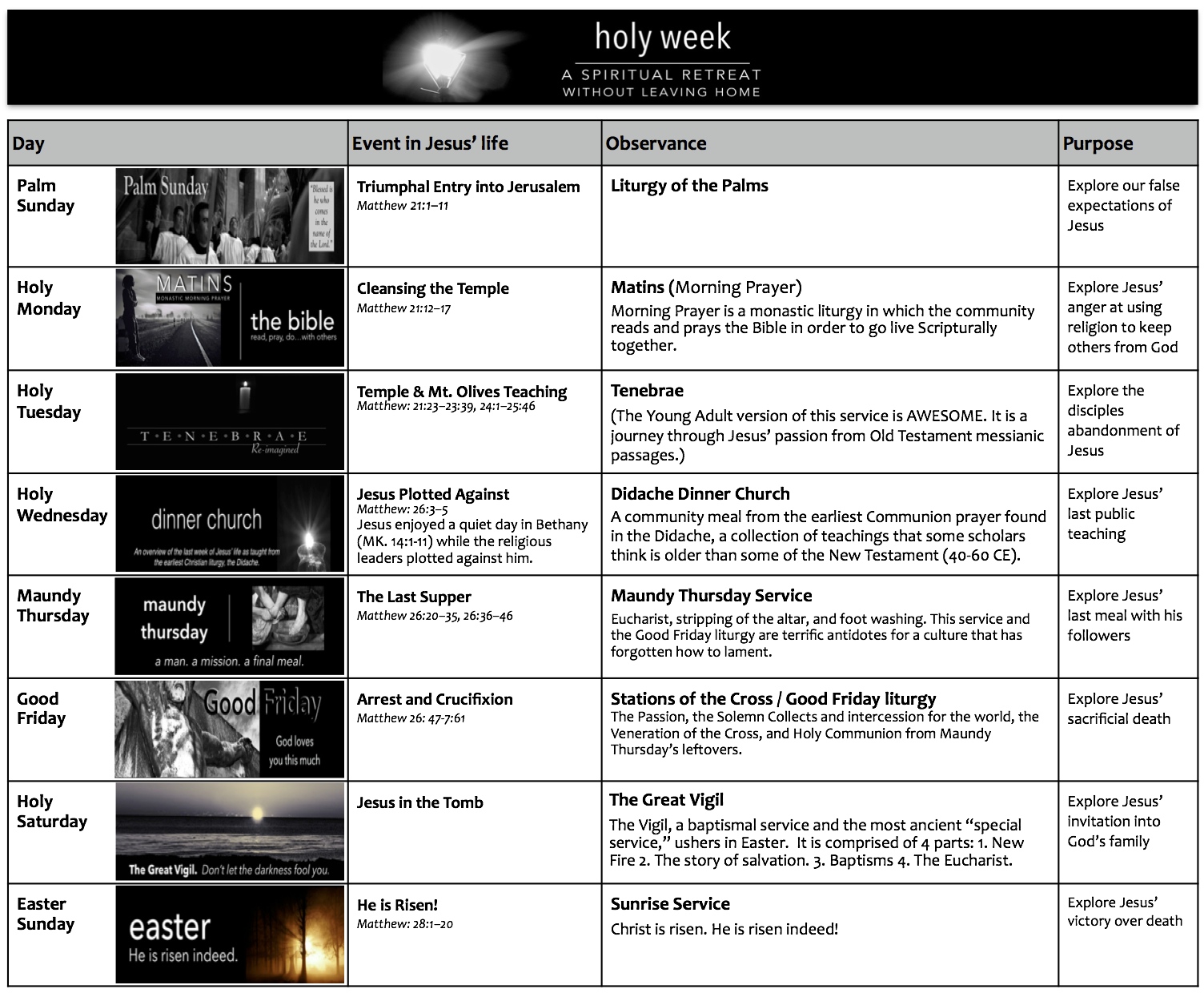
Holy Week, in a nutshell, is a spiritual retreat without leaving home. Remember summer youth camp? You had an authentic, transformative experience of God in a group of others having the same experience. You came home connected to those people and God in a new way. You thought, “That was fantastic. I am different and I can hardly wait to come back next year.” Holy Week is a lot like that.

Holy Week is series of liturgical experiences that walk us through the final week of Jesus’ life. We journey with Jesus, in the short span of a week, from His triumphal entry into Jerusalem, to the missing guard unit, neatly rolled grave clothes, and the shocking appearance of a risen Savior. In a symbol and story impoverished culture, Holy Week opens our hearts to the gift of Jesus’ victory over sin and death. This is more than a psychological remembrance, it is actively allowing ourselves to be in that final week, baptized (immersed) into his death…”Do you not know that all of us who have been baptized into Christ Jesus were baptized into his death? …in order that, just as Christ was raised from the dead by the glory of the Father, we too might walk in newness of life.”  (Romans 6:3-4)

Holy Week is sacramental

…and we are sacramental creatures. Regardless of any initial reaction you may have to that word, hear me out. A sacrament is a tangible symbol that creates what it signifies. Like kissing. When you first kissed that special someone on the doorstep at the end of the evening, it did more than represent thinking the girl was pretty and nice and that you enjoyed talking with her. It actually created and amplified those feelings. You walked back to your car more emotionally connected to her than you were when you opened her door a brief moment earlier.  And when her front door clicked shut, you fist pumped the air. “Heck, Yeah!” Because that kiss actually made more of what it signified.

So God gave us, fleshly, sacramental, critters that we are, a God who came in flesh. Who lived. Who breathed. Who touched us and was touched by us. Who walked willingly to a criminal’s cross, laid down, spread his arms wide for humanity, and waited for real nails to pierce his hands and feet. It is because you too are flesh and blood that you should engage in Holy Week…because Holy Week creates what it signifies: “That I may know Him and the power of His resurrection and the fellowship of His sufferings, being conformed to His death; in order that I may attain to the resurrection from the dead.” (Phil 3:10)

A current reality

The ancient prayers point us to the deep mystery in this: It isn’t “Christ rose.” It is “Christ isrisen!” Holy Week is a current reality. A more real reality. So we do more than meditate on these holy mysteries. We allow them to become true within us, as our baptism is true within us. We join him on Maundy Thursday in His Last Supper. We are with him on Friday in His death. We keep prayerful watch before His tomb on Saturday. With growing anticipation we mark His descent into Hades and His trampling of death by His death. Finally, with shouts of joy, we greet His resurrection on Sunday morning, knowing that one day it will be our resurrection too. In Holy Week, as Orthodox priest Fr. Steven Freeman says, “The life to come becomes the life we live.”

A “deep mystery,” it should be said, is not magic. We must surrender to the prayers and liturgy – faith must be lived. In the end, Holy Week isn’t something we do. It is something that does us.

So what is the hubbub? 

Holy Week is more than an emotionally powerful experience. It is an opportunity for a greater sanctification. As Paul said, “Now if we have died with Christ, we believe that we will also live with him.” (Romans 6:8) Or, as an Arnold Swarzenegger character once said, “Come with me if you want to live.”

Do yourself a favor, make time to engage in Holy Week, especially the three-day “Triduum”: The despair of Golgotha on Good Friday, the muted sorrow of Saturday, the joyful Baptisms at Saturday’s Great Vigil, and the surprise of a risen Savior on Easter morning.

Almighty God, who through your only‑begotten Son Jesus Christ, overcame death and opened to us the gate of everlasting life: Grant that we, who celebrate with joy the day of the Lord’s resurrection, may be raised from the death of sin by your life‑giving Spirit; through Jesus Christ our Lord, who lives and reigns with you and the Holy Spirit, one God, now and for ever.  Amen.

Holy Week Sched 2014 Blog

Bishops vs. Bibles: Authority in the early church.

tug-o-war1

Snark MeterrealMID.003(Apostolic Succession for Newbies, episode 5)

The Development of authority: the role of bishop from 80-200CE

In the last installment I wrote about the rise of bishops in the New Testament church, a development that was occurring at the same time as false teachers were beginning to crop up.

In popular Christianity today a debate rages about authority in the church: the Bible (evangelicals) vs. Bishops (Roman Catholic, Orthodox, many Anglicans). In the early church there was no such debate. There was no tug of war. It was not an issue of either/or. In the second and third centuries as the church debated false teaching it was not a question, of bishops v. the Bible, because there was yet no “Bible” – no single book, but a collection of “God-breathed” or “inspired” (2 Timothy 3:16) “scriptures.” In the early church the question was about WHO gets to interpret those scriptures: individual Christians or the bishops.

“Heresy,” the word for “false teaching” comes from the Greek word, “to choose.” Today people feel free to pick and choose from religious beliefs as if they were walking down the food line in a cafeteria, “I prefer potato salad. I don’t like boiled okra.” That works well at Luby’s. It is a disaster as a test of truth. And it was decidedly un-bueno in the early church. Innovation and “choice” were not on the table: Paul repeatedly gives churches two thumbs up for “maintaining the tradition as I gave it to you” (1 Cor. 11:2, 2 Thes 2:15, 3:6).  Jude felt it necessary to write and appeal to Christians to “contend earnestly for the faith which was once for all handed down to the saints.” Making up a religion of our own devising is something only the most arrogant and foolish would do.

Join me as the first-century turns and look the way the second generation of early Christian leaders known as the “Apostolic Fathers” maintained the message that had been given to them…

The question facing the church at the dawn of the second century: How would Christianity fare with the apostle’s successors-the first generation not led by those who walked with Jesus? This is more than an interesting question. It was a transition critical to giving us the faith and the understanding of the trinity that define the Christian faith to this day.

The Role of Bishop in the New Testament

“Bishops” (or sometimes “elders”) are sparsely mentioned in the New Testament. We have no record of Jesus speaking of the role. However, in the book of Acts, Paul appoints “overseers”* to leave behind in the churches he had started.[1] Paul, wrote and instructed two young pastors, Timothy and Titus, in what to look for in the selection of these bishops.[2] Paul, Peter, and John all greet church’s bishops in their epistles.[3] Bishops were the model of church leadership within twenty years of Jesus’ resurrection (c.50)…before much of the New Testament was written.

The Role of Bishop in the Church Age

The role of bishops expanded quickly. Their importance is seen in the writings of early church fathers…

The earliest Christian writings in existence after the close of the New Testament were from Clement, the second Bishop of Rome (after Peter’s death). Clement, in his First Letter to the Corinthians (c.95), confirmed the way apostles appointed the first bishops: “So preaching everywhere in country and town, they [the apostles] appointed their first fruits, when they had proved them by the Spirit, to be bishops and deacons unto them that should believe.”[4] In Clement, we have a first-hand confirmation of what Luke told us in Acts and what we would intuitively suspect – that bishops were appointed in each town by the same apostles that introduced them to faith in Christ.

How did this second generation of Christians view bishops? Ignatius of Antioch (c100) in his Epistle to the Ephesians cues us in: He advised Christians in Ephesus to “look upon the bishop even as we would look upon the Lord Himself.[5] Don’t miss this: A disciple of John equated unity with the local bishop to unity with Jesus! In his Epistle to the Smyrnaeans, Ignatius advises that those who do “anything without the bishop” both destroy the Churches’ unity, and throw its order into confusion.[6] For Ignatius, and virtually every other early church source who speaks on the issues, the church’s source of unity and spiritual authority went through the bishops and the apostles to Jesus himself. Ignatius also wrote, the “bishops tell us how to interpret the Bible” for “without them, there is no sacrament[7]

Second century father, Irenaeus, bishop of Lyon, (c180) telegraphs his concerns in the title of his treatise: “Against Heresies” – specifically against Gnosticism. In it Irenaeus argued that the unbroken teaching of the bishops proved the truth of orthodox Christianity: His argument was simple-Jesus sent out the Apostles who passed down Jesus’ teaching to us.[8]

In response to the Gnostic idea that there was “secret information” necessary for salvation, Irenaeus wrote,

For if the apostles had known hidden mysteries, which they were in the habit of imparting to ‘the perfect’ apart and privily from the rest, they would have delivered them especially to those to whom they were also committing the Churches themselves. For they were desirous that these men should be very perfect and blameless in all things, whom also they were leaving behind as their successors.[9]

Irenaeus pointed out the obvious: Why would the apostles not tell the disciples the whole truth about Jesus?

In Against Heresies 3:3, Irenaeus then went on to list the apostolic succession of bishops from the Apostles to both Clement in Rome and bishop Polycarp in Smyrna as two examples that would be well known in to all readers in 180AD. “We are in a position to reckon up those who were by the apostles instituted bishops in the Churches, and [to demonstrate] the succession of these men to our own times.”[10] His argument in effect is “we can name names…there are no, and have been no secrets.” He finished the argument with a polemic: “This is the gateway of life [bishops]; all the rest are thieves and robbers.[11]

Coming on Irenaeus’ heals is Tertullian (c. 160-225). Tertullian was the first father to teach in Latin and coined the term “trinity” at the close of the second century. He followed on Irenaeus’ logic when arguing against the Monarchist heresy: “Your teaching may claim to be old. If it were, show us your apostle and the line of your bishops from him?[12]

So we see in the second century that the successors to the apostle’s, the bishops, were both the leaders of the churches and the interpreters of the scriptures. Where did they get that idea? From the apostles themselves, of course. Those outside of the touch and teaching of the bishops were “thieves and robbers.” In the debates with the heretics, it was the bishop, those who received and taught the unbroken message, who had the authority to interpret that message given to them by the apostles.

Next up: Game. Set. Match. Why the Bishop was the trump card in debates in the early church.


*“Bishop” is an English version of the untranslated Greek word “Episcopos.” We do the same thing with “baptism” which is the Greek word “baptizo” which means to “immerse.”

[1] Acts 14:23, Acts 20:28

[2] 1 Timothy 3:1-13, Titus 1:5-9

[3] Philippians 1:1, 1 Peter 5:1, 2 John 1, 3 John 1

[4] Clement. First Epistle to the Corinthians. 42:7 Retrieved from: http://www.ccel.org/ccel/schaff/anf01.ii.html.

[5] Ignatius. Letter to the Ephesians, Chapter 4. Retrieved from: http://www.ccel.org/ccel/schaff/anf01.v.ii.html.

[6] Ignatius. Letter to the Smyrnaeans. Chapter 6. Retrieved from: http://www.ccel.org/ccel/schaff/anf01.v.ii.html.

[7] Documents of the Christian Church. Vol. 1. 3rd ed., ed. Henry Bettenson & Chris Maunder. (Oxford: Oxford University Press, 1999), 41.

[8] Ibid, 78.

[9] Ibid, 74-75.

[10] Irenaeus. 3:3. Retrieved from: http://www.ccel.org/ccel/schaff/anf01.ix.ii.html

[11] Irenaeus. 3:4. Retrieved from:  http://www.ccel.org/ccel/schaff/anf01.ix.ii.html

[12] Documents, 78.


Saying dumb things: Yet another example of catholi-phobia hurting the church

double-facepalm

Photocredit: globalnerdy.com

Snark Meter Sorta Snarky.002

(Apostolic Succession for Newbies, episode 3)

When discussing false teaching in Christianity, it is common to hear evangelicals blame the early church fathers for wandering from the gospel and accepting false teaching early on. This is really not much more than an example of Catholiphobia. You have seen Catholiphobia. That is what is going on when you hear someone say, “That seems sort of…you know…Catholic.” Which is code for, “If a Catholic does it, it must be wrong.” Dropping the Eucharist as the normative weekly worship for Christians, clergy dressing like clergy so that non-Christians know a clergyperson when they see one, and full-body worship (like marking oneself with the sign of the cross) all come to mind as examples.[1] Perhaps the biggest mistake of Catholi-phobia: dropping bishops as leaders of churches.[2]

One seminary professor of mine expressed the Protestant anti-bishop bias like this, “The problem was bishops…a problem we solved by giving the church to teams of elders in the Reformation.” For some reason intelligent, God-fearing people don’t hear the implied heresy in the accusation. What my professor was really saying is that Jesus was wrong – that the “gates of hell” did prevail against the church (Matt. 16:18) for some 1400 years until the Reformation…or some other restoration movement of the 19th century (Church of Christ, Disciples of Christ, LDS) or the 20th century (Pentecostalism). It might surprise many to know that in the early church, bishops did not give the church false teachers, it protected the church against them.

It might surprise many to know that in the early church, bishops did not give the church false teachers, it protected the church against them.

This will take a bit of setup, but it is necessary to get to our final installments on apostolic succession: Bishops vs. bibles: Authority in the early church. And, Game. Set. Match. Why bishops were the trump card in early church disagreements.

Organization in the Early Church

Early Christianity is a study in organic organization. In the gospels we read of Jesus of Nazareth, a compelling and unique itinerant rabbi who spends three years going from town to town with a core-group of followers. Like the rest of the public, the disciples are fascinated by Jesus’ public teaching and healing. They, however, were given private instruction into the meaning behind his teaching and miracle working…that he was ushering in a new kingdom through a new kind of king: “God with us,” a fulfillment of the meaning behind their scriptures. Jesus did this in the ultimate of informal environments: Three years around a fire with him.

After the resurrection, the Acts of the Apostles tells the story of the spreading of the message of Jesus by those apostles, primarily Peter and Paul. As Acts opens, we see the Jewish disciples of the Jewish rabbi leading in predictably Jewish ways. Change begins in Acts 8, when persecution forced many to leave Jerusalem. It took nearly a decade, but the scattered disciples finally begin to consistently extend the story of Jesus to non-Jews in Antioch (Acts 11:19-20). In Acts 11, the Jewish Christians were confronted with what to do with the increasing number of gentile converts. By the end of Acts (Chapters 20 and 24) we see the beginnings of formal organization: bishops (usually translated as “overseers” by modern Protestant translators) and deacons (usually left untranslated) appointed as leaders of local churches. Another word “presbyter” (usually translated “elder”) is sometimes used synonymously. Since churches met in households you would have multiple presbyters or “elders” in a town, and a single bishop (overseer), that would “oversee” them. It was a model co-opted from Roman government. The early Christians faced other core decisions besides organizational and leadership ones, of course. Questions like: What specifically would Christian’s believe? (A question they would solve with creeds)? And what books would comprise the Scriptures? (A question they would solve with canon-which books would be included in the New Testament.)[3] But in the book of Acts, we see the earliest church engaged, not with the story of the creation of the scriptures, but in living the faith out by the human successors to the Jesus story taking the message of faith to the next generation.

The Rise of Heresy

Very quickly, “strange ideas”[4] also reared their head. These were predictable: First, as I just pointed out, the young Christian church was still organizing itself. There were no New Testament scriptures.  The urban, diverse and, early on, rather under-educated Christians had no written source of authority to which to appeal.[5] Second, the witnesses to Jesus left a degree of vagueness about the exact nature of Jesus’ relationship with the Father (was Jesus God “If you have seen me, you have seen the Father” or was it, as Jesus also said, “The father is greater than I.”) Belief had yet to be systematized. Third, Christians had opened the door to increased confusion by our evangelism methods. We were using Greek and Roman philosophers to explain and validate the new Christian faith to the Greco-Roman world.[6] Some folks took this too far and moved from explanation to syncretism-melding the two. Fourth, surely some were intentional false teachers, unscrupulously and opportunistically taking advantage of Christians’ reputation for generosity.[7] But mostly there was a lack of discipleship due to Christianity’s rapid spread. Evangelistic success led to a shortage of mature Christians to see to the training of new converts in the faith. The earliest of the “strange ideas,” Gnosticism, held that it was necessary to learn the “secret knowledge of their spiritual essence” in order to receive salvation.[8] The big question was: How would an emerging movement face conflict? And to what source would they make their appeal?

The answer will surprise you.

Next up: Bishops vs. bibles: Authority in the early church.

[1] I am not critiquing the actual theological problems with Rome, such as allowing the tradition to actively overrule scripture through modern dogmas such as papal infallibility (1869), or the Immaculate Conception (1854) or the over-reactions of the later meetings of the council of Trent against the very reactive Protestants (1550s-1560s).

[2]This is an area that most Protestants, steeped in a materialistic worldview, generally don’t see as anything near a central issue. For sacramental Christians, touch and teaching both are quite important.

[3] Chadwick, Henry. The Early Church. (London, Penguin Books, 1967), 41-44.

[4] Irenaeus, Against Heresies, book 1. http://www.ccel.org/ccel/schaff/anf01.ix.ii.html. Book one lists the bizarre beliefs of many heretical teachers.

[5] Gonzalez, Justo. The Story of Christianity. (Peabody, Mass, Prince Press, 2008. 50-51.

[6] Starting with Paul on Mars Hill (Acts 17) Christians struggled with the question of how to communicate faith to people who don’t accept the authority of the Scriptures.

[7] Gonzalez, 51.

[8] Robinson, B.A., “Gnosticism: Ancient and Modern Beliefs & Practices”, http://www.religioustolerance.org/gnostic2.htm

Everyone can’t be right. Why “the Bible alone” didn’t settle disputes in the early church.

Source: “Bearing Thorough Witness” About God’s Kingdom, New York: Watchtower Bible and Tract Society.

Source: Watchtower Bible and Tract Society.

Snark MeterrealMID.003

(Apostolic Succession for Newbies, episode 2)

Several weeks ago I posted on the unintentional consequences of the doctrine of “the Bible alone. In that article I asserted that, while “sola scriptura” was taught by the early Reformers, it was an over-reaction against medieval Catholicism and does not give a complete picture of the Reformers views. The Reformers did make strong statements against the medieval over-reach by Rome, but if you read more than topical quotes excised from context, the Reformers actually had a very high view of the necessity of the Church as the Body of Christ on earth, and in authority in the Church. They were students of the early Fathers and went to great pains to demonstrate that their views were the views of the Church Fathers.

I press forward today from that previous critique, one that modern evangelicals and Great Tradition Christians generally agree on, that Western culture is abandoning the church even as the church engages in a wholesale embrace of the culture. Popular/contemporary evangelicals and Great Tradition Christians generally stand shoulder to shoulder in our critique of the “fruit” of contemporary evangelicalism – both agreeing that when people do what they want to do, and the church then panders to those individualistic and idolatrous tendencies, that it does fill buildings, but it fills them with empty people…producing mealy, tasteless spiritual fruit in the lives of Christians. If faith were an apple, it would be a Red Delicious, which although it may be red, thanks to hybridization, is generally far from “delicious.”[1]

From there, however, our paths diverge as Christians of the Great Tradition see the problem as going much deeper than the fruit – It is a problem of the root. And the root is the issue of authority in the church. Evangelicals have made the Bible the sole authority. When we do that what we mean is that our own interpretation is our authority. In other words, we end up making ourselves our authority, becoming, de facto, our own “gods.”

The Reformers never intended this. Their actual view of “sola scriptura” was more nuanced and robust. Remember there were 5 solas. 5 “alones” is not really so “alone,” is it? Luther, Calvin, and Cranmer all believed in “Conciliar authority” – the decisions of the world’s bishops gathered in council. Conciliar authority did not rest in any single bishop, it was only present when the bishops were gathered together in council – a “worldwide” or “ecumenical” gathering. This, rather than a specific method of interpretation, was the safeguard against heresy.

The early church’s solution to disputes was grounded in the scriptures, not settled by them.

As surprising as it is to many today, the early church’s solution to disputes was grounded in the scriptures, but not settled by them. It was not individuals using the correct system of historical/grammatical interpretive principles, because the belief of the early church was not “sola scriptura” but rather more like, “prima scriptura” – the scriptures first. That is why church fathers like Ignatius of Antioch writing a mere 20 or so years after the close of the New Testament canon could write, “See that you all follow the Bishop, as Christ does the Father, and the elders as you would the apostles…Let no one do anything connected with the Church without the Bishop. Let that be considered a valid Eucharist which is under the leadership of the Bishop, or one to whom he has entrusted it. Wherever the Bishop appears, there let the multitude of the people be; just as where Christ Jesus is, there is the catholic (universal) church” (Letter to the Smyrneans, 8. CE 111).

So what about the Bible?

Whenever an appeal to bishops is made, evangelicals immediately begin to squirm. Part of this is an accommodation to American individualism in evangelicalism and an obliviousness to our own sin nature’s desire for an absence of authority over us. Part of it though is a rightful question as to the role of the scriptures and abuse by clergy. Objections are usually raised before a case has been made…

“Are you saying that the Bible is in error?” No.

“Are you saying that the Bible is not the Word of God?” Again, no.

I am saying that “The Bible” as a book did not exist in the early church. The “scriptures” (sacred writings) of the Old Testament existed in scrolls where they were stored in boxes in synagogues. These are what Jesus read from when he was handed the Isaiah scroll in Luke 4:17. The scriptures of the New Testament existed within 15-55 years of Jesus’ resurrection, but they had not yet been assembled in book form, called a codex (except for perhaps Mark, which is thought to be the first usage of this Roman accounting tool as an aid to evangelism). The assembling of the entire scriptures into codex form was first done, as far as we can tell, by Constantine when he ordered 50 copies of the Scriptures for the new churches popping up in his new capital, Constantinople in 331CE. The Greek texts (Codex Sinaiticus and Codex Vaticanus) that our modern New Testaments are translated from are possibly from among those 50 Bibles. So, while the idea of God having revealed himself through inspiring authors to write God’s word was present, we have no evidence of either an exact list of those writings, nor copies of them in one binding prior to the mid-fourth century.

The Problem isn’t the Bible. It is interpreting it.

More important than the Bible not being dropped out of heaven in a soft leather binder, though, is the manner in which the early church solved the arguments that arose over the interpretation of those scriptures. Surely that (snark meter on full-high) never happens today!

The scriptures were indeed the rule of faith and conduct. However, interpreting those scriptures written not by Jesus, but by others to point to Jesus is remarkably complicated. Frustratingly, not a single one of the 27 books of the New Testament, written by the church and canonized by the church, was written by our Lord himself. It would have been a most convenient thing indeed if the Holy Spirit were to have given the church the two books necessary for true “clarity” of belief: “Jesus, Book One: Everything you should believe about me.” And “Jesus, Book Two: Everything you should do because of Book One.” Not having these, the early church debated the meaning of the scriptures. Decisions of belief needed to be decided upon and agreed to universally. Otherwise Christians would be staring at an infinite number of Joseph Smith-like “new revelations.” Correct me if I am wrong, but isn’t that precisely what we have today?

And, if interpreting by set principles actually solved theological problems, why do we have 40,000 denominations and counting?

Next Up: The secret of how early Christians settled disputes.

[1] I mean no pejorative in the description “contemporary/popular evangelical.” I am an evangelical in the sense that I have a high view of scripture, the work of Christ in salvation, and of the need for a personal faith. I use this in a descriptive sense of the contemporary evangelical big-box church and the current megachurch methodology of extreme simplicity that leaves people with very little else but Paul’s interpretation of Jesus.

It’s All About Me: How a distortion of “sola scriptura” turned American evangelicals into junkies of the self

Snark MeterHIGH.001

(Apostolic Succession for Newbies, Episode One)

Have you noticed the creeping narcissism in the evangelical church?[1]

Perhaps you have noticed it in the architecture as churches have been remade into the image of the places the world gathers: Foyers into coffeehouses, sanctuaries into concert halls, altars into comedy club stages. Candles and incense replaced with light shows and fog machines borrowed from the nightclub scene.


images-1

…and that actually is a nightclub.

Perhaps you have noticed it in the songs we sing. The self-referential lyrics (count how often “me” and “I” appear)…the way the act of our worshipping becomes the subject rather than God…how few of our songs are about the nature and glory of God.)

Perhaps you have noticed it in the felt-needs orientation of our preaching  – With topics chosen by focus group and slickly marketed: “Come for our series, ‘Awesome Christian Sex!’” Or the way the preaching of the word of God has been reduced to a mere interruption in the song service (joining announcements and the offering.)

Surely you couldn’t help but notice it in Victoria Osteen’s recent exhortation, “You don’t worship for God. You worship for yourself.Oh, she was criticized her for it, but is this not a message we too are subtly sending? Perhaps Ms. Osteen is just more honest about it?

 Where did this start?

 The great strength of evangelicalism is a desire to reach people where they are with the Good News of Jesus Christ. Unfortunately, without a great deal of both self-awareness and self-discipline, our charisms tend to become our curses. As with most problems, our creeping narcissism is an unanticipated consequence – the end result in our culture of 5 centuries of the B-side of Reformers reclamation of the Bible from “ex cathedra” (infallible interpretation by the papacy).  “Sola scriptura” (the scriptures alone), was the rallying cry. Unfortunately, as “sola scriptura” is popularly articulated today, we no longer need a church at all, we are each capable, called even, to be our own sole interpreters of scripture – the Bible is “self-authenticating, clear to the rational reader, its own interpreter of itself, and sufficient of itself to be the final authority of doctrine.” [2] In other words, each individual’s head is the ultimate standard…and, just like that, the idea of the “priesthood of the believer” has been elevated to a de facto “papacy of the believer.” No wonder we have 40,000 denominations…and no wonder an increasing number people are choosing to stay home from them. After all, if I am my own pope, then I am my own church…which, come to think of it, comes pretty close to making me my own “god.”

Unknown

Regrettably, this is a wholesale corruption of what the Reformers actually taught. Calvin, Luther, and Cranmer each have notebooks filled with quotations from the early church fathers. Chris Armstrong, editor of Christian History Magazine, writes, “The Reformation is an argument not just about the Bible but about the early Christian fathers, whom the Protestants wanted to claim…you look and you see it everywhere. The Reformers use the Fathers all over the place…Calvin read Augustine…Luther read Jerome. The index of Calvin’s Institutes is filled with an enormous number of quotations from the Fathers. And in the first preface to that work Calvin did his best to show his teachings were in complete harmony with the Fathers. The Protestants…were keen to have ancestors. They knew that innovation was another word for heresy. ‘Ours is the ancient tradition,’ they said. ‘The innovations were introduced in the Middle Ages!’ They issued anthologies of the Fathers to show the Fathers had taught what the Reformers were teaching.”[3] You see, the magisterium, the gathered wisdom of bishops interpreting the scriptures under the lineage of the tradition was not their problem. In fact, they went to great lengths to prove specifically that their teaching was the Fathers!

But alas, we have jettisoned the Reformers’ actual belief in the wisdom of the church’s teachers, whose interpretation was expected to stand in the tradition of the early Fathers. The mess of pottage we have traded it for is a disembodied sound bit. Disengaged from the Reformers reliance on the Fathers, we have what can be cynically referred to as “solo scriptura” – my private interpretation. And when “solo scriptura” is combined with American individualism and allowed to simmer with post-modern “truthiness,” we get a toxic soup of the dystopic self. We then feed this soup to a generation reared as the centers of the universe, then wonder that they are consumed with self. How could they not be?

 …when “solo scriptura” is combined with American individualism and allowed to simmer with post-modern “truthiness,” we get a toxic soup of the dystopic self. We then feed this soup to a generation reared as the centers of the universe, then wonder that they are consumed with self. How could they not be?

The church has consumed “me” like a diet of high-fructose corn syrup. It tasted so good going down, that we did not notice that we grew both addicted to the taste and unable to roll over in our spiritual flabbiness. Worse, the poison has so clogged our synapses that we are unable even to remember what rigorous, healthy spiritual activity was once like.

Pastors have given up expecting meaningful commitment, service, or faithfulness from congregations. I remember suggesting to a pastor of a church of 3500 how transformative it would be to their community if they assembled 350 groups of 10 to meet and read and pray the Bible together in a year. I was stunned when the pastor said, “We have 3500 who attend, but we only have about 50 who are with us.

I am no longer stunned. I have watched how anything that smacks of commitment is sold on its potential to “bless.” This has now extended to our giving. Perry Noble’s church is offering a 90-day money back guarantee on tithing.  Seriously! Giving in order to get. It seems that every week contemporary mega-evangelicalism offers a new narcissistic low-water mark. And just like that, the commodification and monetization of the church is complete.

Where did we think “nothing but you and a Bible” was going to end? Where did we think that reshaping the church after our cultural preferences would lead?

Have you noticed the creeping narcissism? Do you have examples of your own? Do you see a way out?


Next Week: Part 2- Conciliarity: The Early Church’s balance between “rule by the man” (A secular idea adopted by Rome) and “rule by the book” (an Islamic idea adopted by Protestants).


[1] To be fair, mainliners have had this for years, but it plays out in different ways.

[2] http://en.wikipedia.org/wiki/Sola_scriptura

[3] http://www.christianitytoday.com/ct/2004/januaryweb-only/1-12-52.0.html

Creeds are not Chex Mix. (Creeds for Newbies, Episode 4)

250px-Chex-Mix-Pile

Snark Meter Sorta Snarky.002

When asked what I think of the trendy rewriting of creeds in progressive liturgical churches, I usually respond in the words of imminent theologian Ron Burgundy: “That’s just dumb.”

Creeds are not Chex Mix. You know, the party snack that you pick through taking out the morsels you like. But we don’t high-grade out what we like of God and leave the rest in the bowl. A Luby’s Cafeteria may make for a nice all-you-can-eat Sunday afternoon lunch, but picking and choosing a faith of our own creation is narcissistic and foolish. Not to mention a risky way to live one’s life. The old joke, “God created us in his image and we returned the favor,” comes to mind.

The creeds were written by the early and undivided church as summaries of the faith. They have been vetted by universal acceptance of the entire church, both through time and across geography. When Vincent of Lerins wrote in the 500’s,  “What has been believed everywhere, always, and by all,” he was referring to the faith bounded by the Nicene Creed. The impulse to re-write the creed to make it more relevant is, at best, misguided. The creed is not ours to futz with. (By the way, someone rewriting a creed is almost certainly a baby boomer.) Seriously, stop rewriting creeds.

Passing the Baton

For I handed on to you as of first importance what I received: that Christ died for our sins in accordance with the scriptures, and that he was buried, and that he was raised on the third day in accordance with the scriptures …” (I Cor 15:3-4)

Our role is to explain not to change “the faith that was once for all entrusted to the saints.” (Jude 3) The creed is the universal. Beyond that is adiaphora (things indifferent) – perhaps helpful. Perhaps important. Just not mandatory for recognizing a “like” faith. So we do not change the core. We pass it on, handing the baton of faith to the next generation.

Passing the Baton

When it comes to the substance of the faith, there are two extremes: Fundamentalism and Universalism. Fundamentalism elevates the “you may” to “you must”—tithing, homeschooling, a particular theory of the atonement, etc. Fundamentalism raises the bar making options essential. The opposite is Universalism. Universalism drops the essentials making them optional. Universalism lowers the bar and says, in effect, “There is nothing you must believe.” Universalism leaves us with such a low bar to the faith that few see any reason to join. This is why we don’t “edit” universal truth. Fundamentalism hands the next runner an anvil to run with. Universalism gives them an empty hand-off. We receive and pass on, “the faith that was once for all entrusted to the saints.

The Great Tradition

Seventeenth century Archbishop Lancelot Andrewes explained “tradition” as “one canon (the Scriptures), two testaments, three creeds, and four councils, over the first five centuries.” The three creeds prioritize Christian beliefs. As Rupert Meldinius said in 1627, “In essentials unity, in non-essentials diversity, in all things charity.” Creeds keep the main thing the main thing.

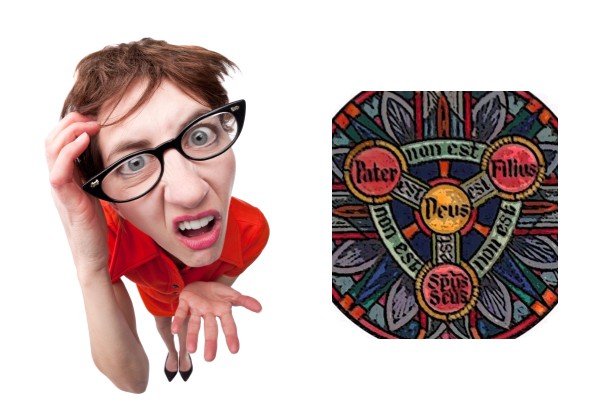
The creeds articulate God as trinity, an idea that is impossible to get one’s mind wrapped around – which doesn’t mean that it isn’t true. In fact, anyone who can contain the infinite God of the universe between their ears really needs to find themselves a bigger God.

Creeds are our wedding vows 

11584032-black-and-white-photo-of-a-groom-slipping-a-gold-wedding-band-on-a-bridea-s-finger-during-the-weddin

Creeds are not about warm-fuzzies or even felt convictions. They are the substance of the faith the church has stood upon since soon after Jesus left. They are like marriage vows-so much so that they form the substance of the promises one makes in Holy Baptism. There is a reason we take marriage vows – It is because human love is fickle. We imagine that love sustains commitment, but actually it is just the opposite. It takes great commitment to sustain love. A couple makes vows and clings to them through thick and thin…and, at the end of life, a thing of loving beauty has been produced. The historic creeds work the same way. The Nicene Creed proclaimed in church is a promise to cling to the glory and vastness of God, even when the pressures of life scream to give up. When said in church, by the community of faith, the Nicene Creed is a weekly prayed promise to act in love toward God. It is our spiritual, “for better for worse, for richer for poorer, in sickness and in health, to love, cherish, and to obey, till death us do part.”

Creeds answer the question, “What must we believe?” We answer,  “We believe in one God, the father, the almighty…”  

Aren’t all Religions are basically the same? (Creeds for Newbies, Episode 3)

The Original Creed

The first Christian creed was, “Jesus is Lord!” (Mark 1:1)  This drew a hedge around what it meant to be Christian…and since it was a play on the Roman creed, (“Caesar is Lord!”) it did this by being a bit prickly to those who were not.

But Aren’t All Religions Basically the Same?

confused.001

This is the mantra of the day-repeated often enough to be assumed uncritically. Unfortunately, the world’s great religions are not at all the same. Each makes individual faith claims that stand (or fall) on their own merits. To say anything less is deeply dishonoring to the world’s great traditions. Every one of the world’s major religions does, however, seek to answer 3 core human Questions:

  1. How did we get here?
  2. What went wrong?
  3. How do we fix it?

The Christian answers, by the way, are;

  1. One God: Father, Son, and Holy Spirit (Gen 1:1-3).
  2. Sin – We voluntarily walked away from our loving creator and God’s good way for us. (Is 53:6)
  3. We don’t. God did. God’s grace was given through Jesus’ death & resurrection. (Eph 2:8-9)

All of which lead to the one really big human question: What about me? Christian Answer: We follow God by faith, living a life of gratitude toward God and faithful service to the world (John 1: 12, Eph 2:10).

The Apostle’s and Nicene Creeds very carefully only answer the first question. They stay on “Who is God?” That is the nature of a creed. Creeds assume that if you get the “who” right, everything else will fall into place. That focus on the “who” is what makes creeds different from confessions. Since creeds are the least you can belief, churches that cannot endorse the Nicene Creed, like the LDS or the Jehovah’s Witnesses, are not considered Christian churches. This is not personal. It is not meanness. It is simply that to not be able to endorse the Nicene Creed means we are talking about different Gods. As we said in our last post, creeds are the broad fence around the very least it means to be a Christian. A lot of groups fit into that playground: Catholics, Orthodox, Protestants, Pentecostals, Copts…anyone who holds to a trinitarian view of God. It is only these late theological innovators that do not wish to enter the fence of the trinity to whom Christians say, “We are sorry. But change your mind on the Trinity and come on in!”

The shape of Creeds: A Trinitarian Narrative

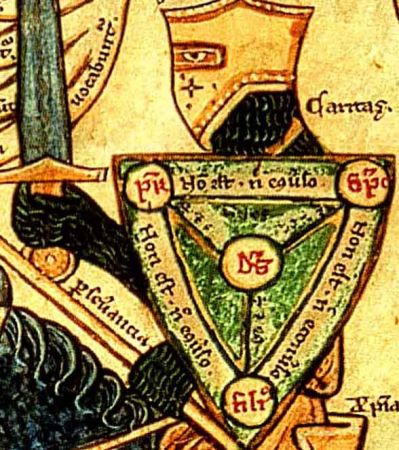
St. Hilary's Shield

St. Hilary’s Shield

At their most basic level, creeds do not express a systematic theology but a narrative one. As I said in the previous post, the creeds give us the interpretive framework from which to view the Christian story – a new story within which to orient our lives. The Christian story, in a nutshell, is that God, dwelling in triune love, desired to share his great love and so created. Taking love for granted, we wandered. God, unwilling to let us go, moved into the neighborhood in the form of Jesus, showed us a vision of a kingdom to come, and went to the cross to redeem us from our sinful God-rejection, walked victorious from a tomb 3 days later, breathed on his own 4o days after that, and went to heaven where he “ever lives to make intercession for us” (Heb. 7:25). From there he will someday return to make all things right. Humans are now invited into that divine love through the plan of God, the work of the Son, and sanctifying action of the Holy Spirit.

So the next time you say the creed. Don’t just say it. Pray it.

Scales and Playgrounds: Why you need the Creed (Creeds for Newbies, Episode 2)

Featured Image -- 3527

Snark Meter Sorta Snarky.002

Creeds over Confessions

Last week one more friend, one with a graduate degree in theology proudly said, “I don’t say creeds. I’m non-creedal.” This friend is both orthodox and devout in his Christian faith, yet he says, “I don’t want to be bound by statements that limit the faith.” Like so many, he is confusing “creedal” with “confessional.”

A Big, Big Playground

Creeds are not about limiting the faith, but rather about pushing the faith’s boundaries out to their widest possible limit. A creed is about how little one can believe and still be recognizably “Christian.” Creeds give the edges of what C. S. Lewis referred to as “Mere Christianity.” Confessions, which came later, do exactly the opposite. Confessions attempt to narrow the conversation from “how little can one believe” to “how much should one believe.” If beliefs are a dartboard, a creed is the outermost circle. “You hit the target, way to go!” A confession is the bull’s eye.

Belief as a bull’s eye is, of course, my friend’s real issue: Whose bull’s eye, whose confession are we to use? Augsburg? Belgic? Heldelberg? Helvetic? Thirty-nine Articles? Baptist? Westminster? …And those are just the ones written between 1430 and 1630! A creed is a fenced playground, but a creed represents the largest playground possible. A confession is the kindergarten play ground – very small and safe. The Nicene Creed is the high school ballfields – a square half mile. If you can’t find room to play at the high school, you really just don’t want to be there.

We Fear Creeds

Creeds have been ignored by evangelicals and progressives alike. Evangelicals busily moved past the creeds in a desire to be culturally relevant and a fear of the world creeping into the church – so evangelicals tightened the reigns with detailed, specific, narrow confessional boundaries. “Are you a Reformed, dispensational, pre-trib, pre-millennial regular Baptist?” “No! I am a Reformed, dispensational, mid-trib, pre-millennial regular Baptist.” “Oh. Sorry, we can’t be friends.” This resulted in “many protestants” – a now collapsing array of denominations.

At the same time liberals were also busy jettisoning historic creeds. For liberals though it was a desire to be theologically relevant and a fear that the world was creeping out of the church.

Scales Before Jazz

photocredit: ehow.com

photocredit: ehow.com

When my children suggested to their piano teacher that they learn popular songs, their piano teacher would patronizingly reply, “We learn scales before Jazz.” The reference was lost on my kids who had never heard Jazz. What they wanted to play was the theme to the after school cartoon, “Arthur.” But the teacher was right, if you know your scales you can play any musical. Creeds are the substance of the faith – The “scales” to teach to every child and newcomer. By definition, creeds are catholic (universal), confessions are sectarian genres. Everyone has a genre preference. But if one doesn’t know the basics, regardless of the genre, what we end up with is bad music.

Creeds unite us around the basic Christian story (the “who” and “why”) rather than the symbols of our tradition (the “how” and “what”). The symbols of our tradition are rich and powerful, but our traditional actions and symbols never stand alone. Their power is that they point to greater truths-the truths specifically expressed in the creeds. Confirmation programs, for example, lose power specifically when our teachers have forgotten to keep the main thing (salvation in Christ Jesus) the main thing. And one cannot master Jazz who has not first mastered their scales.

So Christian, don’t give up your creeds!

The Bible’s Lucky Decoder Ring: The Nicene Creed

We believe in one God, the Father, the Almighty, maker of heaven and earth, of all that is, seen and unseen.

We believe in one Lord, Jesus Christ, the only Son of God, eternally begotten of the Father, God from God, Light from Light, true God from true God, begotten, not made, of one Being with the Father.

Through him all things were made.

For us and for our salvation he came down from heaven: by the power of the Holy Spirit he became incarnate from the Virgin Mary, and was made man.

For our sake he was crucified under Pontius Pilate; he suffered death and was buried.

On the third day he rose again in accordance with the Scriptures; he ascended into heaven and is seated at the right hand of the Father.

He will come again in glory to judge the living and the dead, and his kingdom will have no end.

We believe in the Holy Spirit, the Lord, the giver of life, who proceeds from the Father and the Son.

With the Father and the Son he is worshiped and glorified.

He has spoken through the Prophets.

We believe in one holy catholic and apostolic Church.

We acknowledge one baptism for the forgiveness of sins.

We look for the resurrection of the dead, and the life of the world to come.

The Bible’s Lucky Decoder Glasses (Creeds for Newbies, Episode 1)

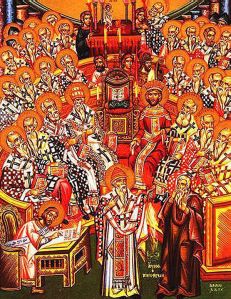
THE_FIRST_COUNCIL_OF_NICEA

The First Council of Nicea

Snark Meter.005

(Part 1)

In 1934, the Little Orphan Annie radio show hit on a terrific marketing gimmick: kids could mail away for a “secret decoder ring” in order to decipher hidden messages.

Perhaps you remember the young protagonist, Ralphie, in the classic movie, “A Christmas Story,” ordering one…

images

…only to be disappointed that the “secret message” was nothing more than “a  crummy commercial.”

If you grew up in the sixties you might have had Johnny Quest “lucky decoder glasses” to interpret secret messages.

6a00e5523ce51288330153919c7056970b-400wi

It may surprise you to know that there are “lucky decoder glasses” to reading and interpreting the Bible – A set of lenses Christians have looked through as keys to understanding the Bible for nearly 2000 years.

Everyone has a set of interpretive lenses through which they see the world and read any text. For orthodox Christianity those lenses are a document originally written in 325 CE called, “The Nicene Creed.”

Settling Fights

As with all doctrinal statements, the Nicene Creed was written to settle a fight. More precisely to clear up confusion over the Bible’s teaching about the nature of Jesus and his relationship with God. You see, Jesus was so unique that people had a hard time “getting” him. Now, my evangelical friends will say, “The Bible settles who Jesus is, just read the plain meaning of the text!” The only problem is “reading the plain meaning” was not working. The early church was reading the Bible…in fact, not only were they reading from the same Testament, they were even reading from the same Gospel, and yet coming to radically different conclusions.

Let’s be honest, the Christian claim that Jesus is fully God while at the same time being fully human is pretty confusing. It shattered any existing thought paradigm. Two thousand years later it is still pretty tough to wrap one’s mind around a claim that astounding.

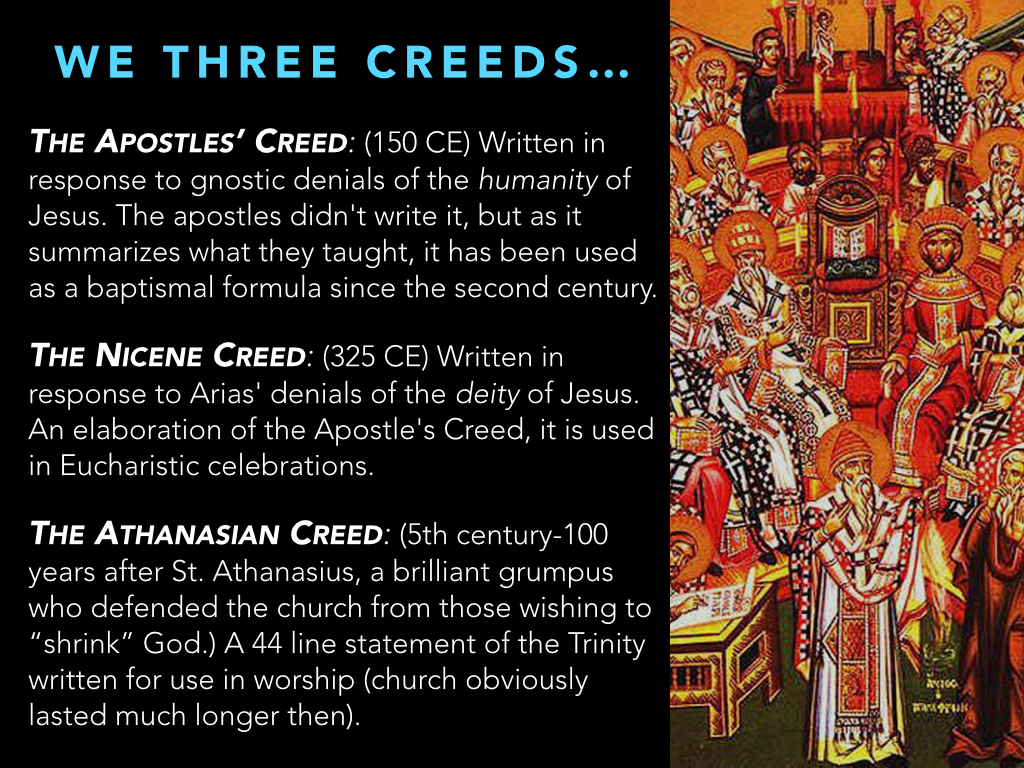
It may be of interest to you that the early Christians struggled with the humanity of Jesus more than his deity. Greeks, influenced by Gnostic thought and the idea “flesh” was corrupt and “spirit” was good,  had a tough time with the notion that Jesus could be a real, actual human. So the early church wrote a creed we know as the “Apostle’s Creed.” It was used in Baptisms. The line, “Born of a virgin” was included specifically to insist that Jesus was an actual, real, burping, got gassy, snored while sleeping on his back, human being.

A century and a half later the struggle had shifted. A priest named Arius had started teaching that Jesus was something less than God (as Jehovah’s Witnesses and Mormons teach today).

Arius’ new teaching began to win people over. (It helped that he was a good preacher and musician. He penned a catchy ditty that all the cool kids were singing, “There was a time when he was not…”) Arius argued out of the gospel of John, “Jesus said, ‘The father is greater than I.'” (John 14:28) The church answered with, “The father and I are one.’  (John 10:30) and ‘If you have seen me, you have seen the father.‘” (John 14:9) So there they are: reading the same gospel and coming to two thoroughly opposite conclusions as to Jesus’ identity and the nature of his relationship with the Father. So is Jesus less than or equal too the Father? This really, really matters because Jesus’ role is to make sacrifice for sins. If Jesus is anything less than completely holy, anything less than divine, his sacrifice will be incomplete…and we will remain dead in our trespasses. (1 John 2:2, Heb 9:26-10:12)

When the “Bible alone” is not enough

How did the church settle this dispute? Is the faith to be, as Arius’ would have had it, endlessly malleable or is there an inner core that is non-negotiable – a “…faith which has been believed everywhere, always, by all“? (Vincent of Lerins, early 400s.)

The church had two trump cards in this argument: catholicity and orthodoxy. 1) Catholicity (universal), the unbroken line of bishops (apostolic authority) traced back to Jesus – an argument of continuity of relationship with Jesus (those related to Jesus by touch). 2) Orthodoxy, an argument of continuity in Jesus’ teachings (those related to Jesus by teaching). The church has argued one or the other for 2,000 years, but both were seen as vital.

Those bishop’s unbroken interpretation of the scriptures present in the conciliar statements generated when they met in worldwide (ecumenical) council. The first of these councils met  in a town in Turkey named Nicea in 325CE. 318 bishops from all around the world attended. They came from as far away as England. The meeting was presided upon by no less dignitary than the rather newly converted emperor of Rome, Constantine. The statement they wrote, stating in unambiguous terms, that Jesus was fully and completely God in flesh, was signed by 315 of the bishops present (Arius and two cronies refused).

Since that time, Christians, whether they are aware of the fact or not, read the Bible through the “lucky decoder lenses” of those bishop’s statement, the Nicene Creed.

And, since the Nicene Creed is so undergirds how we view and interpret the rest of the Bible, it is a pretty decent idea to, as more and more churches are beginning to, pray that creed in church every Sunday. 

(Part two: Creeds: “The Substance of the faith” not “things indifferent” – Creeds are not confessions and it is above our pay grade to rewrite them.)


Nicene Creed Scriptures.001