Wafer Madness: 500 years of communion arguments made simple

439
Snark MeterHIGH.001

What happens to the elements and the people who consume them? When we are talking about Communion, the answer is “it depends”. The options are listed below from “Why bother?” to “I’m seriously considering becoming a wafer-addict!

Memorial: Nothing happens to the elements. Nothing happens to the people.

Calvin: Nothing happens to the elements. Something happens to the people (Jesus is present when faith is present).

Lutheran: Something happens (is added to) the elements (Jesus is “in, under, and through”). Something happens to those who eat (when faith is present).

Orthodox: Something happens to the elements (but that “something” is left undefined). Something happens to those who eat (when faith is present).

Roman: Something happens to the elements (a complex and nuanced “transubstantiation”) and something happens to those who eat (when faith is present).

Does what someone believes about communion matter? If you are a memorialist, since nothing changes and nothing happens, not really. However, if you believe Calvin’s position, it matters. And, if you believe the Lutheran, Orthodox or Catholic view, it matters even more.

Yes, the Eucharist can mean nothing if you do not approach the table with eyes of faith. But is Holy Communion, at its best, intended to be a “Happy Meal” (fun, but no real nutritional value) or a “Magic Cracker” (that will change you if you let it)? The issue isn’t really what you or I think it is or want it to be, but what the Scriptures say it is, and what the early and undivided church taught it to be.

Beyond the facts is the experience of being changed in a Eucharistic community. You can down a wheat chip cellophaned to the top of a disposable cup, or you can feast at the family meal of the Body of Christ. I am hard-pressed to understand why someone who could eat gourmet in their neighborhood bistro gratis would settle for a Happy Meal from the drive-through. “Taste and see that the Lord is good!” (Psalm 34:8)

Wafer Madness.001

 Am I advocating wafer madness? Maybe a little.

While song is the worship language of memorialists and the megachurch, supper is the historic worship language of the church. This isn’t about preference, but about faithfully practicing what was given to us by Jesus, the New Testament authors, and the early and undivided church. For three-quarters of Christian history, Word and Sacrament was literally the ONLY paradigm for worship. This Sunday it will characterize the worship of more than two-thirds of the world’s Christians. I am not trying to be negative, or run down another’s “tradition.” But I do want to say that when you find yourself spiritually hungry, a meal awaits.

If song is your only worship language, consider experiencing the blessings of bi-lingual worship – add supper.

I’m Lovin’ it!

Why Child Celebrity Begins at Church

Blogger Paul Wilkinson points out a sad truth: the church trained many young music stars for professional success but failed to help them know how to cope with that success…

paulthinkingoutloud's avatarThinking Out Loud

If you’ve ever held a hymnbook in your hand, or sung in a church music production, you are at a distinct musical advantage compared to the other kids in your class. Doing drama productions, singing in a couple of middle school choir things, and playing in the school orchestra all certainly furthered my musical education, but going to a large and musically diverse church enriched that education greatly.

Sometimes more is caught than taught, and that was definitely true in my case. I played in the church orchestra and was pianist for the college and career youth group. The church was the first in Canada to broadcast on television, and regularly did major theatrical-style productions ranging from contemporary to operatic. I also learned about sound, lighting, make-up, camera-blocking, stage set-up, mixing paid musicians with volunteers, and learned about the relationship of all these superficials to the ultimate end: the communication…

View original post 563 more words

Eucharist for Newbies

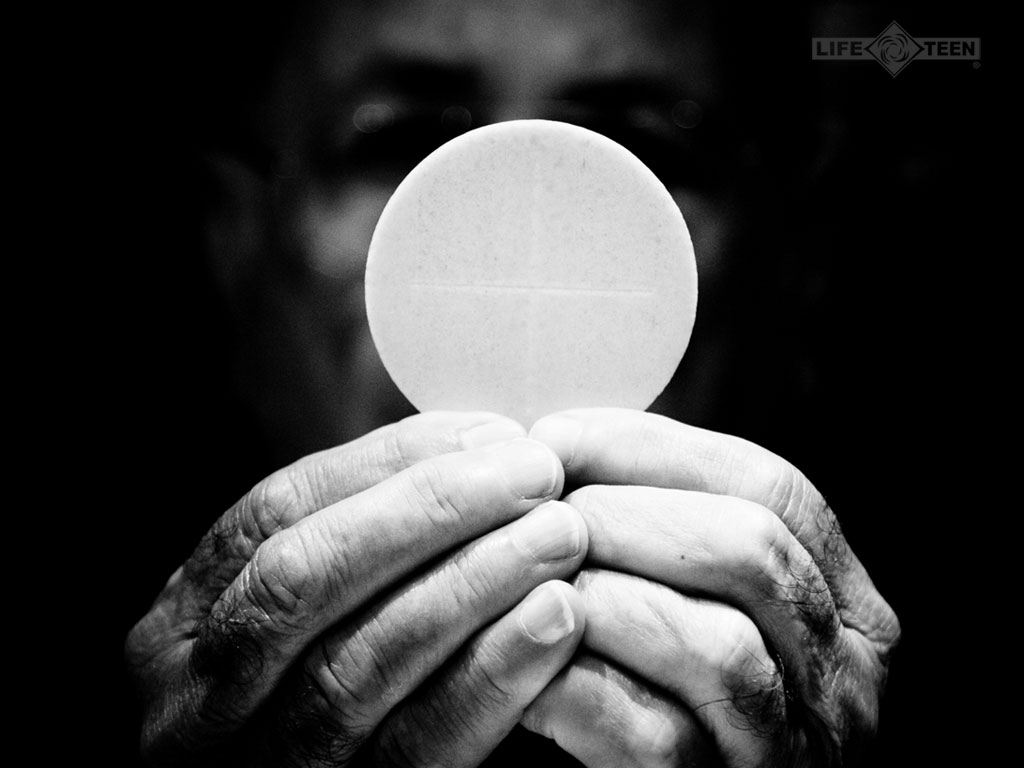
Photo credit: Lifeteen

Photo credit: Lifeteen

Snark Meter Sorta Snarky.002

A light look at 10 things you should know before Sunday.

When American evangelicals think of worship what generally comes to mind is song and sermon. But for most of the Christian era and for most in the Christian era, “worship” has meant Scripture and Sacrament…in other words, Communion…the Eucharist.

1. “Eucharista” is Greek for “Thanksgiving.” You can thank Paul for that: Is not the cup of thanksgiving for which we give thanks a participation in the blood of Christ? And is not the bread that we break a participation in the body of Christ? Because there is one loaf, we, who are many, are one body, for we all share the one loaf.”  (1 Corinthians 10:16-17)

2. Interestingly, there is only one instance when Jesus used the phrase “New Testament” or “New Covenant” (diatheke). He used it, not to describe a book, but the Eucharist. This comes from the earliest historical record of the last Supper, written within perhaps twenty years of the event: “In the same way [Jesus] also [took] the cup, after supper, saying, ‘This cup is the new covenant in my blood. Do this, as often as you drink it, in remembrance of me’” (1 Cor 11:25; emphasis added). So, according to the New Testament, the Eucharist is the New Testament. Long before anyone assembled a book called the New Testament, Jesus had given the chalice as the New Testament in his blood (see Lk 22:20).  (Scott Hahn, The Eucharist in the New Testament)

3. The Eucharist, though, is not just in Paul, there are explicit references to the Eucharist in all four Gospels, Acts, Jude, and Revelation. Over the last fifty years Protestant scholars (John Koenig, Geoffrey Wainwright, Arthur Just, John DelHoussaye) have described a “Eucharistic Provenance of the New Testament.”  These are Protestant scholars recognizing that the New Testament was written to be read aloud in the context of the assembly (Rev 1:3) – and Christians assembled for the meal we call the Eucharist.

4. There are five views of the Eucharist: At the top is the Roman View – The elements incur a essential change, transformed into the body and blood of Jesus, becoming a “Magic Cracker” that appears to be bread, but is, in fact the body of Christ. On the bottom is the memorialist view, in which nothing happens, it is just a “Happy Meal.”* In between, from bottom to top are the views of Calvin (Nothing happens to the elements, but Jesus is present as we lift our hearts in faith), the Lutheran view (the elements become both/and: Jesus and bread/wine), and the Orthodox view (the elements become Jesus, but how and what exactly happens to the elements is a mystery humans cannot define).

5. In Anglicanism there is room for all five views, although very few are memorialists. At the beginning of her reign, Queen Elizabeth was called on to decide whether or not England would remain Catholic, as it had been under “Bloody Mary,” or continue along toward Reformation Protestantism, as was occurring on the continent. As most religious disputes of the day were fought over communion, the clergy reportedly asked, “Which is it, (literally) the ‘body of Christ‘ or (a memorial) ‘The bread of heaven‘?” As the story goes, Elizabeth said something to the effect, “I will not be in the business of peering into men’s souls. When you deliver communion you will say, ‘The body of Christ comma the bread of heaven.'” Basically she was saying, “Communion will be what the person receiving believes it to be.” It is the origin of Anglicanism’s “majoring on the majors”…or “Anglican fudge,” depending on your perspective.

6. The early church repeatedly describes the elements as becoming and being the “body of Christ.” They said, in effect, “Jesus is really here.” But they refused to over-define what that meant. “Transubstantiation,” the word Roman Catholics use to  indicate that the elements truly become the body and blood of Christ, is a word that doesn’t appear until the 11th century. Seminary students are aware that over-definition can be a particular charism of scholasticism. Because both scripture and the unbroken testimony of the early church insist on it, I personally believe in “real presence.” Memorialism ignores far too much scripture and the consistent testimony of the early church (1 Cor 11:29-30) …Why were people getting ill and dying if it is just a reminder? Although the argument could be made that the McDonald’s “Happy Meal” will probably kill you also. Transubstantiation is more specific than can be proved from scripture and causes some significant real world problems – If a frat boy snags a wafer in a prank and runs, do we really have the God of the universe in a prankster’s pocket?

7. The Eucharist is a Sacrament (Yes, Protestants too have Sacraments). Sacrament is Latin for oath…or promise. Simply put: we are promised that we experience Jesus when we obey Jesus…especially when we obey Jesus in the ways Jesus commanded…which is why Protestants traditionally recognize two Sacraments: Baptism & Eucharist, and refer to the rest as “sacramental rites” – permitted and edifying, but not mandated. Btw, for Protestants bugged that Catholics invented the “T word” in the 1100s, Baptists came up the word “ordinance” in their Confession of 1689 to avoid the word “sacrament.”

8. This is not a new sacrifice: Scripture is clear: “Christ…suffered once for sins.” (1 Pet 3:18) The re-presentation of Christ is a “sacrifice of praise and thanksgiving.” (BCP, 363)

9. Eucharist is the original Christian altar call: We come forward, we kneel in humility, we hold outstretched hands as the needy ones we are, and we receive, not grab, the Lord. We receive his grace in humility. We come to receive afresh the grace of God given at the Father’s initiation and at Christ’s expense. All baptized Christians are welcome at the family meal of the Body of Christ. As Cyril described in 400, we make a throne with our hands to receive the body of Christ.

10. At St. Jude’s we use a Eucharistic prayer adapted from the Prayer of Hippolytus written in 215CE. We are following a pattern that was explained as standard Christian worship by Justin Martyr in 150CE. Think about that: What Christians do in the Eucharist is so old that it was already described as the standard and assumed worship pattern of Christians as close to the closing of the NT canon as the writing of the New Testament was to the Lord walking on earth.

Do you want to worship like the early Christians? Try worshipping Eucharisticly. It will bless you.

As Augustine said, “Be what you see; receive what you are.” (Augustine, Sermon 272) -The body of Christ.

So, if you have not before, this Sunday join a celebration of the Holy Eucharist.

The Lord be with you!

*The terms “Magic Cracker” and “Happy Meal” were used in a friendly debate over beer. My Roman Catholic friend insisted, “It is indeed ‘magic cracker.'” My memorialist friend replied, “No. It is only a ‘Happy Meal.’ Fun, but no nutritional value is present.”

A faith that will last: A call to ancient-future youth ministry

Youth-PrayerSnark MeterrealMID.003

It is values driven and data supported. It is life-changing and both church-sustained and church-sustaining.

Click the link then tell me what you think…

Building Faith That Will Last: January 5 Edition of The Living Church Magazine

Our King and Savior Now Draws Near

nativity

Snark Meter.005

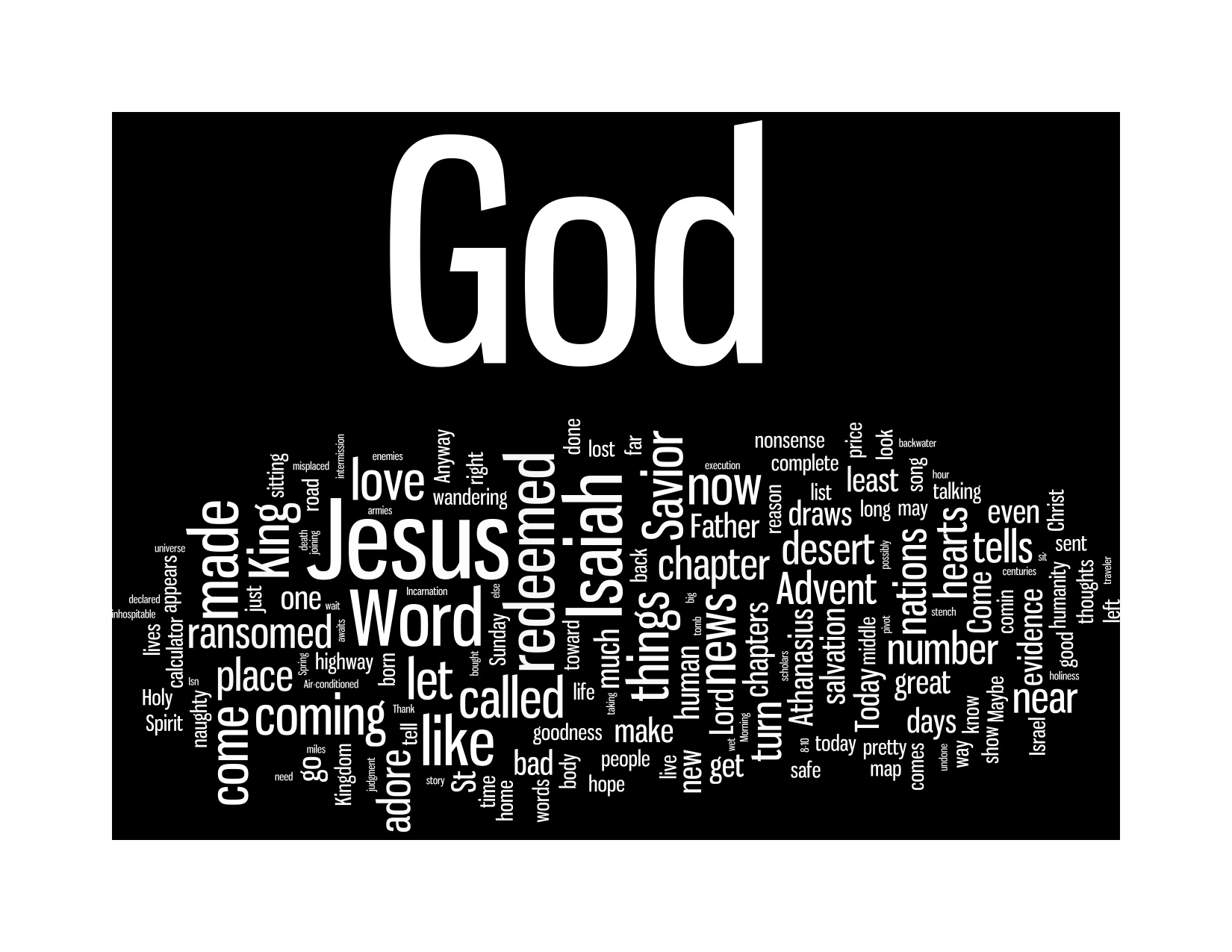
Folks have asked for the sermon that got the “Jesus count” upped after looking at its tag cloud. Here it is…

Today is Rejoice Sunday. The Advent pivot. Today we make the turn from repentance to anticipation. Today we turn toward Jesus. In Matins, the monastic morning prayer service, there is a call and response exclamation of praise called an antiphon. The antiphon in Advent is, “Your King and Savior now draws near.” The congregation gives the logical and heartfelt response, “O come let us adore him.”

Today, as our King and Savior draws near let’s turn our attention to our Old Testament reading, Isaiah chapter 35, written centuries before the birth of Jesus.

Isaiah opens with 39 chapters of God’s impending judgment. There is destruction, desolation, and ecological and political disaster.

Here is a brief sample of the tenor of Isaiah’s warnings from Chapter 34: “Come here and listen, O nations of the earth…the Lord is enraged…His fury is against all their armies. He will completely destroy them, dooming them to slaughter. Their dead will be left unburied, and the stench of rotting bodies will fill the land. The mountains will flow with their blood.”

This is not Christmas material.

For 39 chapters Isaiah tells us that God too has a list. And after checking it twice he has declared, “everyone has been naughty.” The list is unsparing: Judah, their enemies…even obscure nations scholars have a hard time locating on a map. God’s indictments through Isaiah hit, for me at least, uncomfortably close to home: You have treated the poor badly. Ignored your God to pursue the god of your own appetite. You are looking for protection from those who cannot defend you. And the logical consequences are coming…

But right in the middle of it alldropped into the midst of the judgments, like intermission in a movie too long to sit through without a popcorn break, comes chapter 35.

Some say this hopeful song belongs after chapter 40, when Isaiah’s message changes from correction to comfort. Others argue that it should come even later – after the exile. Either way, this poem appears glaringly out of place.

It is as if the Spirit hovered over the scribes who assembled Isaiah’s prophecies and whispered, “Put that over here.”

In the middle of the bad news, God Interrupts.

With words out of place that will not wait until we make things right.

…Words of hope against all evidence and reason.

Isn’t that just like God?

Look with me at Isaiah, chapter 35. The chapter is a song in four stanzas:

Stanza 1: v. 1-2  The desert will bloom – The desert is inhospitable. We have tamed it with asphalt and Air-conditioning, but ask a family trying to get to the US on foot about the desert. Every decade or so, though, we have a wet Spring and wildflowers are everywhere. God’s new Kingdom, the one that started at Jesus’ first coming and will be made complete when he returns, will be like that.

Stanza 2: v. 3-4  So, God says, and here the old Sam & Dave song comes to mind, “Hold on, I’m com in.”

Stanza 3: v. 5-7  Humans too will thrive like the desert coming to life!

Stanza 4: v. 8-10  8 “A highway shall be there,
and it shall be called the Holy Way; 
the unclean shall not travel on it, but it shall be for God’s people; no traveler, not even fools, shall go astray. -You cannot get lost following God’s road. Not even if you are directionally challenged!

9 “No lion shall be there, nor shall any ravenous beast come up on it;
they shall not be found there,”  – God has a new Kingdom in which we will, each and every one of us, be safe.

“the redeemed shall walk there. 10 And the ransomed of the Lord shall return, and come to Zion with singing.” The “redeemed”-those God has bought back. The “ransomed” – those God paid a price for. Our great price payer- God himself is coming. Jesus is on the horizon. And all things will be made new.

And it ends like this: “everlasting joy shall be upon their heads; they shall obtain joy and gladness,
    and sorrow and sighing shall flee away.” Now that is the kind of life we all want!

Beautiful words out of place.

But being redeemed presumes we need redeeming.

Frederich Buechner said, “The Gospel is bad news before it is Good News. It is a speaking of the truth of the way things are.”

Here is the truth: I need redeeming. I realized that one day when I was feeling pretty good about myself. I had been a pretty giving guy and was feeling, to be honest, that God was sort of lucky to have me on his team. Then I got this impression. Maybe it was from the Lord. Maybe I just have an over active conscience. Anyway, I realized that, on my best day, maybe I only have 4 thoughts or actions that are faithless or fearful or nasty…you know the things Episcopalians confess each week, “the things we have done, and the things we have left undone.” Anyway I happened to have that thought sitting at my desk. Unfortunately a calculator was within eyeshot. And I made the mistake of picking up that calculator and multiplying my really optimistic number (4) x the number of days in a year x the number of average years American men live. The resulting number was: 113,380. That’s right, I have a bare minimum of 113,380 sins.

The “bad news before we can get to good news” is that I am a far less admirable person than I care to believe. And God is far more forgiving than I can possibly imagine. Let’s just say that when it comes to sin, the data is not in our favor.

Fortunately, as Scholar Walter Bruggemann tells us, “All doxologies are against the data.”

So as we make this Advent turn, as “Our King and Savior now draws near,” let us look to Jesus, God’s Word out of place to us

St. Athanasius, the 4th century bishop, said Jesus, “has been manifested in a human body for this reason only, out of the love and goodness of His Father, for the salvation of us men.”

Why did our King and Savior draw near? Athanasius tells us it is, “out of the love and goodness of His Father, for the salvation of us.

Ten days from now we will celebrate the birthday of the one St. John called, “The Word made flesh:” God’s unexpected Word out of place. Consider the absurdity of it all…

-The king of the universe born in an outhouse for animals.

-God’s Son wandering and teaching and healing the  least, last and lost, not in the halls of power but in backwater Palestine. Some have euphemistically called Judea a “major thoroughfare of the Empire,” but if that’s so, most of Jesus’ ministry was the equivalent of  wandering I-10 between Eloy and Picacho. If Jesus came today we would politely offer to show him a map.

-He offered up his life on a cross for execution by professionals and called it “a ransom for many.”

-Yet death could not hold him and he walked out of the tomb.

-He disappeared into heaven in front of witnesses, sent his Spirit to dwell in the hearts of his own, and ever lives, talking behind our backs with the Father about how much they adore the likes of us.

-And He has entrusted us with his mission and awaits for us to finish the work of carrying the news of hope in Him to consummate His story.

Words out of place always sound absurd: God joining humanity so that humanity could join God-it just sounds…well, ridiculous.

Against all evidence. Where he is least expected. God has sent a Word, a Word that appears out of place, and that Word tells us, that no matter how it looks, It may be Friday, but Sunday’s a comin’.

So when our prayers tell us “Our King and Savior now draws near” and when our scriptures tell us that the Holy One of Israel is coming for us…

…with kindness and not condemnation, Well what else could we say but, “O Come, Let us adore him”?

You see, when the Scriptures call you and I “the redeemed” and “the ransomed” it isn’t talking about pennies for pop bottles. In Christ Jesus, God has saved us. And God has done so at His initiation and at His expense.

You see, when the Scriptures call you and I “the redeemed” and “the ransomed” it isn’t talking about pennies for pop bottles. In Christ Jesus, God has saved us. And God has done so at His initiation and at His expense.

Athanasius, in his brilliant, “On the Incarnation”, said it like this: “It was our sorry case that caused the Word to come down, our transgression that called out His love for us, so that He made haste to help us…It is we who were the cause of His taking human form, and for our salvation that, in His great love, He was born in a human body.

Do you know God’s great love? Have you allowed God in Christ to be Your King and Savior? Are you numbered among the redeemed?

If not, “it was,” in Athanasus’ words, “for our sorry case he came…out of his father’s great love.” Get on God’s Way. Come see us about beginning a relationship with God in Christ after the service. My encouragement: Do not leave here this morning without allowing one of us to help you onto, as Isaiah said, “the holy way for God’s people.”

And if you do know already God’s great love, let us, as the General Thanksgiving exhorts us, show forth your praise, not only with our lips, but in our lives, by giving up our selves to your service, and by walking before you in holiness and righteousness all our days.”

Our King and Savior now draws near. And all God’s people said, “O Come, let us adore him.” 

Tag Cloud

Unflattering Mirrors: Tag clouds reveal content…or lack thereof

mirror2Snark MeterrealMID.003

Tag Clouds make good Advent and Easter mirrors. Who knew?

Episcopalians, in our neck of the woods anyway, are a small and remarkably insulated bunch from the goings on in the wider Christian community. That was why I was surprised to be fielding questions from the outside world regarding a blog post that amounts to Episcopal insider baseball.

Father Robert Hendrickson, a bright light of a young priest working in a diocesan cathedral, recently made a tag cloud of our Presiding Bishop’s Christmas message. He compared the key words revealed by her cloud to those of Pope Francis’ recent Lumen Fideiand described her sermon as “bordering on gnosticism.” Last year he compared tag clouds of her Easter sermon to those of the Archbishop of Canterbury, the Presiding Bishop of the Evangelical Lutheran Church, the Pope, and even Ricky Gervais’ atheist Easter message. Let’s just say that, from the tag clouds, even the atheist’s message appears to have significantly more Christian content. In cloud format our Presiding Bishop’s sermons appear to be long on insider lingo and social engagement and low on Jesus…that there just isn’t much “there” there.

Pointing out your national leader’s theological shortcomings is a gutsy move for an up-and-comer…a move that caused friends outside of the Episcopal Church to ask, “What’s that guy thinking? ” Would I have criticized our national leader’s sermons online? My strategy in criticizing sermons that I don’t appreciate has generally been the same strategy I use when my wife tries on something that just doesn’t work for her at the department store and asks,  ”Do you love this as much as I do?” I will pretend to have a conversation with a mannequin if necessary to maintain, “If you can’t say something nice.”

But Father Robert’s tag clouds, for all the conversation they are creating, illustrate much more than sermon content…

For one, they reveal a very odd concept for those not of our tradition to grasp: That Episcopalians, as a rule, crucify neither our orthodox nor our gnostics. Our Presiding Bishop will not, as my evangelical friends would like, be charged with violating Christian orthodoxy, nor will her critic’s career be harmed, as many of my progressive friends would like. The ability to stomach dissent, although under fire, is a historic and endearing quality of Episcopalians, a group theoretically not together on theology as much as on the agreement to pray the same words.

However, the theory that “we need not agree” has limitations. I am no fan of Confessional statements, but if there is no real creedal and quadrilateral agreement binding us together as Episcopalians, around what will we orbit when we write the prayers we will pray in unison? There is a core to the faith that makes us recognizably Christian. Or not.

Father Robert’s tag clouds also reflect a growing awareness that our missional strategy – the Episcopal church as “Christianity lite,” a doubt embracing, culturally accommodating, theologically easy onramp for those wanting to consider a practice-based rather than a propositional faith, has not worked very well…in many places we appear to have a creeping universalism that seems lumpy and out of date. Like a microfiber sofa, public doubts about core teachings (resurrection anyone?) and “all roads lead to God” do not make an attractive invitation to come check us out. Our Sunday attendance numbers since our last national leader was selected bear this out: 765,000-640,000 from 2006-2012.

Finally, in Father Robert’s tag clouds we see a hint of what is for me, a person who has spent his adult life working with people from 18-35, a seismic and positive generational shift: Young Episcopal clergy and bishops are both more progressive politically and more traditional theologically. And they are not content to sit on the sidelines and wait for the boomer generation with its (and I do believe this is missionally-motivated) theological fuzziness to get out of their way.

Out of curiosity I made a tag cloud of my sermon for this weekend. I preached out of Isaiah 35 as part of an Advent series, so I expected its references to Jesus to be lowish. Also, my purpose was to sneak up on the Christian message: That just as the Holy Spirit had dropped Isaiah 35 as seemingly a word out of place in the middle of Isaiah’s judgments on Israel, Jesus is God’s Word out of place, dropped into history where least expected. Still, my references to God: Father, Son and Holy Spirit, were minimal enough in the key words that it caused me to cringe like a glance in a mirror at a look that just doesn’t work. Missing too was any indication of our need for a savior. I tore the sermon up and went back to the drawing board.

Tag Cloud

It is not my first rodeo. I know that people come to church quietly desperate for help. If I, as the proclaimer, hold up a fun-house distortion of the Gospel…one that merely reflects back at people what I think they want to see, well, shame on me. I know that the hungry do not need the illusion that we are spiritually well-fed, when in truth we are starving for a Savior. If I fail to hold up a mirror of our deep brokenness and need and then bring the true comfort of the transforming Good News that the Creator of the universe loved us too much to leave us alone, then why bother? God entered our world, not just to demonstrate how to live, but to finally redeem us on Calvary and rise in victory. Christ returned to the Father to intercede on our behalf as his Spirit makes us a people and sends us to extend his Good News in word and deed. Less than the whole Gospel is an unhelpful diet, white bread for the soul. Looking into a mirror that distorts an emaciated spiritual reality may comfort for a while, but eventually hungry people will go somewhere else, some place a meal is served.

I have too many shortcomings as a preacher to criticize another’s sermons. For me, Father Robert’s tag clouds sent me scurrying back to the drawing board to craft a message that better reflects The Message…one that is clear on the reality that, as fourth century bishop, Athanasius wrote,  “It was our sorry case that caused the Word to come down, our transgression that called out His love for us, so that He made haste to help us and to appear among us. It is we who were the cause of His taking human form, and for our salvation that, in His great love, He was born in a human body.”     (On the Incarnation)

How do millennials experience your church?

I asked Christopher to guest post after his comments on my “Kinnaman” post were so eerily similar to statements made by millennials in a recent Q & A hosted by one of the nations most effective ministries to millennials led by millennials, PhoenixOne.

Why Millennials are Leaving the Church: A suggestion.

By Christopher Jones

Profile Picture2

I graduated college two and a half years ago. Unlike many in my generation, I haven’t stopped attending church. I have, however, stopped being part of the church.

According to most metrics, I haven’t “left.” I still show up on Sundays. But wherever I go, I find myself almost completely ignored.

Our problem: Most American churches are structured around families. If you don’t have a family, you are put into a box. Youth ministry. College ministry. And after that? No one knows what to do with you.

In the modern American church, if you’re not married, you’re not an adult. And we millennials are part of a generation that’s getting married later and later for economic reasons.

It takes a lot longer to build a stable career today than it took our parents’ generation. My parents had me when they were 25. I’ll be 25 in four months. By that time, I will have been enrolled in higher education for nearly twice as long as my parents. I’m unmarried, have never been in a serious relationship, have hardly any money, and have moved regularly to pursue my education. Its next to impossible to work towards marriage in such a situation. My situation is hardly unique.

Inter-generational economic differences are another huge rift in the church that no one is talking about. At one church I mentioned to a middle-aged woman that I was likely spending the next year unemployed. She burst out laughing. For some reason the pressure and debt our generation faces to develop future competitiveness in the emerging job market was humorous.

From the minute we step inside the doors on Sunday, post-college millennials face a wall of negative judgments and assumptions. Those with successful careers wonder why we can’t just “work at a factory or a newspaper like I did when I was your age.” The assumption is that we are lazy and think that we are entitled. A better explanation is that those jobs simply don’t exist anymore. Married people, in both overt and covert ways send us the message that the purpose of Christian singleness is marriage (never mind that Paul said the exact opposite in 1 Corinthians 7, but I digress).

Our generation graduated into a world of part-time jobs, unpaid internships, and student loan debt. A world in which shrinking paychecks meet inflated living costs. Yet from the pulpit we still hear sermons attuned to yesterday’s economic concerns. Sermons about not working too hard and not making your career into an idol ring hollow when you’re working late hours struggling to make next month’s rent.

Whatever the cause is, it is certainly not that the church is too conservative. If liberal politics were why we left the church, then we’d be flocking to churches with liberal politics. Yet mainline Protestant churches have declined much more sharply over the past ten years than conservative ones.

No, we millennials often embrace liberal politics as a substitute to fill some of the void that the absence of religion leaves in a person’s soul. Liberal politics provides a supportive community working towards a common goal and offers a promise of an ultimate end state of justice and equality. It’s a substitute for religion, not a cause for rejecting it.

A person can personally believe in salvation through Jesus Christ without going to church. A person can feed the poor and care for the sick without belonging to a congregation. What they cannot do alone is become part of a fellowship of believers. And if our generation doesn’t find that fellowship at church, we’ll stop going.

In short, we millennials just want to be treated like adults. We don’t want to be catered to. We don’t want to be entertained. We certainly don’t want to be eyed suspiciously as some sort of dangerous element by people more interested in passing judgment than trying to understand what life is really like in your twenties in modern America. We want to be included. It’s not that hard. We’re human beings like the rest of you, and we’d like to be treated as such.

*Christopher Jones is an aspiring historian of the ancient Near East currently working towards completing his Master’s Degree in Biblical Archaeology at Wheaton College. He blogs about the ancient Near East at http://riversfromeden.wordpress.com/.

Funerals: Recovering hope in a culture terrified of death (2 of 2)

clip of leaves

Snark MeterrealMID.003

I promise you interesting reading on a topic you were not looking for in the middle of Advent. Although not the usual topics for youth ministry and/or church planters, as advertised in part one (The obsession we cannot avoid), here is the text to our Q & A on funerals.  It will give you a glimpse into the purpose and power of the traditional burial office. It was produced by Nicholas Knisely, Bishop of Rhode Island, Bryan Owen, Rector of St. Luke’s Baton Rouge (blogs as Creedal Christian), and myself. It is available as text for websites or as a customizable flier.

Why have a funeral in a church?

One of the characteristics of an Episcopal or Anglican Church is that you will often see graves inside the church or on the church grounds. When we speak of the Church, we mean both the church militant (those who are alive right now) and the church triumphant (those who have died and ended their earthly race). When you worship in a liturgical Church you are literally and tangibly in the presence of the whole Church. A funeral in the church building is a sign that, even though death seems to divide us from those we love, the Body of Christ is never divided. As members of Christ’s body, we are still connected with those we love but see no longer. Therefore, a funeral in the church building foreshadows that day when we will be reunited with the entirety of the Body of Christ in the presence of God.

Why a burial office (prayer book funeral service) instead of a memorial?

Rather than focus on what we believe to have been important about our loved one’s life, the burial liturgy reminds all present that we are brought into a reconciled relationship with God after our death because of what God has done, not because of what we did in life. Using the burial office rather than trying to create a particular and personal memorial service is a consequence of that belief. In the burial office the gathered body of Christ expresses gratitude for God’s redeeming work in our loved one’s life, hands them over to God’s gracious care, and looks forward in hope to God’s future resurrection of us as well.

Why do clergy accompany the family on the initial consultation with the funeral home? 

It is often a good idea to have the church funeral planner accompany you to the mortuary in order to coordinate arrangements at the beginning of the planning process. The clergy/church representative is your advocate and a calm and supportive presence at a time when difficult decisions must be made.

Why is it important for the body or cremains of the deceased to be present?

Christians believe in the bodily resurrection, not just of Jesus, but of each of Jesus’ followers. We do not know what our new bodies will look like, but we do know that God is going to transform the essence of our whole selves, our minds, our souls, and our bodies. The presence of the body or cremains of our loved one is a sign to all of our trust in God’s plan to redeem and transform us in the end.

When there is a body, why is the casket closed and covered with a pall? 

Holy Scripture tells us that “to be away from the body is to be home with the Lord” (2 Corinthians 5:8). We close the casket because our loved one is no longer present-only their remains.

Once inside the church the casket is completely covered with the “pall.” As Easter people we are dressed in white in our final church service. The pall points to the reality that, whatever our station in life, we all come before God by virtue of being clothed in robes made white by Christ’s loving action on our behalf.

Why are there no eulogies?

Although there is a degree of latitude granted in some parishes, there is a longstanding tradition of not having eulogies in the burial office. This is because the burial office, rather than fixating on the past, orients our faces toward the future promised by God that is a consequence of our relationship with Jesus. It is a good thing to remember the lives of our loved ones and to give thanks for all they have meant to those who remain behind. That work of remembering, though, happens best when we can do it in conversation. Perhaps you will want to have someone speak about your loved one’s life during visitation hours before the burial office, or at the reception following.  You also have the option of having a Vigil the evening prior to the funeral as a time to offer prayers and to share memories of the deceased. (BCP, 465-466). *Feel free to speak with your priest if you wish to discuss this further.

Why is that ‘big candle’ used in the service?

The Paschal Candle is first lit each year in the Easter Vigil to symbolize Christ dispelling the darkness. As the candle is brought into the darkened church, we sing that the light of Christ has conquered the darkness of the grave. The Paschal candle is lit every time the Church celebrates a baptism. In baptism we are “sealed by the Holy Spirit” and “marked as Christ’s own forever.” (BCP, 308) The candle is lit at every funeral to remind us of this unbreakable bond and the truth that nothing in all of creation, including death itself, can separate us from the love of God in Christ Jesus our Lord (Romans 8:38-39).

Why Is the church adorned in white?

The church is adorned in white because the burial office is an Easter liturgy and focuses on the unexpected joy of the resurrection, which the Church has proclaimed for two thousand years. In the liturgy, there is a beautiful phrase, “Yet even at the grave we make our song, Alleluia, Alleluia, Alleluia.” It is in the hardest, darkest times of our lives, that we insist on proclaiming our hope that “in Christ all will be made alive” (1 Corinthians 15:22).

Why does The Prayer book select certain Scripture readings to be used in the service??

The Book of Common Prayer is the result of centuries of thought and theological reflection. As the result of this intentional conversation across generations, the prayer book has provided selections from the Holy Scriptures to sustain us at the time of death. There is a certain latitude given to the officiant and the family planning the liturgy to chose favorite hymns or alternative readings, but the appointed readings have been chosen because they speak directly to the resurrection hope that lies at the heart of the Christian faith.

Why do we have Communion?

God has given us the chance to be united with those we love but see no longer through the redeeming action of Jesus’ sacrifice on the cross. When we share in the sacrament of bread and the wine, partaking in the body and blood of our Lord, we are united with all the hosts of heaven, and all the members of Christ’s Church of all time. We share this final Communion meal, the family meal of God’s own household, in anticipation of that great day. We will not be able to share Thanksgiving or Christmas, birthday or anniversary meals any longer with the people we have lost, but we will, for eternity, share this Eucharistic meal with them. *There are occasions in which communion may not be desirable. Discuss this with the church when planning the particulars of the service.

In Summary

Few are the times in this present age when people are aware of God’s acting to graft us in to his larger and eternal purposes. Baptisms, weddings and funerals are among those occasions. It is in those events when time and eternity touch that we and our loved ones need the truth, beauty, and comfort of the words of Holy Scripture and the great tradition. The burial office exists because the final goodbye to your loved one is simply too significant a matter to make it up as we go.

The liturgy for the dead is an Easter liturgy that finds all its meaning in the resurrection of Jesus Christ.  It gives us permission to express deep sorrow over the death of loved ones.  It also reassures us that all who die in Christ share in the victory of his triumph over death.  Using this liturgy in the church for the burial of a Christian reaffirms and strengthens our faith that just as God raised Jesus from the dead, he will also raise us.

We are glad that you are considering our church for this important event in the life of your family.

Please contact the St. Jude’s church office at (602) 492-1772 to set up an appointment to plan the particulars of the ceremony.

We are planning for this to be the first of a series entitled “Your Church. For Life.” It will include Baptism, Confirmation, & Marriage, four events people look to mark in the church.logo

All of which is to say: When I die, do the world a favor. Give me a funeral.

Death: The obsession we cannot avoid and dare not admit (1of 2)

Funeral1

Snark MeterrealMID.003

In our rush from the church, have we begun using entertainment as religion to answer the questions fundamental to human thriving?

Our culture has almost entirely insulated us from the reality of death. Most of us are awkward with the topic in conversation and go to great lengths to avoid the appearance of nearing death with a plethora of products, services and surgeries designed to cheat aging at any coast. Our post-modern avoidant/fascination with death struck me last night at our local cineplex. The new release lists are heavy with vampires, zombies and time travel…except for the ones about super heroes with death-defying powers. When did death-avoidance become the central theme of our entertainment?

Although we may abandon organized religion, it appears that we do so at our own existential peril. In our rush from the church, it seems we have begun using entertainment as religion to answer the questions fundamental to human thriving.  Last night’s trip to the theater was instructive. The opening line to the movie The Book Thief is “Everybody is going to die someday.” The closing line of the last preview before the movie started was from The Winter Tail: “Maybe it is possible to love someone so much that they cannot die.”  Interestingly, the Christian message is precisely that there is a love so strong it will overcome death. But instead of considering that message, most of us will avoid thinking about death until we stare it in the face – literally looking down at the remains of someone we loved lying in a casket.

Our obsession with death becomes even more curious when viewed in light of our near total buffering from it. In previous generations death came earlier, more often, and closer to home-most likely even in the home. Today we have longer life expectancies, become infirm in care facilities, and enter hospitals when illness becomes terminal. Today when we take our last breath it is usually in an institution rather than in the places of our lives. (This has been covered in the press recently (NPR) and was picked up on the Episcopal Cafe.) Add to these layers of insulation, the entertainment industry. Big entertainment includes in it’s notoriously unreliable curriculum the lesson that people don’t actually die at all. They are “offed” (often quite creatively) only to appear next week on another network, perhaps even in the same time slot.

The media is merely a barometer of our desires – It packages and sells us what market research tells them we want. Having discovered our discomfort with our own mortality, it sells our anxieties back to us in the form of a seemingly endless array of zombies and vampires, with their promise of a life-of-sorts. Perhaps, though, the clearest barometer of our post-modern denial of death is found in the new Tumblr site, “selfies at funerals“. If we cannot cheat death, at least we can laugh at other’s deaths. Turn up the music, dude!

tumblr_mvewmnvDqh1smbgw2o2_r1_500

Perhaps the epitome of our post-modern denial of death is found in the new Tumblr site, Selfies at Funerals...Turn up the music, dude!

All of this, of course, affects the church. Many Christians now have an “It’s a Wonderful Life” theology of the afterlife more akin to ancient Greek (or perhaps LDS) beliefs than orthodox Christianity – this is the popular view we “pass on” to become angels trying to win our wings by aiding the frustrated left on earth.

Contributing to this fuzzy theology is the demise of the traditional funeral. You may never have been to an actual funeral, but you have surely been to a memorial service. A memorial is, of course, about looking backwards – of “memories.” The general liturgy of a memorial is to sing a few of the deceased’s favorite songs and, to continue our It’s a Wonderful Life metaphor, share our remembrances of Uncle Billy.  Occasionally a few too many remembrances, and for too long…glossing over flaws and overstating things a bit on behalf of someone whose life might have actually left a lot to be desired. To be realistic, returning again to It’s a Wonderful Life, although Uncle Billy’s absent-mindedness was cute, it caused the family a great deal of trouble. The pastor then closes the memorial with a short message that makes some reference to Jesus’ as accounting for the deceased’s goodness and gently asking those present to consider a relationship with God in order to join Billy in his eternal home.

As heartwarming and well-intended as it is, the memorial is all about looking backwards. A funeral is all about looking forward. It is about promises and hope bought vicariously. It is about real and eternal life, new bodies, and paradise found, purchased at another’s initiation and another’s expense.

The memorial, when viewed in light of the old-school funeral, reveals a very low view of the transition between life and death, and a fuzzy view of the afterlife…both of which, when added together, diminish our understanding of the purpose of the time we have here on earth. The memorial has very little teaching on the afterlife, very little explanation of what comes next and very little of the historic Christian narrative, “Christ has died. Christ is risen. Christ will come again.” (BCP 363)

In our times of greatest loss our most profound need, besides the presence of those we love, is for the comfortable words of the faith. We need reminders of what lies ahead rather than what lay behind. We need to know that we do not stand alone at the precipice – we are surrounded by the great cloud of witnesses (Heb. 11:1). And because death could not hold Jesus Christ, neither can it hold those who are found in him (1 Cor. 15:20-23). That is why in the traditional Christian funeral we shout in hope, “even at the grave we make our song: Alleluia, alleluia, alleluia.” (BCP, 499)

Here is where I may get into trouble with you: It may feel as if I am treading on the toes of those of us who planned the final services for our parents or wife or brother or Uncle Billy. I should say that, as a pastor, I have done more than a few memorial services myself. We sent my mother on her eternal way with a memorial service. After more theological reflection I can only say that I wish I knew then what I know now. I was the victim of a lack of theology of death and the afterlife. And, as a result, those under my leadership were limited by my lack of understanding. I now see the memorial as a far cry from a prayer book funeral.

Interestingly, while this end of life conversation was going on, three clergy in the Episcopal Church: Nicholas Knisely, Bishop of Rhode Island, Bryan Owen, Rector of St. Luke’s Baton Rouge (who blogs as Creedal Christian), and myself have been working on a question and answer on funeral practices as a customizable parish resource to give people a brief glimpse into the purpose and power of a proper funeral service. It will be available as text for websites or as a customizable flier. I will put up the text that we have worked out as a post in the next several days.

We offer this, not as a condemnation of what anyone has done, but as a resource to help us have a broader perspective on life, death, and the afterlife. The hope is that this would be a helpful planning resource for a time when you need it. The traditional funeral has the perspective of twenty centuries of Christian reflection that both blesses and relieves us of the absurdity of seeking for answers to our deepest longings in zombies and vampires. It offers a more hopeful hope. Not just for Uncle Billy, but for us as well.

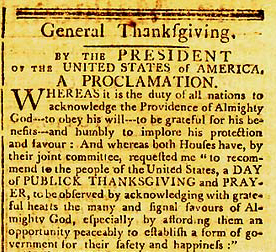
The First Thanksgiving Proclamation: George Washington, 1789

I put this up last year. A fellow Episcopalian involved in ministry with college students, Charlie Clauss, reposted it yesterday with the observation that if George Washington made this proclamation today he would be panned as a religious zealot. For your reading enjoyment…

Matt Marino's avatarthe gospel side

Note the perspective of our first President on the relationship between people of faith and civic responsibility, the idea that we, as a nation, would need the involvement and intervention of Almighty God, and in the final sentence, the idea that religion, virtue, science and prosperity are interconnected rather than opposed.  Make of it what you will. Surely not all change is progress…

THANKSGIVING DAY 1789
BY THE PRESIDENT OF THE UNITED STATES OF AMERICA – A PROCLAMATION

Whereas it is the duty of all Nations to acknowledge the providence of almighty God, to obey his will, to be grateful for his benefits, and humbly to implore his protection and favor – and Whereas both Houses of Congress have by their joint Committee requested me “to recommend to the People of the United States a day of public thanksgiving and prayer to be observed by acknowledging with grateful hearts the…

View original post 396 more words