Millennials still in the church: What do they have in common?

We made it!.001


Snark MeterrealMID.003

I had an interesting conversation with a millennial today. This young man was part of a vibrant youth ministry in a large, fast growing church. He described the youth program as “fantastic!” It was led by a gifted and godly leader, a person I know and hold in high esteem. “Hundreds came through and at least 60 of us had genuinely transformative faith experiences in that group,” the young man told me. Then he dropped the bomb, “But five years later I only know of four of us that are still in church.”

Think about those numbers. Even if you only count those who had a conversion experience, that is still a staggering 94% drop out rate!

Survey after survey has told us this is going on in the White evangelical world, but these millennials went to a Spanish language church – churches that we are told are immune to this phenomenon.

My young friend was visibly discouraged so I changed the subject and we spent a few minutes thinking about what the four of them who “made it” have in common. Here is what we noticed:

The young adults who stayed…

1. Read: Regularly, even (gasp) daily.

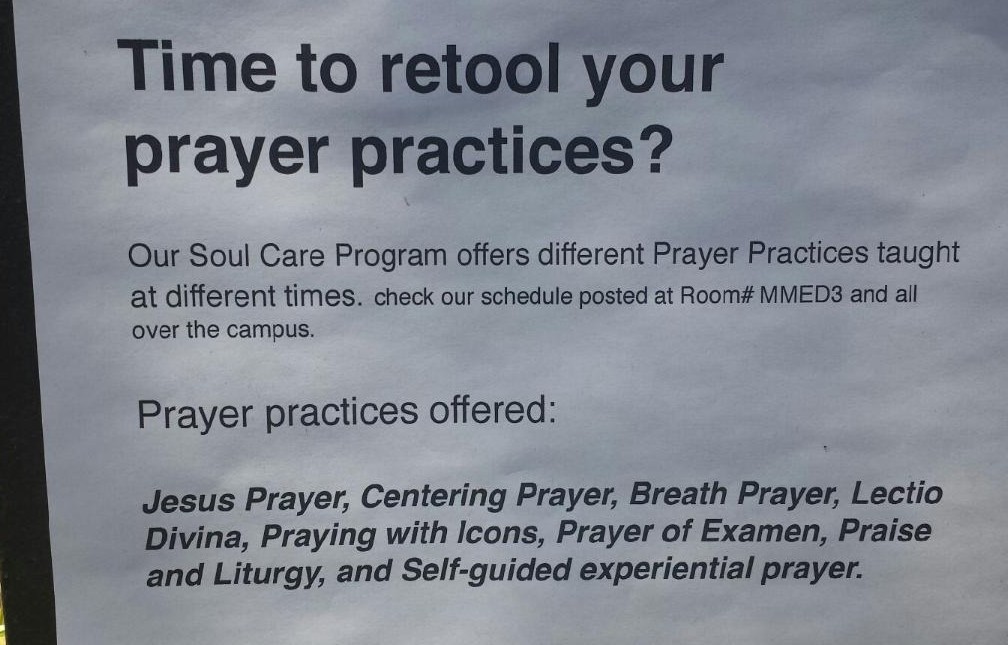
2. Listen: They spend regular time alone listening to God (you know, prayer).

3. Learn: They have learned the historic answers to the basics of the faith and the church. This is not being able to argue Calvinism vs Arminianism or defend inerrancy, but what used to be called “catechesis.”

4. Reflect: They apply the Scriptures and the catechesis they have received to the issues in their lives.

5. Gather: They regularly worship with other Christians to grow in their faith through song, Scripture, sermon and Sacrament, in a format (and this is important) designed for the training of Christians.

6. Follow: They are in active relationship with a mentor who spends time with them…who loves and challenges them.

7. Lead:  They are in active relationships with people they are mentoring. People they know and spend time with…whom they love and challenge.

8. Lean: They are surrounded by a community of others who are doing the same – people they “do life” with and lean on.

These things are both internal and external: Internally the ones who remained have built up reserves of Scripture, prayer, study, and worship. They know the “whats” and “whys” of the faith, and have a method for dealing with questions and struggles in their lives.

And at least as important, Externally, they have a leader above, a community around, and a group below that depend on them.

An obvious question formed: Is there anything on our list that is different from what “built” a young Christian in 1914? 1514? 514? 114?  

As we spoke, it dawned on us that the four had received essentially what disciples in every generation have received from the church: Internal scaffolding to support them in their faith, and webs of external relationships that weave them together. Together these tend to produce people who go through life singing in the key of Jesus.

It became obvious that the ones who are “making it” are exactly the ones we would expect…the ones who learned to love doing the things Christians have loved doing for 2000 years. Wasn’t this what was going on in Acts 2:42-47? Maybe ministry to millennials really isn’t rocket science…unless, of course, we stop doing those things the church has historically done.

My guess is that if you look at the young adults who are in your church, the chances are good that they are specifically the ones who have not just had preaching and programs, but whose lives are intertwined with others, giving them these webs of relationships to go with their faith scaffolding. What would happen to millennials if the church stopped giving students “relevant” curriculums and programs, segregating them away into youth rooms, spending piles of money on lights, fog machines, and xboxes, and simply went back to incarnating the Gospel? The Great Commission is strikingly simple: “Go therefore and make disciples of all nations, baptizing them in the name of the Father and of the Son and of the Holy Spirit, teaching them to observe all that I have commanded you.” (Matthew 28:19-20)

Let’s try that and see if, “lo” and behold, it isn’t just Jesus who is “with us till the end of the age“, but a generation of millennials as well.


By the way, the millennial was Julio Torres, our music leader. The other three are a youth director, a children’s minister, and a youth volunteer. …Which, come to think of it, validates my contention that if you want a millennial to stay in your church, give them a task

How we ruined worship: The church of me, for me, and about me.

 Not all change is good. 

Snark Meter Sorta Snarky.002

We humans are remarkably insular creatures. We tend to assume that our tiny slice of experience is the way things have always been and the way they should be. The here and now is the measure of our reality. Most high school seniors, for example, have never owned a non-smartphone. Yet before the iPhone was released in 2007, most of us survived with the internet bound to our desktop. Speaking of the internet, 97% of all telecommunicated information is moved over it. But twenty years ago, unless you had a government scientist in the family, you had never heard the word “internet.” When I grew up telephones were not only wired to the wall, you had to spin a rotary dial seven times and hope the person you were calling was home to answer. In elementary school a series of amazing inventions changed the way we lived: push buttons, the answering machine, and then, a couple of years later, the telephone company (there was only one) came out with Call Waiting. If you are under forty you cannot imagine what a hassle it was to call someone for days hoping they would answer. We take these things for granted and cannot remember life without them.

In a similar vein, we assume the way we worship is the way it always has been. And, as with smartphone technology, we often assume uncritically that we are better off now than before…

tech-and-nightlife

Technology: “Can” doesn’t necessarily mean “should.”

Today it is common to hear the “song set” referred to as “worship” in the evangelical church. The four song and a sermon liturgy is not exactly like the iPhone – 7 years old. It is more like the internet: 40 years old, widely embraced 20 years ago, and now assumed. But is it biblical? Is this a formula found universally around the world? How does it play in say, Zimbabwe or Belarus? How does 4 songs and a sermon, fog and lights, and coffeehouse and workout rooms in the church stack up next to the unbroken witness of the worship of 2000 years of faithful Christ-followers? And, most importantly, does this help us form God’s people for the building of God’s Kingdom now and prepare us for eternity with our creator and redeemer?

The word worship comes from the Anglo Saxon “worth-ship” – the act of paying homage to God because God is worthy of being paid homage to. In scripture we see the people of God bowing before God in gratitude. In scripture worship is communal, God centered, and based in God’s glory (Ex. 12:27, 2 Chron. 29:29-31, Neh. 8:5-7, Ps. 29:1-3, Matt. 2:11, Matt. 28:17, Acts 2:42, Rev. 22:3).

Yet, far too often, what we call “worship” today is characterized by…

1. Individualism: Me and my experience

2. Narcissism: Me and my desires

3. Power: Me and my potential

And, 4. Entertainment: Me as spectator vs participant (1 Cor 14:26)

So what does Sunday morning look like at your church? Is it geared to you or to God? Look up the lyrics of the song set on your smartphone this Sunday. How often does the pronoun “I” appear versus “we”? Even more telling, how many songs could be sung unchanged if “she” was substituted for “he” and it became a love song to a girl rather than God? St. Augustine said, “He who sings prays twice.” And since, as the early Anglicans pointed out, our “praying shapes believing,” ask yourself a critical question, what exactly are we being shaped into in the church today through our sung and said prayers?

We sing songs that are, in their lyrical content, silly love songs to Jesus. Songs that not only could have been written by a secular band about a girl and the pronouns changed but, I’m told from a friend in the worship “industry,” sometimes actually were. How is it then, that…

…after teaching our young to think of Jesus in the same terms as a teen crush, we wonder why our young people’s faith has all the sustaining power of one.

We evaluate our worship by our warm feelings…feelings carefully created by melody line and key change. Bob Kauflin in his helpful book, “Worship Matters” talks about the worship leader who “spontaneously” fell to his knees in a song. Then Bob realized that the musician had preset a second microphone at knee level.

Health and wealth preachers promise us our “blessing” …if we give to their ministry, of course. I once watched a pastor justify his enormous new house to his congregation by lining up his staff on the stage behind him and telling his congregation, “Don’t hate me because I got mine. God gets me out of the way in order to bless ____” (the next one in the line). “God is going to bless ___ to get him out of the line so that he can keep blessing his way down the line…to you!” It is the God of the pyramid scheme. And we wonder why our young adults, with their BS meters attuned, tune out?

God is no longer the Lord of Creation redeeming and calling humans to join in His great mission to save a lost and dying world. He is a genie in a bottle to be rubbed in order to get more of whatever I want at that moment.

We have reversed the subject and object of our worship. The church has packaged us ourselves and is feeding it back to us. As a result, for most of the church, Sunday worship is: Of me. For me. About me.

If you want to see something sad, watch what happens when a technology is bypassed…like the film camera replaced by digital, or Western Union telegraph replaced by the ATM, or the American gas guzzler replaced by dependable Japanese imports. Sometimes the technology adapts – America now makes some really good cars. Sometimes it does not. You probably haven’t sent a telegram or dropped your film off at the Fotomat recently. What will happen in the American church? Will we continue to view the church as cruise ship?

2014051795124013

A sign at the Urban Youth Worker’s Institute conference this Spring. What does this tell us about what the church will look like in twenty years?

I do see a sign of hope. It is found in a new generation of church musicians – ones who want to know God deeply and to help others on that journey…to worship in Spirit and truth…who know the difference between a psalm, a hymn, and a spiritual song.  There is an emerging group of musicians who know that God-centered worship needs all three, and that worship is larger than just “singing.” It is a generation that understand the historic order of worship has the power to shape lives, and that the words we use in worship matter. They are not afraid of the vetted, historic words of the church. Make no mistake, they want passion…but they are not so naive as to think that emotion sustains. They long for more Scripture in sermons and more pastoring in their own lives from their pastors. They know that art gives power to the message, and that the liturgy gives a life-shaping container to both…but also that liturgy without artfulness and a clear Gospel message is like a lunch box without a meal inside.

Will this new generation of worship leaders refuse to play the good feelings game? If they do, will senior pastors adapt? Will we listen and add these young Turks critiques to what young adults are telling us with their attendance? Will we hold all of this up to the light of scripture and the great tradition? Or will we stay stuck in what we “know” from the outmoded models of the last 40 years-models that only work for a single aging and shrinking generation? If we do not, I fear evangelicalism will go the way of the Fotomat and the rotary phone.

Feedback Request: church plant wants to know how others see them

Snark MeterrealMID.003A few folks in our fellowship have asked how the world sees what we are doing. They asked if I could put some of St. Jude’s web info up on thegospelside.com for feedback. Here it is. Critique welcome.

St. Jude’s Church: Being changed. Inviting others. 

Our aim is to be changed by Jesus Christ and invite others to be changed with us.

Our expression of the Body of Christ does this by being…

::Hospitable – Joy, welcome and hospitality are our spiritual DNA. God has welcomed us, so we welcome you.

::Liturgical – The rhythms of the Christian Year, ancient liturgies, and daily prayer connect us to God and one       another, helping us to grow as a community of Jesus followers.

::Multiethnic – Asking God to build true unity as we grow together in Christ.

::Missional – Looking outward toward the world to share the Good News of Jesus in word and action.

Why St. Jude’s?  Visit us if you desire to…

::be welcomed and valued in a caring community

::be challenged by biblical teaching from a variety of voices

::draw near to God through the ancient words & actions of the first Christians contextualized with relevant music

::experience a multi-ethnic, outward-looking expression of the body of Christ

::be formed by daily immersion in Scripture

::serve in a faith community that is not just in Phoenix but for Phoenix

::be developed as a kingdom leader


About our worship 

Worship at St. Jude’s is liturgical and joyful, a mix of the current and ancient. Each week there is uplifting music, a biblical message, and the celebration of Holy Communion. All are invited!

Our liturgy is projected to make it easy to follow. Visitors can participate as much or as little as they are comfortable with. Our slides are usually in English and Spanish.

Music: Given our multiethnic context, don’t be surprised if there are a variety of musical styles: Gospel, Spanish, spoken word and chant might accompany our hymns and praise songs.

Communion: All baptized Christians are welcome at Communion. Simply come forward holding out your hands to receive the bread. Anyone not desiring Communion is invited to come forward with their arms crossed on their chest to receive a blessing. People are available to pray with you on the sides of the sanctuary during and after Communion.

Children’s Program for ages 3 through sixth grade are offered during the first part of the service.  The children are dismissed at the readings and return to the worship service during the passing of the peace to share Holy Communion with their families. Your children will study an age-appropriate version of what you are studying in the sermon to facilitate talking about the Christian faith with your children at home.


We Believe

::St. Jude’s is shaped by and passes along the historic Christian faith. We are passionate about the Father’s radical love for the world; we embrace Jesus Christ and the fullness of new and eternal life offered through His death and resurrection; and we respond to the person and ministry of the Holy Spirit.

::We are anchored in the Bible as the ultimate standard for life and faith. The Great Commandment (Love God, love others) and Great Commission (Share God’s love) orient us toward the world. The historic statements of the Church (the Nicene and Apostle’s Creeds) guard our belief, and our worship is shaped by the Book of Common Prayer.