Spiritual but not religious: Code for “trendy yet not helpful”

religion-is-nonsense
Snark MeterHIGH.001

I recently walked the final leg of the El Camino de Santiago in Spain.[1] Before leaving I was in a coffee house having a conversation about the trip. A guy behind me asked, “Why Spain?” My response, “It’s a spiritual thing.” Today a lot of people, particularly millennials, care about “spirituality.” 250,000 people walked The Camino in 2015. More will this year. My coffeehouse acquaintance, reflecting the cultural trendiness of “spirituality” said predictably, “I’m curious about that, after all, I’m spiritual but not religious.” To be “spiritual but not religious” is all the rage. Everyone wants “spiritual,” but many desperately reject “religious.” The question is “What do people mean by, “not religious“?

My friend Michael, a really smart priest in Dallas jokes, “‘Spiritual but not religious’ is code for ‘too lazy to get out of bed on Sunday.’” But I don’t think that’s it exactly. After all, millennials seem to be fine with ritual: We watched 2000 people a day crowd the pilgrim masses at the Cathedral of Santiago de Compostela. So while my coffee house acquaintance and many others seek “a personal experience of the divine,” and are also willing to check out a religious service, they are most definitely not running out and joining a church. So, if “religious” doesn’t mean, “I don’t like ritual” or “I’m too lazy to get up on Sunday,” what does it mean?

What is “not religious”?

In the very least, “not religious” means “I don’t see value in joining a faith community.” Perhaps this is because the churches they know are engaged in social causes they don’t like. Or because it is too narrow…or too broad (“everyone is too similar,” or “no-one is like me”). The cynical might say millennials are like Goldilocks – impossible to please. My snarky reply is that the body of Christ has done church by focus group and now doesn’t like it when the masses return the favor.

The second thing “not religious” seems to mean is “I want to do my spiritual life on my own terms.” It is to this group I appeal: Doing your spiritual life on your own is ultimately empty.

Look for example in Luke chapter 7. The first ten verses give us the story of a Roman centurion whose favorite servant is dying. Hearing that Jesus is on his way to town, he sends the town’s Jewish religious leaders with whom he is on good terms to request that Jesus heal his servant. Jesus turns and heads toward his home. The centurion, realizing that a rabbi visiting the home of a gentile becomes ceremonially unclean, sends a second set of friends to tell Jesus, “Lord, do not trouble yourself. I am not worthy” for you to be in my house, “therefore I did not presume to come to you.” He finally says, “You don’t even need to come. Just send the word to heal, and I trust that it will be done. After all, I am under authority too.” Jesus sends the word and the servant is healed. Then it says, “Jesus marveled at his faith.” He then turns to the crowd and, in one of the very few instances of Jesus interacting with a non-Jew, holds the gentile military occupier up as the example of “spiritual.”

What makes the Centurion Jesus’ model for “spiritual”?

First, notice that the man calls Jesus “Lord” (master). Every single one of the the bible’s 66 books uses the word “lord.” It appears nearly 8000 times in the Bible. (For comparison the word “love” is used about 800 times.) As a title for Jesus, “lord” emphasizes his authority, his rule over the whole world. Unlike most religious leaders, the centurion calls Jesus, “Lord.” Let that punch land for a moment: the leader of the most powerful military the world had ever seen calls Jesus, “the one with authority.” Whereas the religious leaders treated Jesus as a colleague, the truly spiritual defer to Jesus as Lord.

Jesus calls that deference “faith.” Faith in the bible is the opposite of sin. Soren Kierkegaard, father of existential philosophy, in a little book called The Sickness Unto Death said, “Sin is: in despair not wanting to be oneself before God….Faith is: the self, in being itself and wanting to be itself, grounded transparently in God.” Sin, regardless of what you may have learned in Sunday School, is not “doing bad things.” Sin is more subtle and much more dangerous: It is seeking our identity apart from God. While its’ antithesis, faith, is finding our identity in God. Faith, finding our identity in the God revealed in scripture and lived out in community, is why being truly “spiritual” always involves being “religious” as well.

Why do we need a defined faith and a defined faith community?

 Simply because they bring us into our created purpose: Finding our identity in Christ as we humbly, confidently surrender to the one rightly called, “Lord.” And having to express that faith by surrendering to other troublesome humans in the community of faith.

 The world, my friends, has realized the vacuousness of life without God. “Spirituality” is an acknowledgement of our unavoidable religious nature. “Spirituality without religion,” though, is an attempt to be nourished through a steady diet of dessert. It is the idolatry of the almighty self. The repeated more than reflected upon millennial mantra of “I’m spiritual but not religious,” reminds me of the six junior high girls I once saw walking through the mall wearing matching red “Dare to be Different!” T-shirts. Convinced they were saying something unique and profound, they failed to see the irony.

Whose fault is this?

Whenever those outside the Christian faith fail to connect there are two dynamics at work: Humanities’ own sin nature (“There is none who seeks God, no not one.” Rom. 3:10-11), and the church’s communication and demonstration of the faith. Unfortunately, instead of showing the way of faith as joyful surrender, popular Christianity has too often attempted to make faith palatable – serving up healthy doses of what Dietrich Bonhoeffer called, “Cheap grace.” Too often the evangelical church has dropped surrender for wish-fulfillment. Conservative churches have often settled for a message of self-help: “seven steps to…(fill in the blank) – diminishing God to one who exists to meet our desires.

While the conservative church has lowered God, the progressive church, on the other hand, has tended to elevate humanity. The progressive church removes the need for redemption by purging our documents of the words of surrender: Father, king, Lord…if a symbol might be deemed “oppressive” or “problematic,” it is not to be understood in its’ redeemed context, but struck from our hymnals, prayer books, and bibles. But God is not known either by shrinking him or elevating us. God is known through faith in the triune one who joined us and became “obedient to death, even death on a cross.Therefore God has highly exalted him and bestowed on him the name that is above every name, 10 so that at the name of Jesus every knee should bow, in heaven and on earth and under the earth, 11 and every tongue confess that Jesus Christ is Lord, to the glory of God the Father.”

In the 1970’s there was a movie called “The Stepford Wives.” In it, a newcomer to an idyllic NYC suburb notices that the wives are unbelievably beautiful and docile. It turns out that the husbands have been eliminating their wives and replacing them with lifelike robots who behave according to the husbands wishes. “Spiritual but not religious” is code for “I want God on my terms.” “Spiritual but not religious” creates a Stepford God who comes on command and exists as a cosmic Jeanie in a bottle or as a dysfunctional parent who wants to be your buddy but won’t give you the discipline your heart craves. And, by the way,”spiritual but not religious” is a natural result of American Protestantism’s uncritical embrace of individualism and rationalism. It is Protestant Christianity that insisted that the world is not a magical and sacramental place and that the almighty self does not need the church to mediate God’s presence. How is “spiritual but not religious”  not the ultimate natural byproduct of the Reformation?

Overcoming the idolatry of the Almighty Self is why the historic church does the things she does when she gathers in worship: In the liturgy we remind our hearts that God is God and we are not. That God is Father and we are not. That God is King and we are not. That Jesus is Lord and we are not.

Jesus calls us to be spiritual and religious; to view our humanity perfectly fulfilled in Christ and our broken idolatrous selves perfectly redeemed by Christ. That can only truly happen in a community of other broken, annoying people.


[1] We did a very small portion. Our iPhones say we walked 150 miles in 10 days. It is fantastic!

Photo from: here
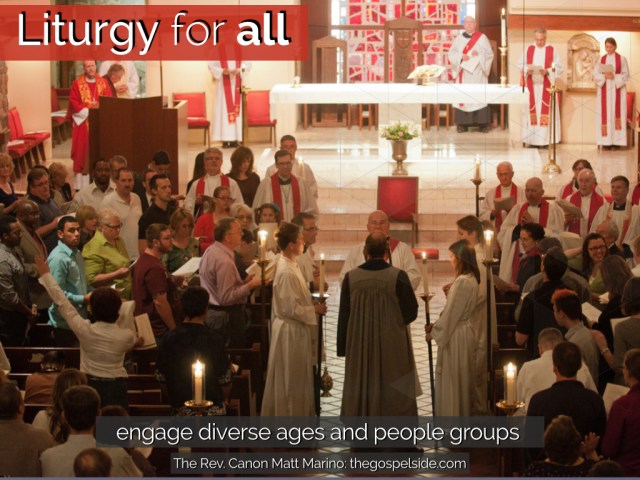
Want to engage Millennials and attract disaffected evangelicals to your church?

Handouts from the Diocese of Qu’Appelle seminar on artful and engaging liturgical experiences…

(Don’t forget to subscribe to the gospel side blog on the right.)

Liturgy for All image.001

Click on the photo to go to dropbox with seminar handouts and other files.

The Polarization of America: Whatever happened to Average Joe?


118947.gifSnark Meter Sorta Snarky.002

Thoughtful author and mega-pastor, Tim Keller, describes a seeming contradiction: How can conservative evangelicalism be experiencing slow growth when the wider culture is growing noticeably more secular? Keller’s answer: It is an indicator of an increasingly polarized America.

“…the number of the devout people in the country is increasing, as well as the number of secular people. The big change is the erosion in the middle…

I have been saying this for years. But finally somebody with a big-boy microphone said it – the middle, if not gone, is going fast.

“You don’t so much see secularization as polarization, and what is really disappearing is the middle.‘”

Here is how a disappearing middle plays out… 

-Politically-

In Arizona one would think that Republicans vying for their parties’ nomination for governor were the Hatfields and McCoys. For six months my inbox has been the sawed off shotgun of spam – Republican on Republican attack ads in every direction. And then the emails from the Democrats arrive. Both sides making sure we know the truth – “those guys” are ruining America! Accusations are fired indiscriminately, like buckshot. Want to win a political race? Run to a partisan sideline and attack your opponent. The middle disappeared.

-Religiously-

This loss of common ground is occurring in religion as well. It is seen on university campus’ as the forces of puritanical secularism rally to deny religious freedoms on even broad creedal bodies. A prominent clergy friend once said, “Twenty years ago I was decently left of center. Now I am the exposed right flank and wondering if there is still room for me.” A once self-proclaimed liberal the exposed right flank? What happened? In his church the “right” may have “quit,” but the middle disappeared.

It is true politically. It is true religiously.

It is also true socio-economically…

-In Our Neighborhoods-

When I was growing up the difference between the wealthy and middle class was a fourth bedroom and room for a second car in your carport. The poor lived in two-bedroom homes two blocks away. Rich or poor, no one was really too far from the middle.

Americans once shared a lot of common ground: Most folks went to church. Most kids went to public school  – even if the school was not good. We all bought clothes at the same mall and food at the same grocery stores. Parents stood together in the streets after work and talked about “our” kids. It was a community of the middle. We were all “Average Joe’s.”

Today in that same neighborhood the children of the one car carport/three bedroom homes are on free and reduced lunch and the parents can’t afford to water the lawns. In the two car/four bedroom homes most of the kids are in $15,000 a year private schools. They do 6 figure remodels of those homes every seven years. (Now before you light me up for being anti-wealth let me assure you that I have nothing against wealth. Neither did Jesus, by the way. Jesus was not anti-wealth. He was pro-generosity. What I am having issue with is the disappearance of Average Joe.)

Average Joe, and his wife Average Jane, were America’s sane, moderate middle. They paid taxes, worked the same job until retirement. They raised nice kids who got in trouble a few times, but who would surely grow up and follow in their average parents’ footsteps.

But along the way Joe and Jane’s kids surprised us. The kids grew up into Katie Cause and Kevin Consumption-polarized and polarizing. Perhaps it was economic pressure. Or fear of change. Or political winds. Whatever the causes, Katie and Kevin picked “sides” in the culture wars and retreated to them. We could have not have done a better job of rearranging our lives around our socio-economics and our politics if we had set out to. Last week a thoughtful clergy-blogger, Fr. Tony Clavier, worried out loud that our religion has become mere cover for our political aspirations.

-The Disappearing Middle-

But here I remain. In the increasingly empty middle.

And I am not leaving. I’m compulsive in my centricity.  I even joined a church who calls itself the “via media.” But I am looking around. And from here the “middle way” looks like the no man’s land between the trenches in the Verdun. Nothing but bullets, bodies, and folks running for cover.

There are some benefits to being in the middle, of course. Occasionally one gets to be a bridge. Which isn’t always as fun as it sounds. Bridges get walked on. And in times of war booby trapped.

And Yet…

Before my cynical soliloquy sends you to the medicine cabinet in search of antidepressants, let me assure you that I actually have hope for a renewed common ground. It comes from our young adults – those misaligned Millennials. At their best, they have the ability to hold deep convictions but without the need to coerce into their camp those who don’t share them. Among the over thirty the word “tolerance” is generally code for “progressive.” For many young adults, who have grown up in diversity, it means, gasp, the ability to have real, actual friendships with those with whom they disagree.

Average Joe and Average Jane are gone. I am fairly certain they are not coming back. But look who is beginning to move into the neighborhood! Their grandchildren, who are less interested in consumption and, although they care deeply for their causes, have a distaste for demonizing others.

And, if you are tired of living on the fringes and looking for a new friendlier place, there is room here in the middle of our block for you…

Millennials still in the church: What do they have in common?

We made it!.001


Snark MeterrealMID.003

I had an interesting conversation with a millennial today. This young man was part of a vibrant youth ministry in a large, fast growing church. He described the youth program as “fantastic!” It was led by a gifted and godly leader, a person I know and hold in high esteem. “Hundreds came through and at least 60 of us had genuinely transformative faith experiences in that group,” the young man told me. Then he dropped the bomb, “But five years later I only know of four of us that are still in church.”

Think about those numbers. Even if you only count those who had a conversion experience, that is still a staggering 94% drop out rate!

Survey after survey has told us this is going on in the White evangelical world, but these millennials went to a Spanish language church – churches that we are told are immune to this phenomenon.

My young friend was visibly discouraged so I changed the subject and we spent a few minutes thinking about what the four of them who “made it” have in common. Here is what we noticed:

The young adults who stayed…

1. Read: Regularly, even (gasp) daily.

2. Listen: They spend regular time alone listening to God (you know, prayer).

3. Learn: They have learned the historic answers to the basics of the faith and the church. This is not being able to argue Calvinism vs Arminianism or defend inerrancy, but what used to be called “catechesis.”

4. Reflect: They apply the Scriptures and the catechesis they have received to the issues in their lives.

5. Gather: They regularly worship with other Christians to grow in their faith through song, Scripture, sermon and Sacrament, in a format (and this is important) designed for the training of Christians.

6. Follow: They are in active relationship with a mentor who spends time with them…who loves and challenges them.

7. Lead:  They are in active relationships with people they are mentoring. People they know and spend time with…whom they love and challenge.

8. Lean: They are surrounded by a community of others who are doing the same – people they “do life” with and lean on.

These things are both internal and external: Internally the ones who remained have built up reserves of Scripture, prayer, study, and worship. They know the “whats” and “whys” of the faith, and have a method for dealing with questions and struggles in their lives.

And at least as important, Externally, they have a leader above, a community around, and a group below that depend on them.

An obvious question formed: Is there anything on our list that is different from what “built” a young Christian in 1914? 1514? 514? 114?  

As we spoke, it dawned on us that the four had received essentially what disciples in every generation have received from the church: Internal scaffolding to support them in their faith, and webs of external relationships that weave them together. Together these tend to produce people who go through life singing in the key of Jesus.

It became obvious that the ones who are “making it” are exactly the ones we would expect…the ones who learned to love doing the things Christians have loved doing for 2000 years. Wasn’t this what was going on in Acts 2:42-47? Maybe ministry to millennials really isn’t rocket science…unless, of course, we stop doing those things the church has historically done.

My guess is that if you look at the young adults who are in your church, the chances are good that they are specifically the ones who have not just had preaching and programs, but whose lives are intertwined with others, giving them these webs of relationships to go with their faith scaffolding. What would happen to millennials if the church stopped giving students “relevant” curriculums and programs, segregating them away into youth rooms, spending piles of money on lights, fog machines, and xboxes, and simply went back to incarnating the Gospel? The Great Commission is strikingly simple: “Go therefore and make disciples of all nations, baptizing them in the name of the Father and of the Son and of the Holy Spirit, teaching them to observe all that I have commanded you.” (Matthew 28:19-20)

Let’s try that and see if, “lo” and behold, it isn’t just Jesus who is “with us till the end of the age“, but a generation of millennials as well.


By the way, the millennial was Julio Torres, our music leader. The other three are a youth director, a children’s minister, and a youth volunteer. …Which, come to think of it, validates my contention that if you want a millennial to stay in your church, give them a task

How we ruined worship: The church of me, for me, and about me.

 Not all change is good. 

Snark Meter Sorta Snarky.002

We humans are remarkably insular creatures. We tend to assume that our tiny slice of experience is the way things have always been and the way they should be. The here and now is the measure of our reality. Most high school seniors, for example, have never owned a non-smartphone. Yet before the iPhone was released in 2007, most of us survived with the internet bound to our desktop. Speaking of the internet, 97% of all telecommunicated information is moved over it. But twenty years ago, unless you had a government scientist in the family, you had never heard the word “internet.” When I grew up telephones were not only wired to the wall, you had to spin a rotary dial seven times and hope the person you were calling was home to answer. In elementary school a series of amazing inventions changed the way we lived: push buttons, the answering machine, and then, a couple of years later, the telephone company (there was only one) came out with Call Waiting. If you are under forty you cannot imagine what a hassle it was to call someone for days hoping they would answer. We take these things for granted and cannot remember life without them.

In a similar vein, we assume the way we worship is the way it always has been. And, as with smartphone technology, we often assume uncritically that we are better off now than before…

tech-and-nightlife

Technology: “Can” doesn’t necessarily mean “should.”

Today it is common to hear the “song set” referred to as “worship” in the evangelical church. The four song and a sermon liturgy is not exactly like the iPhone – 7 years old. It is more like the internet: 40 years old, widely embraced 20 years ago, and now assumed. But is it biblical? Is this a formula found universally around the world? How does it play in say, Zimbabwe or Belarus? How does 4 songs and a sermon, fog and lights, and coffeehouse and workout rooms in the church stack up next to the unbroken witness of the worship of 2000 years of faithful Christ-followers? And, most importantly, does this help us form God’s people for the building of God’s Kingdom now and prepare us for eternity with our creator and redeemer?

The word worship comes from the Anglo Saxon “worth-ship” – the act of paying homage to God because God is worthy of being paid homage to. In scripture we see the people of God bowing before God in gratitude. In scripture worship is communal, God centered, and based in God’s glory (Ex. 12:27, 2 Chron. 29:29-31, Neh. 8:5-7, Ps. 29:1-3, Matt. 2:11, Matt. 28:17, Acts 2:42, Rev. 22:3).

Yet, far too often, what we call “worship” today is characterized by…

1. Individualism: Me and my experience

2. Narcissism: Me and my desires

3. Power: Me and my potential

And, 4. Entertainment: Me as spectator vs participant (1 Cor 14:26)

So what does Sunday morning look like at your church? Is it geared to you or to God? Look up the lyrics of the song set on your smartphone this Sunday. How often does the pronoun “I” appear versus “we”? Even more telling, how many songs could be sung unchanged if “she” was substituted for “he” and it became a love song to a girl rather than God? St. Augustine said, “He who sings prays twice.” And since, as the early Anglicans pointed out, our “praying shapes believing,” ask yourself a critical question, what exactly are we being shaped into in the church today through our sung and said prayers?

We sing songs that are, in their lyrical content, silly love songs to Jesus. Songs that not only could have been written by a secular band about a girl and the pronouns changed but, I’m told from a friend in the worship “industry,” sometimes actually were. How is it then, that…

…after teaching our young to think of Jesus in the same terms as a teen crush, we wonder why our young people’s faith has all the sustaining power of one.

We evaluate our worship by our warm feelings…feelings carefully created by melody line and key change. Bob Kauflin in his helpful book, “Worship Matters” talks about the worship leader who “spontaneously” fell to his knees in a song. Then Bob realized that the musician had preset a second microphone at knee level.

Health and wealth preachers promise us our “blessing” …if we give to their ministry, of course. I once watched a pastor justify his enormous new house to his congregation by lining up his staff on the stage behind him and telling his congregation, “Don’t hate me because I got mine. God gets me out of the way in order to bless ____” (the next one in the line). “God is going to bless ___ to get him out of the line so that he can keep blessing his way down the line…to you!” It is the God of the pyramid scheme. And we wonder why our young adults, with their BS meters attuned, tune out?

God is no longer the Lord of Creation redeeming and calling humans to join in His great mission to save a lost and dying world. He is a genie in a bottle to be rubbed in order to get more of whatever I want at that moment.

We have reversed the subject and object of our worship. The church has packaged us ourselves and is feeding it back to us. As a result, for most of the church, Sunday worship is: Of me. For me. About me.

If you want to see something sad, watch what happens when a technology is bypassed…like the film camera replaced by digital, or Western Union telegraph replaced by the ATM, or the American gas guzzler replaced by dependable Japanese imports. Sometimes the technology adapts – America now makes some really good cars. Sometimes it does not. You probably haven’t sent a telegram or dropped your film off at the Fotomat recently. What will happen in the American church? Will we continue to view the church as cruise ship?

2014051795124013

A sign at the Urban Youth Worker’s Institute conference this Spring. What does this tell us about what the church will look like in twenty years?

I do see a sign of hope. It is found in a new generation of church musicians – ones who want to know God deeply and to help others on that journey…to worship in Spirit and truth…who know the difference between a psalm, a hymn, and a spiritual song.  There is an emerging group of musicians who know that God-centered worship needs all three, and that worship is larger than just “singing.” It is a generation that understand the historic order of worship has the power to shape lives, and that the words we use in worship matter. They are not afraid of the vetted, historic words of the church. Make no mistake, they want passion…but they are not so naive as to think that emotion sustains. They long for more Scripture in sermons and more pastoring in their own lives from their pastors. They know that art gives power to the message, and that the liturgy gives a life-shaping container to both…but also that liturgy without artfulness and a clear Gospel message is like a lunch box without a meal inside.

Will this new generation of worship leaders refuse to play the good feelings game? If they do, will senior pastors adapt? Will we listen and add these young Turks critiques to what young adults are telling us with their attendance? Will we hold all of this up to the light of scripture and the great tradition? Or will we stay stuck in what we “know” from the outmoded models of the last 40 years-models that only work for a single aging and shrinking generation? If we do not, I fear evangelicalism will go the way of the Fotomat and the rotary phone.

Mean people suck. But that’s not why millennials dropped the church.

angry-man.jpg

Snark Meter Sorta Snarky.002

An open letter to Lead Pastors.

Do you hear that sucking sound? It’s the sound of young adults walking out the back door so fast that you can feel the breeze from the pulpit way down at the front of the sanctuary.

Young adults have always been a bit shaky in their church attendance during college. But then a new trend emerged: They stopped coming back. No one worried much about it at first. But as the return rate continued to plummet, the Millennial abandonment of the church became the stuff that keeps pastors up late at night. Millennials are, after all, the ones whose attractive fresh young faces make people say, “Oh, this place is doing really well!”

A few churches are still doing really well with young adults, of course. But multiple studies, such as this one from Pew Research, show that young adults now attend church at 1/2 the rate of their parents at their age. One in three young adults now characterize themselves as  “nones” – religiously unaffiliated.  If you haven’t noticed your church greying yet: fear not, you will.

What is going on with those Millennials? 

According to the narrative, the church is full of narrow, nasty, fearful, bigots. If you are smart, hip, or have a pulse, you should drop the church like a hot rock for something more helpful to your life…like spending Sunday morning playing games on your iPhone at Starbucks, or puttering in your garden, or just pulling your covers up over your head and grabbing another hour of shuteye.

David Kinnaman, in his interesting book, “You Lost Me,” provides a stark articulation of this meme. His team conducted research with more than 1200 young adults. According to the compelling stories he recounts, young adults dropped out because they found the Church to be:

Shallow, with easy platitudes, proof texting, and formulaic slogans.

-Overprotective and repressive: Sexual mores feel stifling to young adults.

Exclusive. Christian claims to exclusivity are a hard sell in a pluralistic culture.

Doubtless. The church is fearful and dare not risk allowing them to express doubts.

Antiscience.

In other words, the church is mean. 

If you talk to folks between the age of 20 and 35 about the church you have probably heard all of the above statements. However, these don’t necessarily paint a complete picture as to why Millennials left. They tell us why they SAY they left – how they have interpreted their experience. So, although Kinnaman’s book has become the “Bible” on Millennials, there is…

Another piece of the puzzle…

It appeared in last April’s edition of Atlantic Monthly: “Listening to Young Atheists.” Alex Taunton interviewed college students who self-identify as atheists and asked them to “tell the story of your journey into atheism.” What he heard was not what he expected – which always makes my ears perk up. To his surprise, young atheists did not wax eloquent about their intellectual difficulties with Christianity – the anti-science, anti-gay, theologically rigid, “easy believe-ism” stuff we all hear about (apologies to my more progressive friends). Neither did they talk about a desire to engage in sinful, frowned upon by the church, lifestyles (apologies to my more conservative friends). Here is what young atheists told Taunton…

1. They had attended church The number one source of college atheists is, wait for it, Christianity…as it was modeled to them.

2. The mission and message of their churches was vague – rather than too much catechesis, they received too little. They were not given an intellectual frame for their faith.

3. They felt their churches offered superficial answers to life’s difficult questions.

4. They expressed their respect for those ministers who took the Bible seriously.

5. Ages 14-17 were decisive  In the middle of forty years of enormous investment in youth ministry, high school is when atheist millennials embraced their unbelief!

6. The decision to embrace unbelief was often an emotional oneusually involving the loss of a trusted youth leader

Did you notice the seedbed that hatched young atheists? It was specifically a reaction AGAINST their experience of the church. Second, they didn’t become atheists in those evil, conspiratorially faith-stealing secular universities. We lost the Millennials when they were in high school – In our youth groups!

One student said, “Christianity is something that if you really believed it, it would change your life and you would want to change [the lives] of others. I haven’t seen too much of that.”

Our big fail?

“Meanness” is style. And apparently a style fail is the least of our issues. According to atheist millennials, we also have a theology fail, a program fail, and a leader fail. The atheists who grew up in our churches tell us that we didn’t:

1) Model love and authenticity during their critical adolescent years.

2) Disciple them. Not downloading information, but the time-intensive task of walking with them, life on life…teaching them Christian practices in a context of friendship.

3) Catechize: Provide historic answers to the historic questions.

4) Allow them to engage their doubts. Talking through doubts is how one gets through them.

5) Integrate them thoroughly into the life of the church. We gave them a soteriology without an ecclesiology:  A personal Jesus without a Body of Christ. We professionalized student ministry and segregated kids away in youth rooms. We let parents, the older generation, and anyone in the church staff not titled, “youth pastor” off the hook.

Students needed a web of relationships and an affiliation bond with the larger church.

But we shuttled them off into “youth services,” creating in-effect parachurch student ministries on church campuses with trendy grow-out-of-it-when-you-graduate names. And, often, by the time they get back from college, their pastor, the student pastor, is gone as well. In a “youth service” model, Millennials have never been in the sanctuary and don’t know those leading in there either. Add in the fact that the sanctuary reflects a ministry model developed for their parent’s generation and, for many, you have strike three, and the Millennials are walking off the field and hanging up their bats.

6. Give them a mission in the world. The doctrine of creation tells us that we were made on purpose for a high and holy purpose. When they were in high school did we give them something epic to do? Something unreachably heroic that they could only see and do with eyes of faith?

Will we listen to them?

Young adult atheists are telling us that we failed to give them a robust faith in the triune God…a faith they were asking us for. And this isn’t just a problem facing “liberal” or “conservative” churches.  While the Left gave them Social Justice Jesus, the Right gave them a truncated, topical Jesus who promises, “Your Best Life Now.” A Fuller seminary friend told me that in a recent survey of graduating youth group seniors the most common thing students, across denominations, wished they had been given more of in youth group wasn’t games, skits, or worship. It was “Bible Study.”

Lead pastors, you have served your mission field of busy 35-55 year olds nervous about cultural change by giving them practical content from fewer, trusted voices on video-venues. What might missionally engaging students in there changing context look like? After all, like you once said to your senior pastor when you were working with youth, “We cannot expect today’s youth ministry to use the models we designed for a previous generation.”

When you and I started in ministry, students came to the church hungry to be entertained. Today they come expecting a sense of the transcendent. Study after study tells us that Millennials long for spiritual practices, meaningful service in the church, and a mission to the world. They seek peer groups to support their faith. They desire older Christian mentors and multi-generational relationships. They come for Scriptural knowledge and, gasp, theology. They come to learn about the God who made them, redeems them, and has a purpose for the world. They come seeking God’s plan and calling on their lives to do something of true and lasting significance.

Yes, the world changed. But while that change occurred we kept giving them a simple Gospel message with fog machines, light shows, and games in which they stuffed their faces with marshmallows.

So they left. But not when we thought. Not why we thought. And not how we thought.

A way forward?

It should be obvious that what I am pointing toward is not less youth ministry but a redirecting of it toward a more robust form. A form more tied to the greater church. The solution to all of this will involve Lead Pastors – You are the source of vision, direction, permission and covering. Nothing changes without your endorsement. Will you allow your Student Ministry leaders to change your student ministry today so that tomorrow’s students don’t bail too? You were an innovator in reaching your mission field. Will you free your student ministers to innovate to a new generation? We all want Christians for life, not just for high school. Will you unravel programs when the data demonstrates that filling youth services today leads to empty sanctuaries tomorrow? 

The truth is staring us in the face. The stakes are too high to throw away another generation with sincere but ultimately unhelpful youth ministry.

A faith that will last: A call to ancient-future youth ministry

Youth-PrayerSnark MeterrealMID.003

It is values driven and data supported. It is life-changing and both church-sustained and church-sustaining.

Click the link then tell me what you think…

Building Faith That Will Last: January 5 Edition of The Living Church Magazine

How do millennials experience your church?

I asked Christopher to guest post after his comments on my “Kinnaman” post were so eerily similar to statements made by millennials in a recent Q & A hosted by one of the nations most effective ministries to millennials led by millennials, PhoenixOne.

Why Millennials are Leaving the Church: A suggestion.

By Christopher Jones

Profile Picture2

I graduated college two and a half years ago. Unlike many in my generation, I haven’t stopped attending church. I have, however, stopped being part of the church.

According to most metrics, I haven’t “left.” I still show up on Sundays. But wherever I go, I find myself almost completely ignored.

Our problem: Most American churches are structured around families. If you don’t have a family, you are put into a box. Youth ministry. College ministry. And after that? No one knows what to do with you.

In the modern American church, if you’re not married, you’re not an adult. And we millennials are part of a generation that’s getting married later and later for economic reasons.

It takes a lot longer to build a stable career today than it took our parents’ generation. My parents had me when they were 25. I’ll be 25 in four months. By that time, I will have been enrolled in higher education for nearly twice as long as my parents. I’m unmarried, have never been in a serious relationship, have hardly any money, and have moved regularly to pursue my education. Its next to impossible to work towards marriage in such a situation. My situation is hardly unique.

Inter-generational economic differences are another huge rift in the church that no one is talking about. At one church I mentioned to a middle-aged woman that I was likely spending the next year unemployed. She burst out laughing. For some reason the pressure and debt our generation faces to develop future competitiveness in the emerging job market was humorous.

From the minute we step inside the doors on Sunday, post-college millennials face a wall of negative judgments and assumptions. Those with successful careers wonder why we can’t just “work at a factory or a newspaper like I did when I was your age.” The assumption is that we are lazy and think that we are entitled. A better explanation is that those jobs simply don’t exist anymore. Married people, in both overt and covert ways send us the message that the purpose of Christian singleness is marriage (never mind that Paul said the exact opposite in 1 Corinthians 7, but I digress).

Our generation graduated into a world of part-time jobs, unpaid internships, and student loan debt. A world in which shrinking paychecks meet inflated living costs. Yet from the pulpit we still hear sermons attuned to yesterday’s economic concerns. Sermons about not working too hard and not making your career into an idol ring hollow when you’re working late hours struggling to make next month’s rent.

Whatever the cause is, it is certainly not that the church is too conservative. If liberal politics were why we left the church, then we’d be flocking to churches with liberal politics. Yet mainline Protestant churches have declined much more sharply over the past ten years than conservative ones.

No, we millennials often embrace liberal politics as a substitute to fill some of the void that the absence of religion leaves in a person’s soul. Liberal politics provides a supportive community working towards a common goal and offers a promise of an ultimate end state of justice and equality. It’s a substitute for religion, not a cause for rejecting it.

A person can personally believe in salvation through Jesus Christ without going to church. A person can feed the poor and care for the sick without belonging to a congregation. What they cannot do alone is become part of a fellowship of believers. And if our generation doesn’t find that fellowship at church, we’ll stop going.

In short, we millennials just want to be treated like adults. We don’t want to be catered to. We don’t want to be entertained. We certainly don’t want to be eyed suspiciously as some sort of dangerous element by people more interested in passing judgment than trying to understand what life is really like in your twenties in modern America. We want to be included. It’s not that hard. We’re human beings like the rest of you, and we’d like to be treated as such.

*Christopher Jones is an aspiring historian of the ancient Near East currently working towards completing his Master’s Degree in Biblical Archaeology at Wheaton College. He blogs about the ancient Near East at http://riversfromeden.wordpress.com/.

David Kinnaman is wrong: How the church really lost the millennials & what we can do to keep the next generation.

You-Lost-Me1-662x1024Snark MeterrealMID.003

(A letter to youth pastors, senior pastors, parents, and church boards)

David Kinnaman is really smart. He writes good books too. However, I question the title and premise of his book, You Lost Me. Did the church “lose” our young adults, as Dr. Kinnaman asserts, by being fearful, anti-science, controlling and hostile? I would like to suggest an alternate theory:  The church didn’t “lose” the millennials at all. Youth were simply never actually in church to begin with.

At this point it is axiomatic that millennials are in an unprecedented exodus from the church.* Books are being published, “You Lost Me” conferences held, and churches are going to great lengths to address the issue of young adults distancing themselves from evangelicalism.[1] These efforts usually result in passionate appeals for market-driven changes to the practice and theology of the church. But rather than beginning with what young adults say, let’s first examine the context that led them there.

How Did We Get Here?

Young adults in Barna’s qualitative studies have compelling stories to tell about the church being fearful, controlling, anti-science, and mean to the LGBT community. Surely those stories need to be listened to. But when we stop and ask ourselves, “What was the last ministry those millennials were a part of?” For most, the answer is the youth ministry. And when we consider that the 15-year-old youth group member of a decade ago is the 25 year-old non-attender of today, a question starts to form:  Did something happen in the youth room that might have caused this?  Follow my line of thought through the dots of what we did in our youth rooms and see if the millennial abandonment doesn’t seem a natural, if unintended consequence…

It Seemed Like Such A Good Idea At The Time

tumblr_lvfmugA0uF1qi39uwo1_500

In the 80’s and 90’s, while mainline churches disinvested in young people, evangelicals began imitating successful parachurch ministries to “attract” students with games and activities. But what the parachurch did in neighborhood living rooms with careful evangelistic purpose was a bit less purposeful (even if “Purpose Driven”) in most church youth rooms. Regardless, evangelism was in. Rigorous discipleship out.

As we moved into the 2000’s, bands, fog machines and light shows became the youth room rage. Tim Elmore dubbed today’s young adults, “the overindulged generation.”[2] The church gladly played along, “wowing” students with noise, technology and millions of pizzas. Students were segregated away from the grownups on Sunday morning in a new idea: the “youth service.” Early on this model of removing youth from the sanctuary was dubbed, “The One-eared Mickey Mouse.[3] The youth service essentially turned the “student ministry” into a parachurch ministry on the church property – perhaps Christ-centered in its message and developmentally appropriate, but segregating youth from the larger faith community in order to do programs “attractive” to students.

Segregation: The Drug Of Choice

images-1

The entire church embraced this paradigm shift. It was the drug everyone wanted: Parents wanted their kids to like church. Pastors wanted undistracted parents listening to their sermons. Worship leaders wanted to avoid the complexity of pleasing multiple generations. Youth Pastors liked the numbers and accolades. Kids liked the band and shorter message. On top of that, donors were excited to write large checks to build expensive facilities with the promise of reaching lost and hurting kids. And if our metrics are seats filled and positive satisfaction surveys, it looked as if it was working. But what are the long-term effects of segregated, program-driven student ministry?

Many students graduate from high school…without having ever seen the inside of the sanctuary or meeting the senior pastor. In effect, without having connected with the larger Church.

In the new model, students develop the crucial affiliation bond not with the church or its leadership, but to the youth pastor and youth program. Because youth pastors have high turnover, new youth pastors have to continually “win” over the last youth pastor’s group. Students get used to being “won” and begin to expect adults to cater to their desires and preferences. The One-Eared Mickey Mouse, led by people with great entrepreneurial gifts but little theological training, became what the market demanded: the great show kids desire and the teaching parents wanted: just enough “God” to motivate kids to avoid drugs and sex.[4] Because youth pastors are generally people of spiritual passion and commitment, many students graduate from high school having had a real experience of the holy but without having ever seen the inside of the sanctuary or meeting the senior pastor. In effect, without having ever connected with the larger Church. In this model, older adults no longer have a role in the formation of the young; parents, who have outsourced their children’s spiritual formation, often oppose a rigorous transformational faith, and the young have no interest in taking their place in the councils of the church…so students graduate from the youth group into the next thing that will cater to their preferencesthe local Starbucks.

An Assembly Line To Build the Self-absorbed

1926-ford-model-t-assembly-line

In fairness, this didn’t start in the youth room. The church shuttles our young down an assembly line from the nursery to the children’s rooms, then to the junior high room, then the high school “youth service.” Then we graduate them to college groups. No one seems to notice that nowhere in that system did we bother to connect our young people to the church at all. 

We have treated students as a market to be pandered to in order to fill youth rooms. And, now that it is time for young adults to take their place in extending the Kingdom of God through the life of the Church, they are, as one would expect, wondering what we are going to do next to woo them. Should we be surprised that they are failing to become mature Christians, participating and leading in the body of Christ? Rather than “equip the saints for the work of ministry,” we have infantilized them. [5]

How did we not see this coming? How did we fail to connect the dots? Instead of connecting them to God and his church, we, with Pavlovian discipline, conditioned our young to jump from church to church as consumers of glitzy religio-entertainment. We systematically taught those with the most to give how to take and take and take.

Are there other factors? Of course there are. For one, parents have largely stopped passing on the faith in the home. For another, the evangelical church has lowered its ecclesiology to something akin to “we exist to be entertain you.” However, right between those two polarities stands a ministry that could bridge the gap: the youth ministry. How? To start with we can drop the misshapen narrative – the narrative that we “lost them” by giving the young too rigorous a theology and by being hostile and negative. Although problematic, fear, negativity, and rigor simply do not tell the whole story at thousands of churches. And trying to un-lose a generation by again pandering to whatever the latest market research says millennials want to hear is not only to fail to be faithful stewards of both the Gospel and them, it is to repeat yesterday’s mistakes.

What now?

The exodus of young adults from the church is a reality caused, not primarily by cultural change or negative message, but by ill-advised leadership decisions by youth pastors, senior pastors, parents and church boards. We did this to ourselves by investing in segregationist youth ministries that proved ultimately unhelpful. What we can do in response? We can repent of where we failed them in their youth rather than by again pandering to where we have left them as young adults.

Then, Youth pastors, pastors, parents and board members, lets put students into the sanctuary on Sunday morning. Reclaim rigorous discipleship, multi-generational relationships, and youth serving as full members of the church. Challenge and equip parents to spiritually lead in their homes. Re-invision youth ministry as youth who DO ministry, pursuing and extending the faith connected to the entirety of the community of faith, the church.

Together lets make sure the next generation of young people does not leave the church when they leave our youth rooms.

*A followup post by a Millennial: How do millennials experience your church?

Continue reading

What’s so uncool about cool churches?

Unintended Consequences: How the “relevant” church and segregating youth is killing Christianity.

I recently spent six-months doing a rotation as a hospital chaplain. One day I received a page (Yes, hospitals actually still use pagers). Chaplains are generally called to the rooms of people who look ill: People gray with kidney disease, or yellow with liver failure, discouraged amputees, nervous cancer patients. In this room, however, was a strikingly attractive 23 year-old young lady sitting up cheerfully in the hospital bed, holding her infant daughter and chatting with family and friends.

Confused, I stepped outside and asked her nurse, “Why did I get paged to her room?”

“Oh, she looks fabulous. She also feels great and is asking to go home,” the nurse said.

“…And you are calling me because?” I asked in confusion.

The nurse looked me directly in the eye and said: “Because we will be disconnecting her from life support in three days and you will be doing her funeral in four.”

The young lady had taken too much Tylenol. She looked and acted fine. She even felt fine, but she was in full-blown liver failure. She was dying and couldn’t bring herself to accept the diagnosis.

Today I have the sense that we are at the same place in the church. The church may look healthy on the outside, but it has swallowed the fatal pills. The evidence is stacking up: the church is dying and, for the most part, we are refusing the diagnosis.

What evidence? Take a gander at these two shocking items:

1. 20-30 year olds attend church at 1/2 the rate of their parents and ¼ the rate of their grandparents. Think about the implication for those of us in youth ministry: Thousands of us have invested our lives in reproducing faith in the next generation and the group we were tasked with reaching left the church when they left us.

2. 61% of churched high school students graduate and never go back! (Time Magazine, 2009) Even worse: 78%  to 88% of those in youth programs today will leave church, most to never return. (Lifeway, 2010) Please read those last two statistics again. Ask yourself why attending a church with nothing seems to be more effective at retaining youth than our youth programs.

We look at our youth group now and we feel good. But the youth group of today is the church of tomorrow, and study after study after study suggests that what we are building for the future is…

…empty churches.

We build big groups and count “decisions for Christ,” but the Great Commission is not to get kids to make decisions for Jesus but to make disciples for Him. We all want to make Christians for life, not just for high school. We have invested heavily in youth ministry with our lives specifically in order engage youth in the church. Why do we have such a low return on our investment?

What are we doing in our Youth Ministries that might be making people less likely to attend church as an adult?

What is the “pill” we have overdosed on? I believe it is “preference.” We have embraced the idea of market-driven youth ministry. Unfortunately, giving people what they “prefer” is a road, that once you go down it, has no end. Tim Elmore in his 2010 book entitled Generation iY calls this “the overindulged Generation.” They ask for more and more, and we give it to them. And more and more the power of God is substituted for market-driven experience. In an effort to give people something “attractive” and “relevant” we embraced novel new methods in youth ministry, that 20 years later are having a powerful shaping effect on the entire church. Here are the marks of being market-driven; Which are hallmarks of your ministry?

  1. Segregation. We bought into the idea that youth should be segregated from the family and the rest of the church. It started with youth rooms, and then we moved to “youth services.” We ghettoized our children! (After all, we are cooler than the older people in “big church”. And parents? Who wants their parents in their youth group?) Be honest: Have you ever thought you know more than your your student’s parents? Have you ever thought your youth group was cooler than “big church”?
  2. Big = effective. Big is (by definition) program driven: Less personal, lower commitment; a cultural and social thing as much as a spiritual thing. Are those the values that we actually hold?
  3. More programs attended = stronger disciples. The inventers of this idea, Willow Creek, in suburban Chicago, publically repudiated this several years ago. They discovered that there was no correlation between the number of meetings attended and people’s spiritual maturity. They learned the lesson. Will we?
  4. Christian replacementism. We developed a Christian version of everything the world offers: Christian bands, novels, schools, soccer leagues, t-shirts. We created the perfect Christian bubble.
  5. Cultural “relevance” over transformation.We imitated our culture’s most successful gathering places in an effort to be “relevant.” Reflect on the Sunday “experience” at most Big-box churches:
    1. Concert hall (worship)
    2. Comedy club (sermon)
    3. Coffee house (foyer)

And what about Transformation? Is that not missing from these models? Where is a sense of the holy?

6. Professionalization. If we do know an unbeliever, we don’t need to share Christ with them, we have pastors to do that. We invite them to something… to an “inviter” event… we invite them to our “Christian” subculture.

7. “McDonald’s-ization” vs. Contextualization:  It is no longer our own vision and passion. We purchase it as a package from today’s biggest going mega-church. It is almost like a “franchise fee” from Saddleback or The Resurgence.

8. Attractional over missional. When our greatest value is butts in pews we embrace attractional models. Rather than embrace Paul’s Ephesians 4 model in which ministry gifts are given by God to “equip the saints” we have developed a top-down hierarchy aimed at filling buildings. This leaves us with Sunday “church” an experience for the unchurched, with God-centered worship of the Almighty relegated to the periphery and leading of the body of Christ to greater spiritual power and sanctification to untrained small group leaders.

Does not all of this work together as a package to leave us with churches full of empty people?

Here is an example: Your church. Does it look like this?

If you look closely, you will see the photo on the right is of a nightclub, rather than a church. Can you see what I mean about “relevance” and the clean Christian version of what the world offers? Your youth room is a pretty good indicator of what your church will look like 15 years from now. Because of the principle “What you win them with, you win them to,” your students today will expect their adult church to look like your youth room.

In summary, “Market Driven” youth ministry gave students a youth group that looks like them, does activities they prefer, sings songs they like, and preaches on subjects they are interested in. It is a ministry of preference. And, with their feet, young adults are saying…

…“Bye-bye.”

What might we do instead? The opposite of giving people what they want is to give them what they need. The beauty is that Christianity already knows how to do this.

Once upon a time our faith thrived in a non-Christian empire. It took less than 300 years for 11 scared dudes to take over the most powerful empire the world had ever seen. How did they do it? Where we have opted for a relevant, homogenously grouped, segregated, attractional professionalized model; the early church did it with a  multi-ethnic, multi-social class, seeker INsensitive church. Worship was filled with sacrament and symbol. It engaged the believing community in the Christian narrative. This worship was so God-directed and insider-shaping that in the early church non-Christians were asked to leave the building before communion! With what effect? From that fellowship of the transformed, the church went out to the highways and byways loving and serving the least, last and lost. In that body of Christ, Christians shared their faith with Romans 1:16 boldness, served the poor with abandon, fed widows and took orphans into their homes. The world noticed. We went to them in love rather than invited them to our event.

The beauty of where we are today is that, unlike the girl in the hospital bed, our fatal pill could still be rejected. It is not too late. We can leave the culture-centered models we have been following for more Christ-centered ones. More ancient ones. More rooted ones. And the most beautiful thing is that students actually enjoy them.

So many have commented on this post in the last month that I did a follow-up: O Yeah! And other things I wish I would have said on “Cool Church.”