Happy Anniversary!

1330

Snark MeterMID.002A huge thank you to everyone who has read The Gospel Side blog this year. A year ago I started blogging. I tried blogging once before. No one read it. Not even my family.

When I started my hope was 10 hits a day. My big hairy audacious goal was 100. Imagine my surprise when busy people like you came and read at close to a thousand a day. Thank you so much for allowing me to think out loud with you.

I do have some fun plans in the works. If you have any good ideas to add, bring ’em on!


I’ve been found out! Retraction issued on “evangelical popes” post

apple_lSnark MeterHIGH.001My blog post of three days ago “When did evangelicals get popes” (http://wp.me/p2Gq9e-kb) has generated more hits in less time than any post I have put up before now. Apparently, however, I don’t exactly have my facts straight…

Someone in North Point’s media team is demanding a retraction for three things: 1) They do not have a holographic Andy. 2) They do not have security for holographic Andy and 3) They actually do develop lots of preachers, as Andy isn’t the only one preaching.

I do want to be fair, so let me retract each of these inaccuracies with the care I was accused of not giving:

1)    No hologram: I was told by a seminary professor who sat in the front row at the North Point main campus one Sunday that the video at North Point has Andy in “a holograph so lifelike that they have security to keep people from going on stage to play with it…it took a million dollar investment from a former CNN employee.” This was also described as “holographic” on multiple media outlets (Slate, CNN, MSN). Apparently Andy is actually broadcast on a super high definition giant screen in 2D. According to North Point’s media corporation website, “It …portrays the communicator in life like proportionliterally walking back and forth about 6′ tall.” This was mistaken by my acquaintance, CNN, Slate and MSN as “holographic 3D,” …but is in no way like what they did with Tupac at Coachella, which has been described as “lifelike” and “literally walking back and forth.” Henceforth I shall refer to this technology as “lifelike, super-high def Andy.” It is interesting that the offended staff person made no mention of my million-dollar figure.

2)   No security. The person demanding the retraction did confirm the North Point does have “ushers” that protect the front of the stage and prevent people from going on stage with the non-holographic but utterly lifelike, super-high def Andy. But NO security.

3)   North Point actually does develop preaching leaders. Since real Andy is not the only one on the preaching rota, they are not failing in my actual argument – that video-venue is idolatrously man-centric, GMO crop-like dangerous in its lack of diversity, and fails to develop other preaching voices, making it a long-range train wreck for the Church.  According to North Point’s Wikipedia article there are 41 churches and “strategic partners” in the US and abroad. From a survey of 9 of those “partners” websites, part of being a partner is video-Andy. So they have 41 facilities with “site pastors” all watching Andy (or the other select few on the rota) preach. However, I am assured, this IS developing preaching voices just as if each of those 41 churches had 41 preachers preaching their own messages each week.  Yeah, that math makes sense to me.

North Point’s strength has been its ability to poke fun at itself (“Sunday Morning” parody & the ipod band). I was thinking that NP would be the video-venue church with the ability to be self-reflective. Perhaps my critique hit a bit too close to home for their media people. At least North Point is reading stuff other than their own. I have suspicions the others I named don’t read anything not written by themselves. But perhaps I am wrong. Perhaps we aren’t just watching Big Brother? Perhaps Big Brother is watching us too?

Whether or not andy is in 3D or 2, I still maintain that the video-venue church is like the really pretty girl with tons of issues. You know you shouldn’t date her, you know it won’t end well, but you can’t help yourself, she is just so darn attractive you can’t say no.

What’s a priest for?

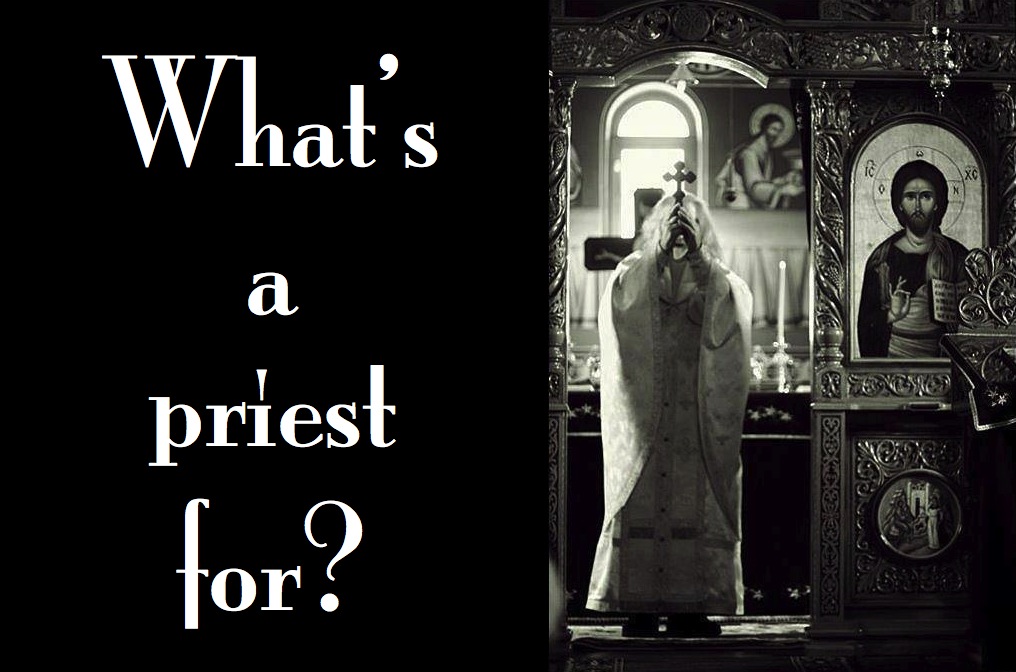
Priest.001In the St. Jude’s Church series on the 39 Articles we come this Sunday to Article 23 – Clergy don’t self-anoint. It is an opportunity to talk about the historic vision of the Church as the gathering of the Body of Christ, and the role of clergy to call Christ’s Bride to worship and holiness of life. And, having worshipped through Word and Sacrament, for the Church to be propelled back into the world for the extension of God’s Kingdom.  Priests pray, teach, offer the Sacraments, preach, declare God’s pardon, bless and console. In short, a priest is to point the people to the Priest: the Great High Priest, Jesus Christ (Hebrews 4:14-5:4, 10:11-12).

I have the privilege of preaching the next three Sundays. We will move on from the role of clergy to consider the corporate spiritual practices of Baptism and Holy Communion.

Snark Meter.005

When did evangelicals get popes?

Snark MeterHIGH.001

The big trend in American evangelicalism: the multi-site video-venue church. It promises to leverage the teaching acumen (not to mention star power) of big name preachers to extend the Kingdom of God.

Has anyone stopped and asked, “What in God’s name are we doing?”

Think about it – we started the Reformation over one man having too much authority in the Church, yet today hundreds of thousands meet in “multi-site” video venues watching preachers like Mark Driscoll or Craig Groeschel or Perry Noble in a box. The new gold standard of this movement is 3D holographic Andy Stanley, complete with security to keep people from going up on stage to play with it…or him.

screen-shot-2012-07-28-at-2-48-47-pm

Think about it while detaching yourself from your favorite multi-site, mega big-box preacher: Isn’t hitching ourselves so fully to one man’s teaching just a little odd? Doesn’t it smack, just a tad, of man-following? Even idolatry?

And, if “it isn’t about me,” as one multi-site preacher is fond of saying, then why not take your nine sites and train up eight new young preachers? Wouldn’t that be a healthier model? What happens to the church if the guy it “isn’t about” gets hit by a bus?

I am not saying that these preachers are not really, really great communicators. I am not saying that they wouldn’t be great guys to get a beer with and talk football or soteriology. But what does it say about us that we spend a million dollars to make Andy Stanley into the Sunday morning version of Tupac at Coachella?

How is this not worse than what we condemn our Roman Catholic brothers for? I don’t know a single Catholic that would be ok with the Pope being piped in for the sermon every Sunday. They laugh at the idea. I know. I asked.

The evangelical world is embracing 7-10 brand-name preachers across the country – the ecclesiological version of GMO crops. Let’s just call it like it is: these men are evangelicalism’s de facto popes.

Some will say, “Yeah but Mark Driscoll and Perry Noble don’t speak ex cathedra.” Really? Their devotees quote them as if they do. In a nod to mega-pastor Steve Furtick’s statement, that they are “making Jesus famous,” doesn’t it seem as if Jesus isn’t the only one they are “making famous”? Not to mention fabulously wealthy.

To be clear, I am not attacking large churches, or video screens. I am not even attacking the bloated clergy salaries paid by churches whose boards are made up of other mega-church pastors – though someone should. I AM attacking a model of leadership: The multi-site, big personality church that trades the Ephesians 4 model of equipping saints and giving leadership away for a model that makes “the man” a black hole of money and Kingdom energy.

Evangelicalism’s strength has always been its willingness to engage the culture to make an impact on lives. The backside of that coin can be an amazing short-sightedness. Does no one wonder what the unintended consequences of our new evangelical popes might be?

So before we cast stones at our Catholic friends for man-following, perhaps we should remove the video screen from our own eye.

Todd, adoption, and a briar patch: Glimpses of God at work

Broken_glass

Facebook gets a lot of grief, but I have a confession, I like Facebook.

It allows me to peek into people’s joys and struggles, rejoice and grieve with friends, and spurs me to pray more. I keep in touch with people I would never see.

One of those I would never see is Todd. We went to elementary and high school together. We were never really close. Todd and I didn’t run in the same crowd. I always appreciated Todd. He was kind to a girl with special needs once in 6th grade. Kids were not nice to people who were different back then. But Todd was. No one can remember the girl’s name even though she went to our school for two years. We just called her “Gomper,” the name of a local program for kids with disabilities. She had a neck brace and her head seemed too small. Social Darwinism was the rule of the day and we all wanted to be part of the crowd. Make no mistake, the crowd” was the one above you, not the one below. So no one talked to Gomper. Some talked at her, but only if they were getting social mileage at her expense. Not Todd. One day Todd stopped a spring loaded door from smashing Gomper. Some kids were waiting to see it happen. They were upset with Todd.

Thirty years later Todd hit me up on FB. I was having a bit of a bad week when his friend request came. I asked him why he had looked me up after all these years. His answer stunned me: “You were the only cool kid who was nice to me.” First of all, I wasn’t actually a cool kid. I was more associated with cool kids. Second, I was not aware that I had been nice to him at all – my lack of social awareness is not a new thing.

I closed my laptop and reflected on my life – my history and the events that have shaped me. It dawned on me: Although I have inadvertently been a jerk to a few on my journey, I  go out of my way to be kind to people. Looking back this seemed odd since I really didn’t have much spare social capital. As I sat wondering why I had spent the better part of a life giving status away, it dawned on me: I  know what rejection feels like. And I don’t want others to feel it.

I realized that there is something Gospel happening in me that I did not expect: God is redeeming my dysfunctions. The great act of redemption, or as the last centuries preachers called it, “the great doctrines of the cross” do involve God forgiving the penalty of sin. But God is also healing the pain of sin. Over the course of my life, with the help of good friends, God, and time, the deep wounds have healed over. The scars are fading. The stories I tell about the lack of hope under the surface of the snarky and attention seeking teenager I once was, feel like I am telling someone else’s stories.

But here is the big surprise, God has not taken away the power of sin in my life. That one God is doing something very different with: redeeming it. Through the fierce grace of the crucified and risen one, the Holy Spirit is reclaiming and transforming my dysfunctions, the sins committed upon me and by me, the ones that held sway over how I saw myself and how I behaved – those are the places my life is actually having the most impact. And that, I am learning, is “thy Kingdom come.”

Don’t misunderstand, my life hasn’t been horrible. But it hasn’t been a bed of roses either. Maybe more of a briar patch: Green yes, but some sharp stuff there too. But God is taking my brokenness and using that which caused the most pain to bless both me and others. Here are a couple for size…

-I was an unwanted child. Given up at birth. Today I instinctively look for the neglected in a room.

-My dad, whom I love dearly and have a good relationship with today, was busy. He eventually left our family for another woman. God is redeeming that too: Being a man my children can do more than love, but like and respect is a true joy. The value I place on remaining close in head and heart with Kari was birthed in the briar patch of infidelity.

-I grew up outside the faith, outside of the message of God’s relentless grace. I first heard the story of Jesus’ crucifixion as a fresh high school graduate at a Young Life camp in 1982.  It was all I could do to keep from standing up in the middle of 300 students and yelling, “Tell me more!” It was too good to be true, this message of God’s unearned favor. Favor purchased not by my ability to get the attention of my father, but by the Father’s attentiveness to the world to gift his son. This son offered himself on a cross, as St. Peter says, “the righteous for the unrighteous, to bring us to God.” God is redeeming even my lack of knowledge of him: To this day I cannot speak of Jesus’ passion without tears in my eyes. I am still grateful to my toes for the hope God brought me through his passion.

My deepest wounds have taught me that all is grace.

Or could be if we would allow it.

Don’t mistake me. I am not winking away pain. I’m not pretending that the hard things didn’t hurt. They did. I have seen too much pain, wept with too many who have been harmed, and sat with too many in death. But those things are being transformed by a God who stared death in the face, took everything death could dish out and handed it back saying, “not today, sir.” For the high price paid by Christ and offered freely – How could I possibly respond to God with anything but the “thank you” of my life? How could we, as  family of grace possibly do life without room for others?

So I give grace. To a fault. I get burned. I get ripped off. I have to be mindful not to expose those under my care to dangerous people. I give too much grace. How can I not, so much has been given to me? Living in the desert I only discovered a few years ago that my favorite food, blackberries, grow on briars. It seems appropriate somehow, God bringing all that tart sweetness from a bramble.

In the movie “Prince of Persia” there is a scene in the desert. The prince is marching across a wasteland into the enemies’ territory. The captured princess (and love interest) is frustrated at his foray. She mocks him. “You even walk like one, the arrogant walk of a prince of Persia.” Dastal, the prince, confesses his secret, “I wasn’t born  a prince at all. I was an urchin.” It was an era without social mobility, so amazed, the princess asks, “How?” “I don’t know,” Dastal responds, “He chose me. He found me and brought me into his home. He is all I have.”

Gratitude. Dependence. Loyal love. Those are what knowing that he was adopted gave Dastal. It is what my welcome into the Kingdom, by our adopting God, has given me. It is what God offers you. On Ash Wednesday we say, “Remember we are dust, and to dust we shall return.” This is not medieval self-abasement. It is remembering who we are and whose we are: chosen, adopted children of the King. It is about remembering so that we  live a Eucharistic (“thanksgiving”) life.

I give grace because I have received it. And the grace I give will never begin to equal the grace I have been given. Partially because when we extend grace, more grace if given. Have you experienced grace, the absolute unearned love of God showered upon your heart? Have you experienced the reality that John describes: “To all who receive him, even to those who believe in his name, he gave the right to become the children of God.”

There is an undeniable brokenness that comes with being human. And, lest we forget, life reminds us all sooner or later. We can deny it. Pretend it doesn’t hurt. Tough it out. But why? Our pain has been purchased. Redeemed like a soda bottle bought back by the corner grocer. There has been a transaction on your behalf. You aren’t just God’s child by birth. You have been chosen and redeemed on a cross. You have been adopted as God’s own: a prince/princess of the Almighty, called into relationship with the entire Holy Trinity for all eternity. You have been given a task and a mission to accomplish. God desires to give each of us grace, and through us, to extend that grace.

For you to be someone’s Todd.

And for someone else to be yours.

So there is no such thing as the unwanted in God’s economy.

No such thing as being Fatherless.

No such thing as a life without a high and holy calling.

But we can live like there is. Some here are walking away from their adoption. Some are keeping the Father at arms length. For you I have one question: ARE YOU NUTS!

There is an expression that kids were using a few years ago. “Are you pickin’ up what I am layin’ down?” God sent his son to lay his life down for you. So that you could have life. Are you picking up what he laid down?

It is specifically through brokenness that God brings forth beauty. But God is no bully and only works when our brokenness is surrendered.

Empty briars or ripe berries? Orphaned or adopted? Sin that so easily entangles or pain fiercely redeemed? The “yes” of your life by faith makes all the difference.

You Don’t Seriously Think… What we do in church matters?

This is the first in a series I am calling “You Don’t Seriously Think…” about ecclesiology – how we should do church. Feel free to join the conversation. You can agree, disagree or file ideas away for future cud-chewing, which is actually a great thing to do. You do not need to agree with me, indeed, that is how “iron sharpens iron.”


Larry-Sanders-The-Medium-Is-The-Message

Snark MeterrealMID.003

Someone wrote today with a comment expressing an idea that at least a hundred people have made on thegospelside blog. Here it is…

“It doesn’t matter how the message of Christ is brought, as long as it is being spread, all glory goes to Him. God works in more ways the one, think about it, each person is different and responds differently to situations. Therefore if church is done in just one way, not everyone will respond the same way. I say do church the way God wants you to, weather (sic) that means with hymns or what looks similar to a night club. That’s the beauty of church, finding what moves on your heart and where God wants you to be.”

Hi Leslie,

Thank you for commenting. You articulated the sincere, well-meaning belief of most of evangelicals I know.  A belief that I once held. It is based in a positive movement toward unity in Christ. So it is sincere, but there is a back side to that coin that makes it one that I don’t think we want to carry. So let me push back a bit…

I am actually saying that how we bring a message does matter. How leaders lead matters. That if this is really about souls, it really matters. This isn’t about style at all, actually. Style is merely what you point to, like symptoms of a disease.

The message matters too.

So a mainline church that has buried the Gospel and preaches pablum matters.

A megachurch that hides the Gospel under moralism matters.

People going home without actually participating in the worship of the living God matters, regardless if that happened in a “relevant” church or an irrelevant one.

Faith as being an hour we attend and a small group rather than a complete conversion of our beings really, really matters.

I don’t just know this from Scripture and the 20 centuries of the faith, I know it from the hundreds of comments on this site about how wounded, abandoned, and left flat people have been from well-meaning Christians and the church. For a year, hundreds of people have gone to a non-media distributed blog someone linked them to on Facebook, logged on and poured out their pain. Gee whiz, it isn’t even what the post was about! These are people who should be surrounded by a community of joy and hope and love in Jesus…umbilically tied to a group that comes together to surrender their lives to the Living God, finding power as they are changed. There are communities that ARE like that, to be sure. But too many of us are buying the book and copying what church X did in Little Rock or LA or wherever instead of loving people and going to them.

The attractional model is about “coming” as a passive response. The missional model is about “going” as an active, Matthew 28 Great Commission response. That is a core difference. One that matters.

So the Church, as the body of Christ matters. And that means how we do it matters too. Because God matters and so do his peeps, both those in and outside of the church.

And, it should be said, this is not about 4 songs and a sermon vs the liturgy. “Come here our organ and choir and see our stained glass” is not any different from “Come hear our cool band and see our cool light show.”

So lets talk about how to love God and be the Church in a way that harms less people. This is not about the “packaging” a message. It could be about repurposing the Sunday gathering in order to honor God, be more biblical, uses the gifts of all Christians and reach a lost and hurting world, many of whom’s pain was caused by us!

“O Yeah!” And other things I wish I would have said on “Cool Church.”

Snark Meter Sorta Snarky.002Years ago a friend of mine went into a bar. He was a young hotshot stockbroker coming from work in an expensive tie and tailored shirt. He was trying to buy a drink for an attractive young lady when an even more confident guy walked up on the other side of the girl, reached in front of her, grabbed my friend’s tie, looked him in the eye and said, “Buddy, your tie is ugly and I’m going to take your girl.” He asked the girl for her drink order and left with her. All my flummoxed friend could muster was a tepid, “O, yeah…” He told me later, “The next day I had a whole list of things I wished I’d said. This is my “next day” regarding my “Cool Church” post…

the-world_s-top-10-best-ties-for-nerds-101. The post sub-title “killing Christianity.” Obviously I did not mean that literally. Christianity won’t be “killed” by weak ecclesiology, segregating students, reductionist theology, moralistic teaching and the new cultural shifts which are rendering “relevant” irrelevant in many places already. But there will be an enormous demographic hole in the church if young adults continue to fail to connect at the rates that they are.

2. Citing statistics: I didn’t. The “Cool Church” post was a summary of a talk I did for an Urban Youth Worker’s Institute Reload Day in 2010. In that address I cited sources of those and many other statistics. They ended up on the cutting room floor in the blog. (I can provide those to anyone who would like them.) I was a brand new blogger and a friend said, “you get 500 words and they tune out.” I was at 1500. If I would have known the traffic the post would generate, I’d have kept those 100 words. 🙂

3. The original talk: The most interesting thing with the UYWI address was the audience reaction. I was the morning keynote. In 30 years of ministry I have never seen a keynote that high-jacked a day the way that one did. Those who were over 30 were visibly angry-scowling even as I critiqued their sacred cows-things that were instrumental in the development of their faith…but were beginning not to work as well any more. The under 30 were as enthusiastic as the older group were angry. They were shouting “AMEN!” “Preach, bro.” “Tell it like it is.” (It is really much so much fun to speak to an Urban audience!) After the keynote I was mobbed by the young who assembled at the front and said, “Thank you for giving voice to what we feel!” Afterwards, the over 30 (the seminar leaders) used their teaching time the rest of the morning, not to present on their topic but to disagree with my keynote. Why this reaction? I think it has something to do with the noise of our culture and young adults wanting to be part of something larger than themselves…including have the church help provide space for silence in the noise. There is a reason that I suspect may be at work here, at least in part, I blogged about it once :https://thegospelside.com/2012/10/11/why-the-big-box-church-works-for-the-over-35-but-not-the-under-25/

So the pushback of the elders, some of whom were literally the architects of “relevant,” was profound. But not nearly so much as the thanks from the young people. Point: Since the culture is ever changing, today’s relevant is tomorrow’s irrelevant. The old ways (of the last 20 years) will simply not work as well in this new cultural context of discontinuous change that we are experiencing. This generation literally has the information of an entire planet at the tips of their fingers.

4. Hater: I should say that I am not against churches being big and I want churches to grow. Not every large church segregates and panders to fill seats. But a lot do. The operative principle of relevance as a model is attraction. This is a matter of movement: Is the direction of engagement “come” or “lets us go”? At its core, “attractional” is the idea that the sanctuary is the locus of evangelism. “Missional” is the idea that the locus for evangelism is the world. Leading from that, in a missional church, the individual believer is the instrument of evangelism in the world vs primarily functioning as an inviter for the real evangelist-the senior pastor. If the time and energy are focused around the facility and the personality of the pastor, then it is attractional and must play the game of being “relevant.” Attendance numbers do not determine the ministry model being embraced. In our context there are a number of really great churches that are large (over 5000 in Sunday Attendance) and NOT relevant by model. Three because they teach the Bible strenuously, the fourth because they serve others. Both of those are good things.

5. We become what we count: What I am opposed to is relevant as a model of church and the idea that big equals effective. That is certainly an assumption in many big-box churches. I am not saying big equals ineffective. Just that it doesn’t necessarily mean effective…unless our definition of “effective” is “big.” The question is “what will you count?” If our metric is bottoms in pews then we will do anything to be full. The church might want to consider metrics that help us measure “disciple-making disciples” for instance. It would be a slower metric, but with a great long-range payout for the church. And it is a biblical metric.

6.  A word for those of us who are older: I would also like to offer an idea for those of us over 30 to look for as we read what millennials are saying (and what is implied) in the plethora of articles out there right now: The opposite of relevant as a movement isn’t “irrelevant.” It is “transcendent.” Relevant means to “be like something else.” Rather than “be like something else,” what I hear millennials asking the church for something is wholly unlike them. Something that has reverence and awe and a sense of the holy. Cultural contextualization isn’t the problem. It might have LeCrae perform at it, but it must be something that also has room for silence and ancient words and actions. Not worship done rote and without excellence, but something that is done artfully with acknowledgement that we are called into something more ancient and rooted than we are in this rootless place of our culture at this time.

7. Not really. I don’t believe that most millennials actually want the church to contort its beliefs and practices to suit their whims. Some will say they do. My children also say they want us to break the rules for them. But they feel more secure when we don’t. We are all like that. It is human nature. The church should be like marriage vows: A marriage that is based on vows we make up is a bit weak. We take the vows that have worked for 2000 years and conform our relationship to something greater than ourselves, that has withstood the test of time. Several recent posts by millennials has said exactly that: First Andrea Dilley, in Change wisely, dude. She posited that young adults are looking for liturgy. Then Rachel Held Evans posted “Why millennials are leaving the church.” She pegged the issue as young adults outgrowing simplistic answers and desiring greater social engagement. Then Brett McCracken wrote http://www.washingtonpost.com/blogs/on-faith/wp/2013/07/31/how-to-keep-millennials-in-the-church-lets-keep-church-un-cool/ saying, in effect, conforming ourselves to some focus group opinion of what people want is as desperate as it looks.

My friend was left standing at the bar, trying to formulate a response as the girl walked away. He so wanted to be “the guy.” He wasn’t. He stood there insecurely wondering if he should ditch the tie and thinking about what he could have said to keep her. The church will never be “the guy” with whom the millennials go home until we get over with our consuming need to be “relevant.” We don’t need to ditch the tie!

In “Cool Church” I said, “What if instead of giving them what they want, we give them what they need.” The irony is that “relevant” isn’t actually what millennials are saying they want. It is the cool thing we think they think is cool. And that is so very uncool.

Liturgy, when artfully done, is powerful and engages young people.

Many people write and say, “I hear you talk about liturgy, but that can’t possibly work with young people.” Here is the 45 second promo video for students to use to invite their friends to camp next summer. We are advertising the three things Christian camping is all about: fun, friends, and God. I am posting it for the last 10 seconds when you can briefly see that liturgy, when artfully done and culturally contextualized, is powerful enough for the young adults who make the video to say “that has to be in.” Lots of camp experiences don’t make the cut. What does make the cut tells you what is important to the 20-22 yr olds making the video.

If you look closely, the video, shot from this summer’s footage, you can see great camp fun, our gifted and godly young leaders, some first-rate proclaimers of the Gospel and a few of the many ways for kids to experience God, from the ancient to modern. The music is just as diverse as the spiritual offerings: Hip Hop/Chant/Hillsong/Black Gospel/Spanish/Taize/Hymns.

Our goal is to raise up a faithful Christian generation that is leading the church and changing the world.

A couple of things about our camp:

1. Our program is a combination of Young Life style energy with a strong emphasis on community building and contemplative and liturgical space all built around a framework of daily immersion in the Bible.

2. About 2/3 of our counselors were teenage converts, the other 1/3 grew up in the church. More than half are non-Anglo.

3. Over the last six years, every youth pastor who has brought students has said, “This wasn’t just the most powerful experience of God my students have ever had, it’s the most powerful experience of God <strong>I</strong> have ever had!

4. We know this works, because I am a numbers geek. We gather data and chart longitudinally on all of the 15 or so different spiritual experiences students engage in during the week.

We are very excited about the way we have blended the best of ancient and modern, catholic worship and protestant theology, fun and depth, community and individual experience. After 30 years of youth ministry and more than 30,000 campers I can honestly say that this is the most unique thing I have seen in camping.

btw, If you are interested in bringing students or observing, contact me.

American culture does not take Christianity seriously. Should it?

One does not need prophetic gifts or the ability to read tea leaves to know that for the Church to be taken seriously by the millennial generation some things will have to change. I have tried to contribute a slightly different voice to this conversation…the voice of one who has spent 30 years working with college and young adult students desiring to reach youth for Jesus. I have NOT jumped on the bandwagon clambering to change the content of the faith. I HAVE said the way forward will be in the way we live that faith out…and that we have a model for that living rooted in our distant past: The followers of Jesus were once a multi-ethnic, multi-economic group.[1] They gathered in seeker INsensitive worship rituals[2] (and went out from the strength of that Acts 2:42 gathered community) and loved the world with their hands, feet, mouths and, often, lives.

What did it look like to the world? Somewhere between 130 and 200 CE an explanation of the Christian faith was offered from anonymous Christian to Diognetus, a tutor to Marcus Aurelius known for being intelligent and fair minded. Read this excerpt[3] describing the Christians Diognetus knew and ask yourself  “Is this what those who know us see?

5 For Christians cannot be distinguished from the rest of the human race by country or language or customs.  2They do not live in cities of their own; they do not use a peculiar form of speech; they do not follow an eccentric manner of life.  3This doctrine of theirs has not been discovered by the ingenuity or deep thought of inquisitive men, nor do they put forward a merely human teaching, as some people do.  4Yet, although they live in Greek and barbarian cities alike, as each man’s lot has been cast, and follow the customs of the country in clothing and food and other matters of daily living, at the same time they give proof of the remarkable and admittedly extraordinary constitution of their own commonwealth.  5They live in their own countries, but only as aliens. They have a share in everything as citizens, yet endure everything as foreigners. 6They marry, like everyone else, and they beget children, but they do not cast out their offspring.  7They share their board with each other, but not their marriage bed.  8It is true that they are “in the flesh,” but they do not live “according to the flesh.”  9They busy themselves on earth, but their citizenship is in heaven. 10They obey the established laws, but in their own lives they go far beyond what the laws require.  11They love all men, and by all men are persecuted.  12They are unknown, and still they are condemned… 13They are poor, and yet they make many rich; they are completely destitute, and yet they enjoy complete abundance.  14They are dishonored, and in their very dishonor are glorified; they are defamed, and are vindicated.  15They are reviled, and yet they bless; when they are affronted, they still pay due respect.  16When they do good, they are punished as evildoers; undergoing punishment, they rejoice because they are brought to life.  17They are treated by the Jews as foreigners and enemies, and are hunted down by the Greeks; and all the time those who hate them find it impossible to justify their enmity….

6 To put it simply…Christians dwell in the world, but do not belong to the world…9The soul, when faring badly as to food and drink, grows better; so too Christians, when punished, day by day increase more and more.  10It is to no less a post than this that God has ordered them, and they must not try to evade it.

7Do you not see how they are thrown to wild animals to make them deny the Lord, and how they are not vanquished?  8Do you not see that the more of them are punished, the more do others increase?  9These things do not seem to come from a human power; they are a mighty act of God; they are proofs of his presence.

American culture does not take the Church seriously. Why should it?

Don’t you think the diminished view of the Church in the eyes of young adults has a lot to do with our walk not matching our talk? We whine and moan and wring our hands when we could love and serve and give and pray and love some more.

We can do better. Instead of seeking our own good and the perpetuation of institutions, we could remember, to paraphrase Paul that we are not our own, we were bought with a price.”[4] Why do missionaries fare so well? Probably because the people group sees the sacrifice of someone leaving all to join them and wonders why. I’m pretty sure that a little more Romans 12:1-2 sacrifice would be pretty jarring to the world right about now.[5]

Different


[1] Check out the leadership group in Antioch in Acts 11 and 13

[2] Read Justin Martyr’s 1st Apology from 150 CE

[4] 1 Cor 6:19-20

[5] I appeal to you therefore, brothers, by the mercies of God, to present your bodies as a living sacrifice, holy and acceptable to God, which is your spiritual worship. Do not be conformed to this world,[c] but be transformed by the renewal of your mind, that by testing you may discern what is the will of God, what is good and acceptable and perfect.

Solving the “Millennial Catastrophe”

Along with the hand wringing over the now undeniable Millennial Bailout on the church comes a sense of desperation among ministry types. Over the last four years the tenor has gone from denial “We have lots of young adults“, to fear. The question one hears over and over is “How do we get them back?”

Perhaps a better place to start the conversation would be to ask, “How have Christians faired in similar circumstances?” Because we have actually been here before: A world that thinks Christians are narrow and bigoted. A world that thinks Christians are superstitious weirdos. A world that thinks we are out of touch with our prudish sexual ethics. That was actually the Roman world the early church was birthed in. Isn’t it odd that in 3 centuries that same empire made Christianity the state religion? (Although I am fairly certain the negatives outweighed the positives on that one.)

So a better question for me is: “How did 11 scared dude’s take over the Roman world?” The answer, when reading the early Fathers, seems to have had three touch points: 1) A multi-ethnic, multi-social class body and leadership team (Acts 11-13 was the origin), 2) Serving the least, last and lost in Jesus’ name and making sure they told everyone in whose name they were serving, and 3) worshipping in a seeker-insensitive manner that gave deep formation to those who had met Christ in the streets.

What have we done? 1) Diversity? According to Mark DeYmaz, 92% of American Christians worship in a mono-ethnic setting and the average church is 10x more segregated than the neighborhood it sits in. 2) Serving? Whereas in the early church Christians were notoriously sacrificial, most of us tithe of neither our time nor our money. 3) Deeply Formative worship? In the early church non-believers were kicked out before communion (the Orthodox still have a vestige of this when they chant “the doors, the doors” in their service for the closing out of the unbaptized). We turned our sanctuaries into revival tents for the lost. Now we no longer have a sanctuary for Word and Sacrament. We no longer have a place in which we  immerse God’s people in God’s story, a locale for the forming of the faithful in the Scriptures and experiencing the power of Sacrament. Those are lost in the “seeker” model…and, as a result, passionate but immature Christians wonder why our churches can elicit emotional response but not sanctified living. Is it any wonder young adults want out!3471456120_7fab1eb557_z