An Antifragile Church: The Power of Disorder, Change, and Failure

Interesting post on how organizations deal with times of social upheaval from the former blogger of “The Curate’s Desk,” Robert Hendrickson.

RHendrickson's avatarA Desert Father

I have been reading with some interest a book by Nasim Taleb titled Antifragile: Things That Gain from Disorder.  The premise of the book is that institutions fall into three distinct categories.

The first is fragile.  These can be seemingly strong organizations that have some fundamental flaws that make them unsuitable for growth and unsustainable.  Think of something like Lehmann Brothers which had a storied name and long history but was shattered by the economic downturn.   These kinds of actors necessarily must control their environment in order to survive.  An uncontrollable change in the environment causes them to collapse.

The next organization is the robust one.  It is able to continue decently performing despite the changes and chances of the environment.  It is a generally desirable category because it is a dependable one however it is not given to any great leaps nor soaring achievements.

preview_powerhouseantifragileThe final category is…

View original post 691 more words

Will we go with Jesus to the Cross?

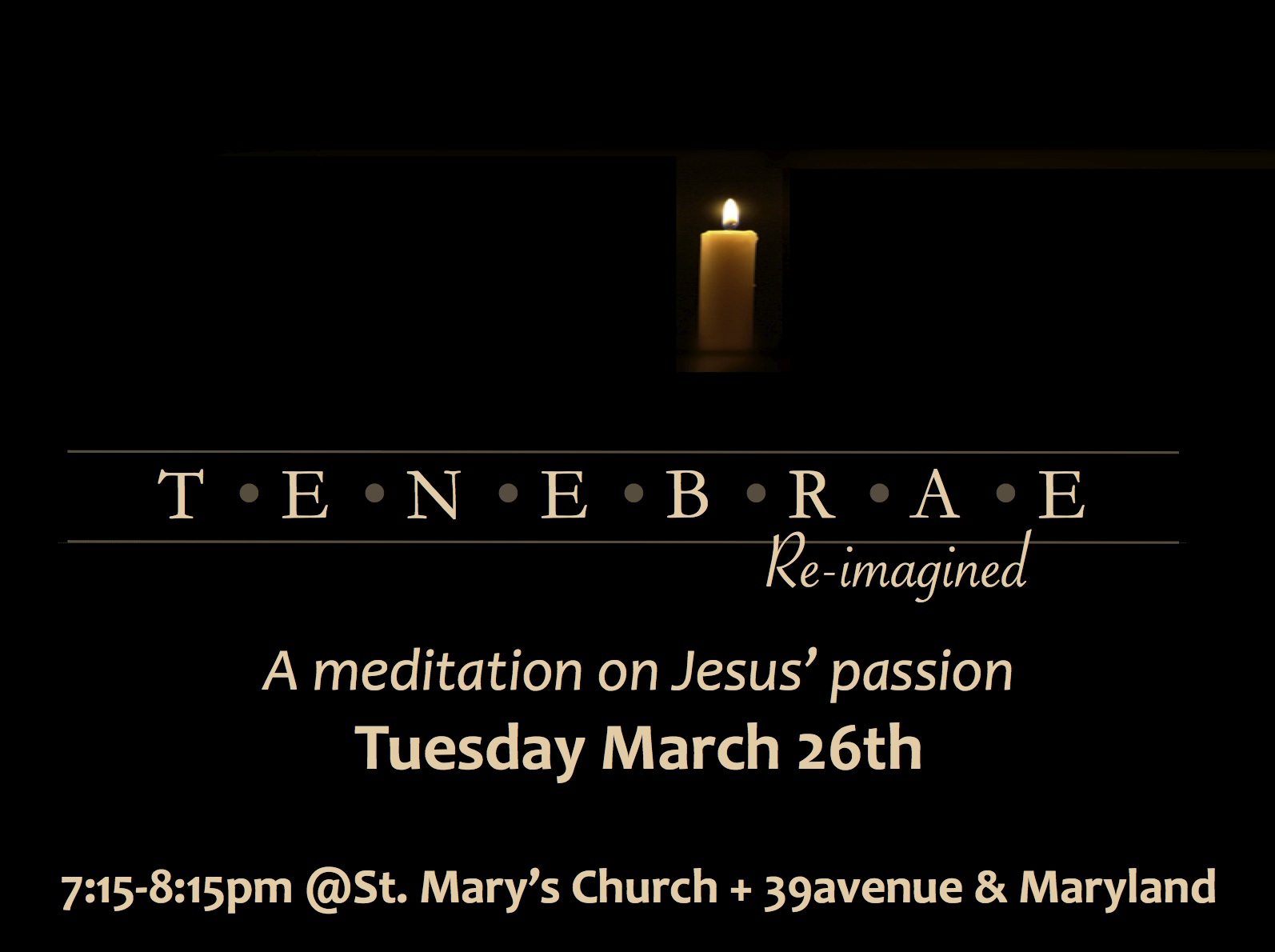
Tenebrae2013If you are in Phoenix and want a more transformative Holy Week experience, come to “Tenebrae Re-imagined.

Tenebrae is a monastic tradition from the 8th Century and uses the extinguishing of candles to represent the fading and fickly loyalty of Jesus’ disciples as he went to and through his passion…and by extension, our fading and fickle loyalty to the crucified Savior as well. It has come back into vogue in the last decade. Unfortunately, most of these services are “insider friendly,” long and involve obscure readings from Lamentations.

We have redone the service in a very powerful way:

1. It traces Jesus’ Passion through Old Testament prophetic passages, material written between 400-1000 years before Jesus was born.

2. It is multi-sensory: It uses both chant and modern music, darkness and light, silence and sound, actors and audience participation.

3. It uses both multi-media & live candles….allowing the room to be actually dark.

4. It is brief: 45 minutes long

If you are from an evangelical tradition, think of it as a Cross-video that plays in your mind – Powerful and brief.

This version, that we wrote, is now being done in 10 places around the country. Last year we did it with PhoenixOne. This year it is led, directed and sung by college and high school students. In the four times we have presented this we have had to ask people to leave more than 30 minutes after the service was finished. It is emotionally powerful and excellent. Come check it out!

Why would anyone join a “brand name” church? (What the heck is an Anglican pt. 2)

Past-Present-Future-neon-sig

The late Robert Webber, Wheaton professor of theology, a convert to Anglican Christianity wrote, “The best way into the future for Christ’s church is one organically integrated with her past. 

The heart of Anglican spirituality is seeking Jesus through common prayer, being formed by a shared immersion in the communal annual reading of the Bible, finding Jesus’ sacred presence in baptism, and weekly participation in the Lord’s Supper and giving ourselves away to the least, last and lost. We emphasize being transformed by God in a prayerful community (God’s calling out “a holy people”) rather than as discrete and disconnected individuals seeking our own subjective experience of God.

For most folks Anglicanism is hard to get their arms around. We tend to focus more on the process of sanctification: becoming like Christ, rather than the event of salvation, as with non-denominational Christians. As such, in America, the Episcopal Church hasn’t been very good at evangelism. So lots of people born in our church leave to “meet Christ” elsewhere – this is a major weakness of ours. Our strength is that it we are phenomenal at giving people a process of spiritual formation: helping people develop spiritual depth. Anglicans do this well because we have access to the deep well of 20 centuries of the church. That is why lots of people seeking Christian maturity join Episcopal churches. In Arizona, for example, 70% of our clergy come from other traditions.

Anglican Christianity is complex and sometimes counter-intuitive. I have found it to be sort of “Master’s degree level” Christianity, whereas most of us are used to high school level Christianity-simple and accessible. It is important to point out that not all need a Master’s degree, but all do need a high school degree. But for those seeking to go deeper-Anglicanism offers a great opportunity.

So I invite you to come pray with us. You will be blessed.

*”Anglican” means “English” and “Episcopal” means “bishops.” The Anglican/Episcopal Church originated in and is in relationship with the Church of England and is led by bishops. Our churches are all over the world. Together we are called the “Anglican Communion.” With around 78 million members, the Anglican Communion is the third largest branch of the Christian family tree, behind Roman Catholics and Orthodox Christians. In this article I use Anglican/Episcopalian synonymously. The Episcopal Church is the Anglican Communion’s constituent member church in the United States…although groups of former Episcopalians are now using the name. The disagreements between us are over matters of biblical interpretation, in particular around matters of sexual expression. Many, but by no means all, “traditionalist” Episcopalians have re-affiliated under the banner “Anglican” in the U. S.  

What the heck are Anglican/Episcopalians? How “brand name” Christianity might bless you. (1 of 2)

In this post-brand era, why would anyone join a denominational church? 

Many are blessed by what they are experiencing in the post-denominational “generic” church that dominates the church-going landscape today. If that is you, I am glad and genuinely celebrate with you your satisfaction in God. Many others, however, are longing for something more: searching for something “missing” in their Christian walk.

Do you long for a faith that is more internal than external? More communal than individual? More rigorous on yourself and roomier toward others? More focussed on the world’s needs and less on the church’s? Do you long for a faith experience with access to the ancient wisdom of the faith and less wedded to our contemporary culture? If any of this resonates, to quote the old commercial, “this Bud’s for you!”

Yes, denominations may be dying, but Anglicanism* is growing, and rapidly. This is especially true among young adults around the world. Some of the growth of Anglicanism is in Anglican churches, but it is also occurring in the larger evangelical world. “Wait a minute?” You might say, “I went to an Episcopal Church and it was 75, 75 year-olds.” That may be true, but Anglican thought and practice is popping up everywhere these days-like at Willow Creek or among the 1000 young adults at PhoenixOne. What is Anglicanism? The simplest definition I have is Reformed-monasticism. Huh? Let me flesh that out a bit…

Anglican Christianity is not about rigidity, ritualism, or being locked into any tradition, old or new, that is not rooted in Scripture and found in the great arc of God working through history. We aim for both the message and methods of Scripture and the earliest Christians.

Now that you know what we are not, what are we? To begin with, Anglicans/Episcopalians are Christians. And Christianity is Christianity. However, Anglican Christianity is a unique and nuanced expression of the Christian faith.

To be grasped Anglicanism really has to be experienced, and more than once. Anglicanism is not about a different Sunday morning experience, but a different vision of life. As such it takes time to be captivated by it. Because it represents a different vision for life, explaining it is also complicated. Indeed, if you ask 10 Episcopalians to explain Anglicanism you may get 11 answers. Another difficulty is that, although we are such a large group worldwide, we are very small in the U. S. Because we are small, most people’s experience of the Episcopal Church is through the media. The Episcopal Church is not very much as it is portrayed in the media-any more than Pentecostals spend all of their time doing backflips down the church aisles or Bible church people spend their days shouting at folks. Anglicanism is more complex than the stereotypes and is differentiated from the other branches of Christianity in some very distinct ways. These distinctions include:

  • Protestant theology/catholic worship. This is where “Reformed Monasticism” comes in. The Episcopal Church embraces the theology of the Reformation with the worship practices and spirituality of the ancient Christians. By “ancient,” Episcopalians are not referring to the theological innovations and abuses of 1200-1500 C.E.,  but rather to the first 5 centuries of the church. That early period saw the New Testament written, confirmed which books would comprise the Scriptures, and developed the Nicene Creed which defines the Christian faith and answered the cults about the nature of the Trinity with a clarity that the faith still relies on today. That period also gives us a pattern of worship. That pattern dates from at least the early-100’s. Our worship is built around monastic rhythms of being immersed in and formed by the daily reading and praying the Scriptures together as a community (called the Daily Office), the weekly communal celebration of communion (called the Eucharist) and then living those rhythms out in the world to bring honor to God’s name and aid our fellows. You will notice that our words and actions in worship are God-directed rather than back and forth from stage to congregation.
  • We both practice and are led by common prayer: “Common” is an old word for “shared”. Churches are always trying to figure out what banner to unify under. For some it is the beliefs of a person (like the Pope or Mark Driscoll), for some a doctrinal statement (like the Westminster or Augsburg Confession). Episcopalians are unified around the idea of being willing to pray the same words together…the words of Scripture and the “safe,” vetted words of the church until God works out our stuff in our own lives. That comes from our roots in England as being Catholics, Protestants and social Christians all in church together. Some long for the idea of “purity” and uniformity of belief in the church. History and experience tells us that theological uniformity is a mirage at best. Being unified around praying the same words is a value that is both holy and extremely difficult to live out. This can be very frustrating as there are often people with us that we think are a bit crazy. They tend to think we are a bit crazy back. But we are attempting to err on the side of generosity and give people room to “work out their salvation” in honesty and sincerity, not to mention “fear and trembling.” So we agree to major on the majors and give room on the minors. What are the majors?
  • Majoring on the Majors: “The Chicago-Lambeth Quadrilateral” defines our “Big Rocks.” They are:  1) Scripture contains all things necessary to our salvation 2) The historic Creeds of the faith (Apostle’s Creed and Nicene Creed) as the sufficient doctrinal statements (which really means that Episcopalians see ourselves as “a church in relationship with other churches” rather than “the ‘true’ church”). 3) Our worship is ordered around the two sacraments that Jesus taught: Baptism and the Lord’s Supper. And 4) Churches are led by bishops who have continuity of relationship and teaching back to Jesus. (Btw, until the 1500s this was the only form of church leadership and to this day about 3/4 of the world’s Christians are part of churches led by bishops in lineal relationship with the first Apostles.)

Why is this important? Simply because it has a high probability of blessing you…and of other’s being blessed as a result of what you receive as you “grow in the grace and knowledge of our Lord and savior Jesus Christ.” (2 Peter 3:18)


Glimmers of Hope: Does going to church even matter?

glimmersSomeone recently told me, “The gathering of Christians in worship doesn’t begin to matter in light of the endless string of calamities, tragedies and bad news in the world.”

I think it does. And I say that as someone who spent most of his Christian life disliking church.

I think it matters more every day. A world desperate for Good News needs to find people of faith together, immersed in the Scriptures, coming to God’s table, becoming more like our Savior, and serving the world.

Is it not obvious how much we need to be in the Scriptures together, be challenged together, affirm our faith together, pray together, repent of our sins together, be reconciled to one another, and eat at the Lord’s Table together? But it isn’t just us who needs this. Is this not what our world needs most from those who name the name of Jesus?

I know that the trendy answer is that we should “do more good stuff.” But for all our failings, Christians are already the most powerful force for good in the world. Yes, we could do more, but nothing more or less than the worship of the God and Father of all is what I believe the world most needs from us. This is true even if the world doesn’t know it. Even our American individualism says we do not need anyone else. Even if our church is boring. Even if we are tired. Even if there is a great football game on television or our kids really don’t want to go.

We need to keep meeting together in order to open our minds and hearts, to be changed by the unchanging Word, to refuse division, and to live our lives in light of eternity.

Once upon a time people arrived in California to hunt for gold. Broke, tired, cold and hungry, the forty-niners toiled, hunched over in icy streams for elusive nuggets. A single glimpse of a yellow glimmer staring back from the creek bed was enough for them to keep going. A broken, tired, cold and hungry world desperately needs the glimmer of hope that Christians in adoration of our Savior send.

A high school friend who came to camp with us several years ago powerfully illustrates this truth: He was on a weekend designed to help students hear, see and understand the Good News of God’s love for them. For this young man it was all a big zero. I woke him up the morning after he waxed eloquent of his boredom with all things religious and dragged him to the staff worship service. After we were dismissed for breakfast, I noticed he had tears in his eyes. He told me that he simply had to give his life to Jesus right then and there. When I asked him what was going on he said, “I saw the way you Christians were worshipping and I knew that I didn’t have that kind of love. I desperately need it.”

You in worship are the glimmer of hope God’s world most needs. This Sunday, go to church.

Grace and peace,

Matt

Here is a thought on the role of Scripture in worship as we prepare to gather next week…Scripture, the Reformers held, is to be placed in the hands of the people and read in common, so as to knit together a people through deep immersion in the Scriptural story. This, New Testament scholar, Bishop NT Wright says, is at the heart of Anglican worship and life: “the simple, daily, communal reading of the Bible, through which the Spirit forms us as a church and equips us for mission in the world.”

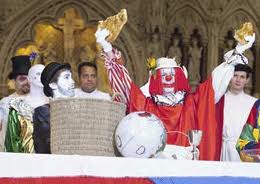
Clergy Gone Wild: Clowning Around With Communion.

Unknown

Snark MeterHIGH.001

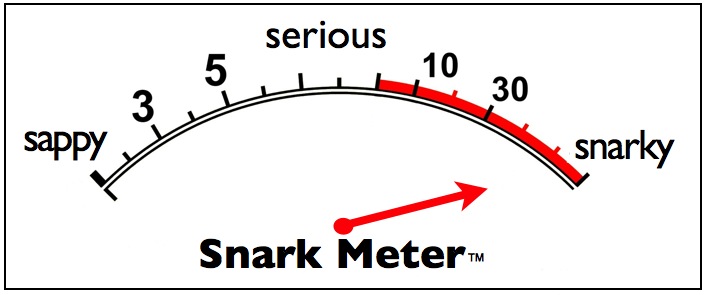
Content warning: Sarcastic blog post. Cynicism intended in love.

Awhile back we saw a spate of “interesting” Eucharists. These included, I kid you not, Seuss-charists, Clown-charists, Pirate Eucharists and a tailgate Eucharist at a Baltimore Raven’s game. A youth director friend, Jeremy Knight, and I were thinking one recent evening that there are many imaginative ways to devalue the Holy Eucharist that have yet to be attempted. Here are a few that came readily to mind…

1. Bear-suit-vestmentscharist: What’s more inviting than a guy in a bear suit?

2. The Hobbitcharist – The procession is an Orcish hoard and the host is referred to as “my precious.”

3. Jeopardycharist: “I’ll take the bread and cup for $300, please.”

4. Avatarcharist: It’s just like the “DancesWithWolvescharist” only in 3d.

5. RockyHorrorPictureShowcharist For children of the ’80’s. Starts at midnight. The virgin gets praised not spanked and, for the Gloria, we can “Do the Time-warp Again.”

6. StarTrekcharist: Word on the street is that Shatner is a postulant for Holy Orders in L.A.

7. Paintballcharist: Anyone who doesn’t genuflect gets double-tapped.

8. Transformerscharist: Save the planet and uphold a transubstantiationist doctrine at the same time.

9. Nudecharist: Warning, only works with the right celebrant.

10. FindingNemocharist: After all, fish and loaves are biblical imagery.

11. Mariocharist…followed by Super-Mariocharist.

12. Ninjacharist: Don’t mock it, Ninjas will take you out.

13. Ryan Seacristcharist: Just because it sounds funny and, hey, we’re Americans, we can always find a new Idol to worship.

All of which are signs of the apocalypse-charist. And finally…

14. MockGodcharist: Haven’t we already? I really do know that this isn’t anyone’s motive. But we sure look like weirdos here.

I am part of a church with an average age of about 22, not a fuddy-duddy. But even I have to wonder why we have trouble realizing that the Holy Eucharist is, as Prayer A says, “a memorial of our redemption,” and treat it with a little respect.

Anglican Christians know the power of the Eucharist. We know it is the best tool in our toolbox. Our recent oddball Eucharists bring an old aphorism to mind: “to a person with nothing in their toolbox but a hammer, everything looks like a nail.” We know the Eucharist “works,” but is it the only tool in our box? Is it the answer to every question – like the old preacher’s joke about the Sunday School teacher who describes in detail a squirrel and asks the students if they know what the answer is and the kid says, “It sure sounds like a squirrel, but I guess the answer’s supposed to be Jesus.”

Can we at least agree that the answer is not to out-weird each other at the altar? How are these odd-sauce Eucharists any different from the shameless attention seeking that we see and critique in the evangelical world…like for example the local church that put an Octogon on their platform and challenged people to “Get in the cage and fight for Jesus”?

When we do these “creative” celebrations of the Lord’s Supper we appear self-referential, theologically simple minded and missionally clueless. Do we actually believe that if we just dress up the bread, wine and our clergy with enough silliness the world will beat a path to our red doors?

I have heard it said that these are “great for kids.” Help me understand this, what happens when the kids find out their priest isn’t really a clown? Or (wait for it) that they actually are?

Wouldn’t it be more helpful if, instead of inviting people to outlandish communion celebrations, we returned to the ancient church practice of going to the world; loving and serving people and speaking of our motivation rooted in the hope we have in the resurrected Christ? Or we could just sit around the office typing up more kooky Eucharists for liturgical junkies. Anyone for a Djangounchainedcharist? It would be high-action, and justice oriented – timely, trendy and attractional. We’d pack ’em in!

How we worship…and does it matter. (Pt. 2)

Ordination. All Saints, Phoenix

Ordination. All Saints, Phoenix

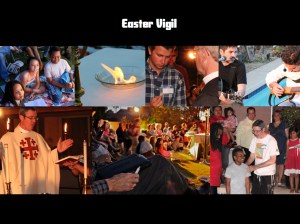
St. Jude's Outdoor Easter Vigil

St. Jude’s Outdoor Easter Vigil

Modern worship, the early church and tradition.

In many ways, liturgy is the opposite of modern worship forms. Let me describe modern worship for a moment. (And I really am attempting to describe rather than criticize.) Today worship in most of evangelical America follows what is known as the “Relevant” model – “worship” as several songs and a sermon. This model utilizes the connecting points of our culture in order to be “outsider friendly.” The connecting point where today’s culture engages with one another are the coffee house, the concert hall, and the comedy club. When you think about your church, how many of those are present? The “relevant” liturgy is essentially horizontal and aimed at relating to the unchurched. It is referred to in many churches as a worship “experience.” The goal of “relevant” worship is to alter the delivery method toward the styles and events people prefer without altering the message. The standard objection is, “What is wrong with that? Don’t you want non-Christians to be comfortable in church?” The answer, and this is coming from a missional person who has spent his career in evangelistic ministry, is “Not really.” Let me explain…

Liturgy in many ways is exactly the opposite of the modern church. Liturgy is focused, not on the outsider but the insider – the person already committed to Jesus. Not that liturgy doesn’t sometimes speak powerfully through symbol to the non-believer, especially in this post-modern age. However, the goal of liturgical worship is to make believers specifically uncomfortable; To involve us physically in order focus us vertically on the greatness and grandeur and holiness of the triune God. In that way it is a Romans 12:1 experience “Do not be conformed to this world but be transformed by the renewing of your mind.” From that uncomfortable worship that unraveled our idolatrous image that we are the center of the universe, the early followers of Jesus went into the highways and byways telling the world the Good News of Jesus that was transforming them in their daily time with God and their practice for heaven each week in the liturgy.

The liturgy isn’t mine or yours. It isn’t endlessly malleable by the church staff to do whatever they want in church. In short, it’s not about what we like or what we “prefer.”  The shape of the liturgy was handed to us by the earliest Christians. They borrowed the pattern of Word and Sacrament from the Jewish synagogue and temple. We find hints of it in the New Testament and see it laid out in detail by 150 A.D. And don’t miss the significance of this – when we read what those writers describe, they describe it as already ancient, established practice. (You can read Ignatius from 110 CE, Justin Martyr from 150 CE, Clement from 200 CE, and Hippolytus from 225 CE.) Most of the church has followed that pattern since then, because, when your heart is surrendered to God, liturgy works.

Perhaps you have a sense of curiosity about the ancient ways of the faith. I would encourage you to go experience those ways at a church that is thoughtfully liturgical. I would be most surprised if you do not find it spirit-lifting, even though much of the symbolism is subtle and will probably be missed the first few times through.

So go old-school this year: Come worship with us!

How we worship…and does it matter? (Pt. 1)

Henri-Le-Secq-Chalice-ca-1850-painting-artwork-printWhen the subject of worship “style” comes up, people generally start getting antsy. We stop listening and begin forming our objections. The young among us say, “I can worship any way I like.” The more mature, recognizing the self-centeredness of statements like this, will rightly counter with Paul’s limitations on Christian liberty, (1 Cor. 10:23-33) but go on to say, “How we worship is optional, subject to the preferences of the unbeliever, and not mandated by Scripture.” Whether or not that is true will be the subject of a later post.

Let us suspend those arguments for a moment and ask why worship matters… Passages of Scripture that immediately come to mind include the first two commandments, the Psalms, the practice of Jesus both in private and corporate worship (In the gospels we often see Jesus in the synagogue, temple, & private prayer. Jesus begins his ministry at Baptism and ends it with instituting the Lord’s Supper before going out to pray on his way to the Cross to lay down his life. The life of Jesus is surrounded and ordered by worship.) In the book of Revelation, the last thing we are doing is engaged in the “chief end” of humanity, in the words of the Westminster Confession, “to worship God and enjoy him forever.”  Indeed, It appears an inescapable fact that all humans, regardless of religion or irreligion, worship something. We were made to worship.

How then, I wonder, can we say, that the manner in which we worship does not matter? Unless, of course, the object of our worship does not matter.

What if we assume three things about worship, simply because it is true of all of the Christian life: First, that what other Christians have done and thought through time is relevant. We stand on the shoulders of giants. Asking how those who stood closest to Jesus worshiped, is surely wise. Second, that the aspirations of our youngest members is relevant, since they will carry the baton when we are gone. Third, that we are part of a universal church, “one holy catholic and apostolic,” …that we are umbilically tied to every Christian in every corner of the globe, so their practice is also relevant.

Interestingly, On all three of those assumptions, the question arises, “What about liturgy?” After all, It is the way the first Christians worshiped and is the worship pattern enjoyed by 90% of all Christians who have ever walked the earth. Liturgy is also making a comeback among young evangelicals in unlikely places like PhoenixOne, a 1000 person young adult gathering, and on the stage of the church that invented the non-denominational “seeker movement,” Willow Creek. Third, it is the form of worship utilized by 2/3 of the Christians on the planet today. So you might want to check liturgical worship out, if only to see what the cool people are doing. Ok, so I’m joking. Sort of.

The most important thing about liturgy is that it isn’t taught, it’s caught…or, more accurately, something you get caught-up in it…like being tossed into a cold swimming pool by the older kids in elementary school.

The Greek word leitourgia comes from two root words – laos, “the people”, and ergas, “a work”. Therefore, you will hear it said that liturgy is “the work of the people.” That’s a little bit true since liturgy is participatory…the term “pew aerobics” comes to mind. Liturgy does involve all of you in worship – your whole body, which is important because our hearts and heads follow our bodies. You know that intuitively if you have raised your hands or bowed down in worship.

But “work that people do” is not really the meaning of “liturgy” at all. leitourgia was the word to describe an act of public service initiated by a wealthy benefactor. For instance, a person of means might build a temple and foot the bill, but the work itself benefited the community. Any public work done in service to the gods, but for the benefit of the community was liturgy. So liturgy is work dedicated to God, initiated for people, and which serves to transform the worldand that is the big meaning: liturgy is about the faith community being transformed for the purpose of going out and transforming the lost world. And a transformed community that couldn’t stop sharing the Good News is exactly how 11 scared dudes turned the most powerful empire in the world upside down in less than 300 years.

So liturgical worship is for God, transforms us, and benefits a lost world. Who wouldn’t want that?

Questions about Confirmation

What is Confirmation? “Baptism is God saying, ‘You are mine.’ Confirmation is our agreement back, ‘I am yours.’” In other words, Baptism signifies you are a Christian and Confirmation that you have chosen to be a disciple, and as such, are committed to your local parish.

Age of Confirmands?

  • Confirmation is a person’s adult faith decision, so older is better than younger.
  • Students experience their life so much differently after starting high school than before that they tend to discount their very real childhood faith experiences. Youth leaders will always help students to honor their previous concrete-operations faith decisions, but we are swimming against their experience of themselves.
  • They must be old enough to have experienced life’s challenges in order to have a faith experience that sustains them through those challenges.
  • Students must have the developmental maturity to make a lifelong adult decision…when thought of in those terms, 7th grade is pushing it. Please start no earlier than that!

Goals?

  1. To make sure students are evangelized not just catechized. Best practice: Begin Confirmation with summer camp! Our Chapel Rock junior high youth camp has a “What is a Christian, and will I be one?” message sequence. The camp program was specifically designed to be a Confirmation pre-retreat.
  2. For kids to own, “This is my God (Christian), my tribe (Episcopalian/Anglican) and my family (parish).” Best practices:

        -Connect old and young. “Adopt a granny/grandy/prayer-partner/buddy programs leave generations connected to one another in ways that give momentum to the entire church.

Integrate kids into worship at every level possible…segregating in worship builds religious consumers.

Make church family-friendly. Church exists for the glory of God and the building up of the body of Christ. (Eph. 4) The guiding principle is that those stronger and wiser in the faith serve the weaker and newer. Blend musical forms and instruments.

Resource the parents to be Christian leaders in the home: Make Confirmation a parent program as well as a student one!

Make sure the curriculum teaches “why” rather than simply “what.”  We want students to understand how Anglican traditions, sacraments and liturgy deepens people’s walk with Christ. Confirmation should be evangelism that leads to a life of discipleship. Even the best curriculum needs translation into your context. Currently many are using Confirm Not Conform.

Give them the tools to sustain a lifelong faith: walking with God, living a life shaped by faith, serving others, being able to deal with life’s challenges.

Planning Priorities?

  • Plan Confirmation as part of the larger “Roadmap of Faith” to take an un-churched person to mature faith:  1) Meet people, 2) Tell them about Jesus 3) Help them to grow, 4) Plug them in to church, 5) Train them to join us.
  • Plan your program around experiences: Start Confirmation with camp. End with a service trip. The parishes with the most retention when students become adults came from the our churches doing start/end programs.
  • Make Confirmation at least a school year in length.
  • Teach a positive message. Often we use language that intentionally differentiating us from other Christians. When students get to college we often lose them to evangelical and RC churches when our kids don’t know how to respond when asked, “Do you know Jesus?” (In Arizona, RC youth programs have adopted evangelical language.) When we start with the universal Christian message and emphasize: “We are like other Christians, but with the following distinctives that will bless you,” we teach our uniqueness without having students think we kept something from them when they get to college.
  • Create ownership. The local Catholic diocese is moving towards students having a drivers’ license before starting Confirmation. They put it on the student to drive themselves to the meetings to insure ownership. Find ways to create ownership in your Confirmation program.

Defining Down Worship

There is a lot of talk floating about the internet on worship. I will throw my voice into the mix: I am saddened at the way we in the “relevant” world have defined-down worship to merely “singing.”

Last Sunday I went to a very nice church full of very sincere people. The liturgy (because all churches have their own liturgy) was 4 songs, a prayer and a sermon followed by the liturgical dismissal, “See you next week!”

Three of the four songs were contemporary songs written for performance (i.e. bad for group singing). The one song that lit the congregation up was the point in the medley in which the popular and modern “Beautiful” morphed into “How great thou art.” I wondered if the worship leader connected the dots that the one song to which all hands were raised and all voices joined was the one with theological content in a singable arrangement. Ironically every word of the worship leader’s pastoral prayer assumed a room with only one person in it (“I, me, mine, Lord”) and yet there was a long and strong push during announcement to join groups in order to “become a community.” I wondered if the church’s leadership had any awareness that the lack of connectedness and an ecclesiology oriented exclusively around the individual are related.

We desperately need to remember the roots of our faith. The first Christians converted the known world in 3 centuries. They did it with a seeker-insensitive worship pattern (still used by 2/3 of the Christians on the planet),  sacrificial care for the least and last, and an unwillingness to stop sharing the Good News of God’s love in Christ, and inviting people into the multi-ethnic, multi-class body of Christ.

It doesn’t have to be a choice between a great band singing unsingable songs or being trapped with an organ and an archaic hymnal. Worship could be a recovery of the ancient pattern of Christian worship, artfully and powerfully done, with music that is culturally appropriate to the context you are in.

To do something that radical, though, would take a radical re-orienting of our American individualism. The whole purpose of the ancient liturgy is to conform the body of the Church to a Scriptural pattern of life. The liturgy presumes what the original hearers of the New Testament knew: that most of the “you’s” in the text are really “y’all.”

The liturgy can be nuanced, but leaders should not be rewrite it at whim for the same reason we should not rewrite our wedding vows to “personalize” a marriage-the power of the marriage is specifically the surrendering of ourselves to a greater vision. The same is true with the liturgy – It stands coherently together and has 20 centuries of validation in the lives of countless millions of saints.