Funerals: Recovering hope in a culture terrified of death (2 of 2)

clip of leaves

Snark MeterrealMID.003

I promise you interesting reading on a topic you were not looking for in the middle of Advent. Although not the usual topics for youth ministry and/or church planters, as advertised in part one (The obsession we cannot avoid), here is the text to our Q & A on funerals.  It will give you a glimpse into the purpose and power of the traditional burial office. It was produced by Nicholas Knisely, Bishop of Rhode Island, Bryan Owen, Rector of St. Luke’s Baton Rouge (blogs as Creedal Christian), and myself. It is available as text for websites or as a customizable flier.

Why have a funeral in a church?

One of the characteristics of an Episcopal or Anglican Church is that you will often see graves inside the church or on the church grounds. When we speak of the Church, we mean both the church militant (those who are alive right now) and the church triumphant (those who have died and ended their earthly race). When you worship in a liturgical Church you are literally and tangibly in the presence of the whole Church. A funeral in the church building is a sign that, even though death seems to divide us from those we love, the Body of Christ is never divided. As members of Christ’s body, we are still connected with those we love but see no longer. Therefore, a funeral in the church building foreshadows that day when we will be reunited with the entirety of the Body of Christ in the presence of God.

Why a burial office (prayer book funeral service) instead of a memorial?

Rather than focus on what we believe to have been important about our loved one’s life, the burial liturgy reminds all present that we are brought into a reconciled relationship with God after our death because of what God has done, not because of what we did in life. Using the burial office rather than trying to create a particular and personal memorial service is a consequence of that belief. In the burial office the gathered body of Christ expresses gratitude for God’s redeeming work in our loved one’s life, hands them over to God’s gracious care, and looks forward in hope to God’s future resurrection of us as well.

Why do clergy accompany the family on the initial consultation with the funeral home? 

It is often a good idea to have the church funeral planner accompany you to the mortuary in order to coordinate arrangements at the beginning of the planning process. The clergy/church representative is your advocate and a calm and supportive presence at a time when difficult decisions must be made.

Why is it important for the body or cremains of the deceased to be present?

Christians believe in the bodily resurrection, not just of Jesus, but of each of Jesus’ followers. We do not know what our new bodies will look like, but we do know that God is going to transform the essence of our whole selves, our minds, our souls, and our bodies. The presence of the body or cremains of our loved one is a sign to all of our trust in God’s plan to redeem and transform us in the end.

When there is a body, why is the casket closed and covered with a pall? 

Holy Scripture tells us that “to be away from the body is to be home with the Lord” (2 Corinthians 5:8). We close the casket because our loved one is no longer present-only their remains.

Once inside the church the casket is completely covered with the “pall.” As Easter people we are dressed in white in our final church service. The pall points to the reality that, whatever our station in life, we all come before God by virtue of being clothed in robes made white by Christ’s loving action on our behalf.

Why are there no eulogies?

Although there is a degree of latitude granted in some parishes, there is a longstanding tradition of not having eulogies in the burial office. This is because the burial office, rather than fixating on the past, orients our faces toward the future promised by God that is a consequence of our relationship with Jesus. It is a good thing to remember the lives of our loved ones and to give thanks for all they have meant to those who remain behind. That work of remembering, though, happens best when we can do it in conversation. Perhaps you will want to have someone speak about your loved one’s life during visitation hours before the burial office, or at the reception following.  You also have the option of having a Vigil the evening prior to the funeral as a time to offer prayers and to share memories of the deceased. (BCP, 465-466). *Feel free to speak with your priest if you wish to discuss this further.

Why is that ‘big candle’ used in the service?

The Paschal Candle is first lit each year in the Easter Vigil to symbolize Christ dispelling the darkness. As the candle is brought into the darkened church, we sing that the light of Christ has conquered the darkness of the grave. The Paschal candle is lit every time the Church celebrates a baptism. In baptism we are “sealed by the Holy Spirit” and “marked as Christ’s own forever.” (BCP, 308) The candle is lit at every funeral to remind us of this unbreakable bond and the truth that nothing in all of creation, including death itself, can separate us from the love of God in Christ Jesus our Lord (Romans 8:38-39).

Why Is the church adorned in white?

The church is adorned in white because the burial office is an Easter liturgy and focuses on the unexpected joy of the resurrection, which the Church has proclaimed for two thousand years. In the liturgy, there is a beautiful phrase, “Yet even at the grave we make our song, Alleluia, Alleluia, Alleluia.” It is in the hardest, darkest times of our lives, that we insist on proclaiming our hope that “in Christ all will be made alive” (1 Corinthians 15:22).

Why does The Prayer book select certain Scripture readings to be used in the service??

The Book of Common Prayer is the result of centuries of thought and theological reflection. As the result of this intentional conversation across generations, the prayer book has provided selections from the Holy Scriptures to sustain us at the time of death. There is a certain latitude given to the officiant and the family planning the liturgy to chose favorite hymns or alternative readings, but the appointed readings have been chosen because they speak directly to the resurrection hope that lies at the heart of the Christian faith.

Why do we have Communion?

God has given us the chance to be united with those we love but see no longer through the redeeming action of Jesus’ sacrifice on the cross. When we share in the sacrament of bread and the wine, partaking in the body and blood of our Lord, we are united with all the hosts of heaven, and all the members of Christ’s Church of all time. We share this final Communion meal, the family meal of God’s own household, in anticipation of that great day. We will not be able to share Thanksgiving or Christmas, birthday or anniversary meals any longer with the people we have lost, but we will, for eternity, share this Eucharistic meal with them. *There are occasions in which communion may not be desirable. Discuss this with the church when planning the particulars of the service.

In Summary

Few are the times in this present age when people are aware of God’s acting to graft us in to his larger and eternal purposes. Baptisms, weddings and funerals are among those occasions. It is in those events when time and eternity touch that we and our loved ones need the truth, beauty, and comfort of the words of Holy Scripture and the great tradition. The burial office exists because the final goodbye to your loved one is simply too significant a matter to make it up as we go.

The liturgy for the dead is an Easter liturgy that finds all its meaning in the resurrection of Jesus Christ.  It gives us permission to express deep sorrow over the death of loved ones.  It also reassures us that all who die in Christ share in the victory of his triumph over death.  Using this liturgy in the church for the burial of a Christian reaffirms and strengthens our faith that just as God raised Jesus from the dead, he will also raise us.

We are glad that you are considering our church for this important event in the life of your family.

Please contact the St. Jude’s church office at (602) 492-1772 to set up an appointment to plan the particulars of the ceremony.

We are planning for this to be the first of a series entitled “Your Church. For Life.” It will include Baptism, Confirmation, & Marriage, four events people look to mark in the church.logo
All of which is to say: When I die, do the world a favor. Give me a funeral.

Death: The obsession we cannot avoid and dare not admit (1of 2)

Funeral1

Snark MeterrealMID.003

In our rush from the church, have we begun using entertainment as religion to answer the questions fundamental to human thriving?

Our culture has almost entirely insulated us from the reality of death. Most of us are awkward with the topic in conversation and go to great lengths to avoid the appearance of nearing death with a plethora of products, services and surgeries designed to cheat aging at any coast. Our post-modern avoidant/fascination with death struck me last night at our local cineplex. The new release lists are heavy with vampires, zombies and time travel…except for the ones about super heroes with death-defying powers. When did death-avoidance become the central theme of our entertainment?

Although we may abandon organized religion, it appears that we do so at our own existential peril. In our rush from the church, it seems we have begun using entertainment as religion to answer the questions fundamental to human thriving.  Last night’s trip to the theater was instructive. The opening line to the movie The Book Thief is “Everybody is going to die someday.” The closing line of the last preview before the movie started was from The Winter Tail: “Maybe it is possible to love someone so much that they cannot die.”  Interestingly, the Christian message is precisely that there is a love so strong it will overcome death. But instead of considering that message, most of us will avoid thinking about death until we stare it in the face – literally looking down at the remains of someone we loved lying in a casket.

Our obsession with death becomes even more curious when viewed in light of our near total buffering from it. In previous generations death came earlier, more often, and closer to home-most likely even in the home. Today we have longer life expectancies, become infirm in care facilities, and enter hospitals when illness becomes terminal. Today when we take our last breath it is usually in an institution rather than in the places of our lives. (This has been covered in the press recently (NPR) and was picked up on the Episcopal Cafe.) Add to these layers of insulation, the entertainment industry. Big entertainment includes in it’s notoriously unreliable curriculum the lesson that people don’t actually die at all. They are “offed” (often quite creatively) only to appear next week on another network, perhaps even in the same time slot.

The media is merely a barometer of our desires – It packages and sells us what market research tells them we want. Having discovered our discomfort with our own mortality, it sells our anxieties back to us in the form of a seemingly endless array of zombies and vampires, with their promise of a life-of-sorts. Perhaps, though, the clearest barometer of our post-modern denial of death is found in the new Tumblr site, “selfies at funerals“. If we cannot cheat death, at least we can laugh at other’s deaths. Turn up the music, dude!

tumblr_mvewmnvDqh1smbgw2o2_r1_500

Perhaps the epitome of our post-modern denial of death is found in the new Tumblr site, Selfies at Funerals...Turn up the music, dude!

All of this, of course, affects the church. Many Christians now have an “It’s a Wonderful Life” theology of the afterlife more akin to ancient Greek (or perhaps LDS) beliefs than orthodox Christianity – this is the popular view we “pass on” to become angels trying to win our wings by aiding the frustrated left on earth.

Contributing to this fuzzy theology is the demise of the traditional funeral. You may never have been to an actual funeral, but you have surely been to a memorial service. A memorial is, of course, about looking backwards – of “memories.” The general liturgy of a memorial is to sing a few of the deceased’s favorite songs and, to continue our It’s a Wonderful Life metaphor, share our remembrances of Uncle Billy.  Occasionally a few too many remembrances, and for too long…glossing over flaws and overstating things a bit on behalf of someone whose life might have actually left a lot to be desired. To be realistic, returning again to It’s a Wonderful Life, although Uncle Billy’s absent-mindedness was cute, it caused the family a great deal of trouble. The pastor then closes the memorial with a short message that makes some reference to Jesus’ as accounting for the deceased’s goodness and gently asking those present to consider a relationship with God in order to join Billy in his eternal home.

As heartwarming and well-intended as it is, the memorial is all about looking backwards. A funeral is all about looking forward. It is about promises and hope bought vicariously. It is about real and eternal life, new bodies, and paradise found, purchased at another’s initiation and another’s expense.

The memorial, when viewed in light of the old-school funeral, reveals a very low view of the transition between life and death, and a fuzzy view of the afterlife…both of which, when added together, diminish our understanding of the purpose of the time we have here on earth. The memorial has very little teaching on the afterlife, very little explanation of what comes next and very little of the historic Christian narrative, “Christ has died. Christ is risen. Christ will come again.” (BCP 363)

In our times of greatest loss our most profound need, besides the presence of those we love, is for the comfortable words of the faith. We need reminders of what lies ahead rather than what lay behind. We need to know that we do not stand alone at the precipice – we are surrounded by the great cloud of witnesses (Heb. 11:1). And because death could not hold Jesus Christ, neither can it hold those who are found in him (1 Cor. 15:20-23). That is why in the traditional Christian funeral we shout in hope, “even at the grave we make our song: Alleluia, alleluia, alleluia.” (BCP, 499)

Here is where I may get into trouble with you: It may feel as if I am treading on the toes of those of us who planned the final services for our parents or wife or brother or Uncle Billy. I should say that, as a pastor, I have done more than a few memorial services myself. We sent my mother on her eternal way with a memorial service. After more theological reflection I can only say that I wish I knew then what I know now. I was the victim of a lack of theology of death and the afterlife. And, as a result, those under my leadership were limited by my lack of understanding. I now see the memorial as a far cry from a prayer book funeral.

Interestingly, while this end of life conversation was going on, three clergy in the Episcopal Church: Nicholas Knisely, Bishop of Rhode Island, Bryan Owen, Rector of St. Luke’s Baton Rouge (who blogs as Creedal Christian), and myself have been working on a question and answer on funeral practices as a customizable parish resource to give people a brief glimpse into the purpose and power of a proper funeral service. It will be available as text for websites or as a customizable flier. I will put up the text that we have worked out as a post in the next several days.

We offer this, not as a condemnation of what anyone has done, but as a resource to help us have a broader perspective on life, death, and the afterlife. The hope is that this would be a helpful planning resource for a time when you need it. The traditional funeral has the perspective of twenty centuries of Christian reflection that both blesses and relieves us of the absurdity of seeking for answers to our deepest longings in zombies and vampires. It offers a more hopeful hope. Not just for Uncle Billy, but for us as well.

Halloween: Trick or Treat?

The Gospel of Halloween. A very well-done video of the medieval church’s view of “All Hallow’s Eve.” According to Wikipedia, experts cannot agree if Halloween is of Christian origin or an example of Christians “baptizing” secular culture (like Christmas trees and Easter eggs).

Watch the video and then weigh in. What do you think? Harmless fun for the kids and a chance to be a witness by being present in your neighborhood? Or a bizarre pagan ritual that should be avoided?

*Thank you to Fr. Bryan Owen at the excellent blog “The Creedal Christian” for posting this.

We’re Number 1…well 191 anyway.

The Gospel Side hit the charts

number-friggin-one

Snark MeterHIGH.001

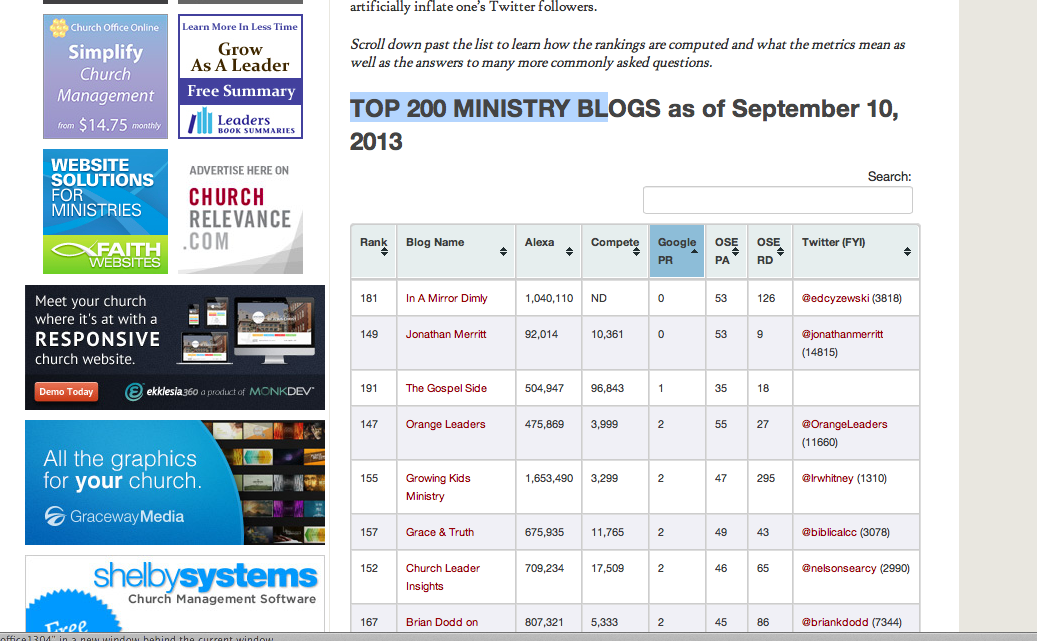
I didn’t know there were charts. Apparently from June-August The Gospel Side was the #191 ranked ministry blog. Which was especially fun since June and July are camp times with virtually no blogging going on.

http://churchrelevance.com/resources/top-church-blogs/

I would like to point out that when sorted by Google page view this blog was number 3. My wife tells me that in her eyes, the Gospel Side is the #1 blog online. So I am going with “We’re number one!”

And please don’t burst my bubble. The line between living the dream and living a delusion is often slight. I may have crossed that line.Screen Shot 2013-10-12 at 1.20.51 PM

The Cloud of Unknowing: 7 steps to successful blogging

Dutch artist Berndnaut Smilde created a cloud in a room.

Dutch artist Berndnaut Smilde created a cloud in a room.

Snark MeterHIGH.001To my surprise, people have begun to contact me for blogging advice. The question usually goes like this: “Can you help me do what you have done?” What they mean is, “How did someone with no media distribution get hundreds of thousands of hits in the first year?”

Always one to “share the love,” I will gladly reveal my “secret sauce.” Caveat: My advice could be summed up in the title of the Christian mysticism classic, “The Cloud of Unknowing.” 

Step One: Have an eccentric motive.  I needed to stay awake in 4 hour theology class lectures. I started blogging to create stress by multi-tasking. That and youth pastors I train kept saying, “I wish you would write this stuff down. This is not what we are hearing at youth ministry seminars and conferences and we need to digest it.”

Step Two: Be clueless. I told a friend I wanted to blog. He said, “Download WordPress. Attach a picture. Tell people who you are. Start posting stuff.”

Step Three: Be un-focussed. Blogs are supposed to be about, to quote Jack Palance in City Slickers, “One thing.” I blog about whatever is floating through my grey matter when I have time to type: youth ministry, milennials, the church, liturgy, esoteric conflicts among Anglicans, leadership, marriage, ethnicity…

Step Four: Entertain Thyself. It helps both you and readers be entertained if you have a catchy title.

Step Five: Scratch your head in amazement when thousands click on your posts because friends forwarded your stuff around on Facebook. That one is really something. One day a friend in North Carolina will fb you and say, “Hey, your article is going around!” You check the blog stats and wonder, “O my gosh! How did this happen?” Then you show the stat page to your wife and ask her to pinch you. Then you refresh and say, “Quick, pinch me again, while you were pinching me 72 people clicked on my blog!”  That rapidly grows old as you realize, a) your wife is not going to spend her day pinching you and b) pinching doesn’t actually make people click on blogs. That is just magical thinking-a holdover from adolescence.

FB is not only responsible for 15x more traffic on my blog than ALL other sources combined, it is indirectly responsible for virtually EVERY hit I have since my very first page view. That was my wife. She wondered why I wasn’t using my time more productively. Those other sources in the photo (with the exception of Twitter) are folks who discovered “the gospel side” from a Facebook forward.

Almost every hit is from fb. The ones that aren't found me on fb.

Almost every hit is from fb. The ones that aren’t found me on fb.

Step Six: Write Mark Zuckerberg a “thank you” note for your newfound friends and colleagues from all over the world. I actually haven’t done that. But I should.

Step Seven: Be nice to people. For heaven’s sake, if someone cares enough to take their time to not only read what you wrote, but to write back to you, treat them with respect.

Blogging is a privilege. The newfound connections and reconnections with people I have not seen in years has been a surprise and a blessing…and the dialogue with people who comment helps me think more clearly and be less insulated than I ever could have been otherwise.

So have fun and blog away!

Happy Anniversary!

1330

Snark MeterMID.002A huge thank you to everyone who has read The Gospel Side blog this year. A year ago I started blogging. I tried blogging once before. No one read it. Not even my family.

When I started my hope was 10 hits a day. My big hairy audacious goal was 100. Imagine my surprise when busy people like you came and read at close to a thousand a day. Thank you so much for allowing me to think out loud with you.

I do have some fun plans in the works. If you have any good ideas to add, bring ’em on!


College Students: Have Your “Ruh Roh” Moment Before Choosing Your Major!

ruhroh8 College Degrees with the Worst Return on Investment: 

8. Sociology
7. Fine Arts
6. Education
5. Religious Studies/Theology
4. Hospitality/Tourism
3. Nutrition
2. Psychology
1. Communications

To my children and college student friends: If you are borrowing money for an education, make sure you do so for something that makes you more valuable in the workforce, not less!

Learn from me, a sociology/psychology major who has worked in education, communications and religion and married a fine arts major. The bad news would make me eat better and take a vacation, but I can’t afford either. I am 8 out of 8 on this data, bro.

Kari and I have a great life. But we have struggled with money, broken cars, deferred home maintenance and still struggle to keep credit cards paid off. The first vacation we paid for ourselves came in our 20th year of marriage. And we didn’t have student loans. If we had to pay today’s tuition prices we would have been paying off our student loans deep into our 40’s.

Those loans will follow you forever. It is easier to get out of needing oxygen than student loans. So make them count!

O, and the really bad news: My really smart, super fun, very personable friend with a PhD in Old Testament from a prestigious East Coast university can’t get Starbucks to even interview him.

starbucks

#becarefulyourfuturemightsuck

And I am not saying you shouldn’t serve God. You can serve God with a chemistry or engineering degree…maybe even in full-time Christian service. But if you don’t have a degree with cash value, you have no fallback and no way to pay off the loans that will keep you out of the low paying ministry job you feel called to.

The best part: When I checked the preview for this post, an ad for Liberty University online popped up offering student loans for a degree in theology. Appropriate.

Source: http://salary.com/8%2Dcollege%2Ddegrees%2Dwith%2Dthe%2Dworst%2Dreturn%2Don%2Dinvestment/

Today: Tears and prayers. But what next?

hc-newtown-school-shooting-20121214The tragedy at Sandy Hook Elementary School is a punch to the gut of an already wobbly America. Can any of us imagine anything more horrifying than a classroom full of dead first graders?

I wonder if we are exhausting our ability to process senseless tragedy. I had a meeting with a friend yesterday. We had an important agenda, but in the wake of breaking news, this brilliant up-and-coming academic could discuss nothing else. My 16 year-old son asked to be tucked in for the first time in 5 years. My 70 year-old father-in-law, posted his shock on facebook. Even the president was reduced to tears. The media is full of information on how to process this with our children. But all over America adults sobbed ourselves to sleep last night.  Our theological frameworks are stretched. Our trust in our fellows diminished. Our numbness increases.

Several things I cannot get out of my head today:

1) The sinking awareness that it is easier for the mentally ill to get a gun than help.

2) The report that since Columbine in 1999, there have been 31 school shootings in the U.S. and 14 in the rest of the entire world. (Source: ABC Nightline)

Newtown, Ct. isn’t even our first mass murder this week. Portland has that distinction. Prior to that, in 2012 alone, there were 41 other murders in 7 other mass-shootings. (Source: Think Progress)

We will say prayers for the victims and for the shooter. We will pray for our country. Our grief will eventually subside. And, if past history repeats itself, do you know what we will do next? We will lock up our schools even more tightly.

Our communities will become a little more paranoid, and our children a little more afraid to venture and roam and try new things. Parents will helicopter more and children risk less. The cost of the Sandy Hook tragedy will be paid by every single elementary school student in America….and our entire society will pay a price for yesterday in lost inventiveness and entrepreneurship. (See Mindset: Carol Dweck)

When something like this happens we tend to “politicize” it in the worst possible way: We retreat into corners and lob partisan platitudes rather than work together to solve our problems. But what if “politicize” meant to “muster the courage to work together to make our nation a better place”? Then what better thing could we do to honor the dead than by working together to see that mass-killings stop? Surely we can meet in the middle and agree on the obvious: Criminals and people with mental illness should not have high capacity semi-automatic guns. It shouldn’t be easier for me to get an assault rifle than a law enforcement officer. We need to become better at identifying potentially dangerous people. We need more accessible help for those with violent tendencies. We need to take seriously the connection between violence in the media and video games and violence in the real world.

People are dying at an accelerating rate at the hands of unhinged people wielding high-capacity, semi-automatic weapons. And we can all agree that a risk-averse, fear-based future is not the right solution for our children. Do we really want to lock up our schools rather than our guns?

This is America. We will never have a country without privately owned guns. It will just never happen. But if we know that humans are sinful and broken, then surely those whose brokenness involves violence should not be in possession of semi-automatic weapons. Unlimited access to high capacity weapons and mental illness have proven to be a disaster: A study in the Journal of Trauma and Acute Care Surgery found that the gun murder rate in the U.S. is almost 20 times higher than the next 22 richest and most populous nations combined. (Source: Nightline) Google a timeline of shootings since 1982. The number that appeared upon cursory inspection to be committed with hunting weapons: 0

We are not a totalitarian state. No one will come and force a solution upon us at the point of their gun. In our system we have the opportunity and responsibility to work together to solve our problems.

We have the opportunity and responsibility to not allow these children to have died in vain. Pull together. Avoid the all or nothing rhetoric that is coming. Live peaceably. Pray faithfully. Worship in your faith community. Vote dutifully. Speak forcefully. Love relentlessly.

The President is right, “He heals the brokenhearted and binds up their wounds. (Psalm 147:3) But what happens after that is up to you and to me.

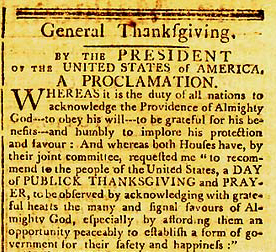
The First Thanksgiving Proclamation: George Washington, 1789

Note the perspective of our first President on the relationship between people of faith and civic responsibility, the idea that we, as a nation, would need the involvement and intervention of Almighty God, and in the final sentence, the idea that religion, virtue, science and prosperity are interconnected rather than opposed.  Make of it what you will. Surely not all change is progress…

THANKSGIVING DAY 1789
BY THE PRESIDENT OF THE UNITED STATES OF AMERICA – A PROCLAMATION

Whereas it is the duty of all Nations to acknowledge the providence of almighty God, to obey his will, to be grateful for his benefits, and humbly to implore his protection and favor – and Whereas both Houses of Congress have by their joint Committee requested me “to recommend to the People of the United States a day of public thanksgiving and prayer to be observed by acknowledging with grateful hearts the many signal favors of Almighty God, especially by affording them an opportunity peaceably to establish a form of government for their safety and happiness.”
Now therefore I do recommend and assign Thursday the 26th day of November next to be devoted by the People of these States to the service of that great and glorious Being, who is the beneficent Author of all the good that was, that is, or that will be – That we may then all unite in rendering unto him our sincere and humble thanks – for his kind care and protection of the People of this country previous to their becoming a Nation – for the signal and manifold mercies, and the favorable interpositions of his providence, which we experienced in the course and conclusion of the late war –for the great degree of tranquillity, union, and plenty, which we have since enjoyed – for the peaceable and rational manner in which we have been enabled to establish constitutions of government for our safety and happiness, and particularly the national One now lately instituted, for the civil and religious liberty with which we are blessed, and the means we have of acquiring and diffusing useful knowledge; and in general for all the great and various favors which he hath been pleased to confer upon us.
And also that we may then unite in most humbly offering our prayers and supplications to the great Lord and Ruler of Nations and beseech him to pardon our national and other transgressions – to enable us all, whether in public or private stations, to perform our several and relative duties properly and punctually – to render our national government a blessing to all the People, by constantly being a government of wise, just, and constitutional laws, discreetly and faithfully executed and obeyed – to protect and guide all Sovereigns and Nations (especially such as have shewn kindness unto us) and to bless them with good government, peace, and concord – To promote the knowledge and practice of true religion and virtue, and the increase of science among them and Us – and generally to grant unto all mankind such a degree of temporal prosperity as he alone knows to be best.
Given under my hand at the City of New York the third day of October in the year of our Lord 1789.
GO. WASHINGTON.

Duped?

I don’t do political rants. First, because I believe the most important races are for school board and town council and no one wants to read about those. Second, because political rants alienate half your friends. The good news is that I have found a way to alienate 100% of my friends, making it possible for me to put up the first, and probably only, political post you will ever read from me. How does one make everyone angry? First, to say I like Obama. Those are “fightin’ words” to half of America. Second, to say, “He duped me and everyone else on his email list.” Those are “fightin’ words” to the other half. How were we duped?

I received multiple emails like the one on top from the Obama campaign urging me to give immediately because of how badly the campaign was being out-fundraised by Romney. Tuesday night CNN ran this graphic revealing that the President not only wasn’t desperately behind in fundraising, but Obama actually outspent Romney 342 to 164 million dollars. Days before the end of the election and I was being told of an urgent need to “get on board” financially when in actuality the President was outspending his opponent by more than a 2:1 margin.

Hmmnnn.

We live in a great country. We listened to two good men campaign on different solutions for our problems. We went out and made our choice. I just wish telling the truth were held in higher regard in the process.