Predestination for Dummies

Weighty theology made simple(r)

hqdefault.jpg

Snark Meter Sorta Snarky.002

If there is a $64,000 question in the Christian faith it is predestination. When it comes to God, who chooses whom?

To consider this age old question look at the passage in John chapter 10 (vs 22-30) in which Jesus delivers one of his “ouch” comments to the religious. Jesus has just finished a sermon in which he used the metaphors that he is both “the door” to the town corral, and “the good shepherd” working for the sheep’s benefit. The religious leaders, upset at the implication that they are profiteering off of and abusing the “sheep,” chase Jesus from the lecture hall and press him: “Stop beating around the bush, are you the messiah or not?

Like a professor on his way back to his office after a controversial lecture, Jesus stops to speak to these unreceptive students. “I have told you. And in case you missed the lecture, I hold healing labs every afternoon.”  The religious leaders are absolutely irate at his answer (in vs. 31 they pick up stones to kill him). Jesus response is, “I’m more than the promised deliverer, I am actually one with the God who sent the deliverer to you…but you can’t understand that because only the chosen here my voice, and you simply aren’t among the chosen.” (v. 25-30) It is an uncomfortable passage – a first century mic drop.

First century sheep in a community corral knew their shepherd’s voice and followed them out to pasture as they sang. Jesus is not so much making an accusation as a statement of fact – those who lack relationship with him are unable to hear his voice. They don’t believe so they don’t hear. And because they don’t hear, they won’t follow. They are apart from him. Therefore, no one is protecting them from being snatched in the end – they don’t have eternal life. The bad news in the Good News is that while all may be invited to the party, not all will show up to it (Matt. 22:1-14). But, hurt feelings aside, Jesus answer raises a theological question that has not gone quietly into the night after some 500 years: When it comes to God, who chooses whom?  

Jesus lobs up an idea here (and in many other places) that God is sovereign and chooses who will have faith. John 15:16 is the classic: “You did not choose me, but I chose you…“. But Jesus also offers up the opposite thought: “But to all who did receive him, who believed in his name, he gave the right to become children of God.” (John 1:12) Which is it? Does God choose humans, or do humans choose God? Christians on both sides of the question agree that God created humanity and, in the fulness of time, redeemed wandering humans through Jesus’ cross, and now initiates relationship with humans. But when it comes to the human response, is our response caused by God, or do we initiate our response ourselves? When we ask, “Who does the choosing?” we have two apparently contradictory ideas held up in the Bible: “Whoever believes in him has eternal life” (John 3:16), yet, “No one can come to me unless the Father…draws him” (John 6:44). So, again I ask, who is choosing?  Jesus’ answers often raise more questions. He is a frustrating savior.

There is a tension between God’s initiative and human responsibility not resolved in the Bible. God draws, yet you and I are presumed to be responsible. God chooses. Yet we must choose. So is it our choice or God’s?

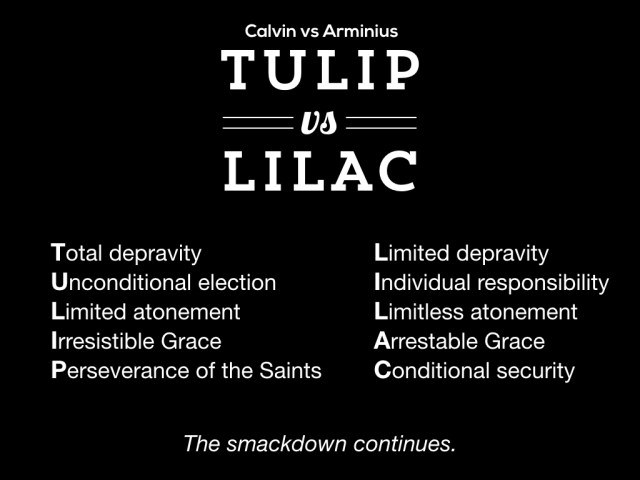
The theological terms for this question are monergism vs synergism. Is it God alone (monergism), or do humans play a role with God in salvation (synergism)? We’ve created entire theological systems around the question: Calvinists (who think it’s all God) have TULIP and Arminians (who think humans are “able”) have LILAC. Both systems are elegant in their internal consistency. Both bump up against the Bible at key points – all over are two seemingly inconsistent ideas: God is sovereign, in charge of the world and chooses you and I, and yet, you and I are accountable for our response to God. The very word “accountable” presumes that, since we are “able,” we are held to “account.” (Remember, the most basic Protestant tenant of biblical interpretation is to “assume the clear meaning of words.”)
Tulip v Lilac.001.jpeg

It is a classic conundrum: If God knows all, is all powerful, and sovereign over all, what kind of free will do we have? If God is really all loving and allows us to choose, have we not saved ourselves? And if we save ourselves, did we really ever need God to begin with? Yet the scriptures, both Old and New, hold up both premises: God is sovereign. We must respond. I know what you are starting to think: Matt, quit dodging the question! But if scripture rather than my system be the foundation of the Christian life, I simply cannot.


Yes, some preachers commit to one system and some to the other. But the truth is that honest preachers can’t give the question of who’s doing the choosing a neat bow that explains all the scriptures’ teaching on this point. The Gospel is so simple a child can understand it, yet so deep that the most brilliant folk to walk the earth have spent their lives plumbing its’ depths. We just cannot tie a neat bow around the issue of God’s sovereignty and human freedom. We are in mystery here, and it would be wise to tiptoe at this point. Jesus said, “You did not choose me, but I chose you.” And we know that every page of the Bible implies that our choices count, or, as Joshua said, “Choose you this day whom you must serve.”

What I know is this: The bible tells us that God chooses. Full stop. And God tells us to choose him back. Full stop.

And that is, frustratingly, that.


What’s Really Great About Texas: A Newcomer’s View of the Lone Star State

Texasnottexas

Snark MeterMID.002

I had heard the stereotypes of the brash Texan. You know the Hollywood image: boot, big-buckle, wide-brim wearers convinced their state is the center of the universe, the Eden of God’s creation…who on a second beer launch into a soliloquy of Texas possessing a larger, more impressive version of any landmark or feature anywhere else on the planet. Well, after nearly a year of Lone Star living, I tip my Stetson to the stereotype. Most Texans are indeed convinced to the bottom of their Lucchese boots of the unique and unrivaled beauty of the Great State of Texas. State pride is everywhere here: Lone Stars are plastered on everything from automobiles to ice cream machines. Four foot tall five-points festoon the exteriors of suburban homes. There are more state flags in Texas than grains of sand on Gulf Coast beaches. “Don’t mess with Texas” isn’t just a highway anti-littering slogan, it’s a state motto.

What Texans don’t know is that the strength of Texas is not its uninterrupted, “pretty-ish”-on-the-one-right-week-of-the-year topography. Texas has horrible weather and dizzyingly tall high-rises built to look out over nothing more than unending prairies and smog. Texas, while spread over 1/3 of the continent, has less elevation change than any other Western state. Most of Texas is flat. Flat with grass. Flat with trees. Flat with cactus. Flat with thickets. Do you hear the common denominator? Texans will drive three hours from Houston to spend the weekend in hills, something people in the rest of America only need step outside to find. No, the strength of Texas is not Texas.

The strength of Texas is Texans. Somehow the interminable swath of tedious topography known as Texas bred a new type of human, the Texan. The Texan is as unique as the Texas topography they love is not. Texans are faithful, courageous, confident, resourceful, and gracious. Texans are tough on themselves and hospitable to guests. While they may have earned the reputation for being insufferable about their state, they are humble and self-effacing about their own accomplishments. Texans consider strangers family, give the shirt off their back, and show up for your barn raising. Texans bring Texas sheet cakes the size of Rhode Island to church socials and casseroles to sick neighbors. Texans celebrate your gusher and cry with you when your hole was a bust. Texans know how to play: They know about beer and bourbon, football, fishing, and guns. For Texans, rodeo is something you do and give your kids a day off school for, not a road you buy designer goods at retail on. Texans still go to church and mean it when they say, “God bless you.” I was with a group of Texans at a beer tasting on a church retreat. Seriously. A Texas football team was in the playoffs. Football is a spiritual experience for Texans so, naturally (to them), the game was on the television. When the national anthem began, without a word, every man in the room quit talking and tasting, and turned and faced the flag with hat over heart. Really, they do that in Texas.

To the rest of America I say, trust me, you want an invitation to the home of a Texan or a Texan beside you in a dark alley. You want a Texan as your attorney or banker or shoe shine guy. But when Texans talk about “the great beauty” of Texas, folk from the rest of the country wonder if someone has spiked their mint julep with something more hallucinogenic than bourbon.

After nine months in Texas, do I want to go home? Nope. I’ve begun to feel what many Texans say, “I wasn’t born here, but I got here as quickly as I could.” But not because of Texas, because of Texans. Because of Texans, Texas becomes “home” faster than any place on earth. But the next time a Texan wants you to drive two hours to look at a rock or a hill or the fender of a ’61 Impala that got stuck in an embankment, forward this article to them. They still won’t believe that you have no interest at all in their “landmark” at the end of a torturously long country road, but that you are there because you are honored to spend the day with a Texan.

…And I’ll lay odds they invite you to dinner and try to pick up the tab.

Easter’s Empty Promises


Unknown.jpeg

Snark MeterrealMID.003

In the classic movie A Christmas Story there is a scene in which Ralphie receives a decoder in the mail to decipher the encrypted messages at the end of the Little Orphan Annie radio show. Ralphie tears open the package, turns on the radio, and waits in great anticipation for the secret message at the end. With the untranslated note in hand, Ralphie runs to the one room a 9-year-old can decode in secrecy, the bathroom. He locks the door and feverishly deciphers… The background music and the pounding on the door by younger siblings urgently needing in crescendo as Ralphie reads the covert message: “Be. Sure. To. Drink. Your. Ovaltine.” The camera closes on Ralphie’s disappointed face as he says, “A crummy commercial!”

Ralphie is not the only one who has been played. The world has perfected ‘the empty promise”- the exploitation of our deepest desires: our need to “be in the know,” our need for relationships, financial freedom, health, security… the world twists our desires back on us, promising us that for a few easy payments we can have, have, have. But over and over the world’s promises prove empty.

One researcher when hearing that people with a 500k net worth defined, “financial security” as 5 million dollars, asked people with a net worth of 5 million dollars to see what they thought financial security looked like. Their answer: 50 million. Cadillac, knowing that if we do “arrive” it only highlights the emptiness of the promises, is pitching the idea that we should never arrive, just “Maintain The Pursuit.” The world has sold us the empty promise, the “crummy commercial,” that if we only had 10x more emptiness that would somehow equal satisfaction. The math doesn’t add up, but we keep debiting our bank accounts to litter the doorsteps of our souls with packages full of empty promises.

But here is the good news: God doesn’t play that game. Instead of empty promises, Easter is God’s emptiness full of promise.

Consider the three empty promises of Easter in Luke 24: An empty cross, and empty tomb, and empty burial clothes.

That first Easter morning our text joins grieving women on their way to finish the traditional burial rituals and pay their last respects to Jesus.

 v.1 “on the first day of the week, at early dawn, they went to the tomb, taking the spices they had prepared.” Coming over a rise the women see three crosses silhouetted against the rising sun. They draw near and gaze upon the center cross, the one that had held Jesus. Dark stains mark where his hands had been affixed. Splotches where the thorns had cut into the back of his head. Streaks down the rugged cross reveal the scourging of his back. They pause silently before the large dark patch on the ground where Jesus had bled out when a soldier ran the spear into his heart to confirm his death. In the starkness of that bloodstained wood lies our first promise: Sin is forgiven.

Our problem, God tells us, is not that we need to achieve more of the empty promises we seek, but that we are looking look for life apart from God – to use God’s simpler word, our problem is “sin.” Isaiah had written “your sins separate you from God.” (Is. 59:2) Sin was why Jesus said he went to the cross – As Paul said, “While we were yet sinners Christ died for us.” (Rom. 5:8)

Our first promise, the promise of the empty cross, is that you and I have a substitute – One who was “pierced for our transgressions.” (Is. 53:5) Our women, in their grief, have not yet connected that Jesus was the Passover lamb slain for the sins of the world. The empty cross, though, is the promise that sin is, once for all, forgiven.

The ladies continue on the short distance to Joseph of Arimathea’s family tomb. They had removed Jesus’ lifeless body from the cross, and placed it in their influential friend’s nearby family burial cave on Friday afternoon. They had completed as much of the burial ritual as they could before the holiday began. Several days later and still devastated, they return. v.2 “they found the stone rolled away from the tomb, but when they went in they did not find the body of the Lord Jesus.”

Nothing is as it should be: No stone, no seal, no guard. And looking inside, no body. They double-take to make sure they were at the right place. They have found the second empty promise of Easter: the empty tomb.

The emptiness of the tomb is disorienting because Jesus’ executioners made quite sure this particular tomb could never become empty. While Jesus’ disciples hid for their lives, the religious leaders and their Roman overlords, knowing Jesus’ predictions of an encore, had prematurely covered the tomb with the large stone door, sealed it with the imprint of the emperor, and stationed a unit of Roman soldiers, the most skilled, highly armed killing machines the world had yet seen. They inadvertently gave posterity a gift: a clear evidence trail. But the women are not conducting an investigation, they are grieving their slain master. Confused, their minds attempt to piece together the emptiness…

 v4 While they were perplexed about this, behold, two men stood by them in dazzling apparel. … frightened they bowed their faces to the ground, the men said to them, “Why do you seek the living among the dead? He is not here, but has risen. Remember how he told you, while he was still in Galilee, that the Son of Man must be delivered into the hands of sinful men and be crucified and on the third day rise.”  The most “perplexing” part of this for our ladies, isn’t seeing angels but their even more unlikely message: He “has risen.”

Speaking of “empty,” these days many offer empty accusations: Jesus wasn’t really dead, they went to the wrong tomb, the disciples (eleven terrified, hiding dudes) took it. One modern scholar even suggests they never did put Jesus in a tomb, he was eaten by dogs. No rats. No dogs. Implausible excuses manufactured by those ignoring the evidence, like a sophomore trying to explain why they showed up without their Algebra homework. One wonders if they dost protest too much. Or perhaps they simply realize what the apostle Paul realized in the first century: that if Jesus did walk out of that tomb, then he is the Son of God and death itself has been conquered (1 Cor. 15). If Jesus is “Risen indeed,” then I must lay down my empty excuses and follow him…If the tomb be empty then I must drop the charade of hoping the world’s empty promises pan out…the illusory charade of ownership to a life that was formed by another and bought with a price by One who, “gave his life as a ransom for many.” (Mk 10:45)

Where the empty cross tells us sin has been paid for, the empty tomb tells us that death itself has been defeated. And if the grave cannot hold Jesus Christ, neither will it hold those who are his.

And so our women, their grief interrupted… v.8“remembered his words, and returning from the tomb, they told all these things to the eleven and to all the rest. … v.11 but these words seemed to them an idle tale, and they did not believe them.” Unsurprisingly, the dead returning to life seemed as tragically absurd to the disciples as it would to you and I.  …except for one who had been surprised by Jesus before.  v.12 Peter rose and ran to the tomb; stooping and looking in, he saw the linen cloths by themselves;

Peter found the tomb as advertised: empty. Then he saw the surprise inside: The clothes Jesus had been buried in – cloth that John chapter 19 tells us had been glued to Jesus’ body with aromatic spices, were lying neatly folded. This is the third promise out of emptiness: Empty grave clothes. If someone had stolen Jesus’ body, why pry off the burial clothes and fold them neatly? What burglar makes the bed? What Peter saw convinced him forever – Jesus has risen. “… and he (Peter) went home marveling at what had happened.”

Before long Jesus would appear to Mary Magdalene, then to rest of the Apostles, and eventually to more than 500 at one time. He walked with them. Talked with them. Ate with them. They saw him and touched him and talked to him. Once again, they had fellowship with their Lord. That is the promise of the empty burial clothes – Jesus’ presence: his desire for real relationship with you and I. The Christian faith does not promise a vaguely present “force” to be with you. The Christian faith offers a living Savior who desires personal presence with each of us – just as he did 2000 years ago.

Consider Jesus Christ: The cross couldn’t stop him. The tomb couldn’t hold him. Burial clothes couldn’t restrain him – He is risen indeed!

So while the Romans and religious leaders failed to produce a body that looked enough like Jesus to fake anyone out, Jesus walked, and talked, and touched, and loved, and healed. He did it that first Easter and he does it today. And he wants to do it with you and I.

The Christian message is that you and I can know Jesus Christ. We can know his love and care. We can know his healing and forgiveness. We can know his power over sin. We can know his victory over death. We can know him, closer than a brother, present within you.

The women approaching the tomb had no idea the wonderful promises that awaited them:

The empty cross – the promise their sins were forgiven.

The empty tomb – the promise of their eternal life.

The empty burial clothes – the promise they would once again walk with Jesus Christ – their living Savior.

The empty promises of Easter are given freely, “to all who receive him.” As St. John wrote, “To all who receive him, even to those who believe in his name, he gave the right to become the children of God.” The question is will you receive the living One? Will you allow his grace to cover you? Will you allow Him whose promises are demonstrated through emptiness to be your fulfillment?

The Christian faith is much more than a single simple decision, but who you entrust your life too does start there. We can either entrust our lives to the empty promises of the world or the One delivers promises from what appears to all the world to be emptiness.  You choose.


Worship: How Reshaping Desires Redirects Destiny


confused guy.jpg

Snark MeterrealMID.003

Why are you here? Part two 

(In part one I made the case that we all worship and that it is the object of our worship that determines our destiny. In Part two I tell you how to tap into the transformative power of worship and why it works.)

Two kinds of worship: Personal and corporate.

Personal worship is humbly giving God glory and returning God’s love by joyously joining the Triune One’s dance in the interior of our own hearts. We ought to do that. It is the Communion with the Most High in personal worship that gives us songs in the night (Acts 16). But there is another kind of worship: Corporate worship. Corporate worship, which occurs in church, in a group, is an entirely different ballgame. While worship alone with God is about giving God glory and often involves powerful emotions, worshipping corporately is NOT about feelings at all. Worshipping corporately is the way God reshapes our love – the way God remolds us and re-habituates our desires. The way God helps us learn how to let go of the gods of our culture and worship the true and living God. Let me explain:

Our modernist educational system has sold us the incorrect vision that we are primarily thinking creatures (Descartes “I think therefore I am.”). But we experience our lives, not as decisions or commitments, but as story and longing. We experience our lives, not as thoughts, but as feelings. This is why when you had an Algebra test and a huge crush on someone, you had a hard time studying…even when you knew you really needed to focus on Algebra. Descartes was wrong: We are defined and shaped by what we love!

Our futures are determined by our desires. The pattern of historic Christian corporate worship was designed to allow God to remake our desires into God’s desires.

In the Gospel of John, Jesus first words are a question: “What do you want?” Jesus knows that our wants are the well from which our identity flows. That is why Jesus doesn’t ask “What do you think? Or What do you know? He asks “What do you want?”

His last words in John begin with the question: “Do you love me?” The simple truth is that we want what we love. We are first and foremost wanters. We are lovers. We are not defined by what we know or think, but by what we desire. This is why the secret to lasting change in our lives…learning a new instrument, or sport, or a work out plan, isn’t to make up our mind, but to have a greater desire for something that might be. We have to love the image of us dunking a basketball or having ripped abs more than the the social media that distracts us…or the image of being the spouse or parent or employee or leader we admire more than playing Stack on our phones. It is when our desires are reshaped that our destiny is changed.

In the corporate worship of historic Christianity we follow a pattern that, over years of repetition, reshapes our desires into God-shaped ones. The pattern of historic worship goes like this: We gather and read God’s word, the Bible. Then we sing the Bible, someone teaches from the Bible. Then we respond to the Good News of Jesus by stating our beliefs in creeds, praying for the world, confessing our sins, accepting God’s forgiveness, and being reconciled to each other in the passing of the peace. Finally, we bring a portion of God’s material blessings and offer them back to God and set them aside with bread and wine, asking God to make them the body and blood of Jesus. In this meal we are reminded of Jesus and his saving acts on our behalf. As Augustine said, “Eat what you are, become what you eat.” “Eat what you are” (the body of Christ), “become what you eat” (the body of Christ). This takes a lifetime of shaping in a community. On many Sundays worship might be, like many of Michael Phelps grueling, lengthy training sessions, going through the motions. But they are motions that groove the pattern of God into our souls like the grooves on an old record album. It is a grinding that uncovers who we were designed to be. It is a polishing that unleashes our inner beauty to the light. It is the repetition that builds strength and makes Phelps perfect stroke a habit.

But, you may ask, “What about when I am in a large group and we are all raising our hands and the hair on the back of my neck stands up?” My answer is that those times when you experience the worship heebie jeebies are mostly a private worship experience you are having in the midst of a group. The corporate rituals are where the transformative magic actually reside. The experience of “wow” is like topping out on a fourteener on a backpacking trip in Colorado. You get to say you did it, but the real distance happened in the valleys, with little ability to see above the trees and monotonously placing one foot in front of the other.

So why are you here? Answer: You were designed to worship. We will, all of us, bow before something. Who will you bow before? We will, all of us, dance with someone. Will you, as the old saying went, “dance with the one that brung you”? Bowing and dancing are grounded in God’s nature as holy yet merciful. Worship is always diminished when we emphasize one aspect of God’s nature at the expense of the other. We can never fully dance without bowing, and although one might bow without joyfully joining the dance, don’t.

So start your training. “It’s what you do in the dark”…what you do over and over when no one is looking, that brings clarity and performance in the race of life. It is engaging in the discipline of trained worship that will “put you in the light.”

Engage in a regular pattern of repetitive worship. Begin unleashing your destiny this Sunday.

*Photo credit: http://www.tripwire.com

Why are you here?

https://www.youtube.com/watch?v=Xh9jAD1ofm4

Snark MeterrealMID.003

Michael Phelps new commercial unlocks the secret of overcoming uncertainty.

 I watched Michael Phelps new Under Armour commercial today. A powerful testimony to the value of sacrifice, commitment, and repetition, it shows the most decorated Olympian in history preparing for his final Olympiad this summer in Rio. The tag line: “It’s what you do in the dark that puts you in the light.”

I have many meetings with people I refer to as “the uncertain.” Often the person will look up from their coffee or craft beer and say, “I guess the real reason I wanted to meet with you is that I don’t know what I should be doing with my life.” I listen and then politely ask them to back up and ask themselves a prior question, “Why are you here?” My question is generally met with a blank stare. So I gently push the issue, “Really. Why are you here? What were you made to do?” Confusion usually turns to frustration and the stammering of some version of, “I’ve got enough problems without you starting an existential crisis.”

The irony is that they already have the existential crisis. But the willingness to dig deeply enough to get at the root, like my desire to quick-weed my yard in Spring, prevents a true solution to that crisis.

Ultimate questions lurk beneath the question.

“What should I do” can only be answered in light of knowing why we are here, what we were made for.

In another bit of irony, we get at why we are here and what we are for backwards, by starting with what we do. Not our paying job, of course, but we we actually spend our private energy on. (To be clear, in the Christian worldview people are not valued based on human performance, but in the mercy of God based in the performance of Jesus, as seen in his life, death and resurrection for wandering humanity.) But what we spend our time doing points to why we are here and what we are to do.

That thing we do…

What is it we do? Answer: Worship. Uhmm, yes, our secular culture still spends most of its’ time and energy in worship. Worship is a contraction of the old English words “Worth-ship” – that which we value, that which we love, that which we long for. Isn’t most of what you spend your energy on love? We desire. We want. We long. We are worshipping creatures.

In the Old Testament the word that is translated “worship” means to “bow before.” Don’t we all bow before something? The question is, “Are we bowing before the right things?” Young people in American “achiever” culture face tremendous pressure to “bow” – to fit in…look “right,” get to the “right” school, have the “right” friends…act the part. Even among individualistic “meta-narrative rejecting” post-modern males, our “individualism” tends to look pretty uniform. I see a lot of plaid flannel, skinny jeans and untrimmed beards – a grown-up version of the eight junior high girls I once saw in a mall wearing matching “Dare to be different” t-shirts. Sure, we are individuals, as long as you hold to the correct politics and sensitivities of our age. But if what we “value,” what we “worship,” is indistinguishable from our culture, surely we will end up as nothing more than this generation’s shallow sellouts to the outward trappings of our culture’s vision of success.

So we are worshipping creatures, made to worship. And we need to worship beyond ourselves. Redirecting our worship outside of ourselves, at the one who made and redeemed us, gives one a center and a grounding that our culture alone cannot. This is because it is worship rightly directed that fulfills your design, fulfills God’s plan for you. Worshipping God is the first step in identifying what one should do with their life.

Wait a moment: You are telling me that going to church is going to help me figure out a career? Are you daft? But better than questioning my sanity would be the question, “How does one best worship beyond themselves?”

Worship in the Christian worldview has been grounded in a vision of God’s two-fold nature revealed in the Old and New Testaments. God has many more characteristics, but the two foundational ones in historic Christianity have been that God is both perfectly holy and perfectly loving.

Holy yet loving. …Transcendent yet immanent. Awesome and out there, yet intimate and desiring to indwell us by the Holy Spirit. Out of God’s nature comes our need to worship. (Col 1:16, Eph 1:11, 1 Pet 2:9, Is 43:6-7)

God’s holiness reveals God as the grandest being in the universe. A being who spoke the universe into existence. God is a worthy of worship in the glory of God’s being. A being we should bow before.

God’s love: The Greek Orthodox have the idea of “perichoresis” Greek for “rotation.” The idea is that in the Trinity we have the One God in a divine Three-Person dance. God in love and unity, created humanity to invite us into the dance of eternity. “For God so loved the world” that he breathed it into existence. Then, when we had wandered away into sin and death, he “he gave his only begotten son” as “an offering and a sacrifice unto God.” (Eph 5:2)

These two foundations to God’s nature are revealed time and again in Scripture. Yet, much to our shame, the church has had a difficult time holding these two truths in tension.

Up Next: Part 2: How Reshaping Our Desires Redirects Our Destiny

Smudgy Foreheads


ashes

Snark Meter.005

Wednesday you will notice people with smudgy foreheads. When you see this, resist your inner-parent urging you to dab at them with a moist napkin. They are not the victims of poor grooming habits, nor have they lost a dare. It is merely Ash Wednesday, the day in which Christians of the ancient traditions commemorate the beginning of the season of Lent by attending religious services in which they were charged to, “Remember that you are dust, and to dust you shall return.”  (Genesis 3:19)

What is Lent?

Lent, is the archaic word for “Spring.” It has come to refer to the 40 days of spiritual preparation preceding Easter. Christians traditionally spend the season before Easter in repentance, almsgiving, and self-denial in an effort to remember our need for God and God’s great saving acts in the passion and resurrection of Jesus. (40 is symbolic of Jesus’ 40 days fasting and temptation in the wilderness)

Where did it come from?

The tradition of ashes has its roots in the ancient Jewish prophets who urged “repent in sackcloth and ashes.” Among Christians, the imposition of ashes and the 40 day fast began in Europe in the 4th century.

What’s the point?

Ash Wednesday and Lent are not about spiritual brownie points, impressing God, nor making belated New Year’s resolutions, like dropping that last five pounds by cutting chocolate.  Rather, Lent is about mindfulness – Thinking more about God and others, and less of ourselves. Christians are penitent during Lent because we are grateful for God’s provision for humanity through Jesus.

We go to church on Ash Wednesday to be marked outwardly with ashes as we remind ourselves inwardly of our need for the unquenchable, fierce love of God to enliven us.

Christians of the ancient tradition spend 40 days in Lenten practices, either giving up something we enjoy and/or taking on a new spiritual activity. The mindfulness generated by self-denial and self-discipline prepare our hearts to be more fully present for the remembrance of the saving acts of Jesus during Holy Week.

What happens at an Ash Wednesday service?

They are usually brief. You will hear biblical passages calling people to repentance and have ashes imposed on your forehead with the words, “Remember you are dust and to dust you shall return.” (Gen 3:19) Holy Communion is then celebrated.

Checking out a service…

You do not need to be a member to attend. EVERYONE is welcome at an Ash Wednesday service. EVERYONE is invited to receive ashes. Although different churches have different rules for receiving communion, in the Episcopal church our canons ask you to be a baptized Christian to receive communion. (If you are not baptized you may simply stay in your seat or come forward with the congregation, arms crossed, to receive a blessing).

Tired of the noise?

In the midst of debates and news cycles and narcissism, when even America’s pastor urges us to be our own “I Am”, engaging in self-examination and the contemplating our own mortality is refreshingly against-the-grain. Ash Wednesday and Lent create space to become more aware of our need for reconciliation with God and others. Ash Wednesday is an active way to do that with the support of other seekers. This Wednesday, find a service and attend!

2016 Christmas Wish for Evangelicals: Drop the War on the War on Christmas

Courtesy StarbucksCourtesy Starbucks

Snark Meter.005

In your Christmas clearance shopping I suggest stocking up on a gift we evangelicals could give the world next Christmas: Drop the war on “the war on Christmas.” Lets stop trying to out-Grinch the Grinches.

In the children’s Christmas classic, “The Grinch Who Stole Christmas,” the Grinch was a grouchy, cave-dwelling monster with a heart “two sizes too small.” From his lair on icy Mount Crumpit, the Grinch could hear the merry Who’s preparing for their Christmas festivities in Whoville below. Annoyed, the Grinch decides to stop Christmas from coming. He crudely disguises himself as Santa, and forces Max, his loyal but unloved dog, to drag his sleigh to Whoville, where he steals all of the Who’s Christmas presents, trees, and, as he disappears up the chimneys, even the log for their fires.

Yes, American culture does seem to be taking a hard turn from our Christian Christmas cultural assumptions

With the “Starbucks war on Christmas” hoax, you might have missed the less spectacular but actual cultural squeeze:

-Brunei mandated jail time for Muslims celebrating Christmas but generously deciding that Christians could celebrate, as long as the decorations were not visible from the street.

–Australian schools outlawed carols. So did VA hospitals in the U.S.

–New Hampshire was added to the list of states whose public schools do not allow the word “Christmas” on printed material or in classrooms.

–A Brooklyn principal outlawed all references to Christmas, stars, and Santa because they might “represent a religious system.”  (Santa is religious?)

And how have Christians responded? Grumpiness, lawsuits, and economic boycotts.

Imagine how different the Grinch that Stole Christmas might have been if Whoville had been populated by American evangelicals…

The people of Whoville were in quite a tizzy.

Nativities and carols gone awol, we’d better get busy.

Boycotting and arguing on the news shows,

expressing our outrage until our face glows.

Organizing alternate candidates to run.

And filing our lawsuits, crowdsourcing its’ fund.

war-on-christmas

The negativity and desperation are not very attractive. But, if we cannot remember the Bible’s encouragement to return good for evil, perhaps we can remember how the inhabitants of Whoville actually responded…

As dawn breaks on Mt. Crumpit, the Grinch is preparing to dump the town’s presents into the abyss. Listening for the Who’s bitter and sorrowful cries, the Grinch is puzzled to hear them, not lamenting, but singing joyful Christmas melodies. It dawns on him that, “maybe Christmas, perhaps, means a little bit more” than just presents and feasting. The Grinch’s shrunken heart suddenly grows three sizes larger, and the converted Grinch returns the Who’s presents and is warmly invited to the Who-feast, where he has the honor of carving the Roast Beast.

If only that were the strategy we would adopt!

We cannot fix internal spiritual issues with external political solutions.

Broken systems are the result of broken people. Our political and educational systems are merely windows into who we are as a people. In Phoenix we lived on a corner. And because of how our house was angled, our front window was a magnet that drew the eyes of everyone who drove down Northview Ave. One Advent season, after our impressive Christmas tree had been up several days, I was outside and noticed that I hadn’t put any ornaments on the back side of said tree. How embarrassing – our beautiful tree was grotesquely bare to the street. Now I could’ve painted the window to fake a well-decorated tree or I could pull the decoration boxes back out of the attic and stretch around and fix the tree. Friends, attempts at political solutions to the passing of Christmas from the public sphere is nothing more than painting a phony picture on the front window. The problem isn’t the window. It’s what’s inside. Americans are not celebrating Jesus on the inside. Looking “Christmas” on the outside does not fix that.

People fear the baby because they don’t know the baby.

Church attendance tells us that most Americans simply don’t know the baby as the king of the universe. That he existed before all things. That he was both God and human. That he is the one “by whose stripes we were healed.” That he would die in our stead, to forgive not just our grinchiness but all of our other sins. That Christ alone has the power to bring us peace with God. They don’t know that he left us His Spirit to live within us, his church to support us, and promised us eternity in his grace-filled presence. You need to know that story. You need to let it soak deep so deeply into your bones, to marinade in it so deeply, that God’s love leaks out of you every time you open your mouth…to become a walking song from Whoville wafting into the ears of the Grinches.

It is only the Gospel that makes the bitter joyful, that heals burned over hearts. That reminds us that from God’s forgiveness we offer others forgiveness. Our neighbors will never really see love in the crèche at city hall. They can only see it in you and I. It is God’s forgiveness that gets inside the windows. And the last thing anyone needs, especially today, is a painted on faith.

I had an old youth group kid once who was a pk. And as preacher’s kids go, he was a pretty good one. But he had a bizarre desire to “look more Christian.” He was obsessed with his external “testimony.” I told him, “Quit worrying about looking like a Christian. Just draw close to Jesus and others will see him.” Jesus always shines through the windows.

My encouragement for next Christmas: Return being grouchy and seeking political “wins” today. In your day after Christmas bargain hunting, stock up on the joy of introducing people to Jesus   the great miracle of God with us. Christmas is for giving because, after all, “God so loved the world that he gave…”


What is truth?

15813134301_faf9c81d6f_bSnark MeterrealMID.003

Our cultural “believies” and the war against fundamentalism.

Unless you have spent the last two weeks living under a rock you have been stunned by the violence in the name of religion. This is not the first time the news has been bad. And not the first time religion was involved.

In the Christian calendar last Sunday was Christ the King – the one modern day in our liturgical year. Christ the King Sunday was given to us by pope Pius XI at the end of WWI. As hard as it is to imagine, the carnage then was far worse: 18 million died as machine guns, planes, tanks, chemical warfare brought our ability to kill into the modern era.  And an ugly truth: the leaders on both sides claimed to follow Christ.

Pius XI called it, “a failure to remember God.” He thought, “the people need to remember that this world does indeed have a king, but that king is not us. The pope set aside the last Sunday of the Christian year as an acknowledgement of the gracious rule of the King of Peace…and to grieve and groan our failure to walk in the way of peace. It is a day to remember and return – sort of a societal Ash Wednesday.

Christ the King is a powerful idea. But there was another response to the Great War: Rather than deepen religious commitment, some philosophers and politicians sought to eliminate it. The results of the attempt to eliminate religion were staggering. The next 70 years saw the atheistic states of Lenin, Stalin, Hitler, Mao, Amin and the Kmer Rouge kill more people than every religious war in history. Somewhere between 110 and 260 million people died at the hands of those seeking to eradicate religion.

Religion proved far more resilient than they imagined, though. 20% of America was still in church last Sunday. China and Africa are in the midst of the fastest extension of Christianity in history. Hinduism, Buddhism and Islam are also growing. Social science has acquiesced to a persistent truth: Humans are religious.  Maybe you have noticed that the narrative has changed from “God is dead” to “there are too darn many gods.” But a question remains: What do we do when people behave badly and use religion to justify that behavior? Since eradicating religion didn’t work, today another solution is being tried: To relativize and privatize religion.

You may not know it, but this isn’t the first relevatizing’s first rodeo. Pontius Pilate attempted the same strategy 2000 years ago. (John 18:33-38) Hours before being crucified Jesus was delivered to Pilate’s doorstep by religious leaders begging for his execution. Pilate, of the Roman knight class, was governor – the ancient version of being on a military “remote.” Do well and he would retire to a cushy life. Blow it and he would return home in disgrace. The last thing Pilate wanted was a religious squabble getting out of hand. Going inside he asked Jesus,  “Are you the king of the Jews?” (v.33) Jesus replied,  “My kingdom is not of this world, that’s why my soldiers aren’t fighting.” (v.36) In other words, Jesus wasn’t breaking Roman laws.

Pilate pressed him, “So you are a king?” (v.37) Pilate wants to worm his way out of the sticky political mess outside. Jesus wants to get into the mess that is Pilate’s interior: “I have come to bear witness to the truth.” “Everyone who is of the truth listens to my voice.” Even on trial, Jesus is inviting Pilate to himself. Pilate shrugs,  and utters the expression forever linked to his name, “What is truth?” (v.38) Then, knowing he is going to condemn an innocent man, Pilate walks out without waiting for an answer.

We all have times when we, like Pilate. don’t want to hear it…times when we want what we want and don’t want others intruding on those wants. Quite the opposite of Christ the King, this is me the king. Comedian Charles CK calls these, “my little believies.” He says, “I have things I believe. I don’t follow them. They just make me feel good about who I am. They are my believies.” “Believies” aren’t new, they’ve been with us since Adam and Eve did what they wanted in the garden. It’s always easier to walk away from truth than to confront where our beliefs lead.

In his book The Reason for God Tim Keller looks at our cultural “believies.” The first “believie”: “There can’t be one true religion.” The claim to exclusivity, we are told, is wrongheaded and dangerous. “After all,” this line of thought goes, “religion is nothing more than a cultural construct – Syrians are Muslim and Americans are Christian because of the culture in which we were raised. The arrogance that arises from the conviction that one has the absolute truth is responsible for the evil in our world.” So, we are told, religion should be condemned and relegated to the purely private sphere of life.

Tim Keller points out, though, that condemning religion is only possible if one holds to some other, some alternate, belief system – and all belief systems require both a “leap of faith” and a perspective of superiority. For the secularist both of these are inherently inconsistent. Keller also argues that privatization is never possible as everyone, no matter what faith or creed, brings a value system into the public discussion.

Now we are hearing a new “believie”: “Religion isn’t the problem. Fundamentalism is.” But be honest, we all have fundamental beliefs. In a pluralistic world the issue isn’t how deeply we hold our beliefs, but where those beliefs lead. Rather than pretending differences do not exist between religions, what if we were honest about them and instead evaluated which set of beliefs lead their believers to be the most loving and receptive toward those with whom they differ? Which set of unavoidably exclusive beliefs lead to humble, peace-loving behavior? Using those criteria, I believe Christianity has much to offer a world in crisis…much more than the secularists solution of relative, culture bound, privatized religion.

How could you possibly trust someone holding the philosophy that truth is relative not to cheat you?

After all how could you possibly trust someone holding the philosophy that truth is relative not to cheat you in business? Not to cheat in your marriage? To finish the job of parenting your children? Oh, a relativist might do all of those things. But there is nothing in their belief system to encourage their dependability. Heck, you can’t even count on the relativist not to crucify the innocent son of God.

The problem with our culture’s believies, is that they leave us with bigger problems than they solve. In contrast to our culture’s “spiritual but not religious” view, the Christian world view teaches:

  1. Truth is Objective (Truth is what is.)

Atheist Bertrand Russell talked about proving a teapot orbiting between earth and Mars.” But my ability to argue the point is irrelevant to that object’s actual existence. Either a teapot is spinning out there or it isn’t. Contrary to the oft repeated myth that truth is relative, Truth is what is, regardless of what I would like it to be. 

  1. Truth is Revealed: Truth is difficult to discern. Luckily we were not left on our own at this point. Truth was revealed generally in nature, but specifically in Jesus Christ and God’s word, the scriptures. Truth is what God says it is…not what I or my culture would like it to be.
  2. Truth is Narrow: The only area in which we struggle with the idea that truth is “narrow” is religion. Think about it…

Do you want a chemist with a broad definition of chemistry? Imagine a “broad” chemist bringing you a glass of H2O2: “What is one little extra atom of oxygen among friends?” Unfortunately H2O2 isn’t water. It’s peroxide. Truth is narrow.

Do you want an accountant who has a broad definition of addition? “Who says 2+2 must = 4? Why can’t it equal 3 or 311?” I’m guessing the IRS auditor will not be sympathetic. Why? Because Truth is narrow.

Do you want a pilot with a broad definition of what constitutes a runway?  “That airport is really busy today, but the freeway is long and straight. How about we set this 737 down on the Interstate?” Truth is narrow.

Do you want a spouse with a broad definition of love? “This is great Janice. Our love is awesome. Why don’t we share it…You have four sisters. Let’s all get married!” The answer to all of these is, No way! Truth is narrow. And finally…

  1. Truth is not private, it’s Personal. For a Christian, truth is not a what, truth is a who. Christian faith is based in the who of Jesus Christ. God loved humanity so completely and so relentlessly, that having seen our rebellion from before creation, God had a plan in place to redeem our fallen world. It involved his son Jesus Christ personally coming to earth, demonstrating a life of peace and self-sacrifice…A life of love and intimacy with his Father. And a life in which our rebellion and God’s wrath would be satisfied by Jesus’ self-emptying love – his personal replacement for you and I on the cross. And we know it worked because three days later Jesus walked from the tomb, seen by scads of people, and was bodily assumed into the clouds before his stunned follower’s eyes. People, truth is personal – bound irretrievably and irrevocably to God’s love for you, personally, through his son, Jesus Christ.

What is truth?

Jesus told Pilate, “I came to bear witness to the truth.” Jesus Christ said, “The truth will set you free.” And Jesus said, “I am the truth.” Looking at Jesus, his friend John wrote, “To all who receive him. Even to those who believe in his name, he gave the right to become the children of God.” For Jesus, this is personal. It is about you and I becoming family with God.

What do we do with Truth?

The great need for truth in our day is not to win the argument for absolute truth’s existence, but to walk in humility as children of the True One. What part of the truth of Christ’s kingship over your life bugs you? What do you not want to wait around and hear? Where are you passing the buck or fearing another’s agenda in your life? When you see the news do you fear? Or do you see God’s opportunity to share the love and light of Christ? The world cannot afford for you and I to privatize our faith. If you are the follower of a King whose kingdom is not of this world, despair not – light shines brightest in the darkness. The world most needs light when it is dark outside.

(An adaptation of a sermon. To watch that sermon click the graphic. Sermon starts 17 minutes in.)

Christ the King 2015.001


Larry Bird and the power of repetition (pt. 2)

Part 2 of a series on the Daily Office

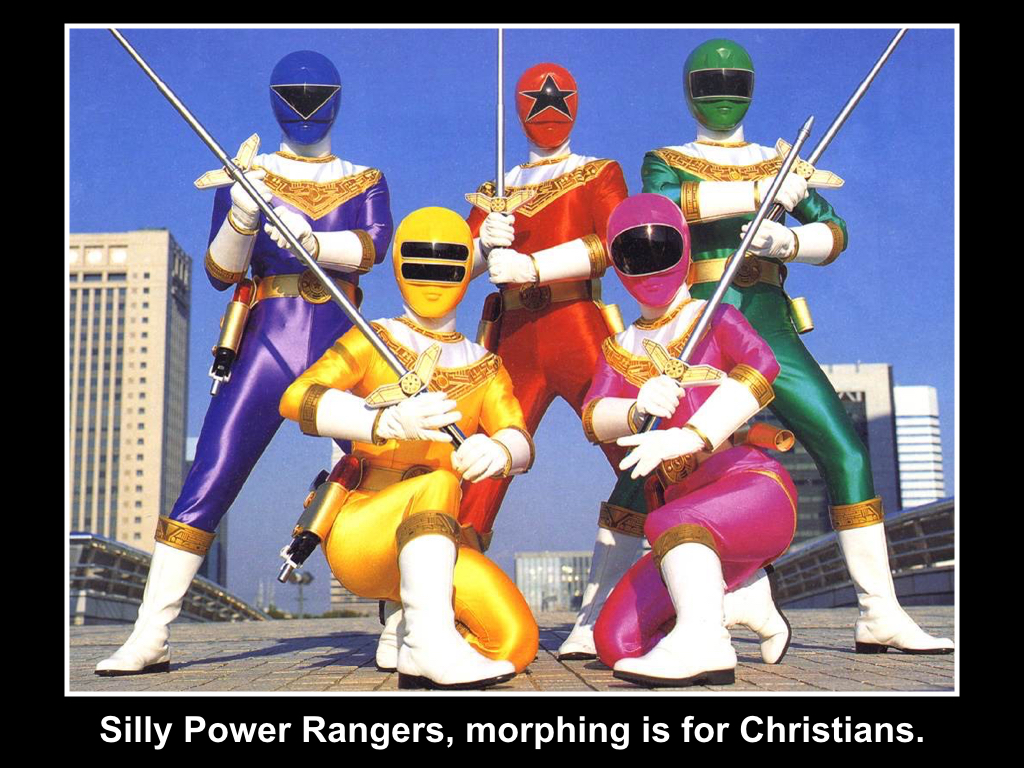
How is one “remolded” from within? How are people “transformed”? It helps to know a bit about the word we translate “remold” or “transformed.” The original Greek word is “metamorpho.” We get “metamorphosis” from it. “Morphing” entered the public consciousness in the 1990’s in the children’s show, “The Mighty Morphin’ Power Rangers,” in which teenagers had the power to transform, accessing super powers to save the world from alien invasion. There is also a DC Comics superhero by the named Metamorpho who is so transformed that, unlike most superheroes, he cannot return to his pre-changed state.

250px-Nolan_metamorpho

The problem with “morphin’” as a pop-culture phenomenon is that the Power Rangers gave us the silly idea that morphing is something that we could do ourselves and do in an instant…and a change that could be undone just as easily. Scripture paints a different picture. In the New Testament “Metamorpho” is only used three times: Once of Jesus who is “morphed” at the transfiguration. The second is in Romans 12:2. The third is in 2 Corinthians 3:18 “And we all, with unveiled face, beholding the glory of the Lord, are being transformed into the same image from one degree of glory to another.


Silly Power Rangers.001

In both places Paul uses “metamorpho” to refer to followers of Jesus the word is in the passive voice – the action of transformation does not happen by us rather it happens to us. In both places it is in the second person plural, “y’all” – In other words the “transformation” is for the whole church as a community, rather than merely for the rare super-hero or super-saint. In both places being “remolded” presumes a life-time of faithfulness rather than the instantaneous appearance of transformation, such as Jesus’ transfiguration or the Power Rangers. In 2 Corinthians 3:18, “metamorpho” is the process of becoming like Jesus: “being transformed(by the Holy Spirit) “into the same image (Jesus), from one degree of glory to another” (we become progressively more like Him). These two usages of “morphing” leave us with three principles: 1) Transformation is a work of God’s grace that happen to us rather than by us, 2) it is for the whole community, 3) it occurs over a lifetime…in other words, through repetition.

Interestingly enough, the power of repetition to change us is exactly the idea the Anglicanism was founded on. The concern driving Archbishop Cranmer, assembler of the first Book of Common Prayer, was how to make disciples of Jesus in a nation in which the king had just dissolved the monasteries and their communal life of prayer. Archbishop Cranmer, in the Preface to his first edition of the Book of Common Prayer (1549) set forth the following goals to course-adjust the worship of the English church, freeing it from medieval papal innovations:

  1. Combine the seven books necessary for communion, daily prayer services, and scripture readings into one book for use by all Christians (rather than just the clergy). That way the church would “need no other books for their public service, but this book and the Bible.” Worship, thereby, would be “by the book” – a book of shared prayers. That book would be…
  2. Understandable – rather than the “holy language” of Latin, the bible and the prayer book would be read in the language of the people so that “…they might understand and have profit by hearing.”
  3. Common: Everyone in the community would be united by this set of scripturally constructed prayers prayed together that “…the whole realm shall have but one use.”
  4. Scriptural: “The whole Bible (or the greatest pare thereof) should be read over once in the year.

Thomas Cranmer also articulated the idea that scripturally-immersive “common prayer” is the ancient and original method God had used to form the people of God and was “…agreeable to the mind and purpose of the old fathers”  

To the surprise of many Episcopalians, Archbishop Cranmer’s vision for the church and Christian life was not the weekly Eucharist, but the Daily Office: The services of Morning and Evening Prayer. Cranmer, imagined a life in which Christians would meet daily to read and pray the Word of God together as a community in order to live as God’s Word in the community. In the services of Morning and Evening Prayer we read the Bible every day, each year, for the rest of our lives with the result that we would live story-formed lives. As old record albums had grooves cut in them for the needle to follow, Christians lives deeply cut in the scriptures have grooves in our souls that make our lives sing Jesus to the world. The scriptures and the ancient prayers based upon those scriptures form a daily routine grooving the patterns of Jesus into our lives, transforming us into the image of Christ through a pattern that we surrender ourselves to – an immersion in the scriptures deeply permeates our souls s0 that when tough times come we go into layup mode-automatically channeling the stories, cadences, and rhythms of the presence of God.

What might we be like if Christians were so formed and immersed in the scriptures that we had the time in the scriptures that Larry Bird had in shooting jump shots? I have a feeling that we might be like Metamorpho-the super hero so transformed he could never return to his former state.

We are, each of us, being shaped by something…always being conformed into the image of something. What is it you are being formed into? What if we were shaped by daily immersion in the Bible? What if we read it, prayed it, and did it together, as a group? My guess is that we would be, as Paul described,transformed into the same image from one degree of glory to another.” A daily ritual such as the Daily Office is a chance to have a “warmup routine,” a familiar pattern that conforms us to Christ by immersing us in the scriptures. When embraced over time it gives us the ability to, like Larry Bird with a basketball, get to places spiritually we could never get another way.

Larry Bird and the Power of Repetition

59e8ccbb63ad4ff3a1b66252a5b83ccb

Snark MeterrealMID.003

How the Daily Office will change your life (Part 1)

Like most American Christians I have spent significant time looking for “fresh” Jesus experiences. Several years ago I decided that looking for “new” things was an unhelpful exercise in missing the point. That conviction struck me as I reflected on an experience I had years ago with Larry Bird…

My part-time job teenage job was Phoenix Suns ball-boy. While my friends worked the usual food service and retail gigs, I worked the visitor’s team bench and locker room. I wasn’t just paid better than my friends, I watched games from the floor and had the opportunity to rub shoulders with NBA Hall of Fame greats like Kareem, Dr. J, Magic Johnson, Larry Bird, and Michael Jordan. Well, maybe “rub shoulders” is overstating it. I tossed them towels and put their jerseys on their shoulders when they came out of the game. During those years I noticed something: The very best players, the really great ones, all had a consistent warm-up routine they followed identically, even superstitiously, before each game.

Game nights for me involved arriving three and a half hours before tipoff to set up the visitor’s locker room with towels and soda before the team bus pulled up an hour later. One afternoon in February of 1980 I entered the bowels of Veterans Memorial Coliseum to hear the echo of a basketball being dribbled. I craned my head toward the court and saw the arena lights already on through the tunnel.  The security guard, seeing my confused look informed, “Some Celtics rookie showed up early.” I set up the locker room and walked into to the court to see this curiosity for myself. Larry Bird had finished his layup cycle and was shooting his way “around the world.” I guess Larry had paid for a cab to arrive early and go through his routine. Seeing my ball boy jersey, he asked if I would shag balls as he shot his way farther and farther away from the basket. Fans of professional basketball may know that 1979-80 was not only Bird’s rookie season, it was also the first year of the three-point line, which at 23’9’’ is quite a distance to hurl a basketball with either form or accuracy. Larry continued to shoot his way further from the basket until he was at the 3-point line. Larry Bird was a forward. I had not seen a forward shoot from the still new and rarely used three-point line. What Larry did next I had never seen any player do: He continued to move beyond the arc until he was shooting a full 10’ behind it. I grew impatient chasing balls shot from a distance one could not possibly use in a game. I asked him why he was wasting his time. Larry responded in his Indiana drawl, “You never know,” he said winding up a shot from 12’ past the line on the right side of the arc near the scorer’s table sideline, “when I might need this shot to win a game.” I almost laughed out loud – an NBA coach was not going to give a game-winning shot to a rookie.

Five hours later, with time running out and the Suns holding a two-point lead, the Celtics broke their huddle and inbounded the ball to Larry Bird. The rookie dribbled into the front court where he launched a 30’ shot from within three feet of the spot he had told me he might need to shoot from in warmups. His shot caromed off the backboard and dropped through the net giving the Celtics a one-point lead over the Suns with half a minute left. How did Larry make impossible shots look easy? The answer: repetition – the thousands of shots Larry had launched in his practice routine.

By the time a basketball player reaches the NBA they have practiced tens of thousands of shots, but they still start their warmups with layups. Why do men who can dunk still practice layups? They know how to do a layup. Layups are boring. The truth is that greatness in both sports and the Christian walk is not about information, it is about formation. There is a difference. Information is knowledge. A good Jr. high player knows the mechanics of a proper jump shot. But it was the two decades of repetitive discipline, honed on an outdoor court in Indiana winters, shooting until his hands bled, that gave Larry Bird the freedom to do things others could not on a basketball court. The principle Larry Bird knew is that Repetition leads to transformation. We see this at work in scripture: Romans 12 opens with, “I appeal to you therefore, brothers, by the mercies of God, to present your bodies as a living sacrifice, holy and acceptable to God….” Then Paul explains how to present our bodies to God, “Do not be conformed to this world, but be transformed by the renewal of your mind.” The Phillips translation phrases it like this, “Don’t let the world squeeze you into it’s mold, but let God remold you from within.”

(Next Up: Part 2 How does God “remold us” spiritually, and the basis of Anglican spirituality.)