
Death: The obsession we cannot avoid and dare not admit (1of 2)

Funeral1

Snark MeterrealMID.003

In our rush from the church, have we begun using entertainment as religion to answer the questions fundamental to human thriving?

Our culture has almost entirely insulated us from the reality of death. Most of us are awkward with the topic in conversation and go to great lengths to avoid the appearance of nearing death with a plethora of products, services and surgeries designed to cheat aging at any coast. Our post-modern avoidant/fascination with death struck me last night at our local cineplex. The new release lists are heavy with vampires, zombies and time travel…except for the ones about super heroes with death-defying powers. When did death-avoidance become the central theme of our entertainment?

Although we may abandon organized religion, it appears that we do so at our own existential peril. In our rush from the church, it seems we have begun using entertainment as religion to answer the questions fundamental to human thriving.  Last night’s trip to the theater was instructive. The opening line to the movie The Book Thief is “Everybody is going to die someday.” The closing line of the last preview before the movie started was from The Winter Tail: “Maybe it is possible to love someone so much that they cannot die.”  Interestingly, the Christian message is precisely that there is a love so strong it will overcome death. But instead of considering that message, most of us will avoid thinking about death until we stare it in the face – literally looking down at the remains of someone we loved lying in a casket.

Our obsession with death becomes even more curious when viewed in light of our near total buffering from it. In previous generations death came earlier, more often, and closer to home-most likely even in the home. Today we have longer life expectancies, become infirm in care facilities, and enter hospitals when illness becomes terminal. Today when we take our last breath it is usually in an institution rather than in the places of our lives. (This has been covered in the press recently (NPR) and was picked up on the Episcopal Cafe.) Add to these layers of insulation, the entertainment industry. Big entertainment includes in it’s notoriously unreliable curriculum the lesson that people don’t actually die at all. They are “offed” (often quite creatively) only to appear next week on another network, perhaps even in the same time slot.

The media is merely a barometer of our desires – It packages and sells us what market research tells them we want. Having discovered our discomfort with our own mortality, it sells our anxieties back to us in the form of a seemingly endless array of zombies and vampires, with their promise of a life-of-sorts. Perhaps, though, the clearest barometer of our post-modern denial of death is found in the new Tumblr site, “selfies at funerals“. If we cannot cheat death, at least we can laugh at other’s deaths. Turn up the music, dude!

tumblr_mvewmnvDqh1smbgw2o2_r1_500

Perhaps the epitome of our post-modern denial of death is found in the new Tumblr site, Selfies at Funerals...Turn up the music, dude!

All of this, of course, affects the church. Many Christians now have an “It’s a Wonderful Life” theology of the afterlife more akin to ancient Greek (or perhaps LDS) beliefs than orthodox Christianity – this is the popular view we “pass on” to become angels trying to win our wings by aiding the frustrated left on earth.

Contributing to this fuzzy theology is the demise of the traditional funeral. You may never have been to an actual funeral, but you have surely been to a memorial service. A memorial is, of course, about looking backwards – of “memories.” The general liturgy of a memorial is to sing a few of the deceased’s favorite songs and, to continue our It’s a Wonderful Life metaphor, share our remembrances of Uncle Billy.  Occasionally a few too many remembrances, and for too long…glossing over flaws and overstating things a bit on behalf of someone whose life might have actually left a lot to be desired. To be realistic, returning again to It’s a Wonderful Life, although Uncle Billy’s absent-mindedness was cute, it caused the family a great deal of trouble. The pastor then closes the memorial with a short message that makes some reference to Jesus’ as accounting for the deceased’s goodness and gently asking those present to consider a relationship with God in order to join Billy in his eternal home.

As heartwarming and well-intended as it is, the memorial is all about looking backwards. A funeral is all about looking forward. It is about promises and hope bought vicariously. It is about real and eternal life, new bodies, and paradise found, purchased at another’s initiation and another’s expense.

The memorial, when viewed in light of the old-school funeral, reveals a very low view of the transition between life and death, and a fuzzy view of the afterlife…both of which, when added together, diminish our understanding of the purpose of the time we have here on earth. The memorial has very little teaching on the afterlife, very little explanation of what comes next and very little of the historic Christian narrative, “Christ has died. Christ is risen. Christ will come again.” (BCP 363)

In our times of greatest loss our most profound need, besides the presence of those we love, is for the comfortable words of the faith. We need reminders of what lies ahead rather than what lay behind. We need to know that we do not stand alone at the precipice – we are surrounded by the great cloud of witnesses (Heb. 11:1). And because death could not hold Jesus Christ, neither can it hold those who are found in him (1 Cor. 15:20-23). That is why in the traditional Christian funeral we shout in hope, “even at the grave we make our song: Alleluia, alleluia, alleluia.” (BCP, 499)

Here is where I may get into trouble with you: It may feel as if I am treading on the toes of those of us who planned the final services for our parents or wife or brother or Uncle Billy. I should say that, as a pastor, I have done more than a few memorial services myself. We sent my mother on her eternal way with a memorial service. After more theological reflection I can only say that I wish I knew then what I know now. I was the victim of a lack of theology of death and the afterlife. And, as a result, those under my leadership were limited by my lack of understanding. I now see the memorial as a far cry from a prayer book funeral.

Interestingly, while this end of life conversation was going on, three clergy in the Episcopal Church: Nicholas Knisely, Bishop of Rhode Island, Bryan Owen, Rector of St. Luke’s Baton Rouge (who blogs as Creedal Christian), and myself have been working on a question and answer on funeral practices as a customizable parish resource to give people a brief glimpse into the purpose and power of a proper funeral service. It will be available as text for websites or as a customizable flier. I will put up the text that we have worked out as a post in the next several days.

We offer this, not as a condemnation of what anyone has done, but as a resource to help us have a broader perspective on life, death, and the afterlife. The hope is that this would be a helpful planning resource for a time when you need it. The traditional funeral has the perspective of twenty centuries of Christian reflection that both blesses and relieves us of the absurdity of seeking for answers to our deepest longings in zombies and vampires. It offers a more hopeful hope. Not just for Uncle Billy, but for us as well.

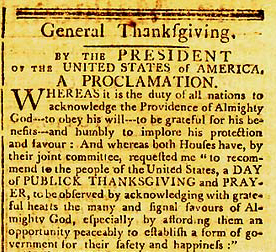
The First Thanksgiving Proclamation: George Washington, 1789

I put this up last year. A fellow Episcopalian involved in ministry with college students, Charlie Clauss, reposted it yesterday with the observation that if George Washington made this proclamation today he would be panned as a religious zealot. For your reading enjoyment…

Matt Marino's avatarthe gospel side

Note the perspective of our first President on the relationship between people of faith and civic responsibility, the idea that we, as a nation, would need the involvement and intervention of Almighty God, and in the final sentence, the idea that religion, virtue, science and prosperity are interconnected rather than opposed.  Make of it what you will. Surely not all change is progress…

THANKSGIVING DAY 1789
BY THE PRESIDENT OF THE UNITED STATES OF AMERICA – A PROCLAMATION

Whereas it is the duty of all Nations to acknowledge the providence of almighty God, to obey his will, to be grateful for his benefits, and humbly to implore his protection and favor – and Whereas both Houses of Congress have by their joint Committee requested me “to recommend to the People of the United States a day of public thanksgiving and prayer to be observed by acknowledging with grateful hearts the…

View original post 396 more words

The Secret to a Great Life

Great Life Slide.002Snark Meter.005 There is a secret. It will change your life. And once you know it, you will never forget it.

I first realized I was “that guy” in our neighborhood at my daughter’s pirate-themed fifth birthday party. I suspect many youth ministry people grow up to become “that guy.” This really shouldn’t come as a surprise. The years we spend active with teenagers develop a set of skills, that when exercised with small children, in particular, small children with overprotective parents, make us quite popular with those children and considerably less so with their parents.

We had recently moved from a street where we had the only children on the block to a neighborhood with at least 30 kids in our children’s age group. Much to our chagrin, every one of those kids and their keepers converged on our home for my daughter’s party-the parade from both directions was quite a sight. My wife quickly disappeared out the back to the store for twenty more hotdogs while I attempted to appear nonplussed at the incursion. One neighbor looked over my backyard and remarked flatly, “Disneyland wasn’t this crowded last summer.”

In less time than it took to light the candles on my five year old’s cake, I made a rookie mistake. While on grill duty I shouted, “Who wants the first hot dog?” It was like the scene from a movie. Time briefly went to slow motion as thirty over-eager kids dropped what they were doing, turned, and began to run toward me with arms in the air shouting, “I do!” Unfortunately, time shifted back to full speed as the horde accelerated toward the grill. Elbowing for position around the blazing grill, thirty kids shouted, “Me first! Me first! Me first!”

The other parents cringed, imagining gory injuries and expensive lawsuits.

As for me, the danger was lost in my glee at discovering I had the ability to incite an elfish riot. I spent the rest of the afternoon enjoying the novelty of this newly discovered skill: “Who wants to hit the piñata first?” “Me first! Me first! Me first!”

“We are playing freeze tag. Who wants to be it first?”  “Me first! Me first! Me first!”

“Who wants the first cup cake?” “Me first! Me first! Me first!”

“Me first” is cute and funny with five-year olds…although apparently not as cute as I found it to be, since it would take the better part of a decade to convince my neighbors that I actually am a grown up. But regardless of how “me first” appears in a group of kindergarteners, looking out for numero uno is most un-adorable in adults.

“Me first” comes so easily, though. Self-protection is a powerful human motivator – perhaps the first hard-wired human inclination. “Me first” is, well, normal. The interesting thing is that when we follow what is “normal,” when we go “me first,” we don’t insure our thriving at all. We actually diminish ourselves. Rather than protect us, self-preservation, it turns out, shrinks our lives. And we end up with a life that inspires neither us, nor anyone else.

A good example of “me first” occurs in the fifth chapter of John’s Gospel in an incident known as “the healing by the pool.” The short version is this: Traveling rabbi Jesus walks into town for a religious conference with his (at least) twelve students. With a seventy-mile journey on foot behind them, they head to the city well to cool off. Jesus wanders into the pool house, a place frequented by the sick and homeless. The water in the pool was actually the run-off from the pool Jesus belonged at, the nice folk’s pool, immediately uphill from this one. At the pool, Jesus runs into a crippled guy, apparently squatting on a prime panhandling location. The guy uses his rehearsed speech on Jesus who tells the handicapped man to get up and walk. This he does. (Jesus has this inexplicable ability to speak to disease and death and the weather and they obeyed him…and the witnesses report this with little commentary other than to make sure that we know that they didn’t understand it either at the time.)

Anyway, the man who hadn’t walked for nearly four decades gathers his stuff and leaves so quickly that he doesn’t get Jesus’ name. The man heads for the temple, the normal place one would go to re-enter society. On the way in, a group of pastors hassle the guy for carrying his stuff on the Sabbath – they want to theologize rather than thank God…religious people having problems is nothing new. These pastors want to know who is responsible for the “illegal” healing, but the newly mobile man cannot give a name since he never bothered to get it. Then Jesus finds the man again in the temple…don’t get me started on how weird it is that a man can receive the use of his legs and not stop to get the name of the person who healed him. Jesus travels with an entourage, meaning he isn’t exactly inconspicuous, but Jesus is the one who is interested in continuing the relationship, not the other way around. When Jesus finds the man, he tells him to “stop sinning.” We have no clearly stated reason as to what that was about, but the man, continuing his peculiar behavior, immediately goes back to the religious leaders and rats Jesus out. Then this man uses the legs Jesus healed to walk out of history, never to be heard from again.

Think about it: A guy gets healed…then just walks away. It sounds sort of “Me first!” doesn’t it?  

The religious leaders are worried about the theology of the event. “Me first!”  

And then the healed man turns over the name of his healer to the authorities. “Me first!”

There is no evidence that our unnamed man ever followed Jesus. No evidence of any heart-change to go with his change of mobility.  No evidence that he gave as much as a simple, “Thanks, bro.” There is no indication that he did anything other than use his legs to wander away. He simply did the “normal,” expected thing. The “me first” thing. The saddest part is what could have been had our man not been so self-absorbed. Jesus was about to commission eleven scared dudes to start a revolution of love, a revolution that would conquer the greatest empire the world had ever known in under 300 years, and our man could have been in on the ground floor.

Did you notice what happened? Both our man and the religious leaders turned a potentially world-altering event into something to be insulated against. They knew what most religious people eventually realize: If you let Jesus get too close, he will mess up your life. I think everyone in this story was trying to keep Jesus at arms length, lower the bar…make Jesus manageable. They defined Jesus down so that they could be religious enough but carefully maintain their position in the driver’s seat of life – you know, “Me first!”

CS Lewis said, “We are like kids in the slums content to make mud pies while a feast on holiday by the sea is being offered.” We simply lack vision for what our lives could be – we cannot see past “Me first!”

Have you noticed there are no great stories of “me first”? No fairy tales of self-preservation. No great myths of the self-serving. No super-heroes of the self-absorbed. That is because the secret of a great life is not “me first.” The secret to a great life is spelled m.e.t.h.i.r.d.

We learn this from Jesus who advised a seeker to “love God first and love your fellows as you love yourself” (Mark 12:28-31). Jesus, who was combining several earlier wisdom statements of Moses (Deuteronomy 6:4-5 & Leviticus 19:18), apparently considered this “me third” business an important enough message that he said it more than once (Matthew 22:34-40) – something great teachers do with important lessons.

Why is it so important to love God first? First of all, Jesus is a God willing to step into where the world says he doesn’t belong…to set free captives too crippled to realize their bondage, who chases the wanderers and frees from both religiosity and secular selfishness-who brings mercy and redemption when no one was asking – O, what a Savior.

But even more, if the Jesus event is true, then to be on God’s mission, to be God first and other’s second is what you and I were made for. It is the key to finding our great “Why?”

So what of you?  

-Have you lowered the bar on your expectations of God?

-Have you forfeited divinely-given dreams of the impact your life might make for God?

What is normal…what is natural, is “me first.” But a great life, a really stellar life, one that you and others are inspired by is lived me third.

So love God first. Love others second. And for sure love “me.” Just love me third. 

Spiritual Baseball: the unlikely path to intimacy with Jesus

Babe-Ruth-at-bat

Snark MeterrealMID.003Every once in a while you meet someone and immediately sense they are wise and grounded. One of those for me was a Roman Catholic youth pastor. We met some fifteen years ago at an outdoor cafe. While the coffee cooled he made small talk by mentioning the Protestant activities his children were involved in: Awana, Fellowship of Christian Athletes, Young Life, and attending a Christian high school. I laughed and probed just a bit: Was he a wanna be Protestant? He laughed back and said, “Absolutely not. It’s just that it is pretty hard to come to faith in my Church.” His answer baffled me. Why, I asked, would he choose to be involved in a church in which it was hard for his children to come to faith? How, I wondered, did he not see himself as making my point for me? The jovial youth minister grinned again, handed me a pen, pushed a napkin toward me and said, with the hint of a smirk, “Make a list of your ten favorite authors.”

I scratched names on the napkin until he reached over and grabbed the pen, and said, “Ok, I’m stopping you at fifteen. I notice that of your fifteen favorite authors, thirteen of them are liturgical Christians.” I had never heard the word ‘liturgical’ and didn’t want to admit it, so I glossed over that detail and asked him what his point was.

He asked, “Why do you like those authors: Nouwen, Lewis, Temple, Wesley, Chesterton, Wright, Manning, Stott?”

“I guess because they write as if they have intimacy with Jesus,” I said.

He answered without hesitating, “Exactly,” he said, “I’m in my Church because it is how you become intimate with Jesus.”

“O, come on!” I objected.

He pointed at the napkin and reminded me it was my list. He then said something that took me a decade to understand, “If you want true intimacy with Jesus, it will probably happen in a liturgical church: Catholic, Orthodox, Episcopalian, old-school Lutheran.”

We sat there another half hour and I decided that what he was saying is that if the spiritual life were a game of baseball, then first base is a relationship with Jesus. If one does not get on base, nothing else matters. That was why his kids were in evangelical activities. Second base might be knowing the Bible. Third, giving your life away in service for God and the Kingdom. But a “home run,” in the Christian life, is intimacy with Christ…what the Orthodox masters call “theosis” – a fulfillment of the image of God. I left that meeting wanting to “make it home,” but without the least awareness that, for millions over the last 2,000 years, the “home run” I longed to experience has been a common one in liturgical traditions.

And yes, I do realize that statement sounds arrogant and just plain incorrect to evangelical ears. After all, every evangelical church in America has a healthy collection of members who left the liturgical world precisely because they hadn’t gotten “on base” in a liturgical church.

What you may not realize is how non-normative the American 4 song/sermon worship format is in the scope of things. For 3/4 of Christian history, the liturgy was the only form of Christian worship. Even today, nearly 3/4 of the Christians on the planet worship God in the ancient pattern of Word and Sacrament. That doesn’t make the liturgy better, worse or more or less biblical, it does say that what most Christians know as “worship” is a bit of an outlier.

I am not saying that liturgical churches are perfect or have more holy people or that there are not dead liturgical churches…I’m fairly sure that dead liturgy might be the worst sort of dead. Just that for the lion’s share of Christians who have ever lived, worship was not song and sermon but Scripture and Supper.

…for the lion’s share of Christians who have ever lived, worship was not song and sermon but Scripture and Supper.

I didn’t understand what my Catholic friend was talking about precisely because I had been to a liturgical church a few times and found it repetitive and, frankly, numbing. What I discovered was that the power is precisely in the repetition…that, as a rough rock in a stream becomes a smooth stone from years of water flowing over it, the Christian is formed into the image of God when we surrender ourselves to the three-fold pattern of daily immersion in the Scriptures, weekly feeding in the Eucharist, and the annual cycle of the Christian year, combined with contemplative practices like those of the desert fathers. I have found that these are re-orienting my perception of reality, the way I view time, life, and the world around me, in ways that words on a page cannot fully capture. It is freeing me to love those who oppose me and work for the good of those who seek my harm.

You may not be interested in walking the path to the ancient Church, known in Anglicanism as “the Canterbury trail.” I was not either. Ironically it is a journey that has given a depth to my walk with Christ that I never imagined. Like someone who has never tasted ice-cream, I didn’t know what I was missing.

What about you? If you have walked with Jesus for several decades, is intimacy/spiritual union something the church you worship in is nurturing in you? In what ways, corporately and individually are you finding intimacy with Jesus? Or have you, like many, given up on intimacy with God as having a corporate expression? If so, I invite you to the sandlot to play ball.

Batter up.

Where is Your Help? A Sermon for a Shutdown America

I lift up my eyes to the hills.
 From where does my help come?

My help comes from the Lord, 
who made heaven and earth.   (Psalm 121: 1-2)

Obama-Shutdown

Snark MeterrealMID.003

I lift up my eyes to the hills.
    

            From where does my help come?

As a month-old baby I was on the floor of the 1964 Republican nominating convention. My father was campaigning for Barry Goldwater. Democrats were ruining America. So we were Republicans.

I lift up my eyes to the hills.
    

            From where does my help come?

In college I read that Winston Churchill said, “Any man who is under 30 and is not a liberal, has no heart…” The heartless were ruining America. So, in college, as a young man with a heart, I became a Democrat.

I lift up my eyes to the hills.
    

            From where does my help come?

Upon graduation I became a teacher in a Christian school. I was popular with students and parents, but not the administration. I was, you see, too liberal. I am not sure I really knew what a liberal was, but I did know they were what was wrong with America. Mr. Churchill said, “Any man who is under 30, and is not a liberal, has no heart; and any man who is over 30, and is not a conservative, has no brains.” Not wanting to be brainless, I became a conservative.

I lift up my eyes to the hills.
    

            From where does my help come?

I embraced conservative talk radio as I moved to Wickenburg, Arizona. Wickenburg is, after all, a very conservative town. I, however, worked for a liberal church. They were clear that what was wrong with America was conservatives. So I began listening to liberal talk radio.

I lift up my eyes to the hills.
    

            From where does my help come?

Eventually I realized that listening to angry people angrily telling me that the other guys are evil and that our only hope is in their political solutions was making me…angry.

im so angry i made a sign picketer

I lift up my eyes to the hills.
    

            From where does my help come?

In Luke chapter 23 we read of Jesus’ trials. It is a vivid portrait of political chaos. In the first twenty-five verses, one can feel the tension as the Prince of Peace and Lover of our Souls, in the grip of angry religious people, is turned over to fearful political power. You can sense the confusion of the political leaders unable to figure out what to do with a hot potato Messiah.

Politics has always had a strange relationship with Jesus.  On this day they played ping-pong with him: Jesus is taken to the Roman Governor, Pontius Pilate. Wanting to avoid the blood of an innocent, Pilate, sends him to Herod, the ruler of Jesus’ home region, Galilee. Herod, sensing the religious elite’s ire, sends Jesus back to Pilate – all in order to figure out how to kill the God-man voluntarily laying down his life.

And yet today we continue to naively wait for our salvation to come from political systems.

I lift up my eyes to the hills.
    

            From where does my help come?

Have we not made politics a Hunger Games for a dreadful America? We watch on tv and the internet as Americans point fingers and tear one-another down in a peculiar form of entertainment. The only winners are giant media conglomerates who have what they want: our eyeballs.

And we willingly play along, litmus testing one-another: Are you for or against immigration reform? Obamacare? Life? Marriage equality? After we litmus test each other, we try to convert one another to our position. Now I am not saying that political ideas are unimportant. I am asking why we are convinced they must divide Christians. After all: Politics do not and never did save. If it did the most political groups would be the most generous groups, the most open-hearted groups, the most joyful ones. Am I the only one who notices that the more politicized one becomes the angrier they appear? I don’t do many absolutes, but here is one: Political philosophies and agendas are NOT the Gospel.

We humans are conversion machines. We want to change people’s minds about everything: where to buy shoes on sale, what smartphone to use, who to vote for. So I ask, when you lift up your eyes, where is your hope set?

So be a good citizen: be informed and vote a Christ-surrendered conscience.

Be a good citizen: be charitable to those who do not share your convictions, assuming they too are people of good will.

But remember also that, If you claim the name of Jesus, you are a citizen of a King who said his Kingdom is NOT of this world.

And when you convert someone, make sure it is to the thing that matters most.

I lift up my eyes to the hills.
    

            From where does my help come?

Perhaps America and Christianity once shared values. But cultures bob like an unmanned boat on the ocean. America is changing. Some of these changes will make us more just. Some will surely make us less so. One evidence that America and Christianity are, in some ways at least, increasingly at odds is shown in the way people today become angry when the church attempts to discipline them. One hears, “What I am doing is not against the law. Who is the church to tell me what to do?” The implied message is that God is not our authority, America is. Perhaps this was always so. Perhaps cultural change is revealing something that was always there, that many of us confuse an idol wrapped in Stars and Stripes with the Living God.

I lift up my eyes to the hills.
    

            From where does my help come?

Have you noticed that valuing biblical principles is not the same as loving Jesus? I can want a biblical lifestyle without being captivated by the one that book came to reveal. I can live a “biblical” morality and remain my own functional deity.

Have you noticed that we often want moral absolutes for others, and moral flexibility for ourselves? Perhaps we don’t want grace, as much as we want permission?

Have you noticed that we can spend hours on media coverage and opinion shaping but very little time actually with God?

So I implore you – leave the politics, leave the anger, and leave the “principles.” Walk away from them to pursue Jesus’ presence and joyfully extend the Good News of God’s grace.

Consider what grace does: Grace forgives and welcomes…it cleans up our lives…it creates a community that embraces those at the fringes, and it causes us to love those whose lives aren’t yet in its grip. Grace is also supremely unfair and only made possible by the grossest of injustices.

I lift up my eyes to the hills.
    

            From where does my help come?

Grace has only one source. One deadly, costly source: a cross. At that cross, on that old hill, we are all on equally slippery footing. There is no need to argue about who lives closer to the sun: We are all so far away that it matters not. At the Cross, and the cross alone, the grisly price of God’s grace, was shed for you and for me. It bids us to look for our salvation from one place and one place alone.

I lift up my eyes to the hills.
    

            From where does my help come?

                         My help comes from the Lord. 

*This post was yesterday’s sermon on Article 37 in a series at St. Jude’s Church on the 39 Articles of Religion, the foundational theological statement of Anglicanism. The topics were set in March. It was an ironic accident that the Article on the Christians relationship to the state came up this week. Scripture: Psalm 121, Luke 23: 1-25. The text of the 37th Article in contemporary English is:

“The power of the Civil Magistrate extends to all men, Clergy and Laity, in all things temporal; but has no authority in things purely spiritual. And we hold it to be the duty of all men who are professors of the Gospel, to pay respectful obedience to the Civil authority, regularly and legitimately constituted.”

Article 37.003

The church isn’t a restaurant. It’s culinary school.

Restaurant.035Snark MeterrealMID.003

Last week’s “The church doesn’t exist to feed you” post pushed lots of people’s buttons…mainly because I put myself in the awkward position appearing to argue against the Bible. Let me morph the analogy a bit…

For most of my Christian life I disliked church. REALLY disliked it.

Not bored, as in “I would rather watch my team play.”  Not, “Oops I forgot to set my alarm.” But a tension in the neck that ruins Saturday date night when I realize that in the morning my wife expects me to get up and go to church sort of a dislike.

It wasn’t a God problem. At 18 I fell in love with Jesus. Soon after I developed a crush on the Bible. I love serving others. Most weeks I would rather do ministry than go on vacation. But church? Not so much.

I found church relentlessly reductionistic: four songs, sermon, pass the hat, then off to lunch. The best part of that liturgy was the lunch. I had an undergrad degree in the Bible and a pile of master’s credit in theology. Give me the text and I could give you the conclusion to nine out of ten sermons. I was more than bored. I was convinced Sunday worship was utterly irrelevant.

Can you relate just a little? Have you ever sat in church and wondered, “What is this getting me, besides 10% poorer?”

Part of the problem was my mental image of the church: I saw it as a restaurant designed to feed me.

Think about what happens at a restaurant:

            -You choose one you like

            -You drive to it

            -Someone seats you

            -You order what you are in the mood for

            -Then you eat the meal and sit in judgment on it: “I like this”,  “I don’t like that.”

A restaurant is a narcissistic, preference-driven experience. Which is fine for a restaurant, but it is a certain kind of soul death when I view the church that way.

Lobster.036My wife and I once went to Pappadeux’s on “all you can eat lobster night.” We watched people with butter dripping down their forearms and chins, eating three and four enormous lobsters in a single sitting. It was as revolting as it sounds. You can imagine the girth of people who consume 5000 calories before dessert. When we use the church as a restaurant, and sit back waiting for someone to serve us we will either go home hungry or huge.

But what if we changed our perspective? What if we saw the church less like a restaurant and more like culinary school.

Culinary School.038

While a restaurant is a place of preference that exists to meet MY desires. Culinary school is a place of perseverance where one comes to be equipped to feed OTHERS. Culinary school is something you invest your time, talent and treasure in because you have a sense of calling.

In Ephesians four, Paul describes us as “baptized into one body,” “living lives worthy of our calling,” “in the unity of the Spirit” and THEN Paul portrays God as giving gifts “to equip the saints” to change the world …in the case of culinary school, through tasty, nourishing, healthy, well-prepared, well-presented food.

The Church does not exist to feed us. It exists to equip us.

The “church,” “ecclesia” in Greek, literally “the called out ones” have been “called out” specifically to be equipped through Word, Sacrament and discipline to return to the world and call others to the banquet table of God’s great love feast.

Think about the joy that happens over a table in a great little neighborhood bistro: Joy is made possible in culinary school. Culinary school is the place where:

-You sell your stuff, pay big tuition dollars, and move into a bad apartment, all because you are committed to a goal

-You get a set of tools – really good ones!

-You learn a new set of skills

-You are in a community of people with a vision

-It is also a place where there is tremendous conflict as you learn your craft…but a place with support and encouragement and accountability also

-They set you in front of a dangerous stove and let you play with the nobs, and try mixing stuff up and seeing how it tastes and hope you don’t blow the place up while you learn

All so your class can go out into the world with a vision for places where people will be fed and cared for and real community built.

That, friends, I would suggest to you, is what the church is supposed to be:

-Those “called out”

-Equipped with tools and knowledge

-Allowed to practice

-Giving grace to one-another, with support and encouragement provided

-A community where conflict is expected and forgiveness extended

-A community where we are playing with dangerous tools: the Keys to the Kingdom of God

-A community with a mission to change the world.

That is why the church asks people to spend valuable time seeking God, give 10% of their money, and serve others…because Jesus and his kingdom is just so important. We are all busy. But we find time to do what we want to do. What if we fell so in love with Jesus and his call on our lives that we make HIM our priority, and the culinary school that is the Church the place where we are equipped?

In the Christian life one is only truly blessed when they are in the community of faith, giving themselves to that community and giving themselves and the Gospel message away to create a different world.

What about you?

-Have you met the Master Chef, Jesus the Messiah? Have you given your life to him by faith? Have you been baptized as the public entrance into that faith?

What is your view of the Church? Have you been showing up, as at a restaurant, to be fed? Or are you coming to be equipped and move out to change God’s world?

The world awaits. It awaits the flavor and seasoning and the freshness that can only come when we step into God’s mission. It awaits the beauty and warm relationships that happen when we do our parts and dish up a big steaming bowl of the goodness of God in the person and work of Jesus Christ.

There is the aroma of Christ on those who serve (2 Cor. 2:15). There is the taste of the goodness of our God.  There is a beauty for the eye to behold when the presentation is with grace.

Like a restaurant that hasn’t opened, the neighborhood might not know the wonderful things in store for them until they begin to smell the aroma of Christ in your kitchen and you begin to serve God’s recipes at the banquet table of the Kingdom. Are you waiting to be fed or being equipped to taking your gifts into the world? A hungry world awaits its Savior.

Your church isn’t supposed to “feed” you

This is cute. But we aren't babies.

This is cute. But we aren’t babies.

Snark Meter Sorta Snarky.002

I have lame Christiany-sounding excuse fatigue. Here is the latest: “I am leaving this church because it just doesn’t feed me.” Pardon me but your church is not supposed to “feed” you. It probably isn’t your fault, though. You were probably sold this bill of goods by the church that talked you into coming their way the last time you were feeling spiritually bored.

Consider the “feedlot” model: We pick a church, like we pick a restaurant…one that dishes up what we like and are in the mood for on a steaming plate set before us. Then we sit in judgment. “That was good this week.” Or perhaps, “That sermon was a little mushy, and cold…like overcooked broccoli, pastor.” We tip if the service was good and expect to go home full.

Yes, I do know the term “pastor” is the Greek word for “shepherd,” but shepherds protect sheep. Sheep eat for themselves. Besides, the Lord is our shepherd, not your pastor. Your pastor is a human not the Holy Spirit.

There is a legitimate role for pastors. It is found in Ephesians 4. Pastors have been given their gifts “ to equip the saints for the work of ministry.”

Consider God’s purpose in the giving of all of these gifted “apostles, prophets, evangelists, shepherds and teachers”: It was EQUIPPING YOU  “for the work of ministry, for building up the body of Christ, until we all attain to the unity of the faith and of the knowledge of the Son of God, to mature manhood, to the measure of the stature of the fullness of Christ.”  Rather than being passive recipients of a meal, this is a picture of a community sharing its gifts with one another as it engages in mission.

The early Christians had a love that “compelled” them into the world in invitation and self-emptying service (2 Cor. 5:13-15).  Please don’t bail out on your church because it doesn’t passively “feed” you. The church isn’t supposed to be a restaurant with waiters that pre-chew our food and dribble it into us like the SNL soft-teeth skit. It is supposed to be culinary school. Think about what culinary school gives someone: tools, knowledge, practice, confidence and helps you find a job cooking in the real world. Both visions of the church will change you: One will make you fat and passive. The other will change both you and the world as you serve it, adding flavor and taste to those around you.

So before you put a grotesque and distorted burden on your church, ask yourself how discipleship happened historically. Hint, it wasn’t sitting in a class memorizing gospel presentations or Bible verses on overcoming temptation. It was life on life: walking with Jesus. The disciples hung out around the fire with the Master for three years as he prayed, taught, modeled, questioned, healed, demonstrated, prayed some more and finally sent them to…”go make disciples” and to “obey all I have commanded.” Every bit of this was active.

This is possibly a very different model from your church. If your church is using you as a passive recipient of the staff’s teaching, doing all of the evangelism themselves and merely using you as an “inviter” and the sanctuary as an evangelism platform, then perhaps you might want to ask them to STOP feeding you! Ask them instead to start equipping YOU and the rest of the church to “do the work of ministry.”

So stop asking your church to feed you. Ask them to equip you.

If you like this you might like: The Church is Christ’s bride. Not his baby mama.

or: The church isnt a restaurant its culinary school