Creeds are not Chex Mix. (Creeds for Newbies, Episode 4)

250px-Chex-Mix-Pile

Snark Meter Sorta Snarky.002

When asked what I think of the trendy rewriting of creeds in progressive liturgical churches, I usually respond in the words of imminent theologian Ron Burgundy: “That’s just dumb.”

Creeds are not Chex Mix. You know, the party snack that you pick through taking out the morsels you like. But we don’t high-grade out what we like of God and leave the rest in the bowl. A Luby’s Cafeteria may make for a nice all-you-can-eat Sunday afternoon lunch, but picking and choosing a faith of our own creation is narcissistic and foolish. Not to mention a risky way to live one’s life. The old joke, “God created us in his image and we returned the favor,” comes to mind.

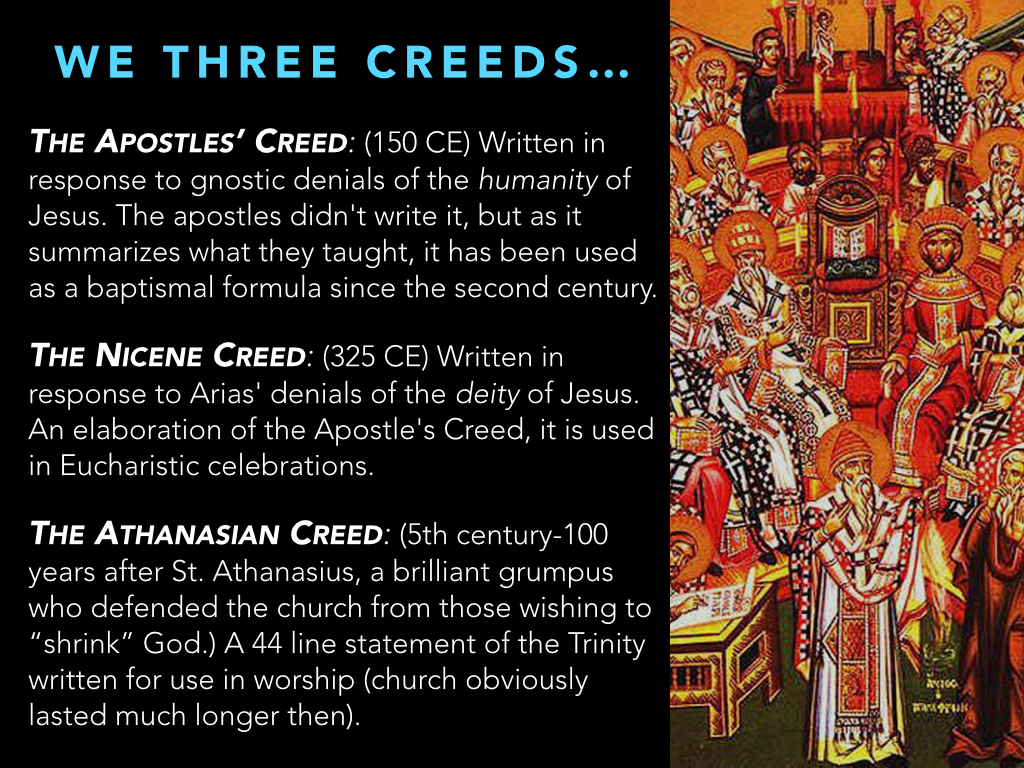
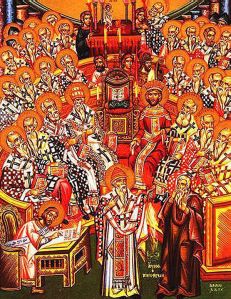
The creeds were written by the early and undivided church as summaries of the faith. They have been vetted by universal acceptance of the entire church, both through time and across geography. When Vincent of Lerins wrote in the 500’s,  “What has been believed everywhere, always, and by all,” he was referring to the faith bounded by the Nicene Creed. The impulse to re-write the creed to make it more relevant is, at best, misguided. The creed is not ours to futz with. (By the way, someone rewriting a creed is almost certainly a baby boomer.) Seriously, stop rewriting creeds.

Passing the Baton

For I handed on to you as of first importance what I received: that Christ died for our sins in accordance with the scriptures, and that he was buried, and that he was raised on the third day in accordance with the scriptures …” (I Cor 15:3-4)

Our role is to explain not to change “the faith that was once for all entrusted to the saints.” (Jude 3) The creed is the universal. Beyond that is adiaphora (things indifferent) – perhaps helpful. Perhaps important. Just not mandatory for recognizing a “like” faith. So we do not change the core. We pass it on, handing the baton of faith to the next generation.

Passing the Baton

When it comes to the substance of the faith, there are two extremes: Fundamentalism and Universalism. Fundamentalism elevates the “you may” to “you must”—tithing, homeschooling, a particular theory of the atonement, etc. Fundamentalism raises the bar making options essential. The opposite is Universalism. Universalism drops the essentials making them optional. Universalism lowers the bar and says, in effect, “There is nothing you must believe.” Universalism leaves us with such a low bar to the faith that few see any reason to join. This is why we don’t “edit” universal truth. Fundamentalism hands the next runner an anvil to run with. Universalism gives them an empty hand-off. We receive and pass on, “the faith that was once for all entrusted to the saints.

The Great Tradition

Seventeenth century Archbishop Lancelot Andrewes explained “tradition” as “one canon (the Scriptures), two testaments, three creeds, and four councils, over the first five centuries.” The three creeds prioritize Christian beliefs. As Rupert Meldinius said in 1627, “In essentials unity, in non-essentials diversity, in all things charity.” Creeds keep the main thing the main thing.

The creeds articulate God as trinity, an idea that is impossible to get one’s mind wrapped around – which doesn’t mean that it isn’t true. In fact, anyone who can contain the infinite God of the universe between their ears really needs to find themselves a bigger God.

Creeds are our wedding vows 

11584032-black-and-white-photo-of-a-groom-slipping-a-gold-wedding-band-on-a-bridea-s-finger-during-the-weddin

Creeds are not about warm-fuzzies or even felt convictions. They are the substance of the faith the church has stood upon since soon after Jesus left. They are like marriage vows-so much so that they form the substance of the promises one makes in Holy Baptism. There is a reason we take marriage vows – It is because human love is fickle. We imagine that love sustains commitment, but actually it is just the opposite. It takes great commitment to sustain love. A couple makes vows and clings to them through thick and thin…and, at the end of life, a thing of loving beauty has been produced. The historic creeds work the same way. The Nicene Creed proclaimed in church is a promise to cling to the glory and vastness of God, even when the pressures of life scream to give up. When said in church, by the community of faith, the Nicene Creed is a weekly prayed promise to act in love toward God. It is our spiritual, “for better for worse, for richer for poorer, in sickness and in health, to love, cherish, and to obey, till death us do part.”

Creeds answer the question, “What must we believe?” We answer,  “We believe in one God, the father, the almighty…”  

The Bible’s Lucky Decoder Glasses (Creeds for Newbies, Episode 1)

THE_FIRST_COUNCIL_OF_NICEA

The First Council of Nicea

Snark Meter.005

(Part 1)

In 1934, the Little Orphan Annie radio show hit on a terrific marketing gimmick: kids could mail away for a “secret decoder ring” in order to decipher hidden messages.

Perhaps you remember the young protagonist, Ralphie, in the classic movie, “A Christmas Story,” ordering one…

images

…only to be disappointed that the “secret message” was nothing more than “a  crummy commercial.”

If you grew up in the sixties you might have had Johnny Quest “lucky decoder glasses” to interpret secret messages.

6a00e5523ce51288330153919c7056970b-400wi

It may surprise you to know that there are “lucky decoder glasses” to reading and interpreting the Bible – A set of lenses Christians have looked through as keys to understanding the Bible for nearly 2000 years.

Everyone has a set of interpretive lenses through which they see the world and read any text. For orthodox Christianity those lenses are a document originally written in 325 CE called, “The Nicene Creed.”

Settling Fights

As with all doctrinal statements, the Nicene Creed was written to settle a fight. More precisely to clear up confusion over the Bible’s teaching about the nature of Jesus and his relationship with God. You see, Jesus was so unique that people had a hard time “getting” him. Now, my evangelical friends will say, “The Bible settles who Jesus is, just read the plain meaning of the text!” The only problem is “reading the plain meaning” was not working. The early church was reading the Bible…in fact, not only were they reading from the same Testament, they were even reading from the same Gospel, and yet coming to radically different conclusions.

Let’s be honest, the Christian claim that Jesus is fully God while at the same time being fully human is pretty confusing. It shattered any existing thought paradigm. Two thousand years later it is still pretty tough to wrap one’s mind around a claim that astounding.

It may be of interest to you that the early Christians struggled with the humanity of Jesus more than his deity. Greeks, influenced by Gnostic thought and the idea “flesh” was corrupt and “spirit” was good,  had a tough time with the notion that Jesus could be a real, actual human. So the early church wrote a creed we know as the “Apostle’s Creed.” It was used in Baptisms. The line, “Born of a virgin” was included specifically to insist that Jesus was an actual, real, burping, got gassy, snored while sleeping on his back, human being.

A century and a half later the struggle had shifted. A priest named Arius had started teaching that Jesus was something less than God (as Jehovah’s Witnesses and Mormons teach today).

Arius’ new teaching began to win people over. (It helped that he was a good preacher and musician. He penned a catchy ditty that all the cool kids were singing, “There was a time when he was not…”) Arius argued out of the gospel of John, “Jesus said, ‘The father is greater than I.'” (John 14:28) The church answered with, “The father and I are one.’  (John 10:30) and ‘If you have seen me, you have seen the father.‘” (John 14:9) So there they are: reading the same gospel and coming to two thoroughly opposite conclusions as to Jesus’ identity and the nature of his relationship with the Father. So is Jesus less than or equal too the Father? This really, really matters because Jesus’ role is to make sacrifice for sins. If Jesus is anything less than completely holy, anything less than divine, his sacrifice will be incomplete…and we will remain dead in our trespasses. (1 John 2:2, Heb 9:26-10:12)

When the “Bible alone” is not enough

How did the church settle this dispute? Is the faith to be, as Arius’ would have had it, endlessly malleable or is there an inner core that is non-negotiable – a “…faith which has been believed everywhere, always, by all“? (Vincent of Lerins, early 400s.)

The church had two trump cards in this argument: catholicity and orthodoxy. 1) Catholicity (universal), the unbroken line of bishops (apostolic authority) traced back to Jesus – an argument of continuity of relationship with Jesus (those related to Jesus by touch). 2) Orthodoxy, an argument of continuity in Jesus’ teachings (those related to Jesus by teaching). The church has argued one or the other for 2,000 years, but both were seen as vital.

Those bishop’s unbroken interpretation of the scriptures present in the conciliar statements generated when they met in worldwide (ecumenical) council. The first of these councils met  in a town in Turkey named Nicea in 325CE. 318 bishops from all around the world attended. They came from as far away as England. The meeting was presided upon by no less dignitary than the rather newly converted emperor of Rome, Constantine. The statement they wrote, stating in unambiguous terms, that Jesus was fully and completely God in flesh, was signed by 315 of the bishops present (Arius and two cronies refused).

Since that time, Christians, whether they are aware of the fact or not, read the Bible through the “lucky decoder lenses” of those bishop’s statement, the Nicene Creed.

And, since the Nicene Creed is so undergirds how we view and interpret the rest of the Bible, it is a pretty decent idea to, as more and more churches are beginning to, pray that creed in church every Sunday. 

(Part two: Creeds: “The Substance of the faith” not “things indifferent” – Creeds are not confessions and it is above our pay grade to rewrite them.)


Nicene Creed Scriptures.001

Defending an Unfettered Free Market? Christians give up the moral high ground yet again

Magic conch

Snark MeterHIGH.001

 “Unfettered Free Markets Suck.”  

-Adam Smith’s great, great, great, grandson

I have just finished Barry Asmus and Wayne Grudem’s book, “The Poverty of Nations.” In it they argue that prosperity is best arrived at by unfettered free markets, clear titles to property, and the rule of law – all of which make risk taking entrepreneurship possible. I agree with titles and law. I take issue with their first premise: the unfettered free market. I think that defending the unfettered free market is a mistake, especially for Christians. Before I attack it, here are some common arguments for the free market:

1) Free markets allocate resources efficiently. No one person or government can allocate resources the way competition, working freely, can.

2) Free markets take advantage of all of the information in a society, generating stability. No one bureaucracy can adequately plan the way every consumer’s needs can, stimulating through the mechanism of supply and demand, the fulfillment of consumer’s needs.

3) Free markets generate creativity and promote innovation. Steve Jobs says, “I can make a better phone” and we are all better off.

4) Free markets limit the abuse of power by keeping it distributed widely, into the hands of each and every consumer.

These all contain at least an element of truth. And, although I am acquainted with both Barry and Wayne and think highly of them, I would like to push back against the idea of unfettered free markets…[1] Unfettered free markets are simply not, to use a common colloquialism, “all that.”

1) Competition is imperfect. Agents in the UFM (unfettered free market) will naturally conspire to decrease competition – oligarchies anyone?

2) Bidding is also. The UFM assumes that we are all equally free to “bid” for services. Children and future generations, for example, are not. Companies can and do work against their own long-term interest for short-term gain (Chinese air pollution reaching American shores and the Great Pacific Garbage Patch come to mind).

Photo credit: Lea Kelley

Photo credit: Lea Kelley

3) Cost divergence = markets that aren’t really “free”: The UFM assumes that the nominal cost (what I pull out of my wallet to buy a car) and the real cost (all of the expenses of driving my car: cost to build the roads, lost opportunity cost of land under the freeway, pollution cost of car, cost of administering and policing the roads) are equal. They are not. A government was probably involved in taxing consumers to cover the real cost. Societies’ must provide infrastructures. Do you want that infrastructure planned and inspected by disinterested parties or the company profiting from the bridge you are driving on? Thought so.

4) Socialists are happier. If the UFM was the best economic system then people living in them should be “happiest.” In fact, that is what Dr. Grudem and Mr. Asmus tell us. Unfortunately, the evidence does not bear that out. (http://goo.gl/FZSKVL) Bloomberg reports, The “happiest people,” year after year live in Northern Europe: 1) Denmark, 2) Norway, 3) Switzerland, 4) The Netherlands, 5) Sweden. All are tightly controlled economies. The U.S. ranks 17th.

So color me a believer in some government regulation of economies. Unfettered free market systems regularly create long-term nightmares that people band together and elect governments to solve. Drive up the I-95 toward Philadelphia. It looks like a scene from the movie Soylent Green. Consider also the chemical companies in East St. Louis. Those companies spent 100 years gerrymandered out of the school district of their plant workers so that they didn’t have to pay for schools for their own employees children…even as their toxic sludge oozed up into the basements of those schools. Humans can and should band together to make sure that some decision-making is centralized for the common good – automobile safety regulations, and eliminating lead paint on children’s playground equipment come to mind.) The issue is to figure out which regulations are “doable” (like lead paint) and which are not (a $30/hr. minimum wage) and then give government the teeth for enforcement. A government with no teeth is no government (Insert name of any one of dozens of countries with ineffective/corrupt governments here).

Regulating human selfishness is, by the way, biblical:

1)   “The love of money is the root of evil. The UFM assumes that I will love money and my self-interest…not God and neighbor. Do we really want a system that glorifies our sin nature, rather than one which acknowledges but works to moderate it? (1 Timothy 6:10)

2) Scripture assumes that humans, because of sin, are not “free,” but natural oppressors of other humans. (See Amos 2:6-7, 4:1-9). Has an unfettered FM really insured human thriving? Ask the employees of the Triangle Shirtwaist Factory. O wait, we can’t.

3) We are told to “Bear one another’s burdens.” (Gal 6:2) Let’s employ the hermeneutic principle known as “the clear meaning of words: “Bear”: to carry.” “One another’s”: someone else’s. “Burdens”: That which is heavy.

4) Generosity, the “re-allocation of wealth,” was commanded of individuals (Deuteronomy 23:24-25) in early Israel…but the early government was too weak to provide services. To maintain a completely individualized system leaves aid unevenly distributed-a burden upon those in places with more poor. In an era with more social organization we can do better.

5) There are numerous injunctions to create government. Scripture repeatedly advises the appointment of “judges” – administrators of law and social organization (2 Sam 7:11, 1 Chronicles 17:10, 1 Chronicles 26:29, 2 Chronicles 19:5.) This starts when Jethro sees a need (Exodus 18:13-27). He then creatively solves the problem by generating a new solution: judges for disputes. Why can we not utilize this same method in economics?

6) Did I mention that Jesus told us to share? More than once, too: (Mark 10:21-22, Luke 6:20-21, Matt 25:34-36, Mark 12:41044, Luke 14:12-14, Luke 16:19-25, Luke 11:39-42, Luke 12:16-21).

The question is how best to administer sharing and some regulation for the common good. In Acts, the church gave that task to deacons. Are church buildings and local deacons the most efficient way to care for the poor? Perhaps in some places. Probably not in all places.

And then, there is still that question as to where the “happiest people” live. Again, the data says that Dr. Grudem is wrong. It is NOT the places with the most open and most unfettered free markets, but specifically those places in which markets have some public controls to protect consumers.

The sad thing for me is the way much of the American church defends partisan policies (no economic limits or regulations…Somalia comes to mind) as if this is the Gospel of Jesus Christ. Do I really need to say that it is not? I recently posted on FB my joy that a friend, a music minister at his church, and brought to the U.S. as a 9 year old, received Deferred Action to be able to work. Christians railed against this…against a Christian music minister being given the freedom to  work in the market as the result of his parent’s illegal actions 15 years earlier. It generated 120 comments in 24 hours.

And we wonder that Christians are no longer seen as crusaders for good? O how we have fallen. In the 1840’s 1/3 of active abolitionists were ordained clergy. The church, once seen as a bastion of care for the less fortunate, is now seen as a tool of tax and charity avoidance. God’s people are commanded to care for the widow, orphan, and alien (Jeremiah 22:3, Exodus 12: 49, Mal. 3:5, Ps. 82:3, 68:5, 10:17-18, Ex. 22:22-23)  …And yet we argue for a free market for all…unless, of course, you might not be able to produce papers when stopped for Driving While Brown.

Julian the Pagan, in his (362 AD) campaign to revive paganism wrote, “I think that when the poor happened to be neglected and overlooked by our priests, the impious Galileans (Christians) observed this and devoted themselves to benevolence. They support not only their poor, but ours as well, everyone can see that our people lack aid from us.”

Where did this spirit go? Once upon a time we Christians were known for our love and self-sacrifice. We were known as great defenders of the week and great lovers of those in need.

Will the church reclaim a moral high ground? One in which we love our Lord and His least, last, and lost more than we love protecting our markets, our assets, and our borders?


[1] Barry is a great guy and a friend of Young Life. Wayne is also a very nice man, a best selling author, and has a most amazing array of memorized Scripture.


Real Worship: A summons to the feet of Jesus


Snark MeterrealMID.003

Real worship is about Jesus. It IS costly. And it DOESN’T make sense.

Scientists tell us of the powerful ability of the sense of smell to trigger memories—that the olfactory bulb in our brain links scent to event. That is why walking into a home with cookies baking in the oven can carry you back to the security of grandma’s house decades earlier. Scent, somehow, unifies and cements all 5 senses and places us, momentarily, in the experiences of our past. One suspects the story of the anointing by the woman at Bethany provided just such a fragrant link in the disciples’ minds between burial perfume and Jesus’ looming Passion.

The story of the woman of Bethany was obviously an important one in the early church, as all four Gospel writers record it (Matthew 26:6-12, Mark 14: 3-9, Luke 7:36-49, John 12:1-8). As a whole, the Gospel writers tell us three things in this story: Real worship is about Jesus. It IS costly. And it DOESN’T make sense. That is why it is so odd that in this fragrant Gospel narrative, the memory of the eyewitnesses seems fuzzy… There is a woman. There is an anointing. There is expensive, perfumed oil. There is the objection to using it on Jesus. But then the details start getting jumbled.

Are these four accounts one event? Two? Three? Scholars have wondered for centuries. It’s easy to get frustrated with the Gospel writers here. They carefully name and give character to the Twelve, yet they blur the details of this woman and her story.

Who was this woman? Both Matthew and Mark have Jesus predict that this story will always be told in memory of her…but then her name conspicuously escapes them. Luke tells us she was a “a sinner.” John alone tells us that her name was “Mary.” But Mary was the most common women’s name in first Century Palestine. There were three women named Mary present at the crucifixion that we know of. Which Mary is this?

Luke places the story early in his Gospel. Matthew, Mark, and John place it in Bethany, the day before the Last Supper and Jesus’ arrest by the mob in the garden. Here are a few more details: Several days before his betrayal and death, Jesus and his disciples dine at the home of Simon the Leper in Bethany. While they recline at the table, a woman, whom John, the last Gospel writer by decades, identifies as Mary of Bethany approaches Jesus. We don’t know how long she had followed Jesus. What we do know is that Mary knew that worship has an object: Real worship is about Jesus.

Mary has an alabaster jar of expensive perfume, worth a year’s wages. These jars, we are told, were permanently sealed. To let the perfumed oil out one had to break the neck off. Once opened, like a jar of mayonnaise, it had to be used. Mary broke her jar, and emptied the perfume on Jesus. Real worship is costly.

In another fuzzy detail, John has the woman anoint Jesus’ feet, wiping them with her hair. Matthew and Mark report that the woman of Bethany anointed Jesus’ head.  Both actions flower with symbolism. In the ancient Near East, anointing the head signified Kingship – Kings were anointed at their coronation by the high priest or prophet. The word “Christ,” is a transliteration of the Greek word “Christos,” itself a translation of the Hebrew word for Messiah, which means “the anointed one.”  As Rachel Held Evans says, “This anonymous woman finds herself in the very untraditional position of priest and prophet.” Only in the upside-down Kingdom of Jesus, does this make sense.”  Because real worship DOESN’T make sense.

Anointing feet, on the other hand, models humility, service…love. John’s account is more intimate. Awkward even.  In a culture in which a woman’s touch was forbidden, for Mary to cradle Jesus’ feet in her hands and brush oil over his ankles and toes with the ends of her hair was unthinkable. This is most likely the oil for her own burial she has poured out. Mary breaks her treasured bottle of burial perfume and empties it on Jesus. She spares no expense. She is fully committed. She is “all in” –  sacrificing her own future. The self-emptying of this action foreshadows Jesus’ washing the disciples feet to come the next day on Maundy Thursday. And just as we see the male disciples discomfort at that event, the disciple’s unease at her display of affection is palatable. Real worship is about Jesus. It IS costly. And it DOESN’T make sense.

In the midst of all this symbolism and foreshadowing, Jesus interprets this event for us: It is an act of worship in preparation for his burial. When the disciples rebuke the woman for what they see as a waste of money, Jesus returns the rebuke saying, “Why do you trouble her? She has performed a good service for me. You always have the poor with you, and you can show kindness to them whenever you wish; but you will not always have me. She has done what she could; she has anointed my body beforehand for its burial.” Jesus had been speaking of his impending death for a good while, but the Twelve kept missing it. The idea of a kingdom ushered in with the death of their friend rather than the death of their enemies was unthinkable. It is no wonder they complained about the “waste” of money the anointing represented – they assumed they would need to finance their ministry with Jesus for years to come. Mary alone seems to get it. She is the first of Jesus’ disciples to acknowledge his impending death… the one who anoints “the anointed one.” For this, Jesus gives her his highest praise. “Truly I tell you, wherever the good news is proclaimed in the whole world, what she has done will be told in remembrance of her.” What a remarkable thought—that from open air revival to cathedral, Europe to Uruguay, Israel to Africa, this woman’s story would be told.

Jesus wanted us to remember. Yet we aren’t even sure of the woman’s name. How is it that, unlike other Gospel stories in which details drop out as we get to the later Gospels, her name does not appear until very late? I suspect it is because this good lady did not want it to appear. The beneficiaries of Jesus’ ministry joined the early church after his resurrection. They shared their stories to encourage one another. Later, when it became obvious that Jesus was tarrying in his expected return, writers gathered and recorded those stories. In the early stories of blind Bartimaeus, for example, we know Bart’s name, his dad’s name, and even that a blind friend was beside him in the early Gospels. But by the time (and distance) that Luke writes, Bartimaeus is presumably gone and his name is dropped. Bart’s story had been told so often that it does not even make John’s Gospel, the last one written. So why is this woman not named by the early authors? The obvious guess is that it was specifically because she was still around. And SHE did not want it named.

We know that Mary was a worshipper. My guess, knowing a few Mary types, is that, for Mary, worship was, first and foremost not about her, but about Jesus. And she didn’t want folks to get distracted in admiring her. My guess is that Mary is named by John specifically because she is no longer around to keep a witness from recording her name.

But what of you? Where is your focus? What is your perfume? What do you guard and value above all else? Is it material possessions? Is your perfume your reputation? Friends? Career? Take a moment and name that which you value most, because you cannot pour out that which you cannot name.

The challenge of Mary this Holy Week is that we would dare break open that which we value most and pour it out as a fragrant offering upon our Lord. Perhaps, with the help of the Holy Spirit, the scent might trigger a memory… like the comfort of grandma’s house, bought through decades of difficult labor during hard times, we would be reminded that our comfort from God was bought at a high price. Because Real worship is about Jesus. It DOESN’T make sense. And it IS costly.

*This was the message from “Dinner Church,” our Wednesday Holy Week liturgy for families. The service is based on one done at St. Lydia’s in Brooklyn. It has a contemplative feeling (with Taize-esque music.) It is based on 1 Corinthians and what is thought to be the earliest non-canonical Christian literature, a teaching tool called The Didache. It is essentially the biblical “love feast” (Jude 1:12, 1 Cor. 11). The candle lit room set in a circle and contemplative music work well for our rowdy urban kids. The people prepare the meal together, light the worship/dinner space, pray and sing, and eat over candle light. It also gives us a chance to give folks an overview of the upcoming Triduum of holy week and pass out devotionals for families to use at home.

Holy Week for Newbies

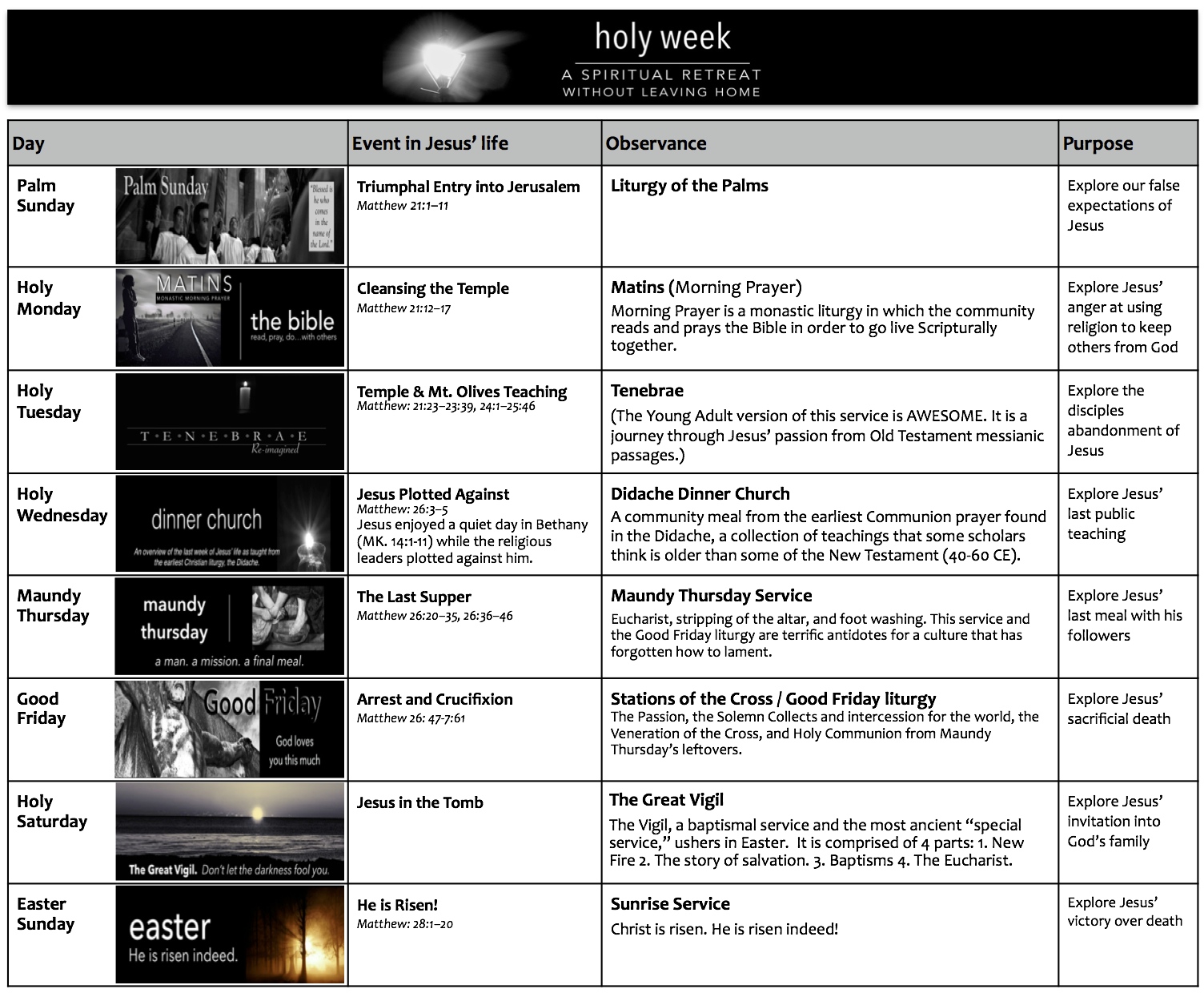
Holy Week.001

Snark Meter.005

A primer for those wondering what all the hubbub is about.

Holy Week, in a nutshell, is a spiritual retreat without leaving home. Remember summer youth camp? You had an authentic, transformative experience of God in a group of others having the same experience. You came home connected to those people and God in a new way. You thought, “That was fantastic. I am different and I can hardly wait to come back next year.” Holy Week is a lot like that.

Holy Week is series of liturgical experiences that walk us through the final week of Jesus’ life. We journey with Jesus, in the short span of a week, from His triumphal entry into Jerusalem, to the missing guard unit, neatly rolled grave clothes, and the shocking appearance of a risen Savior. In a symbol and story impoverished culture, Holy Week opens our hearts to the gift of Jesus’ victory over sin and death. This is more than a psychological remembrance, it is actively allowing ourselves to be in that final week, baptized (immersed) into his death…”Do you not know that all of us who have been baptized into Christ Jesus were baptized into his death? …in order that, just as Christ was raised from the dead by the glory of the Father, we too might walk in newness of life.”  (Romans 6:3-4)

Holy Week is sacramental

…and we are sacramental creatures. Regardless of any initial reaction you may have to that word, hear me out. A sacrament is a tangible symbol that creates what it signifies. Like kissing. When you first kissed that special someone on the doorstep at the end of the evening, it did more than represent thinking the girl was pretty and nice and that you enjoyed talking with her. It actually created and amplified those feelings. You walked back to your car more emotionally connected to her than you were when you opened her door a brief moment earlier.  And when her front door clicked shut, you fist pumped the air. “Heck, Yeah!” Because that kiss actually made more of what it signified.

So God gave us, fleshly, sacramental, critters that we are, a God who came in flesh. Who lived. Who breathed. Who touched us and was touched by us. Who walked willingly to a criminal’s cross, laid down, spread his arms wide for humanity, and waited for real nails to pierce his hands and feet. It is because you too are flesh and blood that you should engage in Holy Week…because Holy Week creates what it signifies: “That I may know Him and the power of His resurrection and the fellowship of His sufferings, being conformed to His death; in order that I may attain to the resurrection from the dead.” (Phil 3:10)

A current reality

The ancient prayers point us to the deep mystery in this: It isn’t “Christ rose.” It is “Christ is risen!” Holy Week is a current reality. A more real reality. So we do more than meditate on these holy mysteries. We allow them to become true within us, as our baptism is true within us. We join him on Maundy Thursday in His Last Supper. We are with him on Friday in His death. We keep prayerful watch before His tomb on Saturday. With growing anticipation we mark His descent into Hades and His trampling of death by His death. Finally, with shouts of joy, we greet His resurrection on Sunday morning, knowing that one day it will be our resurrection too. In Holy Week, as Orthodox priest Fr. Steven Freeman says, “The life to come becomes the life we live.”

A “deep mystery,” it should be said, is not magic. We must surrender to the prayers and liturgy – faith must be lived. In the end, Holy Week isn’t something we do. It is something that does us.

So what is the hubbub?

Holy Week is more than an emotionally powerful experience. It is an opportunity for a greater sanctification. As Paul said, “Now if we have died with Christ, we believe that we will also live with him.” (Romans 6:8) Or, as an Arnold Swarzenegger character once said, “Come with me if you want to live.”

Do yourself a favor, make time to engage in Holy Week, especially the three-day “Triduum”: The despair of Golgotha on Good Friday, the muted sorrow of Saturday, the joyful Baptisms at Saturday’s Great Vigil, and the surprise of a risen Savior on Easter morning.

Almighty God, who through your only‑begotten Son Jesus Christ, overcame death and opened to us the gate of everlasting life: Grant that we, who celebrate with joy the day of the Lord’s resurrection, may be raised from the death of sin by your life‑giving Spirit; through Jesus Christ our Lord, who lives and reigns with you and the Holy Spirit, one God, now and for ever.  Amen.

Holy Week Sched 2014 Blog

Game on. A sermon for Ash Wednesday

sermon

Snark MeterrealMID.003

Here is my Ash Wednesday sermon…not because I am convinced of it’s internet worthiness, but because friends have asked me to share it since I posted on the topic twice this week. 

Scripture: Joel 2:1-2, 12-17 •  Psalm 51:1-17  •  2 Corinthians 5:20b-6:10  •  Matthew 6:1-6, 16-21

Welcome to Spring Training! 

That is what Lent is: Spring Training for the Christian life.  You know Spring Training. It’s where players:

– Find out what they’ve got.

– Learn new skills.

– Figure out what they still need to work on.

Today, Ash Wednesday, is Opening Day.

Now that you are in the ballpark we are going to spend the next 40 disciplined days getting ready for the regular season- life.

I am not a baseball guy. I don’t know much about the game. But one thing I do know is that the person who throws out the first pitch is generally a pretty bad baseball player. Have you ever seen a first pitch? Sometimes it goes into the stands. Sometimes it drops off of the pitcher’s hand and rolls to a stop halfway to the plate.  It us usually thrown out by some famous non-baseballer: an elderly ex-Senator, an opera singer, or a guy who made millions inventing the home latte maker.

Unfortunately, our first liturgical “pitch” on Ash Wednesday, like most first pitches, is a bit off kilter. You should probably know that I am a HUGE prayer book fan. So much so that I am accused of having a crush on all things Anglican. My evangelical friends are adamant that I am a non-objective shill for the Episcopal Church. I can’t help it though. The wisdom and care and catholicity of our prayer book is legendary. But, in an effort to prove them wrong, I have scoured the prayer book and found two things that I wish were not there: One of them is the opening prayer from tonight’s service. I suspect that whoever wrote the opening prayer for Ash Wednesday must be famous – It’s that bad. The theology umpire in me calls, “Foul.”

Here it is again: “Almighty and everlasting God, you hate nothing you have made (We are looking good through the windup) and forgive the sins of all who are penitent: (still not bad) Create and make in us new and contrite hearts, that we, worthily lamenting our sins (Oops. Problems on the release.) and acknowledging our wretchedness, may obtain of you, the God of all mercy, perfect remission and forgiveness;  (And the ball is in the dirt.)

The idea that we are somehow “worthy” in our lamenting or forgiven BECAUSE we are penitent is a theological “Swing and a miss.” We are not rendered worthy through our repentance and we aren’t forgiven through a perfected penitence. That prayer makes it sound as if we are cute and cuddly- as if God is lucky to have such holy creatures as us on his team.

The truth is that we are forgiven because God is so forgiving. It is God’s nature to reconcile fallen humans to himself. It is God’s nature to make all things right…satisfying both his holiness and love in Jesus Christ and giving a new nature freely to humans. It is our nature to jack things up. Give me a relationship: I’ll mess that up. Children: I’ll mess them up. A political system: Oops. A planet: Our track record there isn’t so good either.

Forgiveness, you see, is given not earned… given to humans at the Father’s initiation and the Son’s expense…and that we are drawn to by the Holy Spirit’s wooing – The entirety of the trinity is involved in human salvation. Given the mess we have made of things, the basis for our forgiveness can hardly be our penitence.

We ARE forgiven because we WERE forgiven…on Calvary. That forgiveness was proven three days later as a risen Lord strode from the mouth of an empty tomb. And that is why we are penitent: We have seen the great acts of God on our behalf and we walk in gratitude of God’s love lavished upon us. Obedience is the response to God’s favor, not the price of it. God’s provision provokes our response.

And so, in anticipation of celebrating those holy mysteries at Easter, we begin tonight Lenten disciplines, either giving up something that we enjoy and/or taking on a new spiritual activity: self-denial and self-discipline to remind us of the greatness of our God.

Luckily our liturgy pivots rapidly from the off target opening pitch as we move quickly to the Old Testament prophet Joel. Joel reminds us that God has a right to be ticked at our forgetfulness of God. Joel asks us to “rend our hearts and not our garments.”  God desires an internal brokenness – for brokenness allows God’s love to seep through the cracks in our hard outer shells of self-reliance and transform us from the inside out.

Then we have Psalm 103 in which, just as a good dad “has compassion on his children, so the Lord has compassion on those who fear him – he remembers that we are dust.”   He remembers. Do we?

Then comes our Gospel passage: “Beware of practicing your piety before others.”  Jesus says, in effect, “Don’t trust in your very religious religiosity.”  Can you think of a single time Jesus had something positive to say to those very religious Pharisees who trusted in their religiosity? Neither can I.

Finally, in 2nd Corinthians, chronologically the last of tonight’s passages to be composed, Paul entreats us, “on behalf of Christ, be reconciled to God. For our sake he made him to be sin who knew no sin, so that in him we might become the righteousness of God.”- Paul spells it out: the righteousness of God comes, not from us: It is “of GOD.” The relationship between our repentance and God’s forgiveness is “because of” not “in order to.”

This passage, by the way, is finishing a sentence in which Paul is exhorting the Church, us, to be “Ambassadors for Christ,” bearers of the message of reconciliation…So “You be reconciled,” Paul says, “because for our sake he made (Jesus) to be sin”…the one who had never known sin, “so that” (because of, in order, with the result) “that in Him, we might become the righteousness of God. “

Let that sink in:

-The holy God of creation, whose moral perfection was such that the greatest of his servants, Moses, could only see God’s back as he passed by.

-Whose holiness was so terrifying that, when Moses went up the mountain, the Israelites could only stand at a distance gazing up at that terrifying cloud.

-A God so pure that the ark representing his presence couldn’t be touched with human hands, even to protect it, without them being struck down…

THAT God has declared us to be THAT “righteousness” in his sight.

…and, then, even further, he longs to give us the ministry of reconciling others to his holiness and love.

A high and holy calling awaits us. That is why our humility before God is not just a nice ashy experience for ourselves – We are to be a light to others. We are to increase in love and mercy as we seek Christ. And that increase in love is supposed to be public. Public in order to help to others come to know the love of our Savior, Jesus.

Lent is God calling us deeper into deep – to remold us into the image of his Son and to send us to gather our friends, families, neighbors, and co-workers to his love.

And so we come tonight to be marked outwardly with ashes to remind ourselves inwardly that we are dust.

But we are redeemed dust.  Grateful dust. Dust with a purpose.

And then we will come again to the table with hands outstretched to receive the grace of God anew.

It is a slow process, this becoming like Christ – A long obedience in the same direction. Consuming Jesus and being consumed by him. So, this evening, I exhort you, engage and cooperate. Engage with the prayers. Cooperate with the symbols. Surrender afresh to the Lord of the prayers and symbols, and come, kneel, reach out your hands and receive, and, as the Psalmist said, “taste and see that the Lord is good.”

Game on!

Screen Shot 2014-03-05 at 11.16.47 PM

Ash Wednesday for Newbies

ash-wednesday

Snark Meter.005

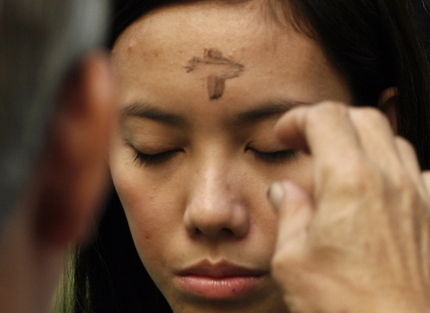
Do not be surprised this week when your co-workers and neighbors appear with smudgy foreheads. You will be tempted to grab a Kleenex and help them rub out the vaguely cross-shapen smears. Resist this urge. They have not become hygienically challenged – It is Ash Wednesday!

What is Ash Wednesday?

Ash Wednesday is the first day of Lent. Lent, an archaic word for “spring,” came to refer to a season of spiritual “training” in the Christian year preceding Easter – Sort of a “spring training” for the spiritual life. Christians in the ancient traditions spend the 6 weeks before Holy Week in repentance, almsgiving, and self-denial in an effort to remember the greatness of God at Easter. Ash Wednesday kicks it all off.

Where did it come from?

The tradition of ashes has its roots in the ancient Jewish prophets (“repent in sackcloth and ashes“). Among Christians, the imposition of ashes associated with a 40 day fast began in the 4th century. Most likely this fast was the Lenten fast, but the evidence is a bit spotty. By the end of the 10th century, though, it was a long-standing custom in Western Europe for the faithful to receive ashes on the first day of the Lent. In 1091, Pope Urban II extended the practice to Rome.

What do you do?

If you attend an Ash Wednesday service you will hear Holy Scriptures calling us to repentance read, have ashes imposed on your forehead with the counter-cultural words, “Remember you are dust and to dust you shall return” (Gen 3:19), and then go forward, empty handed, to receive the Lord’s Supper.

Afterward people go forth to spend 40 days in Lenten practices, either giving up something we enjoy and/or taking on a new spiritual activity. Self-denial and self-discipline prepare our hearts to recall the saving acts of Jesus during Holy Week.

Why?

Contrary to common opinion, Ash Wednesday and Lent are not about spiritual brownie points, impressing God, nor  making belated New Year’s resolutions – like dropping that last five pounds by cutting chocolate.  It is instead about mindfulness. When we think about God, well that is a good thing. By the way, Christians are penitent during Lent because we are grateful for God’s provision in his Son, Jesus. We go to church on Ash Wednesday to be marked outwardly with ashes as we remind ourselves inwardly of our need for the unquenchable, fierce love of God to enliven us.

Can I come?

Yes! You can find an Ash Wednesday service at any Episcopal/Anglican or Roman Catholic Church. Services are usually offered multiple times per day. You do not need to be a member. Everyone is welcome. Although in Roman Catholic churches there are requirements for receiving communion, and Episcopal churches ask you to be baptized for communion, everyone can receive ashes.

I invite you, come to church this Ash Wednesday!

Our King and Savior Now Draws Near

nativity

Snark Meter.005

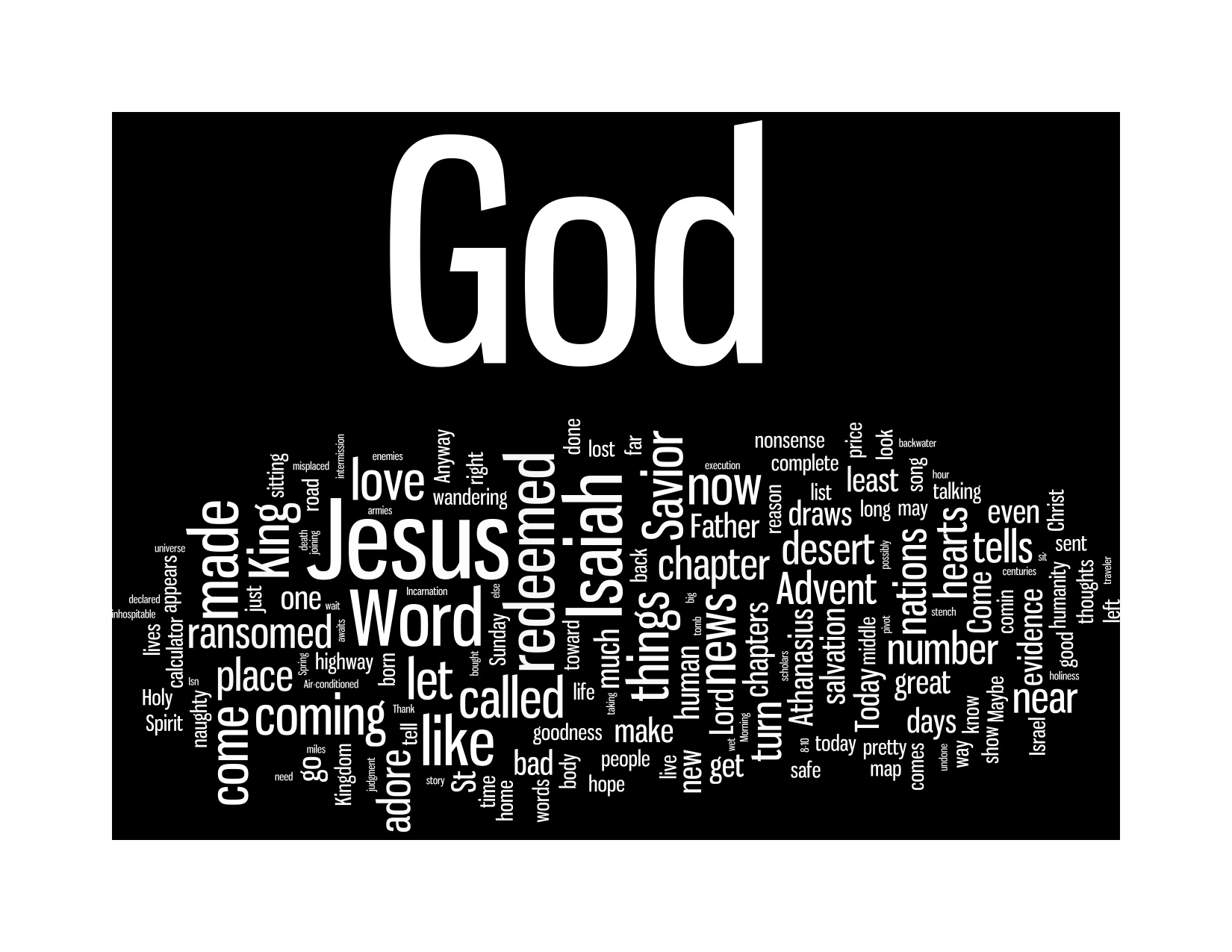
Folks have asked for the sermon that got the “Jesus count” upped after looking at its tag cloud. Here it is…

Today is Rejoice Sunday. The Advent pivot. Today we make the turn from repentance to anticipation. Today we turn toward Jesus. In Matins, the monastic morning prayer service, there is a call and response exclamation of praise called an antiphon. The antiphon in Advent is, “Your King and Savior now draws near.” The congregation gives the logical and heartfelt response, “O come let us adore him.”

Today, as our King and Savior draws near let’s turn our attention to our Old Testament reading, Isaiah chapter 35, written centuries before the birth of Jesus.

Isaiah opens with 39 chapters of God’s impending judgment. There is destruction, desolation, and ecological and political disaster.

Here is a brief sample of the tenor of Isaiah’s warnings from Chapter 34: “Come here and listen, O nations of the earth…the Lord is enraged…His fury is against all their armies. He will completely destroy them, dooming them to slaughter. Their dead will be left unburied, and the stench of rotting bodies will fill the land. The mountains will flow with their blood.”

This is not Christmas material.

For 39 chapters Isaiah tells us that God too has a list. And after checking it twice he has declared, “everyone has been naughty.” The list is unsparing: Judah, their enemies…even obscure nations scholars have a hard time locating on a map. God’s indictments through Isaiah hit, for me at least, uncomfortably close to home: You have treated the poor badly. Ignored your God to pursue the god of your own appetite. You are looking for protection from those who cannot defend you. And the logical consequences are coming…

But right in the middle of it alldropped into the midst of the judgments, like intermission in a movie too long to sit through without a popcorn break, comes chapter 35.

Some say this hopeful song belongs after chapter 40, when Isaiah’s message changes from correction to comfort. Others argue that it should come even later – after the exile. Either way, this poem appears glaringly out of place.

It is as if the Spirit hovered over the scribes who assembled Isaiah’s prophecies and whispered, “Put that over here.”

In the middle of the bad news, God Interrupts.

With words out of place that will not wait until we make things right.

…Words of hope against all evidence and reason.

Isn’t that just like God?

Look with me at Isaiah, chapter 35. The chapter is a song in four stanzas:

Stanza 1: v. 1-2  The desert will bloom – The desert is inhospitable. We have tamed it with asphalt and Air-conditioning, but ask a family trying to get to the US on foot about the desert. Every decade or so, though, we have a wet Spring and wildflowers are everywhere. God’s new Kingdom, the one that started at Jesus’ first coming and will be made complete when he returns, will be like that.

Stanza 2: v. 3-4  So, God says, and here the old Sam & Dave song comes to mind, “Hold on, I’m com in.”

Stanza 3: v. 5-7  Humans too will thrive like the desert coming to life!

Stanza 4: v. 8-10  8 “A highway shall be there,
and it shall be called the Holy Way; 
the unclean shall not travel on it, but it shall be for God’s people; no traveler, not even fools, shall go astray. -You cannot get lost following God’s road. Not even if you are directionally challenged!

9 “No lion shall be there, nor shall any ravenous beast come up on it;
they shall not be found there,”  – God has a new Kingdom in which we will, each and every one of us, be safe.

“the redeemed shall walk there. 10 And the ransomed of the Lord shall return, and come to Zion with singing.” The “redeemed”-those God has bought back. The “ransomed” – those God paid a price for. Our great price payer- God himself is coming. Jesus is on the horizon. And all things will be made new.

And it ends like this: “everlasting joy shall be upon their heads; they shall obtain joy and gladness,
    and sorrow and sighing shall flee away.” Now that is the kind of life we all want!

Beautiful words out of place.

But being redeemed presumes we need redeeming.

Frederich Buechner said, “The Gospel is bad news before it is Good News. It is a speaking of the truth of the way things are.”

Here is the truth: I need redeeming. I realized that one day when I was feeling pretty good about myself. I had been a pretty giving guy and was feeling, to be honest, that God was sort of lucky to have me on his team. Then I got this impression. Maybe it was from the Lord. Maybe I just have an over active conscience. Anyway, I realized that, on my best day, maybe I only have 4 thoughts or actions that are faithless or fearful or nasty…you know the things Episcopalians confess each week, “the things we have done, and the things we have left undone.” Anyway I happened to have that thought sitting at my desk. Unfortunately a calculator was within eyeshot. And I made the mistake of picking up that calculator and multiplying my really optimistic number (4) x the number of days in a year x the number of average years American men live. The resulting number was: 113,380. That’s right, I have a bare minimum of 113,380 sins.

The “bad news before we can get to good news” is that I am a far less admirable person than I care to believe. And God is far more forgiving than I can possibly imagine. Let’s just say that when it comes to sin, the data is not in our favor.

Fortunately, as Scholar Walter Bruggemann tells us, “All doxologies are against the data.”

So as we make this Advent turn, as “Our King and Savior now draws near,” let us look to Jesus, God’s Word out of place to us

St. Athanasius, the 4th century bishop, said Jesus, “has been manifested in a human body for this reason only, out of the love and goodness of His Father, for the salvation of us men.”

Why did our King and Savior draw near? Athanasius tells us it is, “out of the love and goodness of His Father, for the salvation of us.

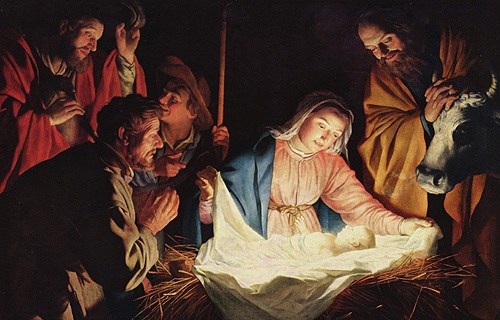
Ten days from now we will celebrate the birthday of the one St. John called, “The Word made flesh:” God’s unexpected Word out of place. Consider the absurdity of it all…

-The king of the universe born in an outhouse for animals.

-God’s Son wandering and teaching and healing the  least, last and lost, not in the halls of power but in backwater Palestine. Some have euphemistically called Judea a “major thoroughfare of the Empire,” but if that’s so, most of Jesus’ ministry was the equivalent of  wandering I-10 between Eloy and Picacho. If Jesus came today we would politely offer to show him a map.

-He offered up his life on a cross for execution by professionals and called it “a ransom for many.”

-Yet death could not hold him and he walked out of the tomb.

-He disappeared into heaven in front of witnesses, sent his Spirit to dwell in the hearts of his own, and ever lives, talking behind our backs with the Father about how much they adore the likes of us.

-And He has entrusted us with his mission and awaits for us to finish the work of carrying the news of hope in Him to consummate His story.

Words out of place always sound absurd: God joining humanity so that humanity could join God-it just sounds…well, ridiculous.

Against all evidence. Where he is least expected. God has sent a Word, a Word that appears out of place, and that Word tells us, that no matter how it looks, It may be Friday, but Sunday’s a comin’.

So when our prayers tell us “Our King and Savior now draws near” and when our scriptures tell us that the Holy One of Israel is coming for us…

…with kindness and not condemnation, Well what else could we say but, “O Come, Let us adore him”?

You see, when the Scriptures call you and I “the redeemed” and “the ransomed” it isn’t talking about pennies for pop bottles. In Christ Jesus, God has saved us. And God has done so at His initiation and at His expense.

You see, when the Scriptures call you and I “the redeemed” and “the ransomed” it isn’t talking about pennies for pop bottles. In Christ Jesus, God has saved us. And God has done so at His initiation and at His expense.

Athanasius, in his brilliant, “On the Incarnation”, said it like this: “It was our sorry case that caused the Word to come down, our transgression that called out His love for us, so that He made haste to help us…It is we who were the cause of His taking human form, and for our salvation that, in His great love, He was born in a human body.

Do you know God’s great love? Have you allowed God in Christ to be Your King and Savior? Are you numbered among the redeemed?

If not, “it was,” in Athanasus’ words, “for our sorry case he came…out of his father’s great love.” Get on God’s Way. Come see us about beginning a relationship with God in Christ after the service. My encouragement: Do not leave here this morning without allowing one of us to help you onto, as Isaiah said, “the holy way for God’s people.”

And if you do know already God’s great love, let us, as the General Thanksgiving exhorts us, show forth your praise, not only with our lips, but in our lives, by giving up our selves to your service, and by walking before you in holiness and righteousness all our days.”

Our King and Savior now draws near. And all God’s people said, “O Come, let us adore him.” 

Tag Cloud

Unflattering Mirrors: Tag clouds reveal content…or lack thereof

mirror2Snark MeterrealMID.003

Tag Clouds make good Advent and Easter mirrors. Who knew?

Episcopalians, in our neck of the woods anyway, are a small and remarkably insulated bunch from the goings on in the wider Christian community. That was why I was surprised to be fielding questions from the outside world regarding a blog post that amounts to Episcopal insider baseball.

Father Robert Hendrickson, a bright light of a young priest working in a diocesan cathedral, recently made a tag cloud of our Presiding Bishop’s Christmas message. He compared the key words revealed by her cloud to those of Pope Francis’ recent Lumen Fideiand described her sermon as “bordering on gnosticism.” Last year he compared tag clouds of her Easter sermon to those of the Archbishop of Canterbury, the Presiding Bishop of the Evangelical Lutheran Church, the Pope, and even Ricky Gervais’ atheist Easter message. Let’s just say that, from the tag clouds, even the atheist’s message appears to have significantly more Christian content. In cloud format our Presiding Bishop’s sermons appear to be long on insider lingo and social engagement and low on Jesus…that there just isn’t much “there” there.

Pointing out your national leader’s theological shortcomings is a gutsy move for an up-and-comer…a move that caused friends outside of the Episcopal Church to ask, “What’s that guy thinking? ” Would I have criticized our national leader’s sermons online? My strategy in criticizing sermons that I don’t appreciate has generally been the same strategy I use when my wife tries on something that just doesn’t work for her at the department store and asks,  ”Do you love this as much as I do?” I will pretend to have a conversation with a mannequin if necessary to maintain, “If you can’t say something nice.”

But Father Robert’s tag clouds, for all the conversation they are creating, illustrate much more than sermon content…

For one, they reveal a very odd concept for those not of our tradition to grasp: That Episcopalians, as a rule, crucify neither our orthodox nor our gnostics. Our Presiding Bishop will not, as my evangelical friends would like, be charged with violating Christian orthodoxy, nor will her critic’s career be harmed, as many of my progressive friends would like. The ability to stomach dissent, although under fire, is a historic and endearing quality of Episcopalians, a group theoretically not together on theology as much as on the agreement to pray the same words.

However, the theory that “we need not agree” has limitations. I am no fan of Confessional statements, but if there is no real creedal and quadrilateral agreement binding us together as Episcopalians, around what will we orbit when we write the prayers we will pray in unison? There is a core to the faith that makes us recognizably Christian. Or not.

Father Robert’s tag clouds also reflect a growing awareness that our missional strategy – the Episcopal church as “Christianity lite,” a doubt embracing, culturally accommodating, theologically easy onramp for those wanting to consider a practice-based rather than a propositional faith, has not worked very well…in many places we appear to have a creeping universalism that seems lumpy and out of date. Like a microfiber sofa, public doubts about core teachings (resurrection anyone?) and “all roads lead to God” do not make an attractive invitation to come check us out. Our Sunday attendance numbers since our last national leader was selected bear this out: 765,000-640,000 from 2006-2012.

Finally, in Father Robert’s tag clouds we see a hint of what is for me, a person who has spent his adult life working with people from 18-35, a seismic and positive generational shift: Young Episcopal clergy and bishops are both more progressive politically and more traditional theologically. And they are not content to sit on the sidelines and wait for the boomer generation with its (and I do believe this is missionally-motivated) theological fuzziness to get out of their way.

Out of curiosity I made a tag cloud of my sermon for this weekend. I preached out of Isaiah 35 as part of an Advent series, so I expected its references to Jesus to be lowish. Also, my purpose was to sneak up on the Christian message: That just as the Holy Spirit had dropped Isaiah 35 as seemingly a word out of place in the middle of Isaiah’s judgments on Israel, Jesus is God’s Word out of place, dropped into history where least expected. Still, my references to God: Father, Son and Holy Spirit, were minimal enough in the key words that it caused me to cringe like a glance in a mirror at a look that just doesn’t work. Missing too was any indication of our need for a savior. I tore the sermon up and went back to the drawing board.

Tag Cloud

It is not my first rodeo. I know that people come to church quietly desperate for help. If I, as the proclaimer, hold up a fun-house distortion of the Gospel…one that merely reflects back at people what I think they want to see, well, shame on me. I know that the hungry do not need the illusion that we are spiritually well-fed, when in truth we are starving for a Savior. If I fail to hold up a mirror of our deep brokenness and need and then bring the true comfort of the transforming Good News that the Creator of the universe loved us too much to leave us alone, then why bother? God entered our world, not just to demonstrate how to live, but to finally redeem us on Calvary and rise in victory. Christ returned to the Father to intercede on our behalf as his Spirit makes us a people and sends us to extend his Good News in word and deed. Less than the whole Gospel is an unhelpful diet, white bread for the soul. Looking into a mirror that distorts an emaciated spiritual reality may comfort for a while, but eventually hungry people will go somewhere else, some place a meal is served.

I have too many shortcomings as a preacher to criticize another’s sermons. For me, Father Robert’s tag clouds sent me scurrying back to the drawing board to craft a message that better reflects The Message…one that is clear on the reality that, as fourth century bishop, Athanasius wrote,  “It was our sorry case that caused the Word to come down, our transgression that called out His love for us, so that He made haste to help us and to appear among us. It is we who were the cause of His taking human form, and for our salvation that, in His great love, He was born in a human body.”     (On the Incarnation)

Funerals: Recovering hope in a culture terrified of death (2 of 2)

clip of leaves

Snark MeterrealMID.003

I promise you interesting reading on a topic you were not looking for in the middle of Advent. Although not the usual topics for youth ministry and/or church planters, as advertised in part one (The obsession we cannot avoid), here is the text to our Q & A on funerals.  It will give you a glimpse into the purpose and power of the traditional burial office. It was produced by Nicholas Knisely, Bishop of Rhode Island, Bryan Owen, Rector of St. Luke’s Baton Rouge (blogs as Creedal Christian), and myself. It is available as text for websites or as a customizable flier.

Why have a funeral in a church?

One of the characteristics of an Episcopal or Anglican Church is that you will often see graves inside the church or on the church grounds. When we speak of the Church, we mean both the church militant (those who are alive right now) and the church triumphant (those who have died and ended their earthly race). When you worship in a liturgical Church you are literally and tangibly in the presence of the whole Church. A funeral in the church building is a sign that, even though death seems to divide us from those we love, the Body of Christ is never divided. As members of Christ’s body, we are still connected with those we love but see no longer. Therefore, a funeral in the church building foreshadows that day when we will be reunited with the entirety of the Body of Christ in the presence of God.

Why a burial office (prayer book funeral service) instead of a memorial?

Rather than focus on what we believe to have been important about our loved one’s life, the burial liturgy reminds all present that we are brought into a reconciled relationship with God after our death because of what God has done, not because of what we did in life. Using the burial office rather than trying to create a particular and personal memorial service is a consequence of that belief. In the burial office the gathered body of Christ expresses gratitude for God’s redeeming work in our loved one’s life, hands them over to God’s gracious care, and looks forward in hope to God’s future resurrection of us as well.

Why do clergy accompany the family on the initial consultation with the funeral home? 

It is often a good idea to have the church funeral planner accompany you to the mortuary in order to coordinate arrangements at the beginning of the planning process. The clergy/church representative is your advocate and a calm and supportive presence at a time when difficult decisions must be made.

Why is it important for the body or cremains of the deceased to be present?

Christians believe in the bodily resurrection, not just of Jesus, but of each of Jesus’ followers. We do not know what our new bodies will look like, but we do know that God is going to transform the essence of our whole selves, our minds, our souls, and our bodies. The presence of the body or cremains of our loved one is a sign to all of our trust in God’s plan to redeem and transform us in the end.

When there is a body, why is the casket closed and covered with a pall? 

Holy Scripture tells us that “to be away from the body is to be home with the Lord” (2 Corinthians 5:8). We close the casket because our loved one is no longer present-only their remains.

Once inside the church the casket is completely covered with the “pall.” As Easter people we are dressed in white in our final church service. The pall points to the reality that, whatever our station in life, we all come before God by virtue of being clothed in robes made white by Christ’s loving action on our behalf.

Why are there no eulogies?

Although there is a degree of latitude granted in some parishes, there is a longstanding tradition of not having eulogies in the burial office. This is because the burial office, rather than fixating on the past, orients our faces toward the future promised by God that is a consequence of our relationship with Jesus. It is a good thing to remember the lives of our loved ones and to give thanks for all they have meant to those who remain behind. That work of remembering, though, happens best when we can do it in conversation. Perhaps you will want to have someone speak about your loved one’s life during visitation hours before the burial office, or at the reception following.  You also have the option of having a Vigil the evening prior to the funeral as a time to offer prayers and to share memories of the deceased. (BCP, 465-466). *Feel free to speak with your priest if you wish to discuss this further.

Why is that ‘big candle’ used in the service?

The Paschal Candle is first lit each year in the Easter Vigil to symbolize Christ dispelling the darkness. As the candle is brought into the darkened church, we sing that the light of Christ has conquered the darkness of the grave. The Paschal candle is lit every time the Church celebrates a baptism. In baptism we are “sealed by the Holy Spirit” and “marked as Christ’s own forever.” (BCP, 308) The candle is lit at every funeral to remind us of this unbreakable bond and the truth that nothing in all of creation, including death itself, can separate us from the love of God in Christ Jesus our Lord (Romans 8:38-39).

Why Is the church adorned in white?

The church is adorned in white because the burial office is an Easter liturgy and focuses on the unexpected joy of the resurrection, which the Church has proclaimed for two thousand years. In the liturgy, there is a beautiful phrase, “Yet even at the grave we make our song, Alleluia, Alleluia, Alleluia.” It is in the hardest, darkest times of our lives, that we insist on proclaiming our hope that “in Christ all will be made alive” (1 Corinthians 15:22).

Why does The Prayer book select certain Scripture readings to be used in the service??

The Book of Common Prayer is the result of centuries of thought and theological reflection. As the result of this intentional conversation across generations, the prayer book has provided selections from the Holy Scriptures to sustain us at the time of death. There is a certain latitude given to the officiant and the family planning the liturgy to chose favorite hymns or alternative readings, but the appointed readings have been chosen because they speak directly to the resurrection hope that lies at the heart of the Christian faith.

Why do we have Communion?

God has given us the chance to be united with those we love but see no longer through the redeeming action of Jesus’ sacrifice on the cross. When we share in the sacrament of bread and the wine, partaking in the body and blood of our Lord, we are united with all the hosts of heaven, and all the members of Christ’s Church of all time. We share this final Communion meal, the family meal of God’s own household, in anticipation of that great day. We will not be able to share Thanksgiving or Christmas, birthday or anniversary meals any longer with the people we have lost, but we will, for eternity, share this Eucharistic meal with them. *There are occasions in which communion may not be desirable. Discuss this with the church when planning the particulars of the service.

In Summary

Few are the times in this present age when people are aware of God’s acting to graft us in to his larger and eternal purposes. Baptisms, weddings and funerals are among those occasions. It is in those events when time and eternity touch that we and our loved ones need the truth, beauty, and comfort of the words of Holy Scripture and the great tradition. The burial office exists because the final goodbye to your loved one is simply too significant a matter to make it up as we go.

The liturgy for the dead is an Easter liturgy that finds all its meaning in the resurrection of Jesus Christ.  It gives us permission to express deep sorrow over the death of loved ones.  It also reassures us that all who die in Christ share in the victory of his triumph over death.  Using this liturgy in the church for the burial of a Christian reaffirms and strengthens our faith that just as God raised Jesus from the dead, he will also raise us.

We are glad that you are considering our church for this important event in the life of your family.

Please contact the St. Jude’s church office at (602) 492-1772 to set up an appointment to plan the particulars of the ceremony.

We are planning for this to be the first of a series entitled “Your Church. For Life.” It will include Baptism, Confirmation, & Marriage, four events people look to mark in the church.logo

All of which is to say: When I die, do the world a favor. Give me a funeral.