The In Between Day

C9czOOKXoAAoF6L

Featured Image -- 3527Holy Saturday

Today is the quiet day.

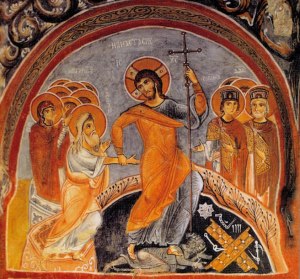
In the church historic, the art for today portrays the Harrowing of Hell, Jesus making proclamation to the “spirits in prison” (1 Peter 3:18-22), trampling the devil, destroying the gates of Hades, and leading Adam and the dead patriarchs from the tomb.

christ-the-conqueror-of-hell1

Unfortunately, life is not lived from eternity backwards. We aren’t with Jesus as he, as the Apostle’s Creed says, descends “to the dead.”  We experience life from the perspective of those living between Good Friday and Easter Sunday.

Years ago, before being president of Eastern Seminary, Tony Campolo was a comedian. He had a memorable bit about the brilliance of Black preaching. He said something to the effect that while white pastors waxed eloquent for thousands of unmemorable words, Black preachers might build a sermon around a single sentence, but it would pack a spiritual punch. Campolo’s example was, “It may be Friday, but Sunday’s a comin’.” It may have been comedy, but it was terrific preaching. (a link of Campolo reprising bits of it 25 years later.) Unfortunately, we do not spend most of our lives in Good Friday, where the wheels come off our hopes and dreams. And we do not, most of us, spend the lion’s share of our life rejoicing in the power of God on Easter Sunday. We spend most of our days in between, in the day with no name, Saturday.

Good Friday is “good” because of Easter. But it gets hard to remember and difficult to believe a dawn is coming stuck in Saturday.

Years ago I read a book by Philip Yancey, an author I knew from excellent devotions he had written in a youth Bible. In the book he relayed a story of a friend’s grandmother who was buried in an Episcopal church yard under an ancient oak tree. She had a single word engraved on her tombstone: “Waiting”.

For God alone my soul in silence waits.” -Ps. 62:5

*If you are a fan of the preaching of the early church, click the photo below for a fantastic sermon attributed to Ephipanius…

cemetery_memories_by_estruda-d5qxwj5

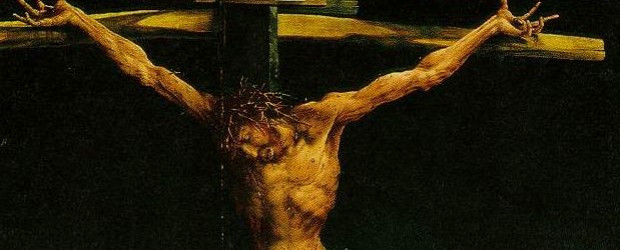
Good Friday: The axis of the cosmos

crucifixion-620x250Featured Image -- 3527

Holy Week for Newbies

Have you ever wondered why an execution is known as, “Good” Friday?

The early church believed Jesus was crucified on March 25th. Further, they believed that, since re-creation happened on March 25th, the first day of creation must have happened that day as well. The early Christian’s view of time was much loftier than the later idea that time revolves around, Anno Domini, “the year of our Lord.” The original idea of Jesus’ followers was that the cross of Christ is the Axis Mundi, a timeless, still center to the universe, around which the entire cosmos rotates. It wasn’t that the earth is the center of the universe. It was that the cross is.

The cross of Christ is the Axis Mundi, a timeless, still center to the universe, around which the entire cosmos rotates.

I was a leader for 25 years with Young Life, a ministry that focusses on explaining Jesus to unchurched high school kids. Every semester leaders do a talk on the crucifixion. One Monday night 140 high school kids were shoehorned into my friend Rawleigh Grove’s living room as I gave the “cross talk.” Regardless of what you have heard of high school kids interest in the things of God, I can tell you that all over the globe more than a million high school kids will hang on every word of the story of Jesus’ crucifixion that night. When the message was finished kids sat in stunned silence. Except for a church kid named Josh. Josh jumped up, ran up to my face and said, “I’ve been in church my whole life. I have NEVER heard this. Why has no one has EVER told me this?”

Without thinking I said, “Maybe the church is so busy telling kids what not to do that we forget to tell you what Jesus did.” That was, it turns out, a pretty good answer. But Josh missed my accidental brilliance. “I don’t know about that,” He turned toward the door, “I’m going Starbucks.” He pulls open my friend’s front door and yells over his shoulder, “It’s the only place still open. I have to tell someone what Jesus did for them!” The door slammed and Josh was gone.

Knowing what Jesus did on the cross in detail, Josh connected the dots to what he did know, that Jesus went to the cross to satisfy a debt that only God could pay. That night Josh’s world began to pivot around a new axis: the immovable cross of Jesus Christ.

Centuries before Jesus lived, Isaiah passed along (in Isaiah 52 and 53) what God told us Jesus would someday do, why he would go to the cross. In John 19:30 Jesus tells us how it panned out – “It is finished.”

Notice that Jesus didn’t say, “I am finished.” He didn’t say, “Oops.” He didn’t say, “three cheers for the attempt.” Jesus said, “It is finished.

Jesus’ “it” was nothing less than the forgiveness of all that stands between us and the Father. All of the wandering, brokenness, and idolatry, taken in one awful fell swoop. The relationship of a lifetime for all eternity freely offered, the opportunity to join God’s high and holy mission to redeem a lost world. That is what Jesus finished on a hill called Golgotha on a cross between two thieves. And the universe rotates around that event.

Isaiah said,  “He bore our griefs and carried our sorrows;” And Jesus thundered, “It is finished.”

“He was pierced for our transgressions,” and “crushed for our iniquities.” It is finished.

“His chastisement brought us peace, and by his wounds we are healed.” That too, finished.

“The iniquity of us all was laid on him.” Finished.

“By oppression and judgment he was taken away.” Done.

“Cut off from the land of the living, stricken for the transgression of my people.” That as well, finished.

“It was the will of the Lord to crush him; and put him to grief.” Finished.

Because of him “many shall be accounted righteous.” Finished.

“He poured out his soul to death and was numbered with the transgressors.” Finished.

“He bore the sins of many.” And guess what, that, too, is finished.

And while the world grew quiet Satan stood in hell and clapped. And Jesus, with perhaps the faintest hint of a grin, shook his head, “uh, uh.” And said, “It. Is. Finished.” And he bowed his head and gave up his spirit.

Why is an execution a “Good” Friday? Because, since that Friday, regardless of what you see or hear or think, the entire cosmos pivots on the axis of the victory won, won on the immovable, finished, cross of Jesus Christ.

*How does one commemorate Good Friday? Generally there are two ways: The Good Friday liturgy and by walking the Stations of the Cross. At St. John the Divine, Houston we have the Good Friday liturgy at noon, and stations at 7am, 1 and 6pm. We also have a very powerful 7-7:45 pm service called “The Service of Shadows” that is an adaptation of a medieval service that tells the story of Jesus’ suffering at the cross through Old Testament prophecy, chant, shared responses, and growing darkness.

28508736_6087307320360_6928442337676754944_n


When God Goes the Wrong Way

hqdefault.jpg

Snark MeterrealMID.003

The “triumphal entry” of King Jesus into Jerusalem was through the back gate. Ironically, at roughly the same time, the other key player in the drama, Roman Governor Pontius Pilate, would have been arriving through the cities’ front gate on his way to the Roman palace just inside the city wall. Kings may outrank governors, but conquerors outrank the vanquished. So, while Pilate arrived in a caravan, with horses, trumpets, and armed retinue; on the back side of the city, the king of the Jews, arrived on a donkey. People bowed for both. For Jesus, though, they bowed in expectation rather than spear-point. Matthew 21:1-10 tells us, they shouted, “Hosanna!” and “spread their clothes and cut branches before him.”  These people were in.

The whole city was stirred.” They were all in.

At least they were on Sunday.

By Friday, though, they were all out.

By Friday, the crowds had abandoned Jesus. The 72 had abandoned him. Even his twelve closest friends abandoned him. By the time they nailed Jesus to a cross on skull hill, none remain save his mother and John, a teenager too young to matter.

Why did the crowd…so passionate on Sunday, jump ship so quickly?

Their disillusionment seems to have begun when Jesus entered the temple the next morning. It would have been a pregnant moment: the crowd anticipating Jesus, their long awaited political deliverer, to turn to the right, toward the Antonia fortress, built by Rome on the temple wall to stare down into the Jewish temple – Big Brother making sure Israel remembered who’s boss. Jesus would show them!

Except that Jesus entered the temple and, where everyone expected him to turn right and shake his fist at the conquering pagans, Jesus wheeled left and began overturning the tables of the moneychangers. Moneychangers had a nice little business converting secular money into special temple money to buy animals for the sacrifices. At a profit, of course.

This act must have been befuddling. “Jesus, we might be getting a C in following God, but at least we are trying. How could you go after us? The Romans are the problem here.”

Palm Sunday exposes an inconvenient truth: No matter how excited we are about God today, we are only days away from turning our back on all that is good and true. It is human nature to turn from God when things don’t make sense.

We can go from “I’m all in” to “I’m so out of here” on a dime. 

I do not want to minimize your pain. It is all too real. When the wheels come off, the crash is brutal. Circumstances appear purposeless. God seems to work slowly. Or worse, God seems to give evil and injustice the nod. It was true on that first Palm Sunday, and it’s true for us – Jesus Christ is not the savior we would choose.

We can’t imagine our deliverer turning (what seems to us) the wrong way.

Jesus Christ is not the savior we want.

But he is the savior we need.

The savior we desperately need.

When you are tempted to think Jesus doesn’t get it, remember this:

Jesus knew temptation: He was in the desert forty days…tempted by Satan” (Mark 1:13).

Jesus knew poverty: “Foxes have holes and birds of the air have nests, but the Son of Man has no place to lay his head.” (Matt 8:20)

Jesus knew weariness: Jesus, tired as he was from the journey, sat down by the well.” (John 4:6)

Jesus knew sorrow: “My soul is overwhelmed to the point of death.” (Matt 26:38)

Jesus knew loneliness: “My God, my God, why have you forsaken me?” (Matt 27:46)

Jesus knew frustration: He overturned their tables saying.…’how dare you turn my Father’s house into a market!’” (John 2:15-16)

Jesus knew disappointment: “O Jerusalem…how often I have longed to gather your children together…but you were not willing.” (Luke 13:34)

Jesus knew ridicule: “Again and again they struck him…and spit on him. Falling on their knees, they mocked him.” (Mark 15:19)

Jesus knew rejection: “many of his disciples…no longer followed him.” (John 6:66)

The author of Hebrews tells us that Jesus is a not “unable to sympathize with our weaknesses.” He gets it.

In that day when the world least makes sense, the pain seems unbearable, when confusion reigns; do not lose hope. God will redeem even this. On your worst day, I believe the Lord is grabbing your face, gazing into your wounded eyes and saying:

“I promise you my child; the magnificence that will one day be yours will so overwhelmingly repurpose and overcome the suffering and pain you are experiencing right now, that it will turn even this tragedy to indescribable joy and unsurpassed splendor.”

So, friend, don’t give up. Don’t pack up your palms and go home. Stay the course. Hang onto your Hosanna when you expect God to go right and he jukes left.

Jesus Christ is not the savior we would choose. But he will never, ever, ever…be anything other than the savior you and I need.


Do I matter?

The encouragement of an obscure Saint.

Snark MeterrealMID.003

tumblr_mecrm6tLeo1rt8jooo1_1280

On Wednesday morning, groggy with sleep and sinus infection, I stumbled into the chapel vesting room to prepare for the 7AM Eucharist. Out of the corner of my eye I noticed a splotch of a red on the liturgical calendar. Red indicates the commemoration of a martyr, in this case St. Bartholomew, one of the twelve apostles. Bartholomew, tradition tells us was martyred by being flayed. He is portrayed in art with a knife in one hand and his own skin in the other.

Think about Bartholomew for a moment…Allow the great childhood Sunday school stories of Bartholomew fill you. Ponder all you know of Bartholomew from your personal Bible study…

Is your mind flooded with remembrances of this great saint? Are you overwhelmed with gratitude at the anecdotes of his faithfulness? Or does your mind, like mine, draw a TOTAL blank?

We drew a blank because a Biblegateway search reveals no information about anyone named Bartholomew in the Bible outside of his being listed among the twelve in the synoptic gospels (Matthew, Mark, Luke). We know nothing about Bartholomew from scripture. But we do know the fruit of his life: Bartholomew, tradition tells us, was the evangelist of the Armenians – The one ethnic group in the middle east to have successfully resisted Islam and wave after wave of persecution from every direction.

Bartholomew may have lived anonymously and died tragically, without a word or deed of his life recorded. But 2000 years later the results of what he did and said are still bearing fruit. The Armenian people, the subject of genocides and persecution, are sustained by the faith learned from Bartholomew the obscure.

Life, for all of , includes the tragic and painful. You may toil in obscurity. But the fruit of a life given away in service to our Lord Jesus points others to him not ourselves anyway. The legacy of a Christian is not our words, but his…not our deeds but his on our behalf. The example of St. Bartholomew tells us that a life given away for the Master always bears fruit. And always, always, matters.

Bartholomew_Fig_4_Michelangelo

*Bartholomew may be the apostle identified as Nathanael in John 1. Nathanael is the apostle that when Philip went and found him to take him to Jesus said, “Can anything good come out of Nazareth?” When Nathanael went with him to Jesus,  Jesus said, “There is an Israelite in whom there is no guile.” Nathanael responded, “How do you know me?” When Jesus told him he saw him sitting under a tree miles away, Nathanael responded with an astounding statement of faith, “You are the son of God, the King of Israel.”

Spiritual but not religious: Code for “trendy yet not helpful”

religion-is-nonsense
Snark MeterHIGH.001

I recently walked the final leg of the El Camino de Santiago in Spain.[1] Before leaving I was in a coffee house having a conversation about the trip. A guy behind me asked, “Why Spain?” My response, “It’s a spiritual thing.” Today a lot of people, particularly millennials, care about “spirituality.” 250,000 people walked The Camino in 2015. More will this year. My coffeehouse acquaintance, reflecting the cultural trendiness of “spirituality” said predictably, “I’m curious about that, after all, I’m spiritual but not religious.” To be “spiritual but not religious” is all the rage. Everyone wants “spiritual,” but many desperately reject “religious.” The question is “What do people mean by, “not religious“?

My friend Michael, a really smart priest in Dallas jokes, “‘Spiritual but not religious’ is code for ‘too lazy to get out of bed on Sunday.’” But I don’t think that’s it exactly. After all, millennials seem to be fine with ritual: We watched 2000 people a day crowd the pilgrim masses at the Cathedral of Santiago de Compostela. So while my coffee house acquaintance and many others seek “a personal experience of the divine,” and are also willing to check out a religious service, they are most definitely not running out and joining a church. So, if “religious” doesn’t mean, “I don’t like ritual” or “I’m too lazy to get up on Sunday,” what does it mean?

What is “not religious”?

In the very least, “not religious” means “I don’t see value in joining a faith community.” Perhaps this is because the churches they know are engaged in social causes they don’t like. Or because it is too narrow…or too broad (“everyone is too similar,” or “no-one is like me”). The cynical might say millennials are like Goldilocks – impossible to please. My snarky reply is that the body of Christ has done church by focus group and now doesn’t like it when the masses return the favor.

The second thing “not religious” seems to mean is “I want to do my spiritual life on my own terms.” It is to this group I appeal: Doing your spiritual life on your own is ultimately empty.

Look for example in Luke chapter 7. The first ten verses give us the story of a Roman centurion whose favorite servant is dying. Hearing that Jesus is on his way to town, he sends the town’s Jewish religious leaders with whom he is on good terms to request that Jesus heal his servant. Jesus turns and heads toward his home. The centurion, realizing that a rabbi visiting the home of a gentile becomes ceremonially unclean, sends a second set of friends to tell Jesus, “Lord, do not trouble yourself. I am not worthy” for you to be in my house, “therefore I did not presume to come to you.” He finally says, “You don’t even need to come. Just send the word to heal, and I trust that it will be done. After all, I am under authority too.” Jesus sends the word and the servant is healed. Then it says, “Jesus marveled at his faith.” He then turns to the crowd and, in one of the very few instances of Jesus interacting with a non-Jew, holds the gentile military occupier up as the example of “spiritual.”

What makes the Centurion Jesus’ model for “spiritual”?

First, notice that the man calls Jesus “Lord” (master). Every single one of the the bible’s 66 books uses the word “lord.” It appears nearly 8000 times in the Bible. (For comparison the word “love” is used about 800 times.) As a title for Jesus, “lord” emphasizes his authority, his rule over the whole world. Unlike most religious leaders, the centurion calls Jesus, “Lord.” Let that punch land for a moment: the leader of the most powerful military the world had ever seen calls Jesus, “the one with authority.” Whereas the religious leaders treated Jesus as a colleague, the truly spiritual defer to Jesus as Lord.

Jesus calls that deference “faith.” Faith in the bible is the opposite of sin. Soren Kierkegaard, father of existential philosophy, in a little book called The Sickness Unto Death said, “Sin is: in despair not wanting to be oneself before God….Faith is: the self, in being itself and wanting to be itself, grounded transparently in God.” Sin, regardless of what you may have learned in Sunday School, is not “doing bad things.” Sin is more subtle and much more dangerous: It is seeking our identity apart from God. While its’ antithesis, faith, is finding our identity in God. Faith, finding our identity in the God revealed in scripture and lived out in community, is why being truly “spiritual” always involves being “religious” as well.

Why do we need a defined faith and a defined faith community?

 Simply because they bring us into our created purpose: Finding our identity in Christ as we humbly, confidently surrender to the one rightly called, “Lord.” And having to express that faith by surrendering to other troublesome humans in the community of faith.

 The world, my friends, has realized the vacuousness of life without God. “Spirituality” is an acknowledgement of our unavoidable religious nature. “Spirituality without religion,” though, is an attempt to be nourished through a steady diet of dessert. It is the idolatry of the almighty self. The repeated more than reflected upon millennial mantra of “I’m spiritual but not religious,” reminds me of the six junior high girls I once saw walking through the mall wearing matching red “Dare to be Different!” T-shirts. Convinced they were saying something unique and profound, they failed to see the irony.

Whose fault is this?

Whenever those outside the Christian faith fail to connect there are two dynamics at work: Humanities’ own sin nature (“There is none who seeks God, no not one.” Rom. 3:10-11), and the church’s communication and demonstration of the faith. Unfortunately, instead of showing the way of faith as joyful surrender, popular Christianity has too often attempted to make faith palatable – serving up healthy doses of what Dietrich Bonhoeffer called, “Cheap grace.” Too often the evangelical church has dropped surrender for wish-fulfillment. Conservative churches have often settled for a message of self-help: “seven steps to…(fill in the blank) – diminishing God to one who exists to meet our desires.

While the conservative church has lowered God, the progressive church, on the other hand, has tended to elevate humanity. The progressive church removes the need for redemption by purging our documents of the words of surrender: Father, king, Lord…if a symbol might be deemed “oppressive” or “problematic,” it is not to be understood in its’ redeemed context, but struck from our hymnals, prayer books, and bibles. But God is not known either by shrinking him or elevating us. God is known through faith in the triune one who joined us and became “obedient to death, even death on a cross.Therefore God has highly exalted him and bestowed on him the name that is above every name, 10 so that at the name of Jesus every knee should bow, in heaven and on earth and under the earth, 11 and every tongue confess that Jesus Christ is Lord, to the glory of God the Father.”

In the 1970’s there was a movie called “The Stepford Wives.” In it, a newcomer to an idyllic NYC suburb notices that the wives are unbelievably beautiful and docile. It turns out that the husbands have been eliminating their wives and replacing them with lifelike robots who behave according to the husbands wishes. “Spiritual but not religious” is code for “I want God on my terms.” “Spiritual but not religious” creates a Stepford God who comes on command and exists as a cosmic Jeanie in a bottle or as a dysfunctional parent who wants to be your buddy but won’t give you the discipline your heart craves. And, by the way,”spiritual but not religious” is a natural result of American Protestantism’s uncritical embrace of individualism and rationalism. It is Protestant Christianity that insisted that the world is not a magical and sacramental place and that the almighty self does not need the church to mediate God’s presence. How is “spiritual but not religious”  not the ultimate natural byproduct of the Reformation?

Overcoming the idolatry of the Almighty Self is why the historic church does the things she does when she gathers in worship: In the liturgy we remind our hearts that God is God and we are not. That God is Father and we are not. That God is King and we are not. That Jesus is Lord and we are not.

Jesus calls us to be spiritual and religious; to view our humanity perfectly fulfilled in Christ and our broken idolatrous selves perfectly redeemed by Christ. That can only truly happen in a community of other broken, annoying people.


[1] We did a very small portion. Our iPhones say we walked 150 miles in 10 days. It is fantastic!

Photo from: here

What’s so “Good” about Good Friday? A lot of truth in one little word

Good Friday 2015.001

Snark MeterrealMID.003

What’s so “good” about Jesus Christ’s death? Why would we commemorate such a thing?

Here is what one of Jesus’ first and closest followers, Peter, wrote about his death several years later:  “Christ also suffered for sins once for all, the righteous for the unrighteous, in order to bring you to God.” (Peter 3:18, NRSV) Consider the implications of that one little pronoun, “for” in this single sentence. “For” occurs in our English translation 3 times. In the Greek New Testament, however, these are three different words.

  • “FOR sins” is “peri” – “concerning” or “about” – We get “perimeter” from this world. This is “about” in terms of “encircling.”
  • “once FOR all” is a single Greek word: “hapax” which is, “a single occurrence that won’t happen again.”
  • “the righteous FOR the unrighteous” – “huper” – for the sake of, on behalf of.”

There is a lot of theology in those three little prepositions: Jesus suffered to “encircle” our sins, in a “one time act”, a righteous replacement “for your sake.”

All of which is pretty darn “good.”

The Justice-ification of the Church: Where we went wrong and how we can do better

witches

Snark Meter Sorta Snarky.002

Years ago a Catholic priest from India told me, “Ghandi said, ‘I look at Jesus and I want to be a Christian. But then I look at the lives of Christians…and I don’t want to be a Christian.‘”  The great scandal of the church, for Ghandi and for us, is the troubling lack of love shown by those of us who call ourselves “Christian.”

Having made pilgrimage to the Holy Land this spring, I was astonished at how small it is: The events in the Gospels can mostly be seen from each other: Bethphage, the village from which Jesus had the disciples borrow a donkey and her colt, is on the Mount of Olives. From this hill you can look across the narrow valley and over the Brook Kidron at the walls of Jerusalem and the gate Jesus rode through on the day we call Palm Sunday. The temple, from whose courts all four Gospel writers record Jesus casting the money-changers, was just inside the city wall. When Jesus entered the temple and focused on the failings of the religious establishment rather than shake his fist at the Roman occupiers whose Antonia fortress stared down into the Temple grounds, Jesus set the stage for the crowd’s turning on him when he stood before Pontius Pilate five days later. You can walk the Via Dolorosa, along which Jesus carried his cross to the place of crucifixion in minutes. The spot where Jesus was crucified and where he was buried are also remarkably close – so close that both the location of the crucifixion, Calvary, and Joseph of Arimathea’s tomb are under the same roof today. It is stunning how little geography God used in the great saving acts of his Son.

Scandalous also is how small the distance between, “Hosanna. Blessed is he who comes in the name of the Lord!” and “Crucify Him!”

In the Gospels this took five days. In the Episcopal Church our liturgy places both the Palm Sunday and Good Friday scripture readings on the same day. My guess is that this is, in part, an acknowledgment that many will not prioritize attendance at the commemorations of our Lord’s redeeming acts in the Paschal Triduum of Maundy Thursday, Good Friday, and the Easter Vigil. But it is also an acknowledgement of basic human nature: The distance between celebrating someone and demonizing them is also remarkably short – because, as humans, we have a remarkable capacity for…small.

Just a little dollop of disappointment and we can move from kindness to vitriol in an instant. We look for scapegoats, rush to judgments, and hold others in bondage with binary thinking. We litmus test and sort people into categories of our own devising. And we cast those short of wholehearted endorsement of the platforms we embrace into outer darkness. A few exhibits:[1]

  • Several months ago at lunch I overhear the animated conversation between a socially active pastor of another mainline denomination and an atheist college professor sharing our table. The pastor labeled group after group, “Evil!” until the atheist professor finally asked him, “Where’s the love, man?”[2]
  • A student asked me to breakfast the next morning and confessed (tearfully) that he was considering leaving the seminary. He was trying to grow in prayerfulness and was told that his pleas for his fellow students to act in love toward others was evidence of insufficient commitment to the social causes espoused by his peers. He was certain he would never gain their acceptance.

A friend posted on Facebook several weeks ago, “I am uncomfortable that my church’s stance on every issue seems to completely mirror the culture.” I think he is right…

…but I am not nearly so nervous about aping the culture as I am about the next exit on this highway: the justice-ification of the church.

Conflating church and culture is surely foolish, and I think, small. But church by focus group is something of a Protestant tradition. What I cringe at is the way Christians (progressive Christians in particular, but we are not alone in this), have managed to turn all social causes into “justice issues.” We do this with seemingly little self-awareness of the ramifications of our crusades. When we label an issue “justice” we stop working for sensible public solutions and begin brandishing swords. This is never so clear as on social media…

We call the press, issue positions, and forward polemics on our Facebook feeds.

But in a pluralistic society there will always be those who do not endorse our worldview. Can we make room for them? Can we “seek to understand before being understood”? Can we begin with the presumption that people are generally of good will and work toward solutions? What if, instead of playing the “justice” card we began with, “How do we find a ‘win’ for everyone?” What if we asked, “What will lead to human thriving?” Or better yet, what if we simply remember that the church is first and foremost a place to worship the Lord, Jesus Christ. How did the church become ground zero for the activism industry?

“But Matt,” you say, “justice is biblical. The Old Testament prophets spoke truth to power.” Yes, but you are not a biblical prophet, and this is not 2600 years ago. Are we not simply using “justice” as a way to avoid making room for others? The shaking of enraged fists and mobs with torches in the night – when we label an issue “justice” then someone is guilty…and they must be punished. “Justice” is not served until the evil is purged. This is especially true when justice is hyphenated.

When we label a disagreement “justice” it generally ends one place: “Burn the witch!”

But I do see examples of hope in the emerging generation of leaders: Two weeks ago a friend who is active in LGBT politics asked me if I would organize a meet and greet between an LGBT political action group and evangelical pastors. Yesterday seventeen young evangelical pastors and thought leaders met with Matthew Vines and others engaged in promoting same-sex marriage. While there was clear theological disagreement, it was a really meaningful time of relationship building, healing, and mutual respect. Here is another: Next week I will be at a luncheon in the Roman Catholic bishop’s office to discuss spiritual unity between evangelicals and Catholics as brothers and sisters in Christ.

It is a short way down the hill to Jerusalem. It is a short way from the cross to the tomb. It is a short way from “Hosanna!” to “Crucify!”

But it is also a short way the other direction.

Going from “Crucify!” to “Hosanna!” is the exact same distance. While it does take more work, the Prince of Peace went up to Jerusalem and was crucified so that no one else need be.

Next week we will celebrate the forgiveness of both human and institutional sin on the cross. We could join Jesus in the way of that cross, extending our arms in love to all who are near. Perhaps if we did that, those who are far will see and notice. And the scandal of the modern church will be swallowed in the scandal of the historic cross.

As that old Indian priest said that day, “I implore you. Make Ghandi wrong. Be Easter people. May the love of our Lord Jesus Christ so shape and form you that all the world would see his mercy.

[1] Out of politeness I will only use examples from my own tribe. Evangelicals and Catholics will be able to think of many of their own examples.

[2] These evils included fracking, pipeline building, driving petroleum based cars, failure to recycle, and the fact that Darren Wilson had not been lynched. (The pastor was white.)

The Right King

Christ the King 2014.001Snark MeterrealMID.003

(Ezekiel 34: 11-16, 20-24, Ps. 100, Eph. 1:15-23, Matt 25:31-46)

(A sermon for Christ the King – A holy day not celebrated in the Episcopal Church)

We are all ruled by something. The question is do we have the right king?

Today is the last day of the Christian Year, known to Anglican Christians as “Stir up” Sunday. That title came from today’s collect in the first, 1549, Book of Common Prayer. We have moved that collect to Advent 3 in our current prayer book: it starts, “Stir up your power O, Lord…”

But then along came the 20th century and WWI. 45 countries took sides in unimaginable violence. Ironically, that the European countries claimed to be “Christian,” and their leaders were all related to one another. Thanks to peerage requirements to “marry an equal,” the gene pool among Europe’s monarchies had become very, very small as European dynasties intermarried. Europe was led, not by royal “families” as much as by 1 big not so happy family. If you opened their tombs you would notice that many sport a genetic feature known as the “Hapsburg Jaw” – an enormous under bite, passed down from Maximillian, an Emperor of the Holy Roman Empire in 1500. Think about this tragic fact: The leaders of the European nations had proximity, culture, religion, and family in common – Yet 18 million died in WWI. They prayed to the same God. They were members of the same family…and still, in four years a generation of young men had been wiped out.

The Hapsburgs were kings. But not the right kind of kings.

Reflecting on the Great War, Pope Pius XI wrote an encyclical letter, “On the Kingship of Christ.” The encyclical dealt with what Pius XI described as “the chief cause of the difficulties under which mankind is laboring.” He wrote that evil in the world was due to a majority of humanity having thrust Jesus Christ and His holy law out of our lives; that Our Lord and His reign had no place either in the private or political sphere. For Pius, and the classical Christian message, as long as individuals and states refuse to submit to the rule of the self-emptying Savior, there could be no hope of lasting peace among nations. Humanity must look for the peace of Christ in the Kingdom of Christ—Pax Christi in Regno Christi.

For Pius XI, only Jesus Christ could possibly be the right kind of king.

So Pius XI instituted a new holy day – the “Christ the King” as “a solemn affirmation of Our Lord’s Kingship over every human society” – King not only of the soul and conscience, intelligence and will, but also of families and cities, peoples and states, and the whole universe. Pius argued that societies without reference to God, deny Christ’s Kingship, and lead to the apostasy of the masses and the ruin of civilization. The Pope believed that an annual public and official assertion of Christ’s divine right of Kingship over humanity in the liturgy would be an effective means of combatting the growing secularism, by “stirring us up” – hence its appropriate placement in the calendar at the close of the Christian year.

It is a liturgy to remind us to bow before the right king.

Christ the King Sunday is more than the logical conclusion to being immersed for the entirety of the Christian year in the story of Jesus. Christ the King is the church giving up on political rulers, even Christian ones, to stem the decay of civilizations. It is only when we have the right king – the saving, servant king of human hearts, that we are able withstand the deadly pestilence of hatred and oppression the world’s systems bring.

It is easy to misunderstand where I am going here…to jump to conclusions. I am not arguing for dominionism, Islamic theocracy, oppressive fundamentalism, or even a return to Christendom. Read our passages carefully: Ezekiel tells us that God is a Good Shepherd. Psalm 100 tells us, “The Lord himself is God.” Ephesians tells us Jesus is, “far above all rule and authority and power and dominion” and that the acting out of that rule “gives us a spirit of wisdom and revelation as we come to know him,” that we have a “hope to which he has called” us, “the riches of his glorious inheritance.” Finally, the Gospel reading told us, that someday Jesus will return, judge all flesh, separating the sheep from the goats and saying to his own, “Come, you that are blessed by my Father, inherit the kingdom prepared for you from the foundation of the world.”

The right king, although above all others, deals with his own as a shepherd deals with their sheep. The right king is himself God and brings his own a spirit of wisdom and revelation. The right king will return for his own and give us a portion of his inheritance.

As Pius the XI so eloquently put it, “If to Christ our Lord is given all power in heaven and on earth; if all men, purchased by his precious blood, are by a new right subjected to his dominion; if this power embraces all, it must be clear that not one of our faculties is exempt from his empire. He must reign in our minds, which should assent with perfect submission and firm belief to revealed truths and to the doctrines of Christ. He must reign in our wills, which should obey the laws and precepts of God. He must reign in our hearts, which should spurn natural desires and love God above all things, and cleave to him alone. He must reign in our bodies, which should serve as instruments for the interior sanctification of our souls, or to use the words of the Apostle Paul, as instruments of justice unto God.” (Pius XI)

The right King, God himself, is beckoning us into a new fellowship as redeemed humanity through a trinitarian union with all that we are. As Christians, we have often confused membership in “one nation under God” with membership in the Body of Christ. But governments are not called to eternal union with Christ. Humans are.

Where will the right King lead us? The natural outcome of Christ our King is that we will can do nothing less than to serve others…as our prayer book says, “serve Christ in all persons.”

Let me give a little direction on how to press on as a child of the right king: In the light of the world’s troubles and our own sinfulness, our lives are only rightly ordered when we have a very, very high view of our King. So I want to close today by reading you an excerpt from one of the great sermons of the 20th Century: “My King,” by S.M. Lockridge, an African-American Baptist preacher. (I recommend you find this on Youtube, because I promise I do not do Pastor Lockridge justice.) Here is Lockridge’s…

My King

“The Bible says He’s a Seven Way King. He’s the King of the Jews – that’s a racial King. He’s the King of Israel – that’s a National King. He’s the King of righteousness. He’s the King of the ages. He’s the King of Heaven. He’s the King of glory. He’s the King of kings and He’s the Lord of lords. Now that’s my King.

I wonder…do you know Him?

My King is a sovereign King. No means of measure can define His limitless love. He’s enduringly strong. He’s entirely sincere. He’s eternally steadfast. He’s immortally graceful. He’s imperially powerful. He’s impartially merciful.

Do you know Him?

He’s the greatest phenomenon that has ever crossed the horizon of this world. He’s God’s Son. He’s the sinner’s Savior. He’s the centerpiece of civilization. He’s unparalleled. He’s unprecedented. He’s the loftiest idea in literature. He’s the highest personality in philosophy. He’s the supreme problem in higher criticism. He’s the fundamental doctrine of true theology. He’s the only one qualified to be an all-sufficient Savior.

I wonder if you know Him today?

He supplies strength for the weak. He’s available for the tempted and the tried. He sympathizes and He saves. He strengthens and sustains. He guards and He guides. He heals the sick. He cleansed the lepers. He forgives sinners. He discharges debtors. He delivers captives. He defends the feeble. He blesses the young. He serves the unfortunate. He regards the aged. He rewards the diligent. And He beautifies the meek.

I wonder if you know Him?

My King is the key to knowledge. He’s the wellspring of wisdom. He’s the doorway of deliverance. He’s the pathway of peace. He’s the roadway of righteousness. He’s the highway of holiness. He’s the gateway of glory.

Do you know Him? Well…

His life is matchless. His goodness is limitless. His mercy is everlasting. His love never changes. His Word is enough. His grace is sufficient. His reign is righteous. His yoke is easy. And His burden is light.

Oh, I wish I could describe Him to you.

But He’s indescribable! He’s incomprehensible. He’s invincible. He’s irresistible. You can’t get Him off of your mind. You can’t get Him out of your heart. You can’t outlive Him, and you can’t live without Him. Well, the Pharisees couldn’t stand Him, but they found out they couldn’t stop Him. Pilate couldn’t find any fault in Him. Herod couldn’t kill Him. Death couldn’t handle Him, and the grave couldn’t hold Him.

Yeah! That’s my King.

That’s my King.”

Amen.

Sharing your faith without feeling (much) like a cheeseball

A “catch all” seminar of quick-hits in which I touch on:

1) Newcomer/Assimilation ministry at your church.

2) A program to equip adults to read the Bible 1 on 1 with young people – works with ANY size church and needs no paid staff.

3. Two tools for sharing Jesus with others: Randy Raysbrook’s, “1 Verse Evangelism” and James Choung’s, “The Big Story.”

4. The two types of Christian spirituality: Pietism and mysticism, and why you want to encourage both.

5. What young people who didn’t leave the church have in common, and how knowing those three things can change your retention of young adults.

Evangelism Seminar: Click to go to folder of tools

Click photo to open dropbox folder of tools

Click on this pic to download slides and presenter notes

Click on this pic to download slides and presenter notes

Tenebrae Reimagined

Shadows 2018

Click on pic to go to dropbox for files

This is a powerful, millennial friendly, holy week liturgy to put in your file for next Spring. If Tenebrae is new to you, you might think of it as a camp “cross-video”…only one that happens in your mind and with much more emotional impact.

It is an adaptation of the 8th century monastic service found in the Episcopal Book of Occasional Services. We kept what works best (candles, the growing darkness of the room, the chant and participation through responsive prayer.) However, we adapted it to utilize the benefits of technology and help it to fit our contemporary context (i.e. one evening rather than three mornings before sunup).

1. Because it uses projected Keynote slides for the readings, you can have the room actually and powerfully dark.

2. Rather than being lost in puzzling Lamentations readings, it tells the story of Jesus’ Passion completely through Old Testament messianic prophecy.

3. It has the opportunity to integrate modern sound (a terrific “earthquake” rumbles the room at the resurrection), and the best of contemporary hymnody (How Deep the Father’s Love) with the symbolism, participation, and chant. It is also quite flexible: You can use the included charts for your own cantor or play the included chant recordings. You can have your own soloist and use a backing track, or play the vocal version of the hymn within the slideshow. (You will still need candles, a table, snuffer, and a black hooded alb. You will also need a Mac with Keynote, screen, sound system, and a good rehearsal.)

4. It is clear enough and brief enough for children to remain engaged. We knew we had a winner the first time we used this. At the point of Christ’s death you could hear people quietly sobbing all over the nave. People stayed in the darkened church long after the service was over. We had to finally ask the last few to leave an hour later to lock up. As far as I can tell some 5-6k folk have attended this service.

If you use it, please shoot me an email with feedback and a photo or two if you can get one in the dark.

Blessings,

Matt+

Pre-service explanation to 800 young adults at PhoenixOne.