Halloween is awesome

Trick-or-treat-1024x789

Snark Meter Sorta Snarky.002

I am an unrepentant fan of Halloween. Oh, I know it is the devil’s day. I know about its pagan roots. I too learned as a new Christian that I am supposed to bring kids to the church for Harvest Festival: the Christian imitation of Halloween.

But every one of my non-Christian neighbors will be in our cul de sac thirty minutes from now, enjoying one another’s company, hanging out, their children laughing and showing off their costumes and drinking hot chocolate together. People drive from miles around to come to my neighborhood because it is a safe place to bring inner-city kids. How unevangelical would it be to pack ourselves into a minivan and drive away on the one night of the year that my unchurched neighbors want to connect? I remember being a twenty-three year old at my first Harvest Festival and saying to my then fiancé Kari, “Here are nearly three hundred terrific people who could be light and salt in their neighborhoods and we are all here instead.”

Frankly, it is a blast to be in my neighborhood, handing out candy to the families who will come to my door, sitting around the fire-pit, bringing young adults from church to my front yard with guitars and djimbes to sing and generally make our yard the center of all the festivities. We will hand out fliers to our church’s Fall Round Up tomorrow afternoon after church – a “Harvest Festival” of sorts, but one specifically not on Halloween. After all, why should the devil have all the fun!

Excuse me, I have to go grab my cassock and sunglasses. I’m going as Neo from the Matrix. Oh, and if you are reading this on your way to the Harvest Festival, turn around. Your neighbors need you!

P.S. Feel free to critique participation in Halloween if you are also not participating in that other pagan holiday, Christmas, with its germanic tribal fertility symbol, the tree.

The True Cross

Church of the Holy Sepulcher at sunrise.

Church of the Holy Sepulcher at sunrise.

Snark Meter.005

Is the cross a sign of your life?

You probably missed it. It didn’t show up in most calendars and you would have to have been born under a lucky star to have heard it mentioned in the media. Monday marked the observation of the Feast of the Holy Cross. On September 14, 335 the Church of the Holy Sepulcher in Jerusalem was dedicated. On that day the “True cross,” discovered by Emperor Constantine’s mother, St. Helena, was brought into the church she had commissioned over the sites of Christ’s crucifixion and burial. But the Feast of the Holy Cross is much more than the celebration of a historically unverifiable artifact. Commemorating the instrument of Christ’s death is appropriate because the central focus of the Christian life is the Cross. The Cross is more than an event in history. It is the event in history.

The Cross is an eternally present reality for those allowing their lives to be hummed in the key of Jesus. The Cross is the unveiling of God in the world. It defines the proper shape of human existence. But what does a cross-shaped life look like?

Mainly it means that a truly meaningful life can’t be found in the self-centered life. We simply were not created to be self-fulfilled. We were not designed to be drinking bird contraptions, endlessly and mindlessly bouncing up and down after whatever fluid the world says we should peck at. Our lives, especially in the midst of trials, find our purpose as we give ourselves away. The way of the Cross, is the way of the other. And God is the ultimate “Other.” St. Paul says, “For you have died, and your life is hidden with Christ in God.” (Col. 3:3). The great truth of the Christian life is that we only find ourselves outside of ourselves. Orthodox priest, Fr. Stephen Freeman, offers helpful advice for living the cruciform life:

 Pray. Prayer is directing our hearts outside of ourselves towards God.

 Be kind. Kindness puts others ahead of ourselves.

 Give thanks always, in all things. Giving thanks acknowledges that our lives are not the products of our own efforts, but a gift from God.

 Forgive. Forgive everyone for everything. The refusal to forgive is the radical separation of ourselves from others.

– Give stuff away. The more, the better. We do not exist to consume. Satisfying our daily needs is enough. When our true life is found outside of ourselves, then sharing what we have with others is the most natural thing to do with our possessions.

 Do not lie. Do not participate in other’s lies. Lying is an act of selfishness – an attempt to create a false reality in order to duck the truth.

I would add: Receive God’s grace: In all of life, but especially in the Eucharist. We do not grab grace in the Eucharist. We make, as Cyprian said “A throne for God with our hands” and receive him.

The Cross is the way of life so, finally,

Embrace the practice of the Cross. Even Protestants can tangibly remind ourselves that we live in the shadow of the cross by making its’ sign frequently. In 250AD church Father Tertullian said that we Christians, “in all our coming in and going out, in putting on our shoes, at the bath, at the table, in lighting our candles, in lying down, in sitting down, whatever employment occupies us, we mark our foreheads with the sign of the cross” (De corona, 30).

The Cross is the remembrance of Christ and points to the great truth that our lives are not our own. They belong to the Crucified One – A Savior who bids His friends to join Him an act of pure love: self-sacrifice.

Did you miss the Feast of the Cross this year? Did it slip past you unawares? Despair not. You need not wait for September 14th to come back around. Simply live a cruciform life.

Because the True Cross is…you.

*This is a riff on Father Stephen’s post for a midweek sermon. If you do not read Father Stephen, you should. http://blogs.ancientfaith.com/glory2godforallthings And yes, I realize that the final sentence is narcissistic to the point of undoing the entire article. “You” just works so much better stylistically than “us”.  🙂

How I became an atheist. And why it didn’t work out for me.


atheists

Snark Meter.005

I have a friend who says he was raised an apathetic. “Apathetic” makes a pretty good description of me growing up as well. I was not an agnostic – someone convinced that God is unknowable. I had no idea if God was knowable. Maybe there was a God. Maybe not. I had never given it much thought. If there was some sort of a supreme being who spun up the world, well, we did a pretty good job of staying out of one another’s way. So I didn’t believe in God. But I didn’t disbelieve in him either.  Like I say, I was an apathetic. I just didn’t care.

At some point, though, one runs into life, or life runs into us, and we start to care.

Life ran into me one summer day after sixth grade. I came home and found my parents sitting on the edge of the bed in their darkened bedroom. My mom’s hands were over her face. I could hear muffled sobs. My dad motioned me in. “Your mom and I, we have decided to separate.” And just like that, with an obviously one-sided “we,” my Leave it to Beaver life childhood was gone. My world had been nice, quiet, predictable, moneyed. Divorce tends to unravel each of those. I was no exception. It turned out that most of my friends were going through their own pain: another divorce, a mom with cancer, a dad fired, an incurable disease. A lot was pressing in on our little group that summer as we sat on the cusp of the developmental mess that is adolescence. So, as sixth grade was about to begin, I looked at the world for the first time and wondered about the pain I felt and the pain I saw.

Broken people, broken families, broken neighborhoods, broken schools, broken cities, broken nations. The list of “broken” is disconcertingly long. How is it, if we are the product of a good and wise creator could the world be in such moral and physical squalor? I became an atheist for the reason many do: Pain. And just like that I was converted. I became a vocal and evangelistic atheist.

I was proud of my newfound disbelief. Make no mistake, it was much harder to be an atheist in the late 70’s. There were no Youtube videos. No Facebook memes. One had to find other atheists to talk to and go to the library and read Aldous Huxley, Bertrand Russell, and Jean Paul Sarte. And atheism wasn’t cool the way it is now. To be an atheist was not avant garde. It was oddball. Things went well, though, in my newfound unbelief.

I relished helping my Christian friends, who were ill-equipped to defend their faith, out of their unreflected upon delusions. I might have left them alone if my Christian friends had seemed happier than the rest of us. Or if there were any evidence, even the slightest, that their faith gave them the strength to live a more moral or kinder life. Unfortunately, my Christian friends tended to be the biggest partiers, the most promiscuous, and oddly, the most judgmental people in my school. Naturally I asked questions about this. “How is it that I, someone who thinks that I answer to no one but myself, live a more moral life than you, someone who will supposedly answer to an all powerful deity who smites people that do the things you do?” Their answer was remarkably unsatisfying: “You just party on Friday and Saturday and ask God to forgive you on Sunday. Christianity is pretty awesome!”

“Seriously?” I would answer. “Marx was right, faith in God is an opiate to justify whatever immoral thing you are in the mood for. More than that, it allows you to feel superior in some God-given right to stand in judgment of others. If I ever were to pick a religion, I can tell you it wouldn’t be something as lame as Christianity.”

Then there was the Bible. Picking that apart with people who don’t know it very well isn’t difficult. And don’t get me started on the weird and distasteful things the church has done (and continues to) through the centuries.

adults-with-imaginary-friends

All in all, atheism worked pretty well for me. At least until the end of sophomore year in biology class…

Sophomore biology is often where churched kids begin to doubt their Christian faith. For the first time they are confronted with Darwin’s theory that time and chance account for life in all of its diversity. As the scientist said at the launching of the Hubbell telescope, “We no longer need ancient myths and foolish speculations to explain our origins.” I didn’t have the slightest inkling biology class would work in reverse for me. But it did. It was the sheep eye dissection unit the last week of school that ruined me as an atheist. The football coach / biology teacher, Mr. Swerdfeger, would sit on the front of his desk with a clear plastic bag filled with sheep eyes in one hand, reach in and grab one, and toss it the queasy students at each lab table.

Biology class had two-person tables and metal stools whose screech on the linoleum made the sound of fingernails on the chalkboard endurable. Biology lab pairs pimply, barely pubescent boys with entrancing young ladies who smell of gardens in Spring. These creatures would turn their attention toward us and inform the boys, “I will NOT touch it.” To have been spoken to by one of these goddesses was a great honor. We would have grabbed the eyeballs anyway to impress, but to have been spoken to guaranteed our obedience.

Mr. Swerdfeger pulled an eyeball from the plastic bag, and threw it toward our table in the back right corner of the class. I snatched the eyeball from the air to place in the wax tray, blackened by thirty years of use and reeking of formaldehyde. As I stared at the mass of tissue in my hand an awareness crept across my mind…There are eight or nine tissue types present in an eyeball: pupil, iris, lens, cornea, retina, optic nerve, macula, fovea, vitreous fluid. Evolution, the unit immediately preceding the dissection unit, explained that biological complexity is the result of beneficial mutation. It is the mechanism of beneficial mutation that allows life to overcome the second law of thermodynamics, which says that in the closed system of the universe, life should be running down. It is beneficial mutation that Jeff Goldblum was talking about in Jurassic Park when he famously said, “Life will always find a way.”

As I held that sheep’s eye it occurred to me that those eight or nine tissue types all have to be present and working together for the eye to be useful. Beneficial mutations are only perpetuated if there is a benefit. There is no benefit to any of those tissues without all of them present together – which should be impossible…unless someone was messing with the recipe. And it dawned on me, something, or someone had interfered in the system.

I dropped the eyeball and stood up. My worldview crumbling as my body rose from my lab stool.

Mr. Swerdfeger was annoyed at the interruption. “What’s the matter, Marino? Are you grossed out?”

“No sir.” I said, “I’m freaked out. I have to leave.” I grabbed my backpack and walked out. worldviews don’t die easily. After wandering aimlessly through the breezeways, I found myself heading home.

I did not realize it, but I had been confronted by a classic God defense: design demands a designer. By the time I walked through our back gate I knew that there must be a God and that I needed to find a religion that explained it or him or her or whatever or whoever. I was not a Christian. I was not even contemplating considering becoming a Christian. I just knew that if someone had asked me that day, “How is atheism working out for you?” My answer would have been, “It isn’t.”

I simply had a hard time believing that what I can see is all there is.

images-1

*By the way, Mr. Swerdfeger was a fantastic teacher. Once when I was in the midst of ditching two weeks of school he rode his bicycle a mile to my house with a pile of homework in his backpack and told me that if I didn’t do the hours of work to pass his class he wouldn’t just fail me, he would find me and hurt me. Mr. Swerdfeger was a large man. He finally retired when the school told him that his biology class was so difficult they were going to make it the AP course. He retired rather than dumb down his curriculum. If you ask me, every high school in the country could use a few Mr. Swerdfegers.

Camp Followup: It isn’t about not “losing” kids. It’s about developing the next generation of Christian Leader

Snark MeterrealMID.003

Ten Ways To Supercharge Your Camping Program To Develop Christian Leaders

When camp is “Awesome” but two months later kid’s lives look just like they did the week before camp something is wrong – the Gospel is a transformative life change, not a temporary high.

Much post-camp “falling away” is alleviated by a great followup plan. But we have a higher bar than keeping kids from “bailing out” on the youth program and the church. We want kids to press on to become disciple-making disciples. A great camping program is a big part of that process. But great experiences without great followup, most literally, wastes the power of the experience. Here are a few thoughts on following-up on summer camps and mission trips…

1) All ministry starts with leaders. The first step in spiritual retention is to have spiritually solid, trained volunteers who are relationally engaged with students year ’round, not just at camp.

2) TAKE kids to camp. We want church leaders to BRING (rather than send) their students to camp. Why? Because to maximize the benefits of the camp experience we want the affiliation bond built at camp to be with a parish leader. You want the emotionally and spiritually intimate cabin group to also be the youth group. That way camp followup is in the local church, building on the good work that was begun at camp, rather than atomizing this powerful experience.

3) Send kids home with food. At our camp we work hard to “send kids home with food.” We have a “taking Jesus home” experience that helps students with how to press on in the Christian life. On the last morning, in front of parents, we have a “say-so,” as in “Let the redeemed of the Lord say so.” (Psalm 107:2)  Students stand up, grab a microphone, and talk about the life-changing experience camp was for them. Then, when parents are in tears over their kid’s tears, youth pastors stand up and line up not-yet-churched students with the youth pastors and groups near them so that they go home ready to plug into a church community. They go home with fliers to help them apply the scriptural truths they have learned, find a church and know when the “reunion” events are during the year.

4) Stay Connected. Have periodic reunions and weekend camps IN PARISHES around your diocese.

5) Gear up (not down) in summer. Kids today tend to be really, really busy. Summer is often the exception. Students are usually either out of town or bored. This makes summer the time of the year in which it is often easiest to build momentum. “Gearing up” after camp has two benefits: First, you can build numerical momentum going into your fall ministry year as excited students invite their unchurched friends to come join the community. Second, you keep students from falling back into old habits and destructive patterns. The spiritual discouragement that accompanies “falling away” not only causes your students to struggle, but it poisons the well with those students’ friend group when they say, “I tried God. It just didn’t work for me.”

6) Equip your parents. Parents are also least busy in the summer. Equipping parents to be the primary source of spiritual formation is not only scriptural (Deut. 6 and Ps. 78), but it is how the faith was passed on for 19 centuries before “youth ministry.” Equipping parents is especially critical in elementary school and junior high. In high school, students are emotionally separating themselves from their parents. In late adolescence your equipping will be more along the lines of making sure parents know the what, when, and why of your ministry and knowing your leaders as safe, trusted Christian adults who are reinforcing the faith of the family. Leaders become parent’s allies, saying what mom and dad say at a time in life when students, for the healthy developmental reason of self-differentiation, tend to look for direction outside of the home.

Leaders become parent’s allies, saying what mom and dad say at a time in life when students, for the healthy developmental reason of self-differentiation, tend to look for direction outside of the home.

7) Fill the Pipeline. Think strategically about your students. What do you want for them in Christ? In our diocese youth camp programs are about evangelism and the beginning of the discipleship process. We program 7th-9th grade to be like a confirmation retreat – an adult experience of Christ…but one with the “talent” of 60 parishes on tap. We program high school to be a discipleship week. Following that experience we have a leadership development camp we call WILD (Wilderness Introduction to Leadership Development) available for high school juniors and seniors. WILD involves a variety of outdoor/wilderness experiences and group leadership skills development. Then we have a three week long experience called Leadership Encouragement and Development (LEAD) for graduating seniors and first year college students. In LEAD, students live in community, serve campers, and are given intensive discipleship and bible study by a team of handpicked youth ministers of spiritual depth with powerful ministries of their own. Needless to say, when our students graduate from high school, young adults growing in their faith from our parishes line up for the chance to be camp counselors (a minimum wage paid position). Also, as part of the development of our young people as Christian leaders, we have a week of discipleship and counselor training to prepare them as counselors. We have a clear, strategic pipeline to develop young people as Christ-centered leaders.

8) Camp Assignments. Our full-time youth ministers spend three weeks each summer at camp. These committed individuals fill senior staff roles: camp speakers, head counselors, and discipling the high school LEAD staff. This builds a shared vision, spiritual commitment, and increases the spiritual, emotional, and physical expectations of our camping ministry, and year-round ministry in the parish.

9) Train volunteers. Many churches do not train volunteers. That sends a message that being a youth worker isn’t very important and neither are our young people. Volunteers buy-in and stay bought-in when they know the goals, the methods to reach those goals, and are equipped to walk with students and share the Good News with them. In our context, we have a variety of training experiences for volunteer youth workers, camp counselors, and both a one-year part-time youth director and a two-year full-time youth minister training program. Your youth leaders are the relational bridge to Christ when students are developmentally separating from their parents. This makes them a critical gift to families. Treat them as such by equipping them well and thanking them often!

youth leaders are the relational bridge to Christ when students are developmentally separating from their parents. This makes them a critical gift to families. Treat them as such by equipping them well and thanking them often!

10) Recruit the called to seminary to be the next generation of Christ-centered, theologically grounded, missionally-minded clergy to lead our churches.

If this looks far larger than simply following up with your students from camp, it is. Your camping ministry is much more than keeping kids busy. It can be the strategic beginnings of a leadership development pipeline to replace yourself with the next generation of Christian leader.

Gimme-gimme Golfball

Snark MeterMID.002

Everything I Need to Know I Learned in Central Phoenix

The Central Phoenix neighborhood I grew up in had its fair share of characters. It would not be inaccurate to say that we were a virtual pantheon of the idiosyncratic. One of our eccentrics was an elderly gentleman we knew as “Gimme-gimme golfball.”  (I use “gentleman”  loosely as he may have been Phoenix’s most ill-tempered resident.)

Yesterday a few elementary school friends and I were catching up in the pizza joint of our childhood. Over thick slabs of Sicilian style, one friend, as old friends do, looked over and made the insider reference: “Gimme-gimme golfball.” At the mention of his name all four of us, middle-aged men decades removed from the old man’s maltreatment, groaned in unison. Anyone who grew up near Chris Town Golf Course can regale you with stories of the places on their anatomy that Gimme-gimme marked with his golf club, an ancient 2 iron. None of us seems to have escaped his withering stare, his snarling curses, or the wack of that 2 iron. At least not in our memories.

Gimme-gimme’s 2 iron might have been the inspiration for the multi-purpose tool. The well-worn club was used mostly as a cane. But it doubled as a retriever of errant golf balls, and, far too often for our tastes, was pressed into service as a device for the bludgeoning of the local preteen male population. Gimme-gimme used that old club for many things…unfortunately, none of them was golf.

2 iron

How is it, you ask, that an elderly man was attacking boys with a 2 iron in a perfectly nice middle-class neighborhood? We boys had ended up on the losing end of a vicious territorial rivalry over our community golf course and the fruit it produced, errant golf balls. The neighborhood nine-hole had been fashioned on the cheap from an old sheep farm. It was acres of open space with trees dividing the fairways, a small lake, a driving range, maintenance sheds beside the abandoned farmhouse, and a grain silo that begged to be climbed. It was next to the source of our most enduring form of entertainment, a large family owned citrus orchard separated from the eastern edge of the course by a long line of ancient and gnarled salt cedar trees. Can you imagine such a place not becoming the stomping-ground of boys for blocks around? Unfortunately, Gimme-gimme thought so too. We were there for mischief. He was there for money.

Chris Town Golf Course

Chris Town Golf Course

One morning in the summer after the fourth grade, I was perched in a salt cedar watching golfers and pretending to be a WWII radio operator defending a Pacific island from bagcart towing invaders. I heard a golf ball bounce off of a cedar trunk and lodge in the rusting iron mesh of the farm fence the cedars had spent five decades attempting to engulf. I scampered down from my hiding place. Reaching into the cedar needles just inside the fence for my newfound treasure, my fingers wrapped around a coveted Titleist ball when, WACK, a blazing pain erupted in my temple. I rolled on the ground, grabbing my head in agony. Through tears I saw the old man’s grizzled arm reach through the fence. “Gimme that ball, kid.” He said, as he pocketed the ball and ambled off, not bothering to look back and see if he had inflicted lasting damage on my now dented noggin.

One day I complained about the old man to a friend when we were in the clubhouse buying candy from the 10 cent vending machine. The golf course manager, within earshot behind a rack of collared shirts for players who showed up in inappropriate attire, barked, “That old man provides a service to the golfers…you should probably stay out of his way.”

Gimme would clean the balls he found in a washtub in the back of his old camper truck, carefully repaint them, and sell them for a dollar through the golf course’s north fence while seated on a 3-legged canvas camp stool on Maryland Avenue. Maybe he was bored. Maybe he was bolstering his retirement income. Maybe both.

Of course we didn’t tell our parents that the old man was marking us up with a 2 iron whenever we got too near his income source. We also didn’t tell them we swam in the lake after hours, or snuck over to the clubhouse and sampled bottles of warm soda from the cases stacked in the shed, or tried to get the night crew to chase us in their gas powered Cushman carts either. Kids didn’t give away their secrets in those days. And parents, well, they didn’t really want to know. But I did ask my dad about the old golf ball salesman once. His reaction was telling. “The old grouch works hard enough. He would make a decent living if he wasn’t such a joyless, angry old cuss. We would rather hike all the way back to the clubhouse and pay retail.” Which explained another mystery: Why the golf course manager was so fond of Gimme-gimme.

I learned an important lesson from Gimme-gimme golfball, lumpy temple and all: When you do a job, do it with smile on your face. After all, a joyless service is no service at all.

Justice: The Episcopal Church riding a one-trick pony into the ground?

Photocredit: Paul Hebert, Symbolist.com

Photocredit: Paul Hebert, Symbolist.com

Snark Meter Sorta Snarky.002

There is an old expression from the days when entertainment starved small town Americans waited for the traveling circus to show up, only to be left flat by the disappointing show: one-tent, one-clown, and a one-trick pony. The one-trick pony was a let down, even for farm kids who spent their afternoons watching summer storms roll through from the porch. Reading reports of the testimony from the General Convention it seems to me that, although we may shrink our structures, we have already shrunk our vision. We have become the ecclesiological expression of the one-trick pony. Our pony is “justice,” and we are in grave danger of riding that horse into the ground.

Our church was once characterized by evangelical and reformed theology, ecumenical dialogue through the Lambeth Quadrilateral, ancient catholic practice, and engagement with the world as a natural outgrowth of the first three. It now appears the pressures of our decline and the narrowness of our seminaries* training have left our laity and clergy unable to argue from the Holy Scriptures informed by the tradition, only from feelings and opinions. The words reported from last night’s “Special Legislative Committee on Marriage” are filled with, “I feel,” “I think,” “I want,” “I believe.”

We seem to be unable to view issues through any lens but the lens of social justice – to the point of public shame. Last night a cathedral dean equated the Book of Common Prayer’s marriage rite language to the flying of the Confederate flag over Charleston.

Here is a money quote from The Living Church’s coverage, “‘How long are we going to allow documents like the Book of Common Prayer to contain language that is explicitly discriminatory?’ asked the Rev. Will Mebane, interim dean of St. Paul’s Cathedral in Buffalo and a member of the Task Force on the Study of Marriage. ‘Demands for the Confederate flag, a symbol of hate, to come down have been heard. … It is time to remove our symbol that contains language of discrimination.’”

The dean from Buffalo actually equated the language of the prayer book marriage rite (lifted directly from another “hate document,” the bible) used in a church in which 3/4 of our diocese’ have same-sex commitment ceremonies to the racially motivated murder of nine faithful Christians assembled in their church to study the scriptures? That is patently irresponsible, thoroughly insensitive, and wholly unexplainable to my African American friends.

But I cannot really blame Reverend Mebane. To quote a well-worn expression, “When your only tool is a hammer everything begins to look like a nail.” When we read the scriptures only through the lens of justice, everything begins to look like a justice issue.  We seem to have reduced ourselves to this one-trick pony. And, dogonnit, we are going to ride that thing until it folds under our weight.

Luckily, and as usual, it is the bishops who ride to our rescue. Bishop McConnell of Pittsburgh pointed out, “A substantial range of voices was excluded in this task force…” Such as the voices of traditionalists, and those of both our ecumenical partners and the other Anglicans in our world-wide communion.

We are fond of quoting our African brethren’s proverbs in our meetings, so let me suggest one: “If you want to go fast, go alone. If you want to go far, go together.” If we keep riding our justice hobby horse fast and alone, it will do what horses ridden for too long do: collapse.

We have same sex blessings. That horse is out of the barn. Now, for the love, can we throw a saddle on something else for a bit? The actual mission of the church: the evangelism of the 2/3 of the world who are outside of the faith and the discipleship of the 1/3 inside it, would be a good place to start.

vintage-circus-show-bus

*Biblical languages, systematic theology, historic exegesis are all absent on the Courses of Study I have seen.

The roomy church: Uniting around what unites us.

Minolta DSC

photo credit: Oh My Apartment. http://tinyurl.com/o4ouzg2

Snark Meter Sorta Snarky.002

A somewhat sarcastic yet serious call to our GC78 delegates to under react.

This post might be the blogospheric equivalent of whistling in the dark. You are pretty sure it won’t really help, but you do it because it makes you feel as if you are at least doing something…

To those of you packing your bags for General Convention let me share a story: Last year I was at the gathering of province VIII ministry leaders. (For non-episcopalians “the province” is episco-speak for one of 9 geographical regions in the Episcopal Church.) At the meeting we were discussing how difficult it is to get folk from the 19 diocese’ and jurisdictions in our province to work together. There was a good deal of frustration at parishes lack of participation in collaborative efforts. We discovered the reason was a lack of understanding of what we were united on. “We aren’t sure other folk are the same kind of Episcopalians we are?” several said. I suggested, “It might help us get buy-in if we had a statement of what we do agree on.” The consensus in the room was that we were such a diverse church that it would be impossible to agree on any kind of a statement. I pushed, “Can the youth people give it a try?” It took one draft and three edits for two liberals, a conservative, and a moderate to hash out a statement of “shared values.” Task completed in one day.

As we showed it around a fascinating thing happened: Other provincial ministry areas saw it and asked if they could use it too. An even more fascinating thing happened when I showed it to two groups of friends. One a group of progressive youth ministers from a variety of traditions (including those the Episcopal Church is in full communion with), the other a group of senior youth directors who lead the group that left us…you know, the grumpy quitters who say we drove them out. Here is where it gets really interesting: Those we are in “full communion” with said, “Those don’t describe us at all.” One, a person with a PhD in theology, said, “I’m not sure I know what half of those points are even about.” The response from the group led by former Episcopalians? “Those are fabulous. Far more descriptive of us than what we wrote!” Now the punchline: The former Episcopalians asked, “Can we use your statement?”

Insert snark: Yes, the theologically pure schismatists asked to use the shared values from a liberal province of the heretic church, while our other pure and undefiled progressive partners, with whom we have so much in common, didn’t even understand the statement.

My point: What unites Anglicans as Great tradition formed, prayer book using, rejectors of the modern pattern of song and sermon for the ancient pattern of scripture and supper, is still far greater than what divides us.

Please remember that as you travel to Salt Lake City. For all of our lawsuits and counter-suits and leisure suits, what unites Episcopalians, even today, is greater than what divides us. That will not be true, though, if you over-define and over-canonicize us. When you go to general convention, do work hard to shrink our national structures to keep resources in the parish for evangelism and discipleship. But PLEASE resist the urge to over-define and consolidate progressive “wins.” Because, as the Reformed Episcopal Church who left us in the 1870’s over two candlesticks and one word (“regeneration” in the baptismal liturgy) show us, what we are arguing about today is not what we will be arguing about tomorrow. Just ask someone from the REC. They put “regeneration” back into their baptismal liturgy in the 1980s. They put the candlesticks back on the altars in the ’60s. No, we will not be arguing about these things in fifty years. Or even twenty. Time will sort out our sexuality stuff. Canonical over-definition and prayer book revision always peels off another 100,000 Episcopalians. And in case you haven’t checked recently, we don’t have them to peel off.

So please, deputies and bishops, as you meet and deliberate our future, please make the hard decisions to shrink our top heavy structures. But when it comes to theological and canonical decisions, especially decisions around marriage, remember that success strategy that you learned in your parish ministry: the power of the under-reaction. You have the votes. You can win. But you can win in a way that creates so many losers as to erase that win. To quote a bishop friend, “Anglicanism, at its’ best is tentative, nuanced and compromised.”

Delegates and bishops, I beg you, under react. Keep us roomy. In a roomy church everyone wins.

Shared Values.001

The Future of the Episcopal Church: Being “poised for growth” is not growth

High-DiveSnark MeterrealMID.003

Old joke: “What do you call a leader with no followers?” Punchline: “Someone taking a walk.”

With General Convention just around the corner there is much talk in Episcopal clergy circles of internal restructuring schemes for our national church office. Interestingly, no one outside our tribe has ever asked me about our “structure issue.” When I speak with other clergy they ask about another issue: “What are you guys doing about your leadership issue?” They see us as having a pressing problem that most of us do not seem to be able to see: A significant number of our “leaders” don’t have many followers.

The numerical decline of the American mainline has left the offices of the historic denominations in a state of continual “restructuring” (a.k.a. “downsizing”). These efforts cost piles of money, take years to enact, and generally leave us with more of the ineffective same. There is a reality instinctively understood by independent churches: churches are neither planted nor grown from national headquarters but by local leaders and their local followers. Church planters know the leadership equation:

 Talent + Preparation + Opportunity + Expectations + Effort = Results

Or as Scott Haas the planter of Substance, a Minneapolis church exploding with millennial generation parishioners says, “The right person, at the right time, in the right location, with the right methods, with the right inner circle of leaders, equals success.”

Our results stare us in the face: In numeric decline for thirty years, we are now in numeric freefall. Episcopal churches have lost a quarter of our Sunday attendance over the past decade: 823,000-623,000 per week from 2003-2013. And, lest you believe the rhetoric our decline has bottomed out, in 2013, the last year we have statistics for, the decline was 2.6%, an increase over the 10 year average of 2.4%. Conclusion, we have shrunk, are shrinking, and the rate of our decline is accelerating.  To make matters worse, this summer our General Convention will contemplate new rounds of canonical and prayer book revisions that threaten to marginalize whole groups of parishioners, threatening yet another slow trickle from our churches. And, as if we have not had enough bad news, we are about to enter what church statistician Lovett Weems calls “the tsunami of death” as our builder generation attendance core become, paraphrasing St. Paul, “absent in the body to be at home with the Lord” over the next decade.

So, If our results do not “equal success,” where in the equation are we falling short? Is it the right people? The right location? The right methods? or the right inner circle? Because our leaders have been telling us for a decade that the Episcopal Church is “poised for growth.”

And, although the first half of this post might seem to indicate otherwise, I actually believe them.

I do believe that with our inner-city locations, historic buildings, broadly creedal ancient-future faith, communities shaped in daily immersion in the scriptures and weekly sacramental worship, our willingness to form communities that help one another strive for personal holiness with grace toward others, of agreeing to pray together rather than agreeing to sign the same doctrinal statements, that we really are poised for growth.

You should know, however, that I myself was once poised. I was a freshman in high school. It was in the swimming unit of second hour Physical Ed. I was poised on the end of the high dive. Every sinew of my skinny body twitched in readiness to propel myself off that board. However, fear won out over the desire to impress the girls below. Fear and the awareness that I did not know how to dive – I lacked diving talent and preparation. So I turned around and slunk down the steps of the board to the jeers of my pre-sensitivity era friends. The point: Being “poised” to do something doesn’t get it done. One still needs talent + preparation + expectations + effort in order to go get the results that opportunity leaves us “poised” to achieve.

Will we Seize Our Episcopal Moment?

Will we turn it around? As “The seed that grows on its own” parable (Mark 4:26-29) taught us this past Sunday, the kingdom will keep growing. Last year, for instance, the Sunday attendance of 10 American churches grew by 2000 people or more. But we will only reap the harvest into our churches if we cast the seeds of the Word of God and wield the sickle to bring in the harvest. We will have to overcome our hesitation at using the God given tools of evangelism and discipleship if we are to bring in the harvest God has prepared. The kingdom is growing. God sees to that. But I see a potential pitfall in our (much needed) restructuring efforts: That of staying in the shed “sharpening” the tools to create what has been referred to as a “leaner, meaner, more responsive instrument.” But then never using it.

Will we seize our Episcopal moment and join God’s harvest? Or will we leave it to others?

General Convention 2015 – Will history repeat itself?

photo credit Susan Snook

photo credit Susan Snook

Snark Meter Sorta Snarky.002

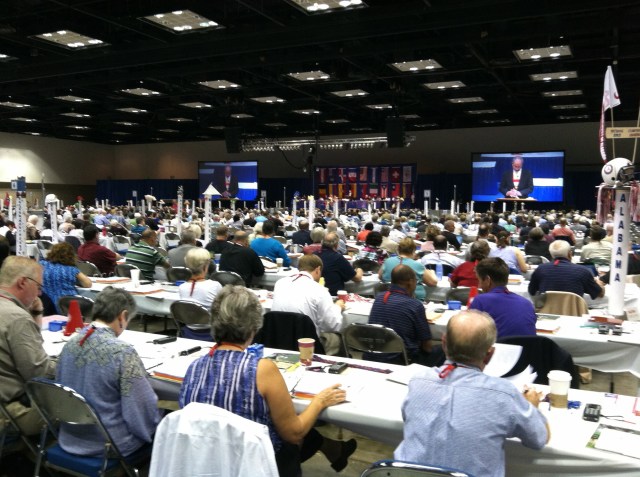
It is a business meeting that inspires either the deepest anxiety or absolute apathy: General Convention – the triennial business meeting of the Episcopal Church.* This July we will have another of these enormous shindigs in Salt Lake City. What happened at the last one encouraged me.

My perspective on General Convention 2012 was somewhat unique: I was not a member of any of the “usual suspects” at General Convention. I was not a “deputy” (elected lay and clergy representative), although I listened privately to the perspectives of many deputies. I was (obviously) not a bishop, although I spent a fair amount of time privately listening to the widely divergent viewpoints of four bishops and their spouses. Neither was I a member of one of the many lobbying groups that show up at these events to push the church toward greater “justice.” Why was I there? I manned a booth with several friends attempting to rally adults to take the Good News of Jesus to youth outside the walls of the church. In other words, I was about as dispassionate an observer as one can be as an insider in our institution.

What encouraged me at GC12? The legislation that summer fell into three basic groups that illustrated trends:

Group One: legislation for theological change

-Allow Communion for people who have not been baptized. (A no brainer for evangelicals, but a big deal theologically for the church historic.): No

-Remove Confirmation as a barrier to holding parish leadership positions. (i.e. some semblance of Christian commitment prior to church leadership.): No

-Updating the 1982 Hymnal (A political precursor to revising the prayer book): No

Trending down: Theological change.

Group Two: legislation for political change 

-The bishops voted to continue making statements on moral issues such as the plight of Palestinian Christians, the use of drones, world hunger, etc. (This is an attempt to “speak truth to power.” Not to be snarky, but it strikes me as somewhat humorous that we think anyone is listening when we, 1% of the countries’ Christians, tell the government to stop shooting cruise missiles.)

-We voted to include the word “transgendered” in the list of what will not prevent someone from seeking ordination.

-We voted to have same-sex blessing rite liturgies approved for use by those who choose to do so.

Trending up: progressive politics

Group Three: legislation for mission and overcoming organizational stasis

-Sell our church HQ building in Manhattan: Approved

-Establish a committee to restructure church governance: Besides our bicameral legislative body, the General Convention, we also have a large national church office and hundreds of national committees & commissions. This new committee to “restructure” was tasked with shrinking all of this.  Approved

-Remove the stipulation that the Presiding Bishop must give up their diocesan bishop role (An attempt to roll back the ever-increasing hierarchical structure of our church since setting up of the national office in 1947.) Approved

-Perhaps most interesting of all: The bishops re-established themselves as the fulcrum in our three part divided form of government by writing a letter to the courts in Fort Worth and Quincy. Skip bracketed paragraph if you are not a church geek. 

[How does a letter rebalance power? A group of conservative bishops had written a “friend of the court” letter (Amicus Brief) to the courts in Fort Worth and Illinois defending the ancient church practice and traditional Episcopal understanding that the diocesan bishop is our church’s highest authority. The majority of the bishops were very angry about this as it undermines our lawsuits in those diocese. However, in a stroke of brilliance they chose to write a letter supporting the new bishops and the churches that remained in the Episcopal Church in Fort Worth and Quincy, without mentioning the substance of the letter written by the conservative bishops. This is dense politics, even for Episcopalians, but our bishops, by affirming the new bishops and NOT addressing the substance of the letter, re-affirmed the traditional view that bishops are the highest authority in our church – rather than a metropolitan such as a Pope, prophet, Archbishop, or even our own Presiding Bishop.]

In one swoop the bishops appear to have re-established themselves as the locus of power in the church, rather than the other two groups (the national office/presiding bishop, and the House of Deputies/Executive Council) who each behave as if they are the prime authorities. Practically speaking, in an institution with balance of powers, someone always gets a vote with just a little more weight than the others. I think it is a good thing if our bishops, who are closer to the mission field than the national office, and in recurring collegial relationship with one another, unlike the deputies. It makes for a safer, more catholic church that the bishops would be the ones with tie-breaking power.

Trending up: The scent of a revolution to drive the church back toward mission.

Summary: We seemed to be becoming a more theologically conservative, more politically progressive church that is irritated at resources being siphoned away from mission to national structures.

Why is this important for this summer’s General Convention? Because this summer we will make decisions that strike at the heart of what many perceive as our orthodoxy: marriage in our prayer book and in our governing documents. These changes will be pushed for “consistency” sake. Indeed, we will be more consistent if we, a church where many are performing same-sex marriages has that practice canonically in place. We will also be a much smaller church if that happens. This will be a bridge too far for many of the 150,000 or so remaining social conservatives in our church. In 2003 823,000 people worshipped in Episcopal Churches on Sunday mornings. In 2013 that number was 623,000 people, numbers that do not include the loss of another 10,000 Episcopalians in South Carolina. Do we really have another 100,000 Episcopalians to peel off to make us, to quote one of our seminary professors, “a leaner, meaner church”?

Far better would be to resist the urge to over-define ourselves. As Nick Knisely, bishop of Rhode Island says, “Anglicanism is tentative, nuanced, and compromised.” The tendency to over-definition is characteristic of other traditions: fundamentalism with detailed statements of faith and Rome over-defining the Eucharist in the 11th century come to mind.

My hope this summer is that cooler heads will prevail. That we will continue our previous trends toward holding the line on matters theological, being open politically, and that the scent of revolution that wanted to drive mission from a national vortex back into thousands of local communities to proclaim the Good News of Jesus in word and deed would be the place our leaders will focus this summer.

Will history repeat itself? One can only hope.


*Bunny trail: Episcopalians will tell you, chests heaving with pride, that our General Convention is the second largest legislative body in the world. When one considers that Episcopalians now comprise less than 1% of the Christians sitting in American churches on any given Sunday morning (623,000 in 2013), it raises one’s eyebrows at the hubris necessary to think that we need a decision making body second only to the group representing the one billion people of India.

How a backwoods battle and a leader you’ve never heard of changed history

Photo of the Battle of Cowpens in the Charleston Custom House.

               Painting in the Charleston Custom House.

Snark MeterrealMID.003

You probably haven’t heard of it. I hadn’t. It is known as the Battle of Cowpens and it isn’t in most high school history books these days. Here is the backstory: America was losing the revolution – badly. The British, well funded, well mannered, and well dressed, had established forts in the southern countryside and were converting loyalists to their cause as the patriots, hungry and ill equipped, hid in the woods. American General, Daniel Morgan, had 300 regulars and was trying to elude a British trap.

Morgan was a veteran. He had proven himself at Quebec and Saratoga. At Cowpens, in the face of a far superior force, Morgan did everything right and modeled leadership under pressure.

What did Morgan do?

  1. He analyzed the situation accurately: Morgan had 300 Continental soldiers. The British under the ruthless “Bloody Tarleton” were marching 1000 crack troops to surround the Americans and wrap up the frontier campaign.
  1. He recruited aggressively: Seeing the hopeless mismatch, Morgan sent out the call to “meet at the cow pens!” This produced 650-ish militia to meet him to attempt to turn the tide.
  1. He motivated passionately: The night before the battle, Morgan went among the untrained militia imploring them “just give me three good shots and you can go home heroes.”
  1. He chose his battlefield carefully: A brilliant strategist and realistic leader, Morgan chose “the cow pens,” as the place his untrained men would make their fight. It is a high and open ground with a road the British would travel down right up the middle. He stationed his Continentals on the uphill side of the pens, an open spot one hundred yards wide by five hundred long. The cow pens were surrounded by dense woods and streams. This prevented flanking. Even more, the swollen Broad River at their back gave his men nowhere to run.
  1. He formulated his plan brilliantly: Three lines of riflemen. Each would shoot at the officers and dragoons and then melt behind the next, each line providing cover for the other and leading the enemy deeper into Morgan’s midst.
  1. He estimated his foe wisely: He knew Tarleton would press the battle, confident of the open ground and anxious for a decisive blow.
  1. He led his men courageously: When the battle began to fall apart, Morgan was right there. He rode among his panicked troops, rallying a right flank in disarray, until it resembled a purposeful wheeling/pivot movement backwards from his right.
  1. He pressed the victory brilliantly: As the British came forward on their left, Morgan’s best men, mounted “Dragoons” were waiting in the trees. They came galloping down, surprising and surrounding Tarleton’s troops. This is known as a “double envelopment.” 120 British troops were killed and 800 surrendered en masse.
  1. He finished honorably: It is often difficult to be a good winner. Morgan was. The American colonists (most of whom were not trained, disciplined ‘regulars’) were very angry about the atrocities and brutal tactics  of “Bloody Tarleton.” They wanted to show no quarter and cut the British down. When the British laid down their arms in surrender, it was Morgan who forced the Americans to overcome their adrenaline and put an honorable end to the fighting. Morgan would never again lead a significant fight. Eight months later ill health would force him to resign his commission. A great leader finishes well.
  1. He did his part faithfully: Morgan was a small part of a big picture. The defeat at Cowpens deprived British General Cornwallis of his offensive weapon. Forced back to Virginia, Cornwallis was pinned on land by Washington and at sea by the timely arrival of the French at Yorktown, thus winning U.S. independence. But it was Morgan, faithfully doing his small part in the back country, who set up the famous surrender at Yorktown. We have the America we have today because of someone most of us have never heard of faithfully doing a job that needed to be done, in an out of the way spot, in the face of great adversity and terrible odds.

What kind of leader will you be?

In your life you will likely be called upon at some point to lead. Will you accept the call? And when you do, what kind of a leader will you be? Today it is fashionable to tell young people, “Follow your passion.” Frankly, that sets up a world that begins and ends with the self. The world was not built on such little thinking. And it is no coincidence that as our culture follows that line of thinking it is running right off the rails. You see, the men and women that you most admire were not people who did what they “wanted” with their lives. The great acts of history, the great leaders of the ages, and the great works of literature were all forged in the fires of difficulty and conflict. I am fairly certain that Dr. King would rather not have been writing from a Birmingham jail. I am fairly certain Lincoln would have preferred not to have to write an address for the slaughter at Gettysburg. I am absolutely certain that the New Testament would not be what it is if Jesus was not crucified and if his followers, Paul and John, were not writing from prison cells and penal colonies. Difficult times produce great humans. The world does not need you to follow some narcissistic “passion.” It needs you to find a need, step into that gap, and do something. Something small or great, that needs doing. To do that thing that is part of the bigger picture. To fight your battle, so that whether or not anyone else notices, you will have contributed to the great victory of leaving the world a better place than you found it. That is leadership.