Will we go with Jesus to the Cross?

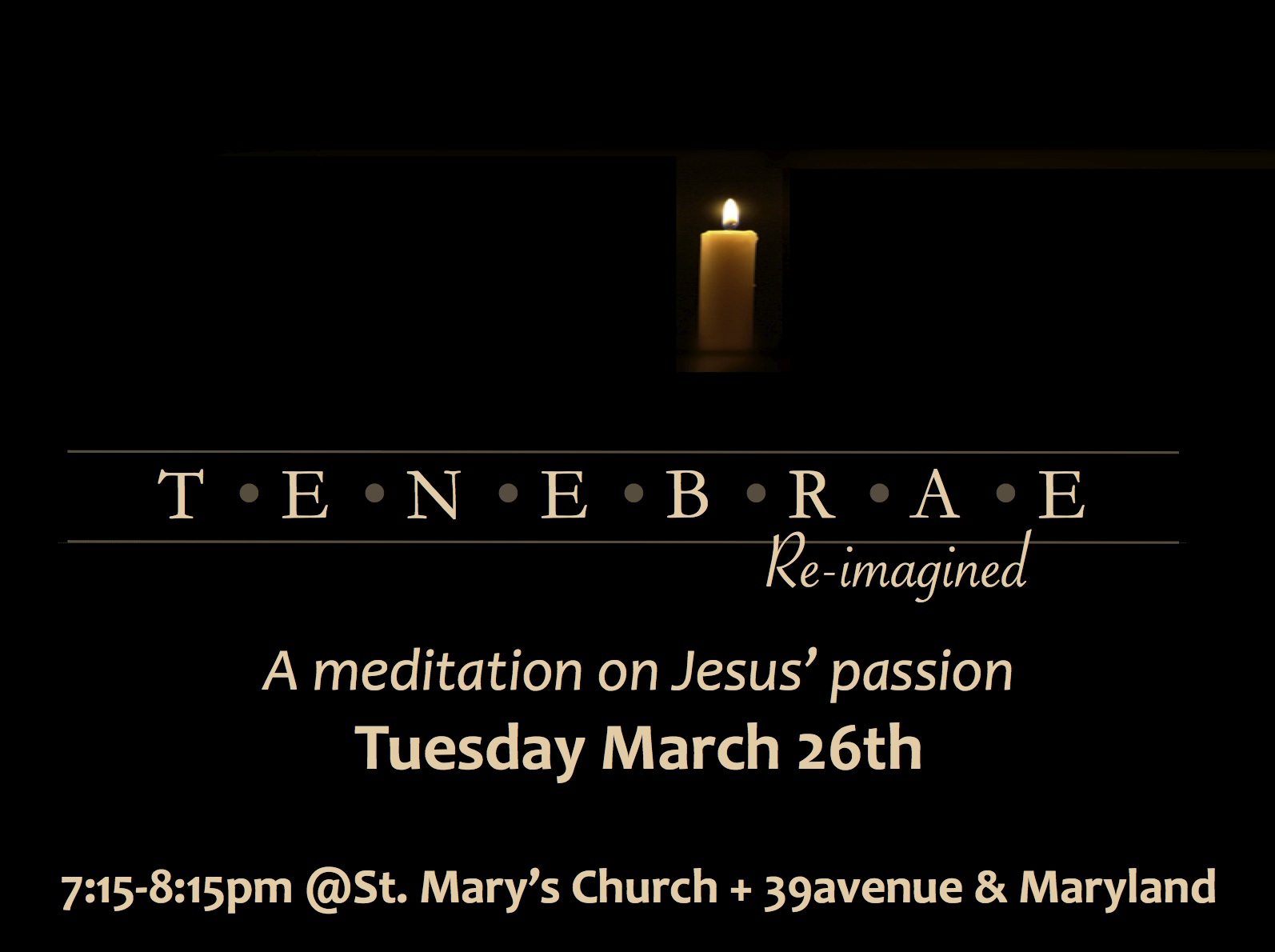
Tenebrae2013If you are in Phoenix and want a more transformative Holy Week experience, come to “Tenebrae Re-imagined.

Tenebrae is a monastic tradition from the 8th Century and uses the extinguishing of candles to represent the fading and fickly loyalty of Jesus’ disciples as he went to and through his passion…and by extension, our fading and fickle loyalty to the crucified Savior as well. It has come back into vogue in the last decade. Unfortunately, most of these services are “insider friendly,” long and involve obscure readings from Lamentations.

We have redone the service in a very powerful way:

1. It traces Jesus’ Passion through Old Testament prophetic passages, material written between 400-1000 years before Jesus was born.

2. It is multi-sensory: It uses both chant and modern music, darkness and light, silence and sound, actors and audience participation.

3. It uses both multi-media & live candles….allowing the room to be actually dark.

4. It is brief: 45 minutes long

If you are from an evangelical tradition, think of it as a Cross-video that plays in your mind – Powerful and brief.

This version, that we wrote, is now being done in 10 places around the country. Last year we did it with PhoenixOne. This year it is led, directed and sung by college and high school students. In the four times we have presented this we have had to ask people to leave more than 30 minutes after the service was finished. It is emotionally powerful and excellent. Come check it out!

Rappelling, Race and Your Role in the Redemption of the World

tumblr_m63xqaWsoc1r4kpnxo1_400A sermon from the Healing of the Paralytic (Mark 2) given at the Diocese of California’s “Equipping the Beloved Community.” Topic: “Reaching people who don’t look like us.” 

Today we heard the story of a person literally at the end of ropes in a strange place.

What is it like to be at the end of a rope hanging over the unknown?

I had that experience once. I took students rock climbing and rappelling on the boulders outside of Tombstone, Arizona, site of the gunfight at the OK Corral. A retired Army Special Forces guy named Mike organized the trips to teach spiritual principles through great adventures.

In case the terms are new, “Rock climbing” is going up a rock face, “rappelling” is sliding back down on a rope – you see it on military recruiting commercials. It was spectacularly fun. Afterwards, we went to dinner in town. We assumed we were done for the night, when the guide turned his station wagon back toward the desert and informed us we were going to night rappel.

In the interest of full disclosure, I am a little bit afraid of the dark.

Don’t laugh – You are too.

We were led up the back of the 90′ cliff by flashlight. The guides tossed the rope over the edge, looked at me and said, “You first.” Ever the reasonable man, I pointed out that it would make more sense to have a trained person on the ground first. Mike says, “We need them up here. You first.”

There was a sliver of moon, which, in the dry air, lit the top half of the cliff face. An outcropping shielded the bottom from the moonlight, The bottom half was a dark mystery.

When rappelling you are attached to the rope by a metal figure 8. This slows your descent by friction. Placing your hand in the middle of your back with the rope in it acts as a brake and you stop. Moving your hand away from the middle of your back allows the rope to slip through the figure 8 and your hand, and down you go.

I started the descent – nine stories in the dark.

Wanting off the rope as soon as possible I go down fast. Perpendicular to the rock face, I jump out as far out as possible to slide down the rope as fast as possible…

I get below the outcropping blocking the moon. Now in blackness, I slow to a crawl. I am shivering in the warm evening.

“How is it going?” The guide yells down at me.

“Great.” I yell up unconvincingly.

“Good.”

“Sure is dark down here.” I say somewhat pathetically.

“Tell us when you are on the ground.”

I feel the end of the rope in my hand.

“Uhhh, we have a problem. I’m out of rope.”

“Good. Send it back up.”

“You aren’t reading me: No rope, AND no ground either.”

If you have had grief training you know the stages: denial, anger, bargaining, depression… In the slowest two minutes of my life I journey through them. Mike, leaning over the edge, starts with denial. “That’s impossible. You are on a 90’ cliff with a 100’ rope.”

As you might imagine, I respond with anger. “That’s a nice theory but I am definitely not on the ground.”

“How far away is it?” The guide calls.

“Since you had me rappel into utter darkness, you tell me.” I move to bargaining: “How about you pull me back up?”

“Sorry, we have no way to get you back.”

Now depression sets in…and a little panic. Beads of sweat form on my forehead. “I hope you have some ideas, I’m stuck here.” I say nervously.

“Uhmm, try poking around with your foot some more?”

So there I am, in a dark place, all alone…at the end of my rope.

We have all been in dark places. Felt alone. As Christians, though, we know we are not actually alone, no matter how dark the night. We are, however, surrounded by people for whom “God with us” is not their reality. They are lost and hurting. In dark places. Alone. At the end of their ropes. Some are aware of this. Others not so much.

Look at what Jesus does with someone in that place…

Picture yourself at our Gospel event that long ago evening: A crowd shoehorned into a living room. The yard also jammed with people. In the crowd, you listen to Jesus teach when dust begins to fall from the ceiling of the sod-roofed home. Dirt chunks, grass and sticks fall to the floor in front of you. Heads pop through the hole. The vandals pull out beams, expanding their damage. And then down comes this guy, lowered in front of Jesus.

Jesus, master of the unexpected, sees “their faith” and “looking at the man says, ‘Son, your sins are forgiven.'”

When most of us hear the “s” word we cringe. Even in church “sin” makes us fidget in our seats. If you are “conservative” you probably have a mental list of personal behaviors that are “sins,” “progressive” and you probably see systemic evil as “sins.” I propose a more ancient way of defining sin…simply as looking for life apart from God. When considered in that way, it explains both our wandering into individual self-destructive behaviors and participation in systemic evil. We were made to worship the one true and living God. We all wander from our purpose and look for life apart from our maker. Jesus looks at the paralytic and says in effect, “You have a bigger problem than legs that don’t work. You have a heart that is looking for life apart from me. I forgive you.” And, “so that you may know that the Son of Man has the power to forgive sins, Get up, take your mat and go home.”

And he does.

Imagine the friend’s giddiness. Can you picture them staring through the hole yelling, “I told you so!” to their wobbly-legged friend?

These friends were pretty amazing. They:

-Went as a team, rather than alone.

-Knew that healing is found in a person, rather than a place.

-Cared enough to bring him to Jesus.

-Wouldn’t take “no” for an answer, neither from their friend, the crowd, or even the homeowner. Imagine the conversation to convince the friend. I would guess the paralytic said something like, “I have no intention of being the butt of every joke in town when your scheme doesn’t work.”

-Went to ridiculous lengths to put their friend in front of Jesus: They risked time, energy, potentially their self-respect, and, surely, a good bit of money at Home Depot afterward. They literally got their hands dirty to bring their friend to the Savior.

What about you? Who are you a spiritual friend to? We have friends all around us who need the healing and forgiveness of the Lord Jesus Christ: at your work, school, in your family, surrounding your church.

Are you willing to do whatever it takes to help them see Jesus…willing to get your hands dirty? Jesus saw “their faith.” Do you faith to bring Christ’s healing and salvation to your community?

I don’t know your context. But I have looked at the demographic data for your schools. They are remarkably integrated. Why isn’t your church?

Shouldn’t a church reflect its community? Why is your church mono-ethnic in an integrated neighborhood? Perhaps, as it was for the paralytic, the way into church is blocked? It isn’t always the crowds that keep people away from the Savior.

Mark DeYmaz, in Building a Healthy Multi-ethnic Church, says the average American church is 10x more segregated than its neighborhood.

Prior to coming to the Diocese I worked in a historically upper middle-class youth ministry in a neighborhood becoming less White by the year. We took our leaders to the high school quad and, while looking at real students, asked “Who on campus isn’t in our ministry and why?” Then leaders picked groups and went and got to know them.

When those kids began to follow Christ we took them to church. A painful thing then began to happen: After worship the young people would say what Luis Acosta said, “Matt, I love that you stalked me for Jesus. I love that you made me come to Bible study and taught me to obey Jesus.’ I love that you are training me to be a Christian leader….but do you have to keep dragging me to these churches.” I was confused: We had gone to Anglo churches, Latino churches, Black churches.  At each the people were nice, the music excellent, the sermon interesting. One student, Luis, pointed out the monochrome reality, “Everyone here was (fill in the racial blank). Then he asked, “Why is God the only racist in my life?

I was stunned by the question. It has been more than 50 years since Dr. King said that 10 am on Sunday is the most segregated hour in America, and still 92% of American Protestants attend mono-ethnic church services. Your own Julia McCray Goldsmith’s son said to her, “I don’t want to go to church-it’s the only place I go that’s all-White.”

We hang signs that say, “We welcome you.” But what do we do to welcome people who don’t look like us?

I came to the Episcopal Church in part because, in addition to promising Protestant theology with catholic worship, access to the wisdom of the earliest Christians and the hopeful idea that we could agree to pray the same words rather than agree on every theological jot and tittle, we believe in the dignity of those who aren’t like us. Unfortunately, “Welcome” is easier to paint on a sign than to do.

Statistically Evangelical churches are much more integrated than Mainline churches. How is that possible? Perhaps while we were talking about justice, they were talking about Jesus.

How will our children believe us that Jesus loves the world and went to the cross for the salvation of humanity if the church looks completely unlike their world?

What if everyone here said, “I don’t care what anyone says or thinks of me, the most important thing in the world is the forgiveness and healing found in Christ.” What if out of that conviction each of us engaged in friendships with people unlike us? What if we talked to the under-represented about what would need to change in us and our churches for them to feel culturally welcomed and spiritually challenged.

Imagine what your world might look like a decade from now if we lived that kind of Biblical welcome…

-Entire neighborhoods walking in the healing and forgiving love of Jesus.

-Not just full churches, but joyful neighborhoods, laughter in the streets and hope in human hearts.

O that we would say the words Isaiah said to God so many years ago, “Here am I. Send me.”

…Back to my climbing story: It turned out I was only inches above the ground. Coming down the cliff face I had angled left toward the moonlight. The cliff bottomed into a downward sloping hill. I had moved just far enough toward the moonlight to leave the ground 2” below my outstretched toes. In the end, I had been afraid of a harmless unknown. Isn’t the unknown what we are really afraid of when it comes to opening wide our churches so that others could experience the love, healing, and salvation of Jesus?

Are you willing to take a risk for the Kingdom? As one who is safe on the rope of God’s mercy, are you willing to go, make unchurched friends, and jump with them into God’s unknown?

When we take a risk we never know what God might do.

And, the paralytic that gets healed might just be us.
Why would anyone join a “brand name” church? (What the heck is an Anglican pt. 2)

Past-Present-Future-neon-sig

The late Robert Webber, Wheaton professor of theology, a convert to Anglican Christianity wrote, “The best way into the future for Christ’s church is one organically integrated with her past. 

The heart of Anglican spirituality is seeking Jesus through common prayer, being formed by a shared immersion in the communal annual reading of the Bible, finding Jesus’ sacred presence in baptism, and weekly participation in the Lord’s Supper and giving ourselves away to the least, last and lost. We emphasize being transformed by God in a prayerful community (God’s calling out “a holy people”) rather than as discrete and disconnected individuals seeking our own subjective experience of God.

For most folks Anglicanism is hard to get their arms around. We tend to focus more on the process of sanctification: becoming like Christ, rather than the event of salvation, as with non-denominational Christians. As such, in America, the Episcopal Church hasn’t been very good at evangelism. So lots of people born in our church leave to “meet Christ” elsewhere – this is a major weakness of ours. Our strength is that it we are phenomenal at giving people a process of spiritual formation: helping people develop spiritual depth. Anglicans do this well because we have access to the deep well of 20 centuries of the church. That is why lots of people seeking Christian maturity join Episcopal churches. In Arizona, for example, 70% of our clergy come from other traditions.

Anglican Christianity is complex and sometimes counter-intuitive. I have found it to be sort of “Master’s degree level” Christianity, whereas most of us are used to high school level Christianity-simple and accessible. It is important to point out that not all need a Master’s degree, but all do need a high school degree. But for those seeking to go deeper-Anglicanism offers a great opportunity.

So I invite you to come pray with us. You will be blessed.

*”Anglican” means “English” and “Episcopal” means “bishops.” The Anglican/Episcopal Church originated in and is in relationship with the Church of England and is led by bishops. Our churches are all over the world. Together we are called the “Anglican Communion.” With around 78 million members, the Anglican Communion is the third largest branch of the Christian family tree, behind Roman Catholics and Orthodox Christians. In this article I use Anglican/Episcopalian synonymously. The Episcopal Church is the Anglican Communion’s constituent member church in the United States…although groups of former Episcopalians are now using the name. The disagreements between us are over matters of biblical interpretation, in particular around matters of sexual expression. Many, but by no means all, “traditionalist” Episcopalians have re-affiliated under the banner “Anglican” in the U. S.  

What the heck are Anglican/Episcopalians? How “brand name” Christianity might bless you. (1 of 2)

In this post-brand era, why would anyone join a denominational church? 

Many are blessed by what they are experiencing in the post-denominational “generic” church that dominates the church-going landscape today. If that is you, I am glad and genuinely celebrate with you your satisfaction in God. Many others, however, are longing for something more: searching for something “missing” in their Christian walk.

Do you long for a faith that is more internal than external? More communal than individual? More rigorous on yourself and roomier toward others? More focussed on the world’s needs and less on the church’s? Do you long for a faith experience with access to the ancient wisdom of the faith and less wedded to our contemporary culture? If any of this resonates, to quote the old commercial, “this Bud’s for you!”

Yes, denominations may be dying, but Anglicanism* is growing, and rapidly. This is especially true among young adults around the world. Some of the growth of Anglicanism is in Anglican churches, but it is also occurring in the larger evangelical world. “Wait a minute?” You might say, “I went to an Episcopal Church and it was 75, 75 year-olds.” That may be true, but Anglican thought and practice is popping up everywhere these days-like at Willow Creek or among the 1000 young adults at PhoenixOne. What is Anglicanism? The simplest definition I have is Reformed-monasticism. Huh? Let me flesh that out a bit…

Anglican Christianity is not about rigidity, ritualism, or being locked into any tradition, old or new, that is not rooted in Scripture and found in the great arc of God working through history. We aim for both the message and methods of Scripture and the earliest Christians.

Now that you know what we are not, what are we? To begin with, Anglicans/Episcopalians are Christians. And Christianity is Christianity. However, Anglican Christianity is a unique and nuanced expression of the Christian faith.

To be grasped Anglicanism really has to be experienced, and more than once. Anglicanism is not about a different Sunday morning experience, but a different vision of life. As such it takes time to be captivated by it. Because it represents a different vision for life, explaining it is also complicated. Indeed, if you ask 10 Episcopalians to explain Anglicanism you may get 11 answers. Another difficulty is that, although we are such a large group worldwide, we are very small in the U. S. Because we are small, most people’s experience of the Episcopal Church is through the media. The Episcopal Church is not very much as it is portrayed in the media-any more than Pentecostals spend all of their time doing backflips down the church aisles or Bible church people spend their days shouting at folks. Anglicanism is more complex than the stereotypes and is differentiated from the other branches of Christianity in some very distinct ways. These distinctions include:

  • Protestant theology/catholic worship. This is where “Reformed Monasticism” comes in. The Episcopal Church embraces the theology of the Reformation with the worship practices and spirituality of the ancient Christians. By “ancient,” Episcopalians are not referring to the theological innovations and abuses of 1200-1500 C.E.,  but rather to the first 5 centuries of the church. That early period saw the New Testament written, confirmed which books would comprise the Scriptures, and developed the Nicene Creed which defines the Christian faith and answered the cults about the nature of the Trinity with a clarity that the faith still relies on today. That period also gives us a pattern of worship. That pattern dates from at least the early-100’s. Our worship is built around monastic rhythms of being immersed in and formed by the daily reading and praying the Scriptures together as a community (called the Daily Office), the weekly communal celebration of communion (called the Eucharist) and then living those rhythms out in the world to bring honor to God’s name and aid our fellows. You will notice that our words and actions in worship are God-directed rather than back and forth from stage to congregation.
  • We both practice and are led by common prayer: “Common” is an old word for “shared”. Churches are always trying to figure out what banner to unify under. For some it is the beliefs of a person (like the Pope or Mark Driscoll), for some a doctrinal statement (like the Westminster or Augsburg Confession). Episcopalians are unified around the idea of being willing to pray the same words together…the words of Scripture and the “safe,” vetted words of the church until God works out our stuff in our own lives. That comes from our roots in England as being Catholics, Protestants and social Christians all in church together. Some long for the idea of “purity” and uniformity of belief in the church. History and experience tells us that theological uniformity is a mirage at best. Being unified around praying the same words is a value that is both holy and extremely difficult to live out. This can be very frustrating as there are often people with us that we think are a bit crazy. They tend to think we are a bit crazy back. But we are attempting to err on the side of generosity and give people room to “work out their salvation” in honesty and sincerity, not to mention “fear and trembling.” So we agree to major on the majors and give room on the minors. What are the majors?
  • Majoring on the Majors: “The Chicago-Lambeth Quadrilateral” defines our “Big Rocks.” They are:  1) Scripture contains all things necessary to our salvation 2) The historic Creeds of the faith (Apostle’s Creed and Nicene Creed) as the sufficient doctrinal statements (which really means that Episcopalians see ourselves as “a church in relationship with other churches” rather than “the ‘true’ church”). 3) Our worship is ordered around the two sacraments that Jesus taught: Baptism and the Lord’s Supper. And 4) Churches are led by bishops who have continuity of relationship and teaching back to Jesus. (Btw, until the 1500s this was the only form of church leadership and to this day about 3/4 of the world’s Christians are part of churches led by bishops in lineal relationship with the first Apostles.)

Why is this important? Simply because it has a high probability of blessing you…and of other’s being blessed as a result of what you receive as you “grow in the grace and knowledge of our Lord and savior Jesus Christ.” (2 Peter 3:18)


Glimmers of Hope: Does going to church even matter?

glimmersSomeone recently told me, “The gathering of Christians in worship doesn’t begin to matter in light of the endless string of calamities, tragedies and bad news in the world.”

I think it does. And I say that as someone who spent most of his Christian life disliking church.

I think it matters more every day. A world desperate for Good News needs to find people of faith together, immersed in the Scriptures, coming to God’s table, becoming more like our Savior, and serving the world.

Is it not obvious how much we need to be in the Scriptures together, be challenged together, affirm our faith together, pray together, repent of our sins together, be reconciled to one another, and eat at the Lord’s Table together? But it isn’t just us who needs this. Is this not what our world needs most from those who name the name of Jesus?

I know that the trendy answer is that we should “do more good stuff.” But for all our failings, Christians are already the most powerful force for good in the world. Yes, we could do more, but nothing more or less than the worship of the God and Father of all is what I believe the world most needs from us. This is true even if the world doesn’t know it. Even our American individualism says we do not need anyone else. Even if our church is boring. Even if we are tired. Even if there is a great football game on television or our kids really don’t want to go.

We need to keep meeting together in order to open our minds and hearts, to be changed by the unchanging Word, to refuse division, and to live our lives in light of eternity.

Once upon a time people arrived in California to hunt for gold. Broke, tired, cold and hungry, the forty-niners toiled, hunched over in icy streams for elusive nuggets. A single glimpse of a yellow glimmer staring back from the creek bed was enough for them to keep going. A broken, tired, cold and hungry world desperately needs the glimmer of hope that Christians in adoration of our Savior send.

A high school friend who came to camp with us several years ago powerfully illustrates this truth: He was on a weekend designed to help students hear, see and understand the Good News of God’s love for them. For this young man it was all a big zero. I woke him up the morning after he waxed eloquent of his boredom with all things religious and dragged him to the staff worship service. After we were dismissed for breakfast, I noticed he had tears in his eyes. He told me that he simply had to give his life to Jesus right then and there. When I asked him what was going on he said, “I saw the way you Christians were worshipping and I knew that I didn’t have that kind of love. I desperately need it.”

You in worship are the glimmer of hope God’s world most needs. This Sunday, go to church.

Grace and peace,

Matt

Here is a thought on the role of Scripture in worship as we prepare to gather next week…Scripture, the Reformers held, is to be placed in the hands of the people and read in common, so as to knit together a people through deep immersion in the Scriptural story. This, New Testament scholar, Bishop NT Wright says, is at the heart of Anglican worship and life: “the simple, daily, communal reading of the Bible, through which the Spirit forms us as a church and equips us for mission in the world.”

It’s Swaggy Approved and Bieberlicious: Why You Want Your Kid To Go To Camp

247234_121278041288993_100002203924385_182057_6933026_n

The question was simple, “What are you telling your friends about summer camp? I am still scratching my head at the 8th grade girl’s answer: “It is absolutely the only thing in the world that is both Swaggy Approved and Bieberlicious.”

I am writing to you both as a parent of teenagers, and as someone who is a little fuzzy on what it means to be, “Absolutely Swaggy Approved” and/or “Bieberlicious.” I am writing to share with you the way Chapel Rock’s summer Youth Camp experience has profoundly affected my children’s faith and lives.

Granted, as the diocesan youth director and one of the architects of our youth camping and leadership development system, I am a bit of an insider. But, anyone who has had children can tell you that the best way to make your kids not want to do something is to force them to do it. We live at Chapel Rock for three weeks during the summer, so my kids had less choice to be at summer camp than they did to eat vegetables or do their homework. On top of that, we came from a ministry that has “resorts” for youth, gives campers a money back guarantee, and has more students involved than there are Episcopalians. To say that my kids had a few reasons not to like camp is an understatement. So how did that  work out?

Ellie, my college freshman daughter sent in her camp counselor application this week saying, “My one priority this summer is to be a counselor at Chapel Rock. Chapel Rock was the best thing about high school, so I am going to make sure that I give others the gift of Jesus that was given to me.” (I should probably say that my daughter had a pretty good high school experience: good friends, was student body president, got good grades. Yet it is Chapel Rock that was “the best thing about high school” for her.)

My son is a typical busy high school kid. He has some fairly intense college goals that involve extra summer classes and summer sailing and scuba programs. When I suggested that maybe this year he might miss camp he said, “Well, that just isn’t an option, Dad. Chapel Rock is my grounding for the coming year. The friendships, the worship, the teaching, the counselors…I come back in a Christ-focused space, an others centered space. Experiencing God at Chapel Rock is what makes me who I am, Dad.”

As a parent, I cannot imagine anything better than to hear that my children are having transformative experiences with God…that they are having them in our Church’s camp is icing on the cake. Our camp is forming my children in a depth of discipleship that will bless them for their entire lives. Camp gives kids a healthy peer group, adult models of the Christian life, and “God-experiences” communicated not just in sacramental worship, but through a sacramental view of life. They do all of this while strengthening the affiliation bond with our “tribe.”

Here is the short version of how it works: Our church’s leaders take (rather than send) students from our church. Our camp leaders – a multi-ethnic, multi-denominational group – the envy of other camps, are models of Christian commitment. Students engage with God in Scripturally based talks, small group discussions, and relevant sacramental and experiential worship. They play and have good, clean, old school fun.

You can imagine how grateful I am for the effect Chapel Rock has had in my children’s lives. They now actively worship God. They now actively serve others. They live lives that respond in gratitude to God’s love, both in what they do and don’t do. If the measure of faith is whether it changes the decisions someone makes, then camp has been a slam-dunk for the other 11½ months of the year.

Chapel Rock Youth Camp is ground zero for changed lives. I have seen a lot of camping in my 30 years of youth ministry, but I have never seen anything with a program like ours. And I have never seen anything that has the disciple-forming impact ours has. For us camp is batting 1000! My reason for writing is simple: As a parent, I am asking you to sign your kid up for youth camp this summer. It is a week that will count. Absolutely.

By the way, I asked the girl what being “absolutely Swaggy Approved and Bieberlicious” means. She said, “It means Chapel Rock is really great and you should come, Duh!”

Duh!

“The Chapel Rock experience is a picture of what life should be like. We were made to live in community, be vulnerable, have fun, and love Jesus. Camp is the perfect opportunity to do all of those things and grow into who we were made to be.” – Bre Krall, counselor

College Students: Have Your “Ruh Roh” Moment Before Choosing Your Major!

ruhroh8 College Degrees with the Worst Return on Investment: 

8. Sociology
7. Fine Arts
6. Education
5. Religious Studies/Theology
4. Hospitality/Tourism
3. Nutrition
2. Psychology
1. Communications

To my children and college student friends: If you are borrowing money for an education, make sure you do so for something that makes you more valuable in the workforce, not less!

Learn from me, a sociology/psychology major who has worked in education, communications and religion and married a fine arts major. The bad news would make me eat better and take a vacation, but I can’t afford either. I am 8 out of 8 on this data, bro.

Kari and I have a great life. But we have struggled with money, broken cars, deferred home maintenance and still struggle to keep credit cards paid off. The first vacation we paid for ourselves came in our 20th year of marriage. And we didn’t have student loans. If we had to pay today’s tuition prices we would have been paying off our student loans deep into our 40’s.

Those loans will follow you forever. It is easier to get out of needing oxygen than student loans. So make them count!

O, and the really bad news: My really smart, super fun, very personable friend with a PhD in Old Testament from a prestigious East Coast university can’t get Starbucks to even interview him.

starbucks

#becarefulyourfuturemightsuck

And I am not saying you shouldn’t serve God. You can serve God with a chemistry or engineering degree…maybe even in full-time Christian service. But if you don’t have a degree with cash value, you have no fallback and no way to pay off the loans that will keep you out of the low paying ministry job you feel called to.

The best part: When I checked the preview for this post, an ad for Liberty University online popped up offering student loans for a degree in theology. Appropriate.

Source: http://salary.com/8%2Dcollege%2Ddegrees%2Dwith%2Dthe%2Dworst%2Dreturn%2Don%2Dinvestment/

The Church is Christ’s Bride, Not His Baby Mama.

man-cheating-unfaithful-boyfriend-talking-to-ex

In case you are not up to speed on the last decade’s slang, a baby mama is someone with whom you made a baby, but have no commitment to and little contact with.  In other words, someone objectified, used, abandoned, and now mocked for being dumb enough to think the guy would actually be faithful to her.[1]

If you are a Christian does that remind you of anything?

I hear similar attitudes towards the church expressed in Starbucks every week. People waxing eloquent about how into ‘Jesus’ and ‘spirituality’ they are, but not so much ‘religion’ or the ‘Church.’ It is why 24 million people watched Jefferson Bethke’s spoken word video “Why I hate religion but love Jesus” last year.

I am most amazed when I see Christian leaders encouraging people to use the church as their ‘baby mama’ –  for their own desires and preferences, and when she no longer ‘does it for me’ to ditch her for a younger, sexier model. What I am whining about exactly? Here are a few examples:

  • Checking to see if the “good preacher” is on before going.
  • Having one church for worship, one for small groups, and one for preaching.
  • Changing churches because you just aren’t “feeling it” anymore.
  • Driving so far across town for a church you like that your unchurched friends would never think of coming with you.
  • Picking your church, not on beliefs, but simply because your friends all go there.
  • Criticizing the church you didn’t go to from Starbucks on Sunday morning.

For the love, have we lost our ability to pick something and stick with it!

The church has played right into our preference driven world by featuring ever-hotter, better packaged versions of itself.[2] And, as with a baby mama, after we have used her, we stand back and mock that she is hurting from our lack of commitment and fidelity. It is the height of fashion to stand close enough to the church to criticize it…sort of like standing close enough to a fire to urinate on it. …and just like people who have had too much beer on a camping trip, everyone laughs and no one asks the obvious question, “Helping or hurting?”

I get that the church has earned its negative reputation. We have often behaved badly. I get that the church has been irrelevant, unloving, unhelpful and invested more in carpet than cast-offs. Surely the church has often behaved as Hosea’s harlot wife, but even so, she is still Christ’s bride and the mother of believers. To quote Tony Campolo’s misquote, “The church may be a whore, but she’s my mother.”[3] Even gangsters have their mother’s backs. It is why “mama” jokes don’t play in the ‘hood. But the church isn’t a baby mama, even with her all her problems she is the spotless bride of Christ.

Bridal imagery, by the way, is all over the New Testament.[4] The church as Christ’s bride was a common image in the early church and remains such to groups with higher ecclesiologies (like Catholics, Orthodox and Anglican). The other feminine image of the church, the church as our mother, is largely from the early Christians, although it too has  roots in Scripture.[5]

What we have done, perhaps as an unintended consequence to the Reformation meets American pragmatism and individualism, is created a religion of me, by me, and for me. Our most holy Trinity of me, myself and I.

The historic vision of the church universal (catholic) is the Church as agent of salvation (proclaiming the Gospel), mediator of salvation (baptizing us into new birth in our spiritual mother, the Church), and means of sanctification (Word, Sacrament and service). It is also this bride for which Christ will some day return.[6] As Cyprian said, “If one is to have God for Father, he must first have the Church for mother”[7]

The motherhood of the Church, showing her as a birthing and nurturing institution, bearing fruit in many “sons of God,”[8] and the bride-hood of the Church, portraying a union with her bridegroom, are not just nice metaphors.  They are necessary to understanding our right place in the cosmos as God’s children.

The Reformers may have removed the direct mediation of the church from salvation, but they still had a very high view of the church. John Calvin, for example, wrote, “The Church, into whose bosom God is pleased to gather his sons, not only that they may be nourished by her help and ministry as long as they are infants and children, but also that they may be guided by her motherly care until they mature and at last reach the goal of faith.”[9]

The church needs us. It needs us to repent of our philandering and commit to her. It needs us as insiders, not as onlookers; As her children, rather than a cheap and unfaithful lover ever looking to move on to his next conquest.


[1] There is a name for people with the most baby mama’s: Big Poppa’s. Here is a website devoted to the professional athletes with the most children by the most women: http://www.complex.com/sports/2012/06/big-poppa-the-athletes-with-the-most-children-by-the-most-women/ Enjoy watching New York Jets, Antonio Cromartie try to remember all of his kids names.

[2] A friend, Dave Wright blogged about this recently at fusionmusing.blogspot.com The posts are under “Youthministry and church” 3 posts about a field trip to an exceedingly cool church sporting 1970’s psychedelic secular rock and very funny preaching.

[3] Wrongly attributed to Augustine by Tony Campolo in Letters to a Young Evangelical.

[4] See, for example: 2 Cor 11:2; Eph 5:21-33; Rev 19:7; 21:2, 9; 22:17.

[5] Passages such as Galatians 4:26, 2 John 1,4 and 5 and Revelation 12

[6] Rev. 21:22

[7] Cyprian, Letter 74.7.2, in Ancient Christian Writers: The Works of the Fathers in Translation

[8] Gal 3:26

[9] John Calvin, Institutes of the Christian Religion, vols. 20-21

Looking for the ultimate win-win in youth ministry? Take kids to camp!

DSC_0637

In the very busy world of your youth ministry team, let me send you the most strategic possible reminder possible for the health of your youth program in both depth and width: Summer camp is just around the corner!

The fastest growing and spiritually deepest youth ministries that I have seen in 30 years of youth work all have one thing in common: They take kids to camp with their leaders. Here is a letter that was on missional church planting guru Mike Breen’s blog (he is a Church of England guy) about the importance of camp. It is from his son, who is an emerging Christian leader. I commend it to you and ask you to spend time every week personally and with your volunteers strategizing summer camp.

  • What leaders will go from your parish?
  • What students have signed up? Which ones haven’t yet and how can you get them to re-prioritize so that they can make the trip?
  • What incentives are you offering to students to bring their unchurched friends?
  • Have you talked to parents to know how much financial help each student will need?

In youth ministry, “contending for the faith,” to paraphrase Jude, is often a matter of getting students to a place where they are simply out of their daily grind. Camp is the most powerful tool youth ministers have to place students before the Savior.

blessings,

Matt

WHY CAMP MATTERS

by Sam Breen

Camps often serve as a milestone in a person’s life – one that can’t be replaced by anything else. Milestones often don’t change your direction, they help you recognize how far you have gone and how much further your have to go. Maybe more importantly, when you gets lost, milestones are a specific point you can visit in order to make sure you start going in the right direction.

I have been to so many youth camps, I lost count a long time ago. Some of my favorite were Soul Survivor UK 2008, where God impacted me personally and began to direct my life in new ways. UCYC camp 2006, where I got into one of the largest food fights I’ve ever been in. Six Flags 2005 — the first time I began to think there was a girl in my life that I wanted to date. Lake Havasu, where I took another step in leading my peers. Wayfarer Camp 2012, where I found a movement I wanted to invest in. Each one of these were important in different ways; some were important because they marked personal developments, like meeting a girl that I instantly wanted to date (and am now married to!). Other camps were places where I got to know God more intimately, and some gave me a new heart for justice in the world.

Camps are important. They have a massive impact in the development of a person, regardless of whether or not the camp has a spiritual aspect. At camp, teenagers are able to pursue independence in a safe environment. The insecure find their self-esteem, lifelong friendships are made, dreams and goals are shaped. The realization occurs that we are part of something bigger than ourselves. Students stand in a room with hundreds of other kids and realize that their life can collide with the lives of others to create life-altering moments.

On top of this, the spiritual element to camp can make a difference that might change lives forever.  Sometimes people are so close to choosing to follow Jesus that all it takes is being away from the normality of the everyday to shake up their world enough to choose Christ. Camp is a pilgrimage, an experience some youth may not find anywhere else. They arrive and discover that they are in a room with hundreds of other students there for the same reason — to experience Jesus afresh. That kind of expectancy can do incredible things in the spiritual realm. It’s not surprise to me that at camps, God seems to “show up” more. When there are that many people in a room, with people standing side by side, almost everyone’s faith grows.

If there is a opportunity for the youth that you are leading to mount another significant milestone in their life, why would you not take that chance? Giving a student an opportunity to join a group going to camp may be exactly what they need to find a new milestone and move a little further to set another.

Link to original post

Clergy Gone Wild: Clowning Around With Communion.

Unknown

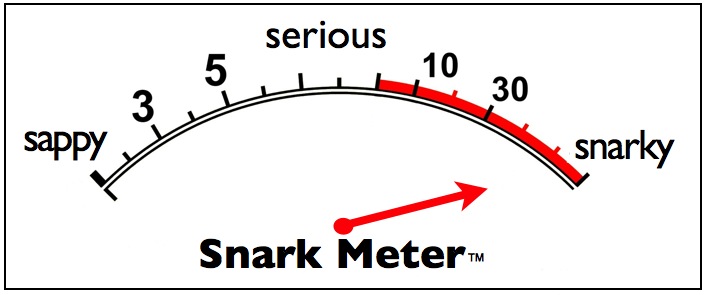
Snark MeterHIGH.001

Content warning: Sarcastic blog post. Cynicism intended in love.

Awhile back we saw a spate of “interesting” Eucharists. These included, I kid you not, Seuss-charists, Clown-charists, Pirate Eucharists and a tailgate Eucharist at a Baltimore Raven’s game. A youth director friend, Jeremy Knight, and I were thinking one recent evening that there are many imaginative ways to devalue the Holy Eucharist that have yet to be attempted. Here are a few that came readily to mind…

1. Bear-suit-vestmentscharist: What’s more inviting than a guy in a bear suit?

2. The Hobbitcharist – The procession is an Orcish hoard and the host is referred to as “my precious.”

3. Jeopardycharist: “I’ll take the bread and cup for $300, please.”

4. Avatarcharist: It’s just like the “DancesWithWolvescharist” only in 3d.

5. RockyHorrorPictureShowcharist For children of the ’80’s. Starts at midnight. The virgin gets praised not spanked and, for the Gloria, we can “Do the Time-warp Again.”

6. StarTrekcharist: Word on the street is that Shatner is a postulant for Holy Orders in L.A.

7. Paintballcharist: Anyone who doesn’t genuflect gets double-tapped.

8. Transformerscharist: Save the planet and uphold a transubstantiationist doctrine at the same time.

9. Nudecharist: Warning, only works with the right celebrant.

10. FindingNemocharist: After all, fish and loaves are biblical imagery.

11. Mariocharist…followed by Super-Mariocharist.

12. Ninjacharist: Don’t mock it, Ninjas will take you out.

13. Ryan Seacristcharist: Just because it sounds funny and, hey, we’re Americans, we can always find a new Idol to worship.

All of which are signs of the apocalypse-charist. And finally…

14. MockGodcharist: Haven’t we already? I really do know that this isn’t anyone’s motive. But we sure look like weirdos here.

I am part of a church with an average age of about 22, not a fuddy-duddy. But even I have to wonder why we have trouble realizing that the Holy Eucharist is, as Prayer A says, “a memorial of our redemption,” and treat it with a little respect.

Anglican Christians know the power of the Eucharist. We know it is the best tool in our toolbox. Our recent oddball Eucharists bring an old aphorism to mind: “to a person with nothing in their toolbox but a hammer, everything looks like a nail.” We know the Eucharist “works,” but is it the only tool in our box? Is it the answer to every question – like the old preacher’s joke about the Sunday School teacher who describes in detail a squirrel and asks the students if they know what the answer is and the kid says, “It sure sounds like a squirrel, but I guess the answer’s supposed to be Jesus.”

Can we at least agree that the answer is not to out-weird each other at the altar? How are these odd-sauce Eucharists any different from the shameless attention seeking that we see and critique in the evangelical world…like for example the local church that put an Octogon on their platform and challenged people to “Get in the cage and fight for Jesus”?

When we do these “creative” celebrations of the Lord’s Supper we appear self-referential, theologically simple minded and missionally clueless. Do we actually believe that if we just dress up the bread, wine and our clergy with enough silliness the world will beat a path to our red doors?

I have heard it said that these are “great for kids.” Help me understand this, what happens when the kids find out their priest isn’t really a clown? Or (wait for it) that they actually are?

Wouldn’t it be more helpful if, instead of inviting people to outlandish communion celebrations, we returned to the ancient church practice of going to the world; loving and serving people and speaking of our motivation rooted in the hope we have in the resurrected Christ? Or we could just sit around the office typing up more kooky Eucharists for liturgical junkies. Anyone for a Djangounchainedcharist? It would be high-action, and justice oriented – timely, trendy and attractional. We’d pack ’em in!