
The Right King

Christ the King 2014.001Snark MeterrealMID.003

(Ezekiel 34: 11-16, 20-24, Ps. 100, Eph. 1:15-23, Matt 25:31-46)

(A sermon for Christ the King – A holy day not celebrated in the Episcopal Church)

We are all ruled by something. The question is do we have the right king?

Today is the last day of the Christian Year, known to Anglican Christians as “Stir up” Sunday. That title came from today’s collect in the first, 1549, Book of Common Prayer. We have moved that collect to Advent 3 in our current prayer book: it starts, “Stir up your power O, Lord…”

But then along came the 20th century and WWI. 45 countries took sides in unimaginable violence. Ironically, that the European countries claimed to be “Christian,” and their leaders were all related to one another. Thanks to peerage requirements to “marry an equal,” the gene pool among Europe’s monarchies had become very, very small as European dynasties intermarried. Europe was led, not by royal “families” as much as by 1 big not so happy family. If you opened their tombs you would notice that many sport a genetic feature known as the “Hapsburg Jaw” – an enormous under bite, passed down from Maximillian, an Emperor of the Holy Roman Empire in 1500. Think about this tragic fact: The leaders of the European nations had proximity, culture, religion, and family in common – Yet 18 million died in WWI. They prayed to the same God. They were members of the same family…and still, in four years a generation of young men had been wiped out.

The Hapsburgs were kings. But not the right kind of kings.

Reflecting on the Great War, Pope Pius XI wrote an encyclical letter, “On the Kingship of Christ.” The encyclical dealt with what Pius XI described as “the chief cause of the difficulties under which mankind is laboring.” He wrote that evil in the world was due to a majority of humanity having thrust Jesus Christ and His holy law out of our lives; that Our Lord and His reign had no place either in the private or political sphere. For Pius, and the classical Christian message, as long as individuals and states refuse to submit to the rule of the self-emptying Savior, there could be no hope of lasting peace among nations. Humanity must look for the peace of Christ in the Kingdom of Christ—Pax Christi in Regno Christi.

For Pius XI, only Jesus Christ could possibly be the right kind of king.

So Pius XI instituted a new holy day – the “Christ the King” as “a solemn affirmation of Our Lord’s Kingship over every human society” – King not only of the soul and conscience, intelligence and will, but also of families and cities, peoples and states, and the whole universe. Pius argued that societies without reference to God, deny Christ’s Kingship, and lead to the apostasy of the masses and the ruin of civilization. The Pope believed that an annual public and official assertion of Christ’s divine right of Kingship over humanity in the liturgy would be an effective means of combatting the growing secularism, by “stirring us up” – hence its appropriate placement in the calendar at the close of the Christian year.

It is a liturgy to remind us to bow before the right king.

Christ the King Sunday is more than the logical conclusion to being immersed for the entirety of the Christian year in the story of Jesus. Christ the King is the church giving up on political rulers, even Christian ones, to stem the decay of civilizations. It is only when we have the right king – the saving, servant king of human hearts, that we are able withstand the deadly pestilence of hatred and oppression the world’s systems bring.

It is easy to misunderstand where I am going here…to jump to conclusions. I am not arguing for dominionism, Islamic theocracy, oppressive fundamentalism, or even a return to Christendom. Read our passages carefully: Ezekiel tells us that God is a Good Shepherd. Psalm 100 tells us, “The Lord himself is God.” Ephesians tells us Jesus is, “far above all rule and authority and power and dominion” and that the acting out of that rule “gives us a spirit of wisdom and revelation as we come to know him,” that we have a “hope to which he has called” us, “the riches of his glorious inheritance.” Finally, the Gospel reading told us, that someday Jesus will return, judge all flesh, separating the sheep from the goats and saying to his own, “Come, you that are blessed by my Father, inherit the kingdom prepared for you from the foundation of the world.”

The right king, although above all others, deals with his own as a shepherd deals with their sheep. The right king is himself God and brings his own a spirit of wisdom and revelation. The right king will return for his own and give us a portion of his inheritance.

As Pius the XI so eloquently put it, “If to Christ our Lord is given all power in heaven and on earth; if all men, purchased by his precious blood, are by a new right subjected to his dominion; if this power embraces all, it must be clear that not one of our faculties is exempt from his empire. He must reign in our minds, which should assent with perfect submission and firm belief to revealed truths and to the doctrines of Christ. He must reign in our wills, which should obey the laws and precepts of God. He must reign in our hearts, which should spurn natural desires and love God above all things, and cleave to him alone. He must reign in our bodies, which should serve as instruments for the interior sanctification of our souls, or to use the words of the Apostle Paul, as instruments of justice unto God.” (Pius XI)

The right King, God himself, is beckoning us into a new fellowship as redeemed humanity through a trinitarian union with all that we are. As Christians, we have often confused membership in “one nation under God” with membership in the Body of Christ. But governments are not called to eternal union with Christ. Humans are.

Where will the right King lead us? The natural outcome of Christ our King is that we will can do nothing less than to serve others…as our prayer book says, “serve Christ in all persons.”

Let me give a little direction on how to press on as a child of the right king: In the light of the world’s troubles and our own sinfulness, our lives are only rightly ordered when we have a very, very high view of our King. So I want to close today by reading you an excerpt from one of the great sermons of the 20th Century: “My King,” by S.M. Lockridge, an African-American Baptist preacher. (I recommend you find this on Youtube, because I promise I do not do Pastor Lockridge justice.) Here is Lockridge’s…

My King

“The Bible says He’s a Seven Way King. He’s the King of the Jews – that’s a racial King. He’s the King of Israel – that’s a National King. He’s the King of righteousness. He’s the King of the ages. He’s the King of Heaven. He’s the King of glory. He’s the King of kings and He’s the Lord of lords. Now that’s my King.

I wonder…do you know Him?

My King is a sovereign King. No means of measure can define His limitless love. He’s enduringly strong. He’s entirely sincere. He’s eternally steadfast. He’s immortally graceful. He’s imperially powerful. He’s impartially merciful.

Do you know Him?

He’s the greatest phenomenon that has ever crossed the horizon of this world. He’s God’s Son. He’s the sinner’s Savior. He’s the centerpiece of civilization. He’s unparalleled. He’s unprecedented. He’s the loftiest idea in literature. He’s the highest personality in philosophy. He’s the supreme problem in higher criticism. He’s the fundamental doctrine of true theology. He’s the only one qualified to be an all-sufficient Savior.

I wonder if you know Him today?

He supplies strength for the weak. He’s available for the tempted and the tried. He sympathizes and He saves. He strengthens and sustains. He guards and He guides. He heals the sick. He cleansed the lepers. He forgives sinners. He discharges debtors. He delivers captives. He defends the feeble. He blesses the young. He serves the unfortunate. He regards the aged. He rewards the diligent. And He beautifies the meek.

I wonder if you know Him?

My King is the key to knowledge. He’s the wellspring of wisdom. He’s the doorway of deliverance. He’s the pathway of peace. He’s the roadway of righteousness. He’s the highway of holiness. He’s the gateway of glory.

Do you know Him? Well…

His life is matchless. His goodness is limitless. His mercy is everlasting. His love never changes. His Word is enough. His grace is sufficient. His reign is righteous. His yoke is easy. And His burden is light.

Oh, I wish I could describe Him to you.

But He’s indescribable! He’s incomprehensible. He’s invincible. He’s irresistible. You can’t get Him off of your mind. You can’t get Him out of your heart. You can’t outlive Him, and you can’t live without Him. Well, the Pharisees couldn’t stand Him, but they found out they couldn’t stop Him. Pilate couldn’t find any fault in Him. Herod couldn’t kill Him. Death couldn’t handle Him, and the grave couldn’t hold Him.

Yeah! That’s my King.

That’s my King.”

Amen.

A prayer for the church

Roman Hospital

Snark MeterrealMID.003 

…to remember her call to the least and last, both individually and institutionally.

The invocation from today’s Phoenix Seminary fundraising breakfast by Dr. John Delhousaye…

Lord Jesus Christ, son of God, you hold the universe together. We know you this way as mystery—as science attempts to trace your effects.

But you also became flesh and are with us until the end of this age. Immanuel, you are the Perfect Physician, always present to take our misery to the cross. You are in it with us.

In A.D. 321, after the Council of Nicea, what we call a hospital came from your heart—to every Cathedral city. But we have forgotten where the hospital came from. Our culture suffers under a collective amnesia; and now, as nearly every Phoenix hospital has been secularized—as if your presence were confined to a chapel—many doctors and nurses feel isolated and limited in their capacity to help the whole person.

Around A.D. 1000, what we call the university came from your mind. The university of Bologna, the first, came into being to study the digest of law from the Christian emperor Justinian, so that justice would be grounded in Truth, not the sway of public opinion. The University of Paris, perhaps the second—closed in the French Revolution, which brought in a fog of atheism yet to dissipate over Europe—came out of the cathedral schools whose founding desire was to know you as Lord in creation and Scripture. It was never faith against science. Faith nurtured science. But we have forgotten this, and secularized universities—as if your presence were confined to the study of religion—have lost their way; they are incapable of providing robust, virtuous, and attractive Truth.

But, Lord, you have never left. Everything belongs to you and is at your disposal. In our exile, we are called to join you in seeking the good of our city. You are the Crucified yet Resurrected one, and you have gone ahead of us to protect the weak, to care for the sick, to feed the hungry, to instruct the mind, to comfort the broken, to provoke the lazy, and to humble the proud.

But how will they know it is you, Lord, the source of all hope and comfort, unless we proclaim your name? For those who suffer from Dementia, family has the sacred task of reminding them who they are. Restore our memory, renew our mind, enflame our heart, until we are born again into new creation. Amen.


*John is professor of New Testament and Spiritual Transformation at Phx. Sem. Some day he will publish his translation and commentaries. They will be must-reads. For those who read theology, they are a bit like Frederick Dale Bruner meets Tom Oden, i.e. first rate biblical scholarship meets church history.

The Bottle Caps Man

6524306851_c5d7d9fff5_z

Snark MeterMID.002

A parable of sorts

Growing up there was an old man who used to ask us kids the same question every day. We had no idea what he was talking about. More than four decades have passed, but when the crowd from the old neighborhood gets together someone will always ask, How empty are your pockets and how full is your heart?”

Central Phoenix was a very different place in the early 1970’s. The “busy streets” were still lined with trees that shaded the open irrigation canals. The ranch style neighborhoods built in the 50’s and 60’s were here, of course, but they were interspersed between what was left of family farms – old homesteads surrounded by the remnants of citrus orchards and horse, cotton, and dairy operations. An enormous farmhouse stood where the school bus turned off of 7th Avenue into our neighborhood. It had nine chimneys. We counted them when the bus went past.

The most coveted thing in our kid world was Bottle Caps – the brand new candy that looked like the metal top on a bottle of pop and tasted like the soda inside. Back then Bottle Caps came in flat foil pouches. They were larger, harder, and with nifty ridges that allowed them to hang on the end of your tongue when you stuck it at the other kids on the bus.

Bottle Caps were an early lesson in the economics of supply and demand – the only place you could get them was from the ice cream truck, a large white panel van with giant decals of frozen product on the sides. The truck would drive through the streets playing music over a loudspeaker mounted to the roof, a Pavlovian cue for kids to grab their nickels and dimes to buy Popsicles and ice cream cones and most everything else moms claimed would “spoil supper.”

The first time I heard the notes of the ice cream truck’s carnival music in the distance I didn’t know what it was. I was playing Kick the Can with the big kids when suddenly the shrubbery began to rustle. All over the street kids emerged from hiding shouting, “Run! We have to get there first!” I ran as hard as I could to keep up with the bigger kids.

We weren’t first though. An old man was already in line. Kids were positively downcast as they watched the man buy every single pack of Bottle Caps in the ice cream truck and stuff them into his bulging pockets. Kids began to shout, “No fair!” “You can’t buy them all!”

And I wonder, How empty are your pockets and how full is your heart?

He wore an old cardigan sweater and corduroy pants and had the most piercing blue eyes. He turned those piercing eyes on us and in a faint Southern accent asked, “So you are upset that I have all the Bottle Caps?”

“Yeah!” Kids shouted in outrage.

“I suppose you want some of these?” He questioned, patting his bulging pockets.

“Yes!” I shouted, reaching over Mark Hickens in front of me.

He bent his head around Mark and looked down upon me. “You are very young. Do you even know what Bottle Caps are?”

“Not really.” I admitted.

He smiled and I couldn’t help but like the way his eyes lit up. “Bottle Caps,” He began, “are the tastiest candy ever invented. Eating them is like being able to chew on soda pop. Bottle Caps make you smile a smile that starts deep inside your tummy and goes from the inside out. How would you like to eat a candy like that?”

My eyes became wide. “Would I? You bet I would!”

How empty are your pockets and how full is your heart?

The man pressed, “What would you say, young man, if I gave you a pack?”

Johnny Dodson said, “Aww, he doesn’t have any money. He’s too little.”  My head dropped in shame. The man lifted my chin and his piercing eyes held my mine. “I didn’t say anything about money. I said, ‘gave,’” he continued.

“FREE? Nobody gives away BOTTLE CAPS!” yelled Johnny’s indignant older brother.

“Well now, I didn’t say ‘free’ exactly either.” The old man moved his gaze to the group.

Now 10 kids were indignant, “What are you talking about Mister?”

How empty are your pockets and how full is your heart?

“Suppose I gave you two packs of Bottle Caps,” the man said turning back to me. “Would you promise to only eat one and give the other away to someone else?”

I was very confused.

He repeated the offer, “If I give you two packs of Bottle Caps, will you promise me that you will eat one and share one with someone else?”

I nodded seriously, “Yes.”

The man held up two green envelopes full of Bottle Caps, one in each hand. I grabbed them and wheeled to leave before he could catch me. “Remember,” he yelled after me. “One for you. One for someone else.”

He then turned to the crowd of kids, reached into his pockets fat with Bottle Caps and said, “Who else will promise to share a pack for a pack of their own?”

I probably don’t have to tell you that every hand shot up. By the time we left, the man’s pockets were empty.

How empty are your pockets and how full is your heart?

The very next day we heard music and jumped on our bikes. When we got to the truck, that old man was at the front of the line again stuffing his pockets with all of the Bottle Caps. He saw me and said, “Hello son. Tell me who did you give your other pack too?”

“My little brother,” I said. “He was really happy.”

“And how did that make you feel?” He asked.

“It was almost as fun as eating my own, Mr. Bottle Caps Man!” I replied, giving him a name that would stick.

He seemed amused by this new moniker and said, “That’s what I thought.” And then he looked around, “So, who can tell me about the person you gave your Bottle Caps to? If you tell me a story I will give you two more packs of this deelicious candy.” He said, his drawling reminding me just how like pop, which was just short of a forbidden substance in our house, they tasted. And again, the man went home without a single package of Bottle Caps for himself.

How empty are your pockets and how full is your heart?

Every morning that summer the same thing happened. When we heard the music in the distance we jumped on our bikes, and tore through the neighborhood to beat that Bottle Caps man to the ice cream truck. And every day the old man with the twinkling eyes would be standing at the front of the line stuffing his pockets with the truck’s entire stock of Bottle Caps. And each day, as we finished our melting popsicles, the Bottle Caps man would listen to our stories and place two packs of Bottle Caps in each of our hands to share with others. And most days the Bottle Caps man went home with empty pockets.

How empty are your pockets and how full is your heart?

Well, as all kids do, we grew up. And the Bottle Caps Man, he aged as well. He became a little slower. His shoulders stooped. He began to use a cane. But somehow he still beat the kids to the ice cream truck. One Saturday, though, after I was far too old for ice cream trucks, the kids arrived and the Bottle Caps Man wasn’t there. It was the ice cream truck driver who told the kids that the Bottle Caps Man had died. Needless to say, you’ve never seen quite so many young people at an octogenarian’s funeral.

At the funeral, much to our surprise, the ice cream truck driver stood up and gave the eulogy. That was how we discovered the secret to the Bottle Caps Man beating us to the ice cream truck all those years – the ice cream truck driver was the Bottle Caps Man’s son. The Bottle Caps Man had an inside line on the route!

How empty are your pockets and how full is your heart?

The son told us that in his early years, Bottle Caps sales kept his ice cream truck in business. When business picked up he told his dad that he didn’t need him to keep buying a case of Bottle Caps every day.  His father told him, “I don’t just do it for you. I do it for the kids.” The ice cream truck driver said, “My dad gave away a fortune in Bottle Caps, one pocket full at a time.” And as he said it, tears filled his eyes…and ours too.

How empty are your pockets and how full is your heart?

The bottle Caps Man taught us that empty pockets can bring smiles. And he didn’t just teach the kids. Parents couldn’t help but smile too when they saw us sharing with each other…and, occasionally, with them.

And as I age, I wonder what kind of old man I will be. Will I be a man, like other old men, who sit in their house counting and recounting a carefully hoarded collection of my favorite “candy”…a collection that is neither useful for others nor joy producing for myself? Or will I live generously?

How empty are your pockets and how full is your heart?

What we did not know was that the Bottle Caps man was teaching us about grace – that we drink from cisterns we did not dig (Deut 6:11), in a land given rather than toiled for (Joshua 24:13). We have been invited to drink from the spring of the water of life without cost (Rev. 21:6), receive an inheritance we did nothing to create (Heb 9:15), and enjoy a salvation purchased at another’s expense (1 Pet 3:18). We are, in every way possible, recipients of grace. Grace is an inexhaustible supply of the goodness of our God, a spigot that can only be turned off by refusing to let it run out on others.  It is a sweet gift that makes us smile a smile that starts from deep inside our tummies. There is abundance in the hands of the great Bottle Caps Man of our souls. Will you share it?

And, since they really are connected, I must ask you, one final time, How empty are your pockets and how full is your heart?

Surprise Endings: Superheroes, fat ladies, and hope for humanity in dark times


Terminator-2-baby_yeah

Snark MeterrealMID.003

We all love the surprise ending. One where the hero miraculously reappears and the bad guys get their due. First it was the western. Then war movies. Next came the Sci-fi, followed by adventure movies. Then it was fantasy…Lord of the Rings, Chronicles of Narnia, and Harry Potter. Now we have superheroes.

When you think about it, aren’t they are all the same plot? How is it that no matter how many times we see this story, and no matter how well we know the narrative, we keep coming back for more? Why do these movies resonate so?

It seems our hearts love the plot line that, no matter how dark the night appears, help is on the way. “Look, up in the sky…” Or as Washington Bullets coach Dick Motta famously said, “The opera ain’t over ‘till the fat lady sings.”

Perhaps it is because no matter how far fetched they are, these movies hum a melody our hearts already know…a tune, sung by that large lady of song which says, “Yes, this is impossible…but a final scene yet remains.”

I think the superhero saga is simply a retelling of the Christian story – the story that our hearts were made for.

Here is that story in a nutshell: Once there was One God – a glorious being who dwelt in perfect unity and love…a holy trinity. Not the self-centeredness of the human trinity of me, myself and I, but the Father, Son and Holy Spirit in self-existent, self-giving love. God desired to share his fullness and joy, so he/they (words fail us in the presence of such glory), created. And God, the creator of creativity, created intricately, painstakingly…lovingly. The first two pages of the Bible describes this in detail.

Then, in less than one page of script, we wreck the entire operation.

And the whole rest of this Bible, all of the other 2000 pages, tell of God’s relentless pursuit to win his wanderers back.

It’s a story of a growing hope. God starts with a single man, Adam. He moves on to a family, Abraham and Sarah’s. From there he widens his rescue to a nation, Israel. Then, finally, God throws out the lifeline to all of humanity.  This deliverance tale finds its fulfillment in the person of Jesus: God becomes one of us, lives among us as a servant. He goes to a cross as the most unlikely part of his Father’s rescue plan. The climax of the story occurs in the days we commemorate as Christ’s crucifixion and resurrection.

Let me remind you of that story line: Jesus is grabbed by angry religious leaders and sentenced by a private mob under the cover of darkness. As an occupied people, his countrymen lack the ability to pronounce the death penalty. So they take him to their Roman occupiers and change the charges against him – Romans do not care about local religious rules, they re-label Jesus a traitor. Jesus doesn’t defend himself. The governor, Pontius Pilate, tries to placate the crowd by having Jesus savagely beaten. But, rather than satisfy the mob, the beating raises their blood lust. Pilate acquiesces and sentences Jesus to the death reserved for the worst criminals: crucifixion. They force Jesus to carry his cross to the hill over the highway where they execute enemies of the state. They nail Jesus to his cross and erect it between two thieves. Six hours later he is dead. But before he dies he says two fascinating things: “Father forgive them, they don’t know what they are doing.” And “It is finished.”

Let that sink in: Jesus actually asks his Father to forgive to forgive his executioners. Then he says, “IT is finished.” Not “I” but “It” – his reason for being on that cross is what Jesus “finished.”

In the end, they take his lifeless body down and place him in a tomb. They seal it with an enormous stone, stamp it with the mark of the emperor, and station a Roman guard unit to protect it.

The end.

Or so it was supposed to be.

But the cosmic filmmaker had other ideas…

But why was Jesus up there anyway? What was his “it”? The power in any story is not only in the action, but what the actions mean.

Jesus was on the cross as an innocent but, we are told, most certainly NOT as a victim. Why way he there? Because you and I really do have a problem that has trapped us. One that reaches into every recess of our existence…a problem that is environmental, relational, interpersonal and existential. It is a problem we cannot avoid and will not go away.

In our hearts we know that God is perfect and holy. …And, when we are honest, we painfully aware of just how much we are not.

It’s a dilemma: A God whom the prophet Habbakuk says, “is too pure to look upon evil,” (Hab. 1:13) has a love that will not allow him to look away.  In Jesus, God manages to right what we made wrong. To ride in and save the day. “God so loved the world that he gave his only begotten son, that whoever believes in him would not perish but have eternal life”(John 3:16).  The unlikely storyline God chose involved a cross, a tomb, and a man who wouldn’t stay dead.

It is called salvation…deliverance…rescue. We were as good as dead in trespasses, and then, As Peter said, “Christ died for our sins once for all. He never sinned, but he died for sinners to bring you safely home to God. (1 Pet 3:18)

Again, he was not a victim: This was in the script all along. Jesus’ death was the rescue plan.

But Jesus is a savior who, no matter how “over” the story appeared, still had a surprise ending up his sleeve. We know that plan worked by the Easter event – Jesus walking out of a tomb. We give it a fancy, religious sounding name, resurrection. But the shocking news was that a man very carefully put on ice did not stay that way. And, now that death cannot hold him, he holds out the hope of life to us as well. Paul said it like this: “Christ has been raised from the dead…the first of a great harvest of all who have died…just as death came into the world through a man, now the resurrection from the dead has begun through another man. Just as everyone dies because we all belong to Adam, everyone who belongs to Christ will be given new life.” (1 Cor. 15:20-22)

God offers his rescue to all. But God, always a gentleman, will not arm twist or manipulate us to accept his offer. In Terminator 2, the terrifying cyborg played by Arnold Schwarzenegger shows up to rescue Sarah Conner. She is terrified. After vanquishing her enemies, the Terminator reaches out to her with the words, “Come with me if you want to live.”

Do you want to live? Will you come with Jesus?

Will you allow his forgiveness to be yours? Will you allow his Spirit to breath new life into you? Will you allow the great author and director to give you love and acceptance…to write a new ending to your story?

John said it like this, “To all who receive him, even to those who call on his name, he gave the right to become the children of God.” (John 1:12)

Tonight, what scene are you in? Are you at the height of success? If so, you might want to resist the temptation to arrogance. You have seen this story. You know the heights are an illusion.

Are you being overcome by the adversities of life? Do times look dark? You need to know, that in Christ, you have an Aslan…A hero with superpowers, unstoppable like a cyborg. A man in a white hat who has already ridden to your rescue…

He purchased your forgiveness on a cross, guaranteed your ultimate rescue when he walked from the tomb, and offers a life transformed in the in-between.

So when all looks lost, look up. For it is not until we are at the end of us that our Super Man can do his thing.

Is it just me, or is that the fat lady I hear warming up her voice in the wings?

Or as the church says, The Lord is risen indeed. Alleluia!”


Real Worship: A summons to the feet of Jesus


Snark MeterrealMID.003

Real worship is about Jesus. It IS costly. And it DOESN’T make sense.

Scientists tell us of the powerful ability of the sense of smell to trigger memories—that the olfactory bulb in our brain links scent to event. That is why walking into a home with cookies baking in the oven can carry you back to the security of grandma’s house decades earlier. Scent, somehow, unifies and cements all 5 senses and places us, momentarily, in the experiences of our past. One suspects the story of the anointing by the woman at Bethany provided just such a fragrant link in the disciples’ minds between burial perfume and Jesus’ looming Passion.

The story of the woman of Bethany was obviously an important one in the early church, as all four Gospel writers record it (Matthew 26:6-12, Mark 14: 3-9, Luke 7:36-49, John 12:1-8). As a whole, the Gospel writers tell us three things in this story: Real worship is about Jesus. It IS costly. And it DOESN’T make sense. That is why it is so odd that in this fragrant Gospel narrative, the memory of the eyewitnesses seems fuzzy… There is a woman. There is an anointing. There is expensive, perfumed oil. There is the objection to using it on Jesus. But then the details start getting jumbled.

Are these four accounts one event? Two? Three? Scholars have wondered for centuries. It’s easy to get frustrated with the Gospel writers here. They carefully name and give character to the Twelve, yet they blur the details of this woman and her story.

Who was this woman? Both Matthew and Mark have Jesus predict that this story will always be told in memory of her…but then her name conspicuously escapes them. Luke tells us she was a “a sinner.” John alone tells us that her name was “Mary.” But Mary was the most common women’s name in first Century Palestine. There were three women named Mary present at the crucifixion that we know of. Which Mary is this?

Luke places the story early in his Gospel. Matthew, Mark, and John place it in Bethany, the day before the Last Supper and Jesus’ arrest by the mob in the garden. Here are a few more details: Several days before his betrayal and death, Jesus and his disciples dine at the home of Simon the Leper in Bethany. While they recline at the table, a woman, whom John, the last Gospel writer by decades, identifies as Mary of Bethany approaches Jesus. We don’t know how long she had followed Jesus. What we do know is that Mary knew that worship has an object: Real worship is about Jesus.

Mary has an alabaster jar of expensive perfume, worth a year’s wages. These jars, we are told, were permanently sealed. To let the perfumed oil out one had to break the neck off. Once opened, like a jar of mayonnaise, it had to be used. Mary broke her jar, and emptied the perfume on Jesus. Real worship is costly.

In another fuzzy detail, John has the woman anoint Jesus’ feet, wiping them with her hair. Matthew and Mark report that the woman of Bethany anointed Jesus’ head.  Both actions flower with symbolism. In the ancient Near East, anointing the head signified Kingship – Kings were anointed at their coronation by the high priest or prophet. The word “Christ,” is a transliteration of the Greek word “Christos,” itself a translation of the Hebrew word for Messiah, which means “the anointed one.”  As Rachel Held Evans says, “This anonymous woman finds herself in the very untraditional position of priest and prophet.” Only in the upside-down Kingdom of Jesus, does this make sense.”  Because real worship DOESN’T make sense.

Anointing feet, on the other hand, models humility, service…love. John’s account is more intimate. Awkward even.  In a culture in which a woman’s touch was forbidden, for Mary to cradle Jesus’ feet in her hands and brush oil over his ankles and toes with the ends of her hair was unthinkable. This is most likely the oil for her own burial she has poured out. Mary breaks her treasured bottle of burial perfume and empties it on Jesus. She spares no expense. She is fully committed. She is “all in” –  sacrificing her own future. The self-emptying of this action foreshadows Jesus’ washing the disciples feet to come the next day on Maundy Thursday. And just as we see the male disciples discomfort at that event, the disciple’s unease at her display of affection is palatable. Real worship is about Jesus. It IS costly. And it DOESN’T make sense.

In the midst of all this symbolism and foreshadowing, Jesus interprets this event for us: It is an act of worship in preparation for his burial. When the disciples rebuke the woman for what they see as a waste of money, Jesus returns the rebuke saying, “Why do you trouble her? She has performed a good service for me. You always have the poor with you, and you can show kindness to them whenever you wish; but you will not always have me. She has done what she could; she has anointed my body beforehand for its burial.” Jesus had been speaking of his impending death for a good while, but the Twelve kept missing it. The idea of a kingdom ushered in with the death of their friend rather than the death of their enemies was unthinkable. It is no wonder they complained about the “waste” of money the anointing represented – they assumed they would need to finance their ministry with Jesus for years to come. Mary alone seems to get it. She is the first of Jesus’ disciples to acknowledge his impending death… the one who anoints “the anointed one.” For this, Jesus gives her his highest praise. “Truly I tell you, wherever the good news is proclaimed in the whole world, what she has done will be told in remembrance of her.” What a remarkable thought—that from open air revival to cathedral, Europe to Uruguay, Israel to Africa, this woman’s story would be told.

Jesus wanted us to remember. Yet we aren’t even sure of the woman’s name. How is it that, unlike other Gospel stories in which details drop out as we get to the later Gospels, her name does not appear until very late? I suspect it is because this good lady did not want it to appear. The beneficiaries of Jesus’ ministry joined the early church after his resurrection. They shared their stories to encourage one another. Later, when it became obvious that Jesus was tarrying in his expected return, writers gathered and recorded those stories. In the early stories of blind Bartimaeus, for example, we know Bart’s name, his dad’s name, and even that a blind friend was beside him in the early Gospels. But by the time (and distance) that Luke writes, Bartimaeus is presumably gone and his name is dropped. Bart’s story had been told so often that it does not even make John’s Gospel, the last one written. So why is this woman not named by the early authors? The obvious guess is that it was specifically because she was still around. And SHE did not want it named.

We know that Mary was a worshipper. My guess, knowing a few Mary types, is that, for Mary, worship was, first and foremost not about her, but about Jesus. And she didn’t want folks to get distracted in admiring her. My guess is that Mary is named by John specifically because she is no longer around to keep a witness from recording her name.

But what of you? Where is your focus? What is your perfume? What do you guard and value above all else? Is it material possessions? Is your perfume your reputation? Friends? Career? Take a moment and name that which you value most, because you cannot pour out that which you cannot name.

The challenge of Mary this Holy Week is that we would dare break open that which we value most and pour it out as a fragrant offering upon our Lord. Perhaps, with the help of the Holy Spirit, the scent might trigger a memory… like the comfort of grandma’s house, bought through decades of difficult labor during hard times, we would be reminded that our comfort from God was bought at a high price. Because Real worship is about Jesus. It DOESN’T make sense. And it IS costly.

*This was the message from “Dinner Church,” our Wednesday Holy Week liturgy for families. The service is based on one done at St. Lydia’s in Brooklyn. It has a contemplative feeling (with Taize-esque music.) It is based on 1 Corinthians and what is thought to be the earliest non-canonical Christian literature, a teaching tool called The Didache. It is essentially the biblical “love feast” (Jude 1:12, 1 Cor. 11). The candle lit room set in a circle and contemplative music work well for our rowdy urban kids. The people prepare the meal together, light the worship/dinner space, pray and sing, and eat over candle light. It also gives us a chance to give folks an overview of the upcoming Triduum of holy week and pass out devotionals for families to use at home.

Game on. A sermon for Ash Wednesday

sermon

Snark MeterrealMID.003

Here is my Ash Wednesday sermon…not because I am convinced of it’s internet worthiness, but because friends have asked me to share it since I posted on the topic twice this week. 

Scripture: Joel 2:1-2, 12-17 •  Psalm 51:1-17  •  2 Corinthians 5:20b-6:10  •  Matthew 6:1-6, 16-21

Welcome to Spring Training! 

That is what Lent is: Spring Training for the Christian life.  You know Spring Training. It’s where players:

– Find out what they’ve got.

– Learn new skills.

– Figure out what they still need to work on.

Today, Ash Wednesday, is Opening Day.

Now that you are in the ballpark we are going to spend the next 40 disciplined days getting ready for the regular season- life.

I am not a baseball guy. I don’t know much about the game. But one thing I do know is that the person who throws out the first pitch is generally a pretty bad baseball player. Have you ever seen a first pitch? Sometimes it goes into the stands. Sometimes it drops off of the pitcher’s hand and rolls to a stop halfway to the plate.  It us usually thrown out by some famous non-baseballer: an elderly ex-Senator, an opera singer, or a guy who made millions inventing the home latte maker.

Unfortunately, our first liturgical “pitch” on Ash Wednesday, like most first pitches, is a bit off kilter. You should probably know that I am a HUGE prayer book fan. So much so that I am accused of having a crush on all things Anglican. My evangelical friends are adamant that I am a non-objective shill for the Episcopal Church. I can’t help it though. The wisdom and care and catholicity of our prayer book is legendary. But, in an effort to prove them wrong, I have scoured the prayer book and found two things that I wish were not there: One of them is the opening prayer from tonight’s service. I suspect that whoever wrote the opening prayer for Ash Wednesday must be famous – It’s that bad. The theology umpire in me calls, “Foul.”

Here it is again: “Almighty and everlasting God, you hate nothing you have made (We are looking good through the windup) and forgive the sins of all who are penitent: (still not bad) Create and make in us new and contrite hearts, that we, worthily lamenting our sins (Oops. Problems on the release.) and acknowledging our wretchedness, may obtain of you, the God of all mercy, perfect remission and forgiveness;  (And the ball is in the dirt.)

The idea that we are somehow “worthy” in our lamenting or forgiven BECAUSE we are penitent is a theological “Swing and a miss.” We are not rendered worthy through our repentance and we aren’t forgiven through a perfected penitence. That prayer makes it sound as if we are cute and cuddly- as if God is lucky to have such holy creatures as us on his team.

The truth is that we are forgiven because God is so forgiving. It is God’s nature to reconcile fallen humans to himself. It is God’s nature to make all things right…satisfying both his holiness and love in Jesus Christ and giving a new nature freely to humans. It is our nature to jack things up. Give me a relationship: I’ll mess that up. Children: I’ll mess them up. A political system: Oops. A planet: Our track record there isn’t so good either.

Forgiveness, you see, is given not earned… given to humans at the Father’s initiation and the Son’s expense…and that we are drawn to by the Holy Spirit’s wooing – The entirety of the trinity is involved in human salvation. Given the mess we have made of things, the basis for our forgiveness can hardly be our penitence.

We ARE forgiven because we WERE forgiven…on Calvary. That forgiveness was proven three days later as a risen Lord strode from the mouth of an empty tomb. And that is why we are penitent: We have seen the great acts of God on our behalf and we walk in gratitude of God’s love lavished upon us. Obedience is the response to God’s favor, not the price of it. God’s provision provokes our response.

And so, in anticipation of celebrating those holy mysteries at Easter, we begin tonight Lenten disciplines, either giving up something that we enjoy and/or taking on a new spiritual activity: self-denial and self-discipline to remind us of the greatness of our God.

Luckily our liturgy pivots rapidly from the off target opening pitch as we move quickly to the Old Testament prophet Joel. Joel reminds us that God has a right to be ticked at our forgetfulness of God. Joel asks us to “rend our hearts and not our garments.”  God desires an internal brokenness – for brokenness allows God’s love to seep through the cracks in our hard outer shells of self-reliance and transform us from the inside out.

Then we have Psalm 103 in which, just as a good dad “has compassion on his children, so the Lord has compassion on those who fear him – he remembers that we are dust.”   He remembers. Do we?

Then comes our Gospel passage: “Beware of practicing your piety before others.”  Jesus says, in effect, “Don’t trust in your very religious religiosity.”  Can you think of a single time Jesus had something positive to say to those very religious Pharisees who trusted in their religiosity? Neither can I.

Finally, in 2nd Corinthians, chronologically the last of tonight’s passages to be composed, Paul entreats us, “on behalf of Christ, be reconciled to God. For our sake he made him to be sin who knew no sin, so that in him we might become the righteousness of God.”- Paul spells it out: the righteousness of God comes, not from us: It is “of GOD.” The relationship between our repentance and God’s forgiveness is “because of” not “in order to.”

This passage, by the way, is finishing a sentence in which Paul is exhorting the Church, us, to be “Ambassadors for Christ,” bearers of the message of reconciliation…So “You be reconciled,” Paul says, “because for our sake he made (Jesus) to be sin”…the one who had never known sin, “so that” (because of, in order, with the result) “that in Him, we might become the righteousness of God. “

Let that sink in:

-The holy God of creation, whose moral perfection was such that the greatest of his servants, Moses, could only see God’s back as he passed by.

-Whose holiness was so terrifying that, when Moses went up the mountain, the Israelites could only stand at a distance gazing up at that terrifying cloud.

-A God so pure that the ark representing his presence couldn’t be touched with human hands, even to protect it, without them being struck down…

THAT God has declared us to be THAT “righteousness” in his sight.

…and, then, even further, he longs to give us the ministry of reconciling others to his holiness and love.

A high and holy calling awaits us. That is why our humility before God is not just a nice ashy experience for ourselves – We are to be a light to others. We are to increase in love and mercy as we seek Christ. And that increase in love is supposed to be public. Public in order to help to others come to know the love of our Savior, Jesus.

Lent is God calling us deeper into deep – to remold us into the image of his Son and to send us to gather our friends, families, neighbors, and co-workers to his love.

And so we come tonight to be marked outwardly with ashes to remind ourselves inwardly that we are dust.

But we are redeemed dust.  Grateful dust. Dust with a purpose.

And then we will come again to the table with hands outstretched to receive the grace of God anew.

It is a slow process, this becoming like Christ – A long obedience in the same direction. Consuming Jesus and being consumed by him. So, this evening, I exhort you, engage and cooperate. Engage with the prayers. Cooperate with the symbols. Surrender afresh to the Lord of the prayers and symbols, and come, kneel, reach out your hands and receive, and, as the Psalmist said, “taste and see that the Lord is good.”

Game on!

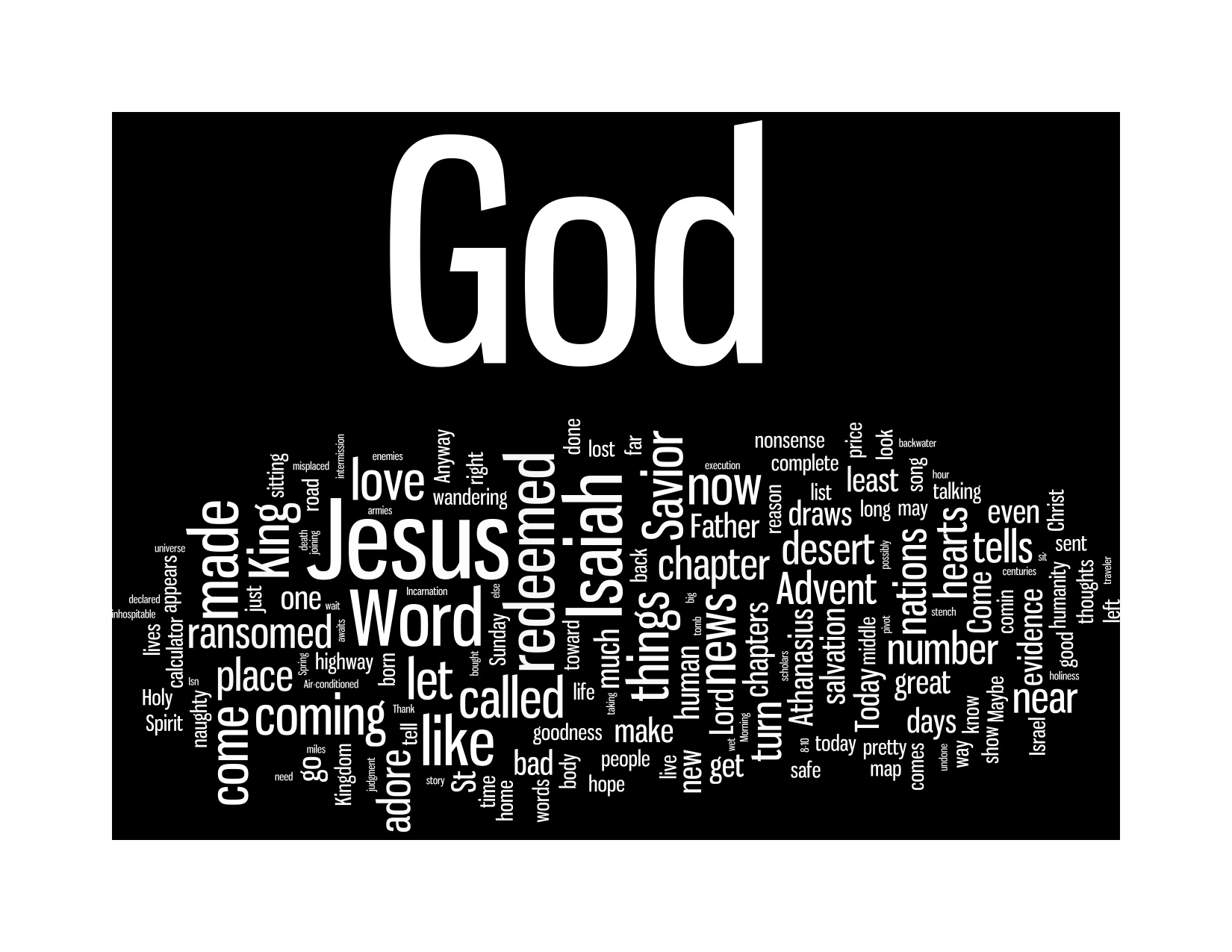
Screen Shot 2014-03-05 at 11.16.47 PM

Our King and Savior Now Draws Near

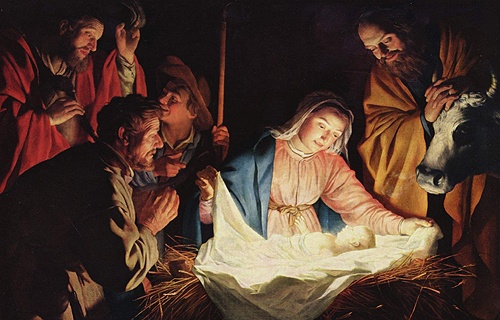
nativity

Snark Meter.005

Folks have asked for the sermon that got the “Jesus count” upped after looking at its tag cloud. Here it is…

Today is Rejoice Sunday. The Advent pivot. Today we make the turn from repentance to anticipation. Today we turn toward Jesus. In Matins, the monastic morning prayer service, there is a call and response exclamation of praise called an antiphon. The antiphon in Advent is, “Your King and Savior now draws near.” The congregation gives the logical and heartfelt response, “O come let us adore him.”

Today, as our King and Savior draws near let’s turn our attention to our Old Testament reading, Isaiah chapter 35, written centuries before the birth of Jesus.

Isaiah opens with 39 chapters of God’s impending judgment. There is destruction, desolation, and ecological and political disaster.

Here is a brief sample of the tenor of Isaiah’s warnings from Chapter 34: “Come here and listen, O nations of the earth…the Lord is enraged…His fury is against all their armies. He will completely destroy them, dooming them to slaughter. Their dead will be left unburied, and the stench of rotting bodies will fill the land. The mountains will flow with their blood.”

This is not Christmas material.

For 39 chapters Isaiah tells us that God too has a list. And after checking it twice he has declared, “everyone has been naughty.” The list is unsparing: Judah, their enemies…even obscure nations scholars have a hard time locating on a map. God’s indictments through Isaiah hit, for me at least, uncomfortably close to home: You have treated the poor badly. Ignored your God to pursue the god of your own appetite. You are looking for protection from those who cannot defend you. And the logical consequences are coming…

But right in the middle of it alldropped into the midst of the judgments, like intermission in a movie too long to sit through without a popcorn break, comes chapter 35.

Some say this hopeful song belongs after chapter 40, when Isaiah’s message changes from correction to comfort. Others argue that it should come even later – after the exile. Either way, this poem appears glaringly out of place.

It is as if the Spirit hovered over the scribes who assembled Isaiah’s prophecies and whispered, “Put that over here.”

In the middle of the bad news, God Interrupts.

With words out of place that will not wait until we make things right.

…Words of hope against all evidence and reason.

Isn’t that just like God?

Look with me at Isaiah, chapter 35. The chapter is a song in four stanzas:

Stanza 1: v. 1-2  The desert will bloom – The desert is inhospitable. We have tamed it with asphalt and Air-conditioning, but ask a family trying to get to the US on foot about the desert. Every decade or so, though, we have a wet Spring and wildflowers are everywhere. God’s new Kingdom, the one that started at Jesus’ first coming and will be made complete when he returns, will be like that.

Stanza 2: v. 3-4  So, God says, and here the old Sam & Dave song comes to mind, “Hold on, I’m com in.”

Stanza 3: v. 5-7  Humans too will thrive like the desert coming to life!

Stanza 4: v. 8-10  8 “A highway shall be there,
and it shall be called the Holy Way; 
the unclean shall not travel on it, but it shall be for God’s people; no traveler, not even fools, shall go astray. -You cannot get lost following God’s road. Not even if you are directionally challenged!

9 “No lion shall be there, nor shall any ravenous beast come up on it;
they shall not be found there,”  – God has a new Kingdom in which we will, each and every one of us, be safe.

“the redeemed shall walk there. 10 And the ransomed of the Lord shall return, and come to Zion with singing.” The “redeemed”-those God has bought back. The “ransomed” – those God paid a price for. Our great price payer- God himself is coming. Jesus is on the horizon. And all things will be made new.

And it ends like this: “everlasting joy shall be upon their heads; they shall obtain joy and gladness,
    and sorrow and sighing shall flee away.” Now that is the kind of life we all want!

Beautiful words out of place.

But being redeemed presumes we need redeeming.

Frederich Buechner said, “The Gospel is bad news before it is Good News. It is a speaking of the truth of the way things are.”

Here is the truth: I need redeeming. I realized that one day when I was feeling pretty good about myself. I had been a pretty giving guy and was feeling, to be honest, that God was sort of lucky to have me on his team. Then I got this impression. Maybe it was from the Lord. Maybe I just have an over active conscience. Anyway, I realized that, on my best day, maybe I only have 4 thoughts or actions that are faithless or fearful or nasty…you know the things Episcopalians confess each week, “the things we have done, and the things we have left undone.” Anyway I happened to have that thought sitting at my desk. Unfortunately a calculator was within eyeshot. And I made the mistake of picking up that calculator and multiplying my really optimistic number (4) x the number of days in a year x the number of average years American men live. The resulting number was: 113,380. That’s right, I have a bare minimum of 113,380 sins.

The “bad news before we can get to good news” is that I am a far less admirable person than I care to believe. And God is far more forgiving than I can possibly imagine. Let’s just say that when it comes to sin, the data is not in our favor.

Fortunately, as Scholar Walter Bruggemann tells us, “All doxologies are against the data.”

So as we make this Advent turn, as “Our King and Savior now draws near,” let us look to Jesus, God’s Word out of place to us

St. Athanasius, the 4th century bishop, said Jesus, “has been manifested in a human body for this reason only, out of the love and goodness of His Father, for the salvation of us men.”

Why did our King and Savior draw near? Athanasius tells us it is, “out of the love and goodness of His Father, for the salvation of us.

Ten days from now we will celebrate the birthday of the one St. John called, “The Word made flesh:” God’s unexpected Word out of place. Consider the absurdity of it all…

-The king of the universe born in an outhouse for animals.

-God’s Son wandering and teaching and healing the  least, last and lost, not in the halls of power but in backwater Palestine. Some have euphemistically called Judea a “major thoroughfare of the Empire,” but if that’s so, most of Jesus’ ministry was the equivalent of  wandering I-10 between Eloy and Picacho. If Jesus came today we would politely offer to show him a map.

-He offered up his life on a cross for execution by professionals and called it “a ransom for many.”

-Yet death could not hold him and he walked out of the tomb.

-He disappeared into heaven in front of witnesses, sent his Spirit to dwell in the hearts of his own, and ever lives, talking behind our backs with the Father about how much they adore the likes of us.

-And He has entrusted us with his mission and awaits for us to finish the work of carrying the news of hope in Him to consummate His story.

Words out of place always sound absurd: God joining humanity so that humanity could join God-it just sounds…well, ridiculous.

Against all evidence. Where he is least expected. God has sent a Word, a Word that appears out of place, and that Word tells us, that no matter how it looks, It may be Friday, but Sunday’s a comin’.

So when our prayers tell us “Our King and Savior now draws near” and when our scriptures tell us that the Holy One of Israel is coming for us…

…with kindness and not condemnation, Well what else could we say but, “O Come, Let us adore him”?

You see, when the Scriptures call you and I “the redeemed” and “the ransomed” it isn’t talking about pennies for pop bottles. In Christ Jesus, God has saved us. And God has done so at His initiation and at His expense.

You see, when the Scriptures call you and I “the redeemed” and “the ransomed” it isn’t talking about pennies for pop bottles. In Christ Jesus, God has saved us. And God has done so at His initiation and at His expense.

Athanasius, in his brilliant, “On the Incarnation”, said it like this: “It was our sorry case that caused the Word to come down, our transgression that called out His love for us, so that He made haste to help us…It is we who were the cause of His taking human form, and for our salvation that, in His great love, He was born in a human body.

Do you know God’s great love? Have you allowed God in Christ to be Your King and Savior? Are you numbered among the redeemed?

If not, “it was,” in Athanasus’ words, “for our sorry case he came…out of his father’s great love.” Get on God’s Way. Come see us about beginning a relationship with God in Christ after the service. My encouragement: Do not leave here this morning without allowing one of us to help you onto, as Isaiah said, “the holy way for God’s people.”

And if you do know already God’s great love, let us, as the General Thanksgiving exhorts us, show forth your praise, not only with our lips, but in our lives, by giving up our selves to your service, and by walking before you in holiness and righteousness all our days.”

Our King and Savior now draws near. And all God’s people said, “O Come, let us adore him.” 

Tag Cloud

The Secret to a Great Life

Great Life Slide.002Snark Meter.005 There is a secret. It will change your life. And once you know it, you will never forget it.

I first realized I was “that guy” in our neighborhood at my daughter’s pirate-themed fifth birthday party. I suspect many youth ministry people grow up to become “that guy.” This really shouldn’t come as a surprise. The years we spend active with teenagers develop a set of skills, that when exercised with small children, in particular, small children with overprotective parents, make us quite popular with those children and considerably less so with their parents.

We had recently moved from a street where we had the only children on the block to a neighborhood with at least 30 kids in our children’s age group. Much to our chagrin, every one of those kids and their keepers converged on our home for my daughter’s party-the parade from both directions was quite a sight. My wife quickly disappeared out the back to the store for twenty more hotdogs while I attempted to appear nonplussed at the incursion. One neighbor looked over my backyard and remarked flatly, “Disneyland wasn’t this crowded last summer.”

In less time than it took to light the candles on my five year old’s cake, I made a rookie mistake. While on grill duty I shouted, “Who wants the first hot dog?” It was like the scene from a movie. Time briefly went to slow motion as thirty over-eager kids dropped what they were doing, turned, and began to run toward me with arms in the air shouting, “I do!” Unfortunately, time shifted back to full speed as the horde accelerated toward the grill. Elbowing for position around the blazing grill, thirty kids shouted, “Me first! Me first! Me first!”

The other parents cringed, imagining gory injuries and expensive lawsuits.

As for me, the danger was lost in my glee at discovering I had the ability to incite an elfish riot. I spent the rest of the afternoon enjoying the novelty of this newly discovered skill: “Who wants to hit the piñata first?” “Me first! Me first! Me first!”

“We are playing freeze tag. Who wants to be it first?”  “Me first! Me first! Me first!”

“Who wants the first cup cake?” “Me first! Me first! Me first!”

“Me first” is cute and funny with five-year olds…although apparently not as cute as I found it to be, since it would take the better part of a decade to convince my neighbors that I actually am a grown up. But regardless of how “me first” appears in a group of kindergarteners, looking out for numero uno is most un-adorable in adults.

“Me first” comes so easily, though. Self-protection is a powerful human motivator – perhaps the first hard-wired human inclination. “Me first” is, well, normal. The interesting thing is that when we follow what is “normal,” when we go “me first,” we don’t insure our thriving at all. We actually diminish ourselves. Rather than protect us, self-preservation, it turns out, shrinks our lives. And we end up with a life that inspires neither us, nor anyone else.

A good example of “me first” occurs in the fifth chapter of John’s Gospel in an incident known as “the healing by the pool.” The short version is this: Traveling rabbi Jesus walks into town for a religious conference with his (at least) twelve students. With a seventy-mile journey on foot behind them, they head to the city well to cool off. Jesus wanders into the pool house, a place frequented by the sick and homeless. The water in the pool was actually the run-off from the pool Jesus belonged at, the nice folk’s pool, immediately uphill from this one. At the pool, Jesus runs into a crippled guy, apparently squatting on a prime panhandling location. The guy uses his rehearsed speech on Jesus who tells the handicapped man to get up and walk. This he does. (Jesus has this inexplicable ability to speak to disease and death and the weather and they obeyed him…and the witnesses report this with little commentary other than to make sure that we know that they didn’t understand it either at the time.)

Anyway, the man who hadn’t walked for nearly four decades gathers his stuff and leaves so quickly that he doesn’t get Jesus’ name. The man heads for the temple, the normal place one would go to re-enter society. On the way in, a group of pastors hassle the guy for carrying his stuff on the Sabbath – they want to theologize rather than thank God…religious people having problems is nothing new. These pastors want to know who is responsible for the “illegal” healing, but the newly mobile man cannot give a name since he never bothered to get it. Then Jesus finds the man again in the temple…don’t get me started on how weird it is that a man can receive the use of his legs and not stop to get the name of the person who healed him. Jesus travels with an entourage, meaning he isn’t exactly inconspicuous, but Jesus is the one who is interested in continuing the relationship, not the other way around. When Jesus finds the man, he tells him to “stop sinning.” We have no clearly stated reason as to what that was about, but the man, continuing his peculiar behavior, immediately goes back to the religious leaders and rats Jesus out. Then this man uses the legs Jesus healed to walk out of history, never to be heard from again.

Think about it: A guy gets healed…then just walks away. It sounds sort of “Me first!” doesn’t it?  

The religious leaders are worried about the theology of the event. “Me first!”  

And then the healed man turns over the name of his healer to the authorities. “Me first!”

There is no evidence that our unnamed man ever followed Jesus. No evidence of any heart-change to go with his change of mobility.  No evidence that he gave as much as a simple, “Thanks, bro.” There is no indication that he did anything other than use his legs to wander away. He simply did the “normal,” expected thing. The “me first” thing. The saddest part is what could have been had our man not been so self-absorbed. Jesus was about to commission eleven scared dudes to start a revolution of love, a revolution that would conquer the greatest empire the world had ever known in under 300 years, and our man could have been in on the ground floor.

Did you notice what happened? Both our man and the religious leaders turned a potentially world-altering event into something to be insulated against. They knew what most religious people eventually realize: If you let Jesus get too close, he will mess up your life. I think everyone in this story was trying to keep Jesus at arms length, lower the bar…make Jesus manageable. They defined Jesus down so that they could be religious enough but carefully maintain their position in the driver’s seat of life – you know, “Me first!”

CS Lewis said, “We are like kids in the slums content to make mud pies while a feast on holiday by the sea is being offered.” We simply lack vision for what our lives could be – we cannot see past “Me first!”

Have you noticed there are no great stories of “me first”? No fairy tales of self-preservation. No great myths of the self-serving. No super-heroes of the self-absorbed. That is because the secret of a great life is not “me first.” The secret to a great life is spelled m.e.t.h.i.r.d.

We learn this from Jesus who advised a seeker to “love God first and love your fellows as you love yourself” (Mark 12:28-31). Jesus, who was combining several earlier wisdom statements of Moses (Deuteronomy 6:4-5 & Leviticus 19:18), apparently considered this “me third” business an important enough message that he said it more than once (Matthew 22:34-40) – something great teachers do with important lessons.

Why is it so important to love God first? First of all, Jesus is a God willing to step into where the world says he doesn’t belong…to set free captives too crippled to realize their bondage, who chases the wanderers and frees from both religiosity and secular selfishness-who brings mercy and redemption when no one was asking – O, what a Savior.

But even more, if the Jesus event is true, then to be on God’s mission, to be God first and other’s second is what you and I were made for. It is the key to finding our great “Why?”

So what of you?  

-Have you lowered the bar on your expectations of God?

-Have you forfeited divinely-given dreams of the impact your life might make for God?

What is normal…what is natural, is “me first.” But a great life, a really stellar life, one that you and others are inspired by is lived me third.

So love God first. Love others second. And for sure love “me.” Just love me third. 

Where is Your Help? A Sermon for a Shutdown America

I lift up my eyes to the hills.
 From where does my help come?

My help comes from the Lord, 
who made heaven and earth.   (Psalm 121: 1-2)

Obama-Shutdown

Snark MeterrealMID.003

I lift up my eyes to the hills.
    

            From where does my help come?

As a month-old baby I was on the floor of the 1964 Republican nominating convention. My father was campaigning for Barry Goldwater. Democrats were ruining America. So we were Republicans.

I lift up my eyes to the hills.
    

            From where does my help come?

In college I read that Winston Churchill said, “Any man who is under 30 and is not a liberal, has no heart…” The heartless were ruining America. So, in college, as a young man with a heart, I became a Democrat.

I lift up my eyes to the hills.
    

            From where does my help come?

Upon graduation I became a teacher in a Christian school. I was popular with students and parents, but not the administration. I was, you see, too liberal. I am not sure I really knew what a liberal was, but I did know they were what was wrong with America. Mr. Churchill said, “Any man who is under 30, and is not a liberal, has no heart; and any man who is over 30, and is not a conservative, has no brains.” Not wanting to be brainless, I became a conservative.

I lift up my eyes to the hills.
    

            From where does my help come?

I embraced conservative talk radio as I moved to Wickenburg, Arizona. Wickenburg is, after all, a very conservative town. I, however, worked for a liberal church. They were clear that what was wrong with America was conservatives. So I began listening to liberal talk radio.

I lift up my eyes to the hills.
    

            From where does my help come?

Eventually I realized that listening to angry people angrily telling me that the other guys are evil and that our only hope is in their political solutions was making me…angry.

im so angry i made a sign picketer

I lift up my eyes to the hills.
    

            From where does my help come?

In Luke chapter 23 we read of Jesus’ trials. It is a vivid portrait of political chaos. In the first twenty-five verses, one can feel the tension as the Prince of Peace and Lover of our Souls, in the grip of angry religious people, is turned over to fearful political power. You can sense the confusion of the political leaders unable to figure out what to do with a hot potato Messiah.

Politics has always had a strange relationship with Jesus.  On this day they played ping-pong with him: Jesus is taken to the Roman Governor, Pontius Pilate. Wanting to avoid the blood of an innocent, Pilate, sends him to Herod, the ruler of Jesus’ home region, Galilee. Herod, sensing the religious elite’s ire, sends Jesus back to Pilate – all in order to figure out how to kill the God-man voluntarily laying down his life.

And yet today we continue to naively wait for our salvation to come from political systems.

I lift up my eyes to the hills.
    

            From where does my help come?

Have we not made politics a Hunger Games for a dreadful America? We watch on tv and the internet as Americans point fingers and tear one-another down in a peculiar form of entertainment. The only winners are giant media conglomerates who have what they want: our eyeballs.

And we willingly play along, litmus testing one-another: Are you for or against immigration reform? Obamacare? Life? Marriage equality? After we litmus test each other, we try to convert one another to our position. Now I am not saying that political ideas are unimportant. I am asking why we are convinced they must divide Christians. After all: Politics do not and never did save. If it did the most political groups would be the most generous groups, the most open-hearted groups, the most joyful ones. Am I the only one who notices that the more politicized one becomes the angrier they appear? I don’t do many absolutes, but here is one: Political philosophies and agendas are NOT the Gospel.

We humans are conversion machines. We want to change people’s minds about everything: where to buy shoes on sale, what smartphone to use, who to vote for. So I ask, when you lift up your eyes, where is your hope set?

So be a good citizen: be informed and vote a Christ-surrendered conscience.

Be a good citizen: be charitable to those who do not share your convictions, assuming they too are people of good will.

But remember also that, If you claim the name of Jesus, you are a citizen of a King who said his Kingdom is NOT of this world.

And when you convert someone, make sure it is to the thing that matters most.

I lift up my eyes to the hills.
    

            From where does my help come?

Perhaps America and Christianity once shared values. But cultures bob like an unmanned boat on the ocean. America is changing. Some of these changes will make us more just. Some will surely make us less so. One evidence that America and Christianity are, in some ways at least, increasingly at odds is shown in the way people today become angry when the church attempts to discipline them. One hears, “What I am doing is not against the law. Who is the church to tell me what to do?” The implied message is that God is not our authority, America is. Perhaps this was always so. Perhaps cultural change is revealing something that was always there, that many of us confuse an idol wrapped in Stars and Stripes with the Living God.

I lift up my eyes to the hills.
    

            From where does my help come?

Have you noticed that valuing biblical principles is not the same as loving Jesus? I can want a biblical lifestyle without being captivated by the one that book came to reveal. I can live a “biblical” morality and remain my own functional deity.

Have you noticed that we often want moral absolutes for others, and moral flexibility for ourselves? Perhaps we don’t want grace, as much as we want permission?

Have you noticed that we can spend hours on media coverage and opinion shaping but very little time actually with God?

So I implore you – leave the politics, leave the anger, and leave the “principles.” Walk away from them to pursue Jesus’ presence and joyfully extend the Good News of God’s grace.

Consider what grace does: Grace forgives and welcomes…it cleans up our lives…it creates a community that embraces those at the fringes, and it causes us to love those whose lives aren’t yet in its grip. Grace is also supremely unfair and only made possible by the grossest of injustices.

I lift up my eyes to the hills.
    

            From where does my help come?

Grace has only one source. One deadly, costly source: a cross. At that cross, on that old hill, we are all on equally slippery footing. There is no need to argue about who lives closer to the sun: We are all so far away that it matters not. At the Cross, and the cross alone, the grisly price of God’s grace, was shed for you and for me. It bids us to look for our salvation from one place and one place alone.

I lift up my eyes to the hills.
    

            From where does my help come?

                         My help comes from the Lord. 

*This post was yesterday’s sermon on Article 37 in a series at St. Jude’s Church on the 39 Articles of Religion, the foundational theological statement of Anglicanism. The topics were set in March. It was an ironic accident that the Article on the Christians relationship to the state came up this week. Scripture: Psalm 121, Luke 23: 1-25. The text of the 37th Article in contemporary English is:

“The power of the Civil Magistrate extends to all men, Clergy and Laity, in all things temporal; but has no authority in things purely spiritual. And we hold it to be the duty of all men who are professors of the Gospel, to pay respectful obedience to the Civil authority, regularly and legitimately constituted.”

Article 37.003

Todd, adoption, and a briar patch: Glimpses of God at work

Broken_glass

Facebook gets a lot of grief, but I have a confession, I like Facebook.

It allows me to peek into people’s joys and struggles, rejoice and grieve with friends, and spurs me to pray more. I keep in touch with people I would never see.

One of those I would never see is Todd. We went to elementary and high school together. We were never really close. Todd and I didn’t run in the same crowd. I always appreciated Todd. He was kind to a girl with special needs once in 6th grade. Kids were not nice to people who were different back then. But Todd was. No one can remember the girl’s name even though she went to our school for two years. We just called her “Gomper,” the name of a local program for kids with disabilities. She had a neck brace and her head seemed too small. Social Darwinism was the rule of the day and we all wanted to be part of the crowd. Make no mistake, the crowd” was the one above you, not the one below. So no one talked to Gomper. Some talked at her, but only if they were getting social mileage at her expense. Not Todd. One day Todd stopped a spring loaded door from smashing Gomper. Some kids were waiting to see it happen. They were upset with Todd.

Thirty years later Todd hit me up on FB. I was having a bit of a bad week when his friend request came. I asked him why he had looked me up after all these years. His answer stunned me: “You were the only cool kid who was nice to me.” First of all, I wasn’t actually a cool kid. I was more associated with cool kids. Second, I was not aware that I had been nice to him at all – my lack of social awareness is not a new thing.

I closed my laptop and reflected on my life – my history and the events that have shaped me. It dawned on me: Although I have inadvertently been a jerk to a few on my journey, I  go out of my way to be kind to people. Looking back this seemed odd since I really didn’t have much spare social capital. As I sat wondering why I had spent the better part of a life giving status away, it dawned on me: I  know what rejection feels like. And I don’t want others to feel it.

I realized that there is something Gospel happening in me that I did not expect: God is redeeming my dysfunctions. The great act of redemption, or as the last centuries preachers called it, “the great doctrines of the cross” do involve God forgiving the penalty of sin. But God is also healing the pain of sin. Over the course of my life, with the help of good friends, God, and time, the deep wounds have healed over. The scars are fading. The stories I tell about the lack of hope under the surface of the snarky and attention seeking teenager I once was, feel like I am telling someone else’s stories.

But here is the big surprise, God has not taken away the power of sin in my life. That one God is doing something very different with: redeeming it. Through the fierce grace of the crucified and risen one, the Holy Spirit is reclaiming and transforming my dysfunctions, the sins committed upon me and by me, the ones that held sway over how I saw myself and how I behaved – those are the places my life is actually having the most impact. And that, I am learning, is “thy Kingdom come.”

Don’t misunderstand, my life hasn’t been horrible. But it hasn’t been a bed of roses either. Maybe more of a briar patch: Green yes, but some sharp stuff there too. But God is taking my brokenness and using that which caused the most pain to bless both me and others. Here are a couple for size…

-I was an unwanted child. Given up at birth. Today I instinctively look for the neglected in a room.

-My dad, whom I love dearly and have a good relationship with today, was busy. He eventually left our family for another woman. God is redeeming that too: Being a man my children can do more than love, but like and respect is a true joy. The value I place on remaining close in head and heart with Kari was birthed in the briar patch of infidelity.

-I grew up outside the faith, outside of the message of God’s relentless grace. I first heard the story of Jesus’ crucifixion as a fresh high school graduate at a Young Life camp in 1982.  It was all I could do to keep from standing up in the middle of 300 students and yelling, “Tell me more!” It was too good to be true, this message of God’s unearned favor. Favor purchased not by my ability to get the attention of my father, but by the Father’s attentiveness to the world to gift his son. This son offered himself on a cross, as St. Peter says, “the righteous for the unrighteous, to bring us to God.” God is redeeming even my lack of knowledge of him: To this day I cannot speak of Jesus’ passion without tears in my eyes. I am still grateful to my toes for the hope God brought me through his passion.

My deepest wounds have taught me that all is grace.

Or could be if we would allow it.

Don’t mistake me. I am not winking away pain. I’m not pretending that the hard things didn’t hurt. They did. I have seen too much pain, wept with too many who have been harmed, and sat with too many in death. But those things are being transformed by a God who stared death in the face, took everything death could dish out and handed it back saying, “not today, sir.” For the high price paid by Christ and offered freely – How could I possibly respond to God with anything but the “thank you” of my life? How could we, as  family of grace possibly do life without room for others?

So I give grace. To a fault. I get burned. I get ripped off. I have to be mindful not to expose those under my care to dangerous people. I give too much grace. How can I not, so much has been given to me? Living in the desert I only discovered a few years ago that my favorite food, blackberries, grow on briars. It seems appropriate somehow, God bringing all that tart sweetness from a bramble.

In the movie “Prince of Persia” there is a scene in the desert. The prince is marching across a wasteland into the enemies’ territory. The captured princess (and love interest) is frustrated at his foray. She mocks him. “You even walk like one, the arrogant walk of a prince of Persia.” Dastal, the prince, confesses his secret, “I wasn’t born  a prince at all. I was an urchin.” It was an era without social mobility, so amazed, the princess asks, “How?” “I don’t know,” Dastal responds, “He chose me. He found me and brought me into his home. He is all I have.”

Gratitude. Dependence. Loyal love. Those are what knowing that he was adopted gave Dastal. It is what my welcome into the Kingdom, by our adopting God, has given me. It is what God offers you. On Ash Wednesday we say, “Remember we are dust, and to dust we shall return.” This is not medieval self-abasement. It is remembering who we are and whose we are: chosen, adopted children of the King. It is about remembering so that we  live a Eucharistic (“thanksgiving”) life.

I give grace because I have received it. And the grace I give will never begin to equal the grace I have been given. Partially because when we extend grace, more grace if given. Have you experienced grace, the absolute unearned love of God showered upon your heart? Have you experienced the reality that John describes: “To all who receive him, even to those who believe in his name, he gave the right to become the children of God.”

There is an undeniable brokenness that comes with being human. And, lest we forget, life reminds us all sooner or later. We can deny it. Pretend it doesn’t hurt. Tough it out. But why? Our pain has been purchased. Redeemed like a soda bottle bought back by the corner grocer. There has been a transaction on your behalf. You aren’t just God’s child by birth. You have been chosen and redeemed on a cross. You have been adopted as God’s own: a prince/princess of the Almighty, called into relationship with the entire Holy Trinity for all eternity. You have been given a task and a mission to accomplish. God desires to give each of us grace, and through us, to extend that grace.

For you to be someone’s Todd.

And for someone else to be yours.

So there is no such thing as the unwanted in God’s economy.

No such thing as being Fatherless.

No such thing as a life without a high and holy calling.

But we can live like there is. Some here are walking away from their adoption. Some are keeping the Father at arms length. For you I have one question: ARE YOU NUTS!

There is an expression that kids were using a few years ago. “Are you pickin’ up what I am layin’ down?” God sent his son to lay his life down for you. So that you could have life. Are you picking up what he laid down?

It is specifically through brokenness that God brings forth beauty. But God is no bully and only works when our brokenness is surrendered.

Empty briars or ripe berries? Orphaned or adopted? Sin that so easily entangles or pain fiercely redeemed? The “yes” of your life by faith makes all the difference.