The Bible’s Lucky Decoder Glasses (Creeds for Newbies, Episode 1)

THE_FIRST_COUNCIL_OF_NICEA

The First Council of Nicea
Snark Meter.005

(Part 1)

In 1934, the Little Orphan Annie radio show hit on a terrific marketing gimmick: kids could mail away for a “secret decoder ring” in order to decipher hidden messages.

Perhaps you remember the young protagonist, Ralphie, in the classic movie, “A Christmas Story,” ordering one…

images

…only to be disappointed that the “secret message” was nothing more than “a  crummy commercial.”

If you grew up in the sixties you might have had Johnny Quest “lucky decoder glasses” to interpret secret messages.

6a00e5523ce51288330153919c7056970b-400wi

It may surprise you to know that there are “lucky decoder glasses” to reading and interpreting the Bible – A set of lenses Christians have looked through as keys to understanding the Bible for nearly 2000 years.

Everyone has a set of interpretive lenses through which they see the world and read any text. For orthodox Christianity those lenses are a document originally written in 325 CE called, “The Nicene Creed.”

Settling Fights

As with all doctrinal statements, the Nicene Creed was written to settle a fight. More precisely to clear up confusion over the Bible’s teaching about the nature of Jesus and his relationship with God. You see, Jesus was so unique that people had a hard time “getting” him. Now, my evangelical friends will say, “The Bible settles who Jesus is, just read the plain meaning of the text!” The only problem is “reading the plain meaning” was not working. The early church was reading the Bible…in fact, not only were they reading from the same Testament, they were even reading from the same Gospel, and yet coming to radically different conclusions.

Let’s be honest, the Christian claim that Jesus is fully God while at the same time being fully human is pretty confusing. It shattered any existing thought paradigm. Two thousand years later it is still pretty tough to wrap one’s mind around a claim that astounding.

It may be of interest to you that the early Christians struggled with the humanity of Jesus more than his deity. Greeks, influenced by Gnostic thought and the idea “flesh” was corrupt and “spirit” was good,  had a tough time with the notion that Jesus could be a real, actual human. So the early church wrote a creed we know as the “Apostle’s Creed.” It was used in Baptisms. The line, “Born of a virgin” was included specifically to insist that Jesus was an actual, real, burping, got gassy, snored while sleeping on his back, human being.

A century and a half later the struggle had shifted. A priest named Arius had started teaching that Jesus was something less than God (as Jehovah’s Witnesses and Mormons teach today).

Arius’ new teaching began to win people over. (It helped that he was a good preacher and musician. He penned a catchy ditty that all the cool kids were singing, “There was a time when he was not…”) Arius argued out of the gospel of John, “Jesus said, ‘The father is greater than I.'” (John 14:28) The church answered with, “The father and I are one.’  (John 10:30) and ‘If you have seen me, you have seen the father.‘” (John 14:9) So there they are: reading the same gospel and coming to two thoroughly opposite conclusions as to Jesus’ identity and the nature of his relationship with the Father. So is Jesus less than or equal too the Father? This really, really matters because Jesus’ role is to make sacrifice for sins. If Jesus is anything less than completely holy, anything less than divine, his sacrifice will be incomplete…and we will remain dead in our trespasses. (1 John 2:2, Heb 9:26-10:12)

When the “Bible alone” is not enough

How did the church settle this dispute? Is the faith to be, as Arius’ would have had it, endlessly malleable or is there an inner core that is non-negotiable – a “…faith which has been believed everywhere, always, by all“? (Vincent of Lerins, early 400s.)

The church had two trump cards in this argument: catholicity and orthodoxy. 1) Catholicity (universal), the unbroken line of bishops (apostolic authority) traced back to Jesus – an argument of continuity of relationship with Jesus (those related to Jesus by touch). 2) Orthodoxy, an argument of continuity in Jesus’ teachings (those related to Jesus by teaching). The church has argued one or the other for 2,000 years, but both were seen as vital.

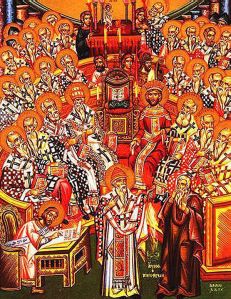
Those bishop’s unbroken interpretation of the scriptures present in the conciliar statements generated when they met in worldwide (ecumenical) council. The first of these councils met  in a town in Turkey named Nicea in 325CE. 318 bishops from all around the world attended. They came from as far away as England. The meeting was presided upon by no less dignitary than the rather newly converted emperor of Rome, Constantine. The statement they wrote, stating in unambiguous terms, that Jesus was fully and completely God in flesh, was signed by 315 of the bishops present (Arius and two cronies refused).

Since that time, Christians, whether they are aware of the fact or not, read the Bible through the “lucky decoder lenses” of those bishop’s statement, the Nicene Creed.

And, since the Nicene Creed is so undergirds how we view and interpret the rest of the Bible, it is a pretty decent idea to, as more and more churches are beginning to, pray that creed in church every Sunday. 

(Part two: Creeds: “The Substance of the faith” not “things indifferent” – Creeds are not confessions and it is above our pay grade to rewrite them.)


Nicene Creed Scriptures.001

Feedback Request: church plant wants to know how others see them

Snark MeterrealMID.003A few folks in our fellowship have asked how the world sees what we are doing. They asked if I could put some of St. Jude’s web info up on thegospelside.com for feedback. Here it is. Critique welcome.

St. Jude’s Church: Being changed. Inviting others. 

Our aim is to be changed by Jesus Christ and invite others to be changed with us.

Our expression of the Body of Christ does this by being…

::Hospitable – Joy, welcome and hospitality are our spiritual DNA. God has welcomed us, so we welcome you.

::Liturgical – The rhythms of the Christian Year, ancient liturgies, and daily prayer connect us to God and one       another, helping us to grow as a community of Jesus followers.

::Multiethnic – Asking God to build true unity as we grow together in Christ.

::Missional – Looking outward toward the world to share the Good News of Jesus in word and action.

Why St. Jude’s?  Visit us if you desire to…

::be welcomed and valued in a caring community

::be challenged by biblical teaching from a variety of voices

::draw near to God through the ancient words & actions of the first Christians contextualized with relevant music

::experience a multi-ethnic, outward-looking expression of the body of Christ

::be formed by daily immersion in Scripture

::serve in a faith community that is not just in Phoenix but for Phoenix

::be developed as a kingdom leader


About our worship 

Worship at St. Jude’s is liturgical and joyful, a mix of the current and ancient. Each week there is uplifting music, a biblical message, and the celebration of Holy Communion. All are invited!

Our liturgy is projected to make it easy to follow. Visitors can participate as much or as little as they are comfortable with. Our slides are usually in English and Spanish.

Music: Given our multiethnic context, don’t be surprised if there are a variety of musical styles: Gospel, Spanish, spoken word and chant might accompany our hymns and praise songs.

Communion: All baptized Christians are welcome at Communion. Simply come forward holding out your hands to receive the bread. Anyone not desiring Communion is invited to come forward with their arms crossed on their chest to receive a blessing. People are available to pray with you on the sides of the sanctuary during and after Communion.

Children’s Program for ages 3 through sixth grade are offered during the first part of the service.  The children are dismissed at the readings and return to the worship service during the passing of the peace to share Holy Communion with their families. Your children will study an age-appropriate version of what you are studying in the sermon to facilitate talking about the Christian faith with your children at home.


We Believe

::St. Jude’s is shaped by and passes along the historic Christian faith. We are passionate about the Father’s radical love for the world; we embrace Jesus Christ and the fullness of new and eternal life offered through His death and resurrection; and we respond to the person and ministry of the Holy Spirit.

::We are anchored in the Bible as the ultimate standard for life and faith. The Great Commandment (Love God, love others) and Great Commission (Share God’s love) orient us toward the world. The historic statements of the Church (the Nicene and Apostle’s Creeds) guard our belief, and our worship is shaped by the Book of Common Prayer.


Holy Week for Newbies

With Holy Week fast approaching I wanted to repost this as an invitation to my friends…

Matt Marino's avatarthe gospel side

Holy Week.001

Snark Meter.005

A primer for those wondering what all the hubbub is about.

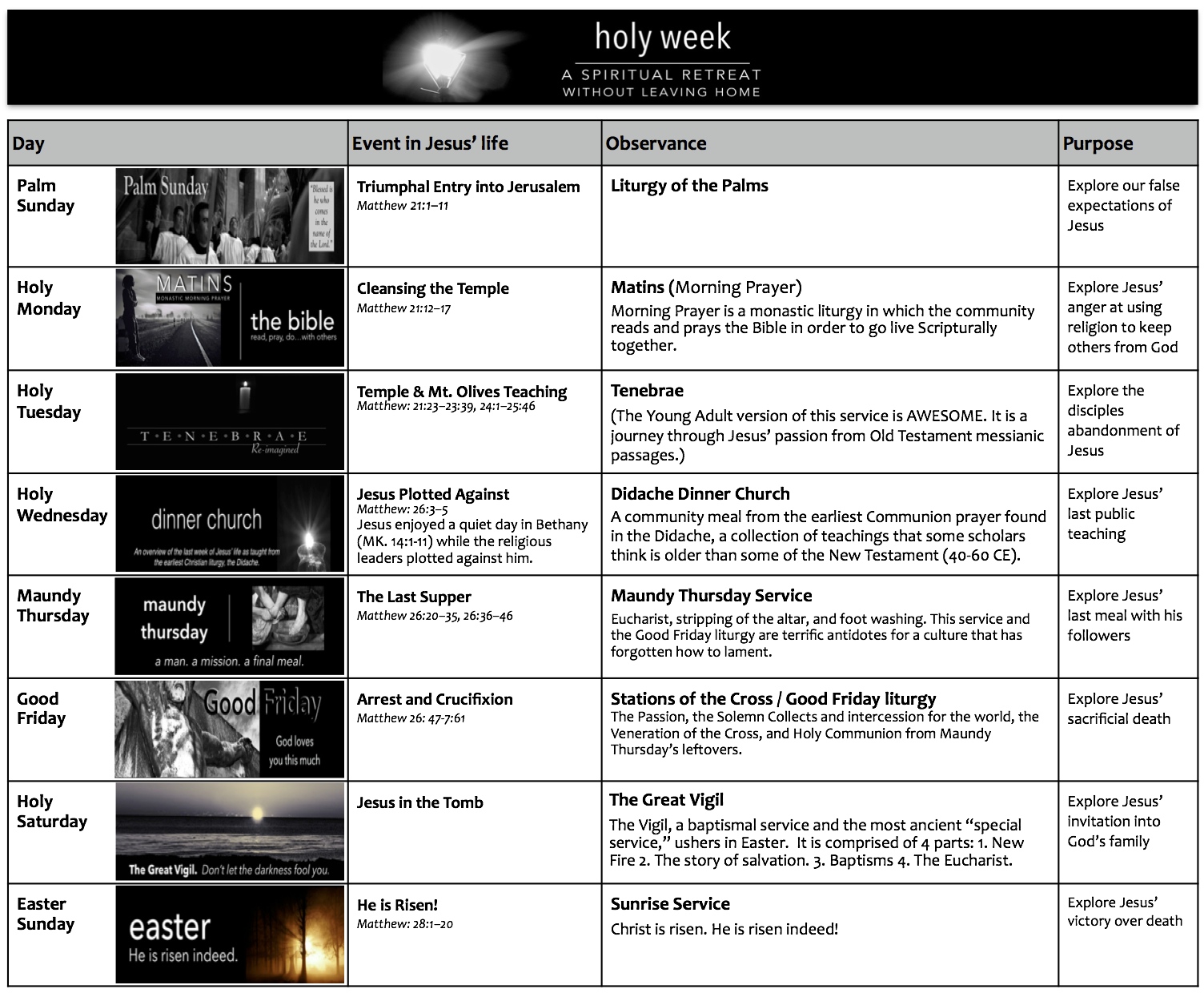
Holy Week, in a nutshell, is a spiritual retreat without leaving home. Remember summer youth camp? You had an authentic, transformative experience of God in a group of others having the same experience. You came home connected to those people and God in a new way. You thought, “That was fantastic. I am different and I can hardly wait to come back next year.” Holy Week is a lot like that.

Holy Week is series of liturgical experiences that walk us through the final week of Jesus’ life. We journey with Jesus, in the short span of a week, from His triumphal entry into Jerusalem, to the missing guard unit, neatly rolled grave clothes, and the shocking appearance of a risen Savior. In a symbol and story impoverished culture, Holy Week opens our hearts to the gift of Jesus’ victory over sin and death. This is more than a psychological…

View original post 621 more words

Holy Week for Newbies

Holy Week.001

Snark Meter.005

A primer for those wondering what all the hubbub is about.

Holy Week, in a nutshell, is a spiritual retreat without leaving home. Remember summer youth camp? You had an authentic, transformative experience of God in a group of others having the same experience. You came home connected to those people and God in a new way. You thought, “That was fantastic. I am different and I can hardly wait to come back next year.” Holy Week is a lot like that.

Holy Week is series of liturgical experiences that walk us through the final week of Jesus’ life. We journey with Jesus, in the short span of a week, from His triumphal entry into Jerusalem, to the missing guard unit, neatly rolled grave clothes, and the shocking appearance of a risen Savior. In a symbol and story impoverished culture, Holy Week opens our hearts to the gift of Jesus’ victory over sin and death. This is more than a psychological remembrance, it is actively allowing ourselves to be in that final week, baptized (immersed) into his death…”Do you not know that all of us who have been baptized into Christ Jesus were baptized into his death? …in order that, just as Christ was raised from the dead by the glory of the Father, we too might walk in newness of life.”  (Romans 6:3-4)

Holy Week is sacramental

…and we are sacramental creatures. Regardless of any initial reaction you may have to that word, hear me out. A sacrament is a tangible symbol that creates what it signifies. Like kissing. When you first kissed that special someone on the doorstep at the end of the evening, it did more than represent thinking the girl was pretty and nice and that you enjoyed talking with her. It actually created and amplified those feelings. You walked back to your car more emotionally connected to her than you were when you opened her door a brief moment earlier.  And when her front door clicked shut, you fist pumped the air. “Heck, Yeah!” Because that kiss actually made more of what it signified.

So God gave us, fleshly, sacramental, critters that we are, a God who came in flesh. Who lived. Who breathed. Who touched us and was touched by us. Who walked willingly to a criminal’s cross, laid down, spread his arms wide for humanity, and waited for real nails to pierce his hands and feet. It is because you too are flesh and blood that you should engage in Holy Week…because Holy Week creates what it signifies: “That I may know Him and the power of His resurrection and the fellowship of His sufferings, being conformed to His death; in order that I may attain to the resurrection from the dead.” (Phil 3:10)

A current reality

The ancient prayers point us to the deep mystery in this: It isn’t “Christ rose.” It is “Christ is risen!” Holy Week is a current reality. A more real reality. So we do more than meditate on these holy mysteries. We allow them to become true within us, as our baptism is true within us. We join him on Maundy Thursday in His Last Supper. We are with him on Friday in His death. We keep prayerful watch before His tomb on Saturday. With growing anticipation we mark His descent into Hades and His trampling of death by His death. Finally, with shouts of joy, we greet His resurrection on Sunday morning, knowing that one day it will be our resurrection too. In Holy Week, as Orthodox priest Fr. Steven Freeman says, “The life to come becomes the life we live.”

A “deep mystery,” it should be said, is not magic. We must surrender to the prayers and liturgy – faith must be lived. In the end, Holy Week isn’t something we do. It is something that does us.

So what is the hubbub?

Holy Week is more than an emotionally powerful experience. It is an opportunity for a greater sanctification. As Paul said, “Now if we have died with Christ, we believe that we will also live with him.” (Romans 6:8) Or, as an Arnold Swarzenegger character once said, “Come with me if you want to live.”

Do yourself a favor, make time to engage in Holy Week, especially the three-day “Triduum”: The despair of Golgotha on Good Friday, the muted sorrow of Saturday, the joyful Baptisms at Saturday’s Great Vigil, and the surprise of a risen Savior on Easter morning.

Almighty God, who through your only‑begotten Son Jesus Christ, overcame death and opened to us the gate of everlasting life: Grant that we, who celebrate with joy the day of the Lord’s resurrection, may be raised from the death of sin by your life‑giving Spirit; through Jesus Christ our Lord, who lives and reigns with you and the Holy Spirit, one God, now and for ever.  Amen.

Holy Week Sched 2014 Blog

Is Lent really 40 days long?

Father Brench in New England offers a nice tutorial on why Lent lasts 46 days, but even more, why a cycle of introspection is a spiritually helpful interruption to our usual praise-dominated worship.

For an idea of how biblical this is, take an afternoon and read all 150 songs in the Jewish hymnal (the Psalms) in one sitting. You will be amazed at how many would not be included in a modern hymnal as unsuitable for public worship.

Fr. Brench's avatarLeorningcnihtes boc

Every now and then someone goes through a calendar and counts the days in Lent and is shocked and annoyed (or at least confused) to discover that Lent is actually 46 days long.  (It’s six full weeks, which is 42 days, plus the days of Ash Wednesday through Saturday adds 4 more to make 46.)

Hey!  What gives?  Is this a conspiracy by the Church to trick people into a 40-day season of discipline when secretly it’s really 46, and we’ve just been tricked because we almost never bother to count?

The answer is going to sound a little weird to those who are not used to the tradition of the Church, but bear with me.  Lent is 46 days long as a season, but it’s only a 40-day fast.  How is this possible?  Because Sundays don’t count.

So, what, does this mean that Lent is a manic depressive season:…

View original post 826 more words

Ash Wednesday for Newbies

ash-wednesday

Snark Meter.005

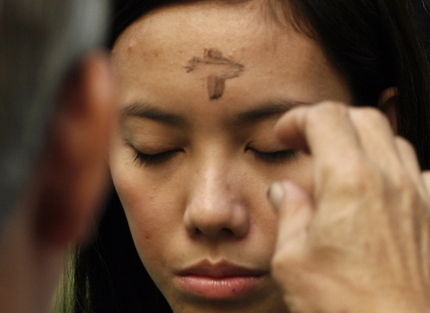
Do not be surprised this week when your co-workers and neighbors appear with smudgy foreheads. You will be tempted to grab a Kleenex and help them rub out the vaguely cross-shapen smears. Resist this urge. They have not become hygienically challenged – It is Ash Wednesday!

What is Ash Wednesday?

Ash Wednesday is the first day of Lent. Lent, an archaic word for “spring,” came to refer to a season of spiritual “training” in the Christian year preceding Easter – Sort of a “spring training” for the spiritual life. Christians in the ancient traditions spend the 6 weeks before Holy Week in repentance, almsgiving, and self-denial in an effort to remember the greatness of God at Easter. Ash Wednesday kicks it all off.

Where did it come from?

The tradition of ashes has its roots in the ancient Jewish prophets (“repent in sackcloth and ashes“). Among Christians, the imposition of ashes associated with a 40 day fast began in the 4th century. Most likely this fast was the Lenten fast, but the evidence is a bit spotty. By the end of the 10th century, though, it was a long-standing custom in Western Europe for the faithful to receive ashes on the first day of the Lent. In 1091, Pope Urban II extended the practice to Rome.

What do you do?

If you attend an Ash Wednesday service you will hear Holy Scriptures calling us to repentance read, have ashes imposed on your forehead with the counter-cultural words, “Remember you are dust and to dust you shall return” (Gen 3:19), and then go forward, empty handed, to receive the Lord’s Supper.

Afterward people go forth to spend 40 days in Lenten practices, either giving up something we enjoy and/or taking on a new spiritual activity. Self-denial and self-discipline prepare our hearts to recall the saving acts of Jesus during Holy Week.

Why?

Contrary to common opinion, Ash Wednesday and Lent are not about spiritual brownie points, impressing God, nor  making belated New Year’s resolutions – like dropping that last five pounds by cutting chocolate.  It is instead about mindfulness. When we think about God, well that is a good thing. By the way, Christians are penitent during Lent because we are grateful for God’s provision in his Son, Jesus. We go to church on Ash Wednesday to be marked outwardly with ashes as we remind ourselves inwardly of our need for the unquenchable, fierce love of God to enliven us.

Can I come?

Yes! You can find an Ash Wednesday service at any Episcopal/Anglican or Roman Catholic Church. Services are usually offered multiple times per day. You do not need to be a member. Everyone is welcome. Although in Roman Catholic churches there are requirements for receiving communion, and Episcopal churches ask you to be baptized for communion, everyone can receive ashes.

I invite you, come to church this Ash Wednesday!

Lent: Spring Training for Christians

Lent Spring Training.001
Snark Meter.005

Wednesday is the Opening Day of Spring Training.

“Lent” is the Dutch and archaic English word for “Spring.” It came to refer to the season of spiritual “training” in the Christian year – hence, “Spring Training.” Play along with the analogy for a moment: Spring Training is where baseball players find out what they’ve got, where they learn and experiment with new skills, and where they figure out what they still need to hone for the regular season. Lent is the Church’s 40-day preparation for the regular season-the rest of life.

And Opening Day, Ash Wednesday, is this week.

Spiritual preparation

Lent is a spiritual practice. Spiritual practices, or disciplines prepare and free us, much the way a great hitter’s thousands of swings, day in and day out, give him the freedom to hit pitches a lesser batter wouldn’t dare swing at, or the way the apostle John’s years in prayer wore out his knees but shaped him into the apostle of love. Lenten practices, over time, produce a freedom, and open us for the grace of God to more fully shape and captivate us.

No “brownie points” are given

Contrary to a common opinion, Ash Wednesday and Lent are not about spiritual brownie points, merit-earning, or God impressing. Neither is it a way to make belated New Year’s resolutions – like dropping that last five pounds by cutting chocolate. No human is rendered worthy through repentance. Worry not, theological policeman: ashes, penitence, and Lenten disciplines are not works to earn God’s forgiveness.

Forgiveness is earned

Forgiveness is earned though…just not by us. Forgiveness was earned by God at God’s initiation and God’s expense. We ARE forgiven because we WERE forgiven – on Calvary. Our forgiveness was proven three days later as a risen Lord walked victorious from the mouth of an empty tomb. That is why we are penitent – We have seen the great acts of God on humanity’s behalf. Our efforts are merely “training” in walking in gratitude of that gift.

And so, in anticipation of celebrating anew the Easter event, we spend 40 days in Lenten practices, either giving up something we enjoy and/or taking on a new spiritual activity. Self-denial and self-discipline remind us of the greatness of our God and Savior.

What happens at an Ash Wednesday service?

If you attend an Ash Wednesday service (you can find one at any Episcopal/Anglican or Roman Catholic Church) you will listen to Holy Scriptures calling us to repentance, have ashes imposed on your forehead to remind you, “remember you are dust and to dust you shall return” (Gen 3:19), and then we will go forward, empty handed, to receive the Lord’s Supper.

The tradition of the ashes began as early as the 4th century, associated with a 40 day fast. Most likely this fast was the Lenten fast, but the evidence is spotty. It is clear that by the end of the 10th century it was a longstanding custom in Western Europe for the faithful to receive ashes on the first day of the Lenten fast. In 1091, Pope Urban II extended the tradition to the church in Rome.

The Scripture readings point us toward our need for humility before God. We will read from the prophet Joel who reminds us that God is rightfully upset at our forgetfulness of both him and the least of his creatures. Joel implores us to, “Rend your hearts and not your garments.”  – It is an internal brokenness God desires, for it is through brokenness that God’s love seeps through the cracks of our hard outer shells of self-reliance and idolatry and transforms us from the inside out.

We will also read 2nd Corinthians 5:20b-6:10, in which Paul entreats us “be reconciled to God. For our sake he made him to be sin who knew no sin, so that in him we might become the righteousness of God.” – A righteousness not from us: It is “of God.” This passage begins with the completion of a sentence in which Paul is exhorting the Church to be “Christ’s Ambassadors,” bearers of the message of reconciliation.

Seriously?

Did the gravity of that sink in? The holy Lord of all creation…the God whom the Israelites in the wilderness trembled at a distance as he hid his holiness in a terrifying cloud atop a mountain…the God whose moral perfection and purity was such that Moses could only see God’s back as he passed by…the God whose ark representing his presence couldn’t be touched, even in its defense, without the offender being struck down…THAT holy God makes us to be THAT righteousness in his sight.

…Even more, that same God calls us to the high and holy calling of reconciling other broken humans to himself.

So the reason Christians are penitent at Lent is that our spiritual life isn’t just a nice experience for ourselves. We acknowledge a calling far beyond human reason or human capacity. Our hope is that, by being increased in love and mercy as we pursue Christ, we would be a help to others in their journey toward the Savior. Lent is an opportunity for God to call us deeper into himself and his high and holy purpose of pointing our friends, families, neighbors, and co-workers to the great mercy of the Triune One.

And so we will go to church on Ash Wednesday to be marked outwardly with ashes as we remind ourselves inwardly that, “We are dust.” But we are redeemed dust.  Grateful dust. Dust with a purpose.

Spring Training is upon us!

Come find out what you’ve got. Learn and experiment with new skills. Figure out what you still need to hone. Every once in a while a professional athlete, for one reason or another misses Spring Training. It almost always shows. Would you like to be more serious about your spiritual “game”? Ash Wednesday is a great place to start.

Wafer Madness: 500 years of communion arguments made simple

439
Snark MeterHIGH.001

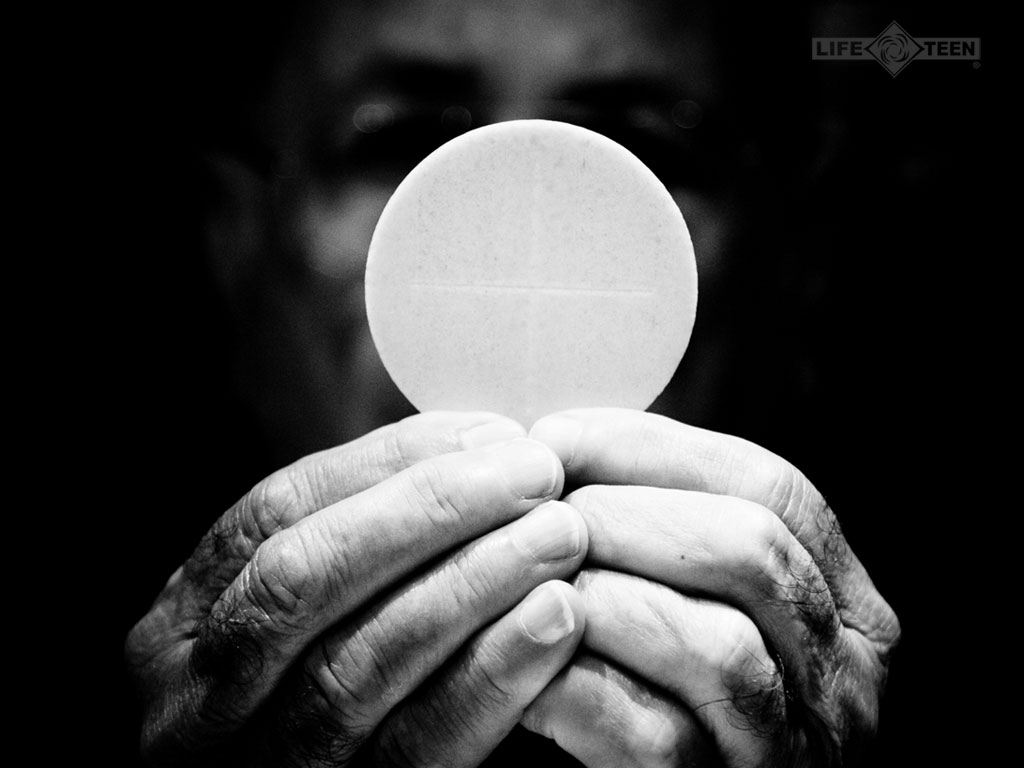
What happens to the elements and the people who consume them? When we are talking about Communion, the answer is “it depends”. The options are listed below from “Why bother?” to “I’m seriously considering becoming a wafer-addict!

Memorial: Nothing happens to the elements. Nothing happens to the people.

Calvin: Nothing happens to the elements. Something happens to the people (Jesus is present when faith is present).

Lutheran: Something happens (is added to) the elements (Jesus is “in, under, and through”). Something happens to those who eat (when faith is present).

Orthodox: Something happens to the elements (but that “something” is left undefined). Something happens to those who eat (when faith is present).

Roman: Something happens to the elements (a complex and nuanced “transubstantiation”) and something happens to those who eat (when faith is present).

Does what someone believes about communion matter? If you are a memorialist, since nothing changes and nothing happens, not really. However, if you believe Calvin’s position, it matters. And, if you believe the Lutheran, Orthodox or Catholic view, it matters even more.

Yes, the Eucharist can mean nothing if you do not approach the table with eyes of faith. But is Holy Communion, at its best, intended to be a “Happy Meal” (fun, but no real nutritional value) or a “Magic Cracker” (that will change you if you let it)? The issue isn’t really what you or I think it is or want it to be, but what the Scriptures say it is, and what the early and undivided church taught it to be.

Beyond the facts is the experience of being changed in a Eucharistic community. You can down a wheat chip cellophaned to the top of a disposable cup, or you can feast at the family meal of the Body of Christ. I am hard-pressed to understand why someone who could eat gourmet in their neighborhood bistro gratis would settle for a Happy Meal from the drive-through. “Taste and see that the Lord is good!” (Psalm 34:8)

Wafer Madness.001

 Am I advocating wafer madness? Maybe a little.

While song is the worship language of memorialists and the megachurch, supper is the historic worship language of the church. This isn’t about preference, but about faithfully practicing what was given to us by Jesus, the New Testament authors, and the early and undivided church. For three-quarters of Christian history, Word and Sacrament was literally the ONLY paradigm for worship. This Sunday it will characterize the worship of more than two-thirds of the world’s Christians. I am not trying to be negative, or run down another’s “tradition.” But I do want to say that when you find yourself spiritually hungry, a meal awaits.

If song is your only worship language, consider experiencing the blessings of bi-lingual worship – add supper.

I’m Lovin’ it!

Eucharist for Newbies

Photo credit: Lifeteen

Photo credit: Lifeteen

Snark Meter Sorta Snarky.002

A light look at 10 things you should know before Sunday.

When American evangelicals think of worship what generally comes to mind is song and sermon. But for most of the Christian era and for most in the Christian era, “worship” has meant Scripture and Sacrament…in other words, Communion…the Eucharist.

1. “Eucharista” is Greek for “Thanksgiving.” You can thank Paul for that: Is not the cup of thanksgiving for which we give thanks a participation in the blood of Christ? And is not the bread that we break a participation in the body of Christ? Because there is one loaf, we, who are many, are one body, for we all share the one loaf.”  (1 Corinthians 10:16-17)

2. Interestingly, there is only one instance when Jesus used the phrase “New Testament” or “New Covenant” (diatheke). He used it, not to describe a book, but the Eucharist. This comes from the earliest historical record of the last Supper, written within perhaps twenty years of the event: “In the same way [Jesus] also [took] the cup, after supper, saying, ‘This cup is the new covenant in my blood. Do this, as often as you drink it, in remembrance of me’” (1 Cor 11:25; emphasis added). So, according to the New Testament, the Eucharist is the New Testament. Long before anyone assembled a book called the New Testament, Jesus had given the chalice as the New Testament in his blood (see Lk 22:20).  (Scott Hahn, The Eucharist in the New Testament)

3. The Eucharist, though, is not just in Paul, there are explicit references to the Eucharist in all four Gospels, Acts, Jude, and Revelation. Over the last fifty years Protestant scholars (John Koenig, Geoffrey Wainwright, Arthur Just, John DelHoussaye) have described a “Eucharistic Provenance of the New Testament.”  These are Protestant scholars recognizing that the New Testament was written to be read aloud in the context of the assembly (Rev 1:3) – and Christians assembled for the meal we call the Eucharist.

4. There are five views of the Eucharist: At the top is the Roman View – The elements incur a essential change, transformed into the body and blood of Jesus, becoming a “Magic Cracker” that appears to be bread, but is, in fact the body of Christ. On the bottom is the memorialist view, in which nothing happens, it is just a “Happy Meal.”* In between, from bottom to top are the views of Calvin (Nothing happens to the elements, but Jesus is present as we lift our hearts in faith), the Lutheran view (the elements become both/and: Jesus and bread/wine), and the Orthodox view (the elements become Jesus, but how and what exactly happens to the elements is a mystery humans cannot define).

5. In Anglicanism there is room for all five views, although very few are memorialists. At the beginning of her reign, Queen Elizabeth was called on to decide whether or not England would remain Catholic, as it had been under “Bloody Mary,” or continue along toward Reformation Protestantism, as was occurring on the continent. As most religious disputes of the day were fought over communion, the clergy reportedly asked, “Which is it, (literally) the ‘body of Christ‘ or (a memorial) ‘The bread of heaven‘?” As the story goes, Elizabeth said something to the effect, “I will not be in the business of peering into men’s souls. When you deliver communion you will say, ‘The body of Christ comma the bread of heaven.'” Basically she was saying, “Communion will be what the person receiving believes it to be.” It is the origin of Anglicanism’s “majoring on the majors”…or “Anglican fudge,” depending on your perspective.

6. The early church repeatedly describes the elements as becoming and being the “body of Christ.” They said, in effect, “Jesus is really here.” But they refused to over-define what that meant. “Transubstantiation,” the word Roman Catholics use to  indicate that the elements truly become the body and blood of Christ, is a word that doesn’t appear until the 11th century. Seminary students are aware that over-definition can be a particular charism of scholasticism. Because both scripture and the unbroken testimony of the early church insist on it, I personally believe in “real presence.” Memorialism ignores far too much scripture and the consistent testimony of the early church (1 Cor 11:29-30) …Why were people getting ill and dying if it is just a reminder? Although the argument could be made that the McDonald’s “Happy Meal” will probably kill you also. Transubstantiation is more specific than can be proved from scripture and causes some significant real world problems – If a frat boy snags a wafer in a prank and runs, do we really have the God of the universe in a prankster’s pocket?

7. The Eucharist is a Sacrament (Yes, Protestants too have Sacraments). Sacrament is Latin for oath…or promise. Simply put: we are promised that we experience Jesus when we obey Jesus…especially when we obey Jesus in the ways Jesus commanded…which is why Protestants traditionally recognize two Sacraments: Baptism & Eucharist, and refer to the rest as “sacramental rites” – permitted and edifying, but not mandated. Btw, for Protestants bugged that Catholics invented the “T word” in the 1100s, Baptists came up the word “ordinance” in their Confession of 1689 to avoid the word “sacrament.”

8. This is not a new sacrifice: Scripture is clear: “Christ…suffered once for sins.” (1 Pet 3:18) The re-presentation of Christ is a “sacrifice of praise and thanksgiving.” (BCP, 363)

9. Eucharist is the original Christian altar call: We come forward, we kneel in humility, we hold outstretched hands as the needy ones we are, and we receive, not grab, the Lord. We receive his grace in humility. We come to receive afresh the grace of God given at the Father’s initiation and at Christ’s expense. All baptized Christians are welcome at the family meal of the Body of Christ. As Cyril described in 400, we make a throne with our hands to receive the body of Christ.

10. At St. Jude’s we use a Eucharistic prayer adapted from the Prayer of Hippolytus written in 215CE. We are following a pattern that was explained as standard Christian worship by Justin Martyr in 150CE. Think about that: What Christians do in the Eucharist is so old that it was already described as the standard and assumed worship pattern of Christians as close to the closing of the NT canon as the writing of the New Testament was to the Lord walking on earth.

Do you want to worship like the early Christians? Try worshipping Eucharisticly. It will bless you.

As Augustine said, “Be what you see; receive what you are.” (Augustine, Sermon 272) -The body of Christ.

So, if you have not before, this Sunday join a celebration of the Holy Eucharist.

The Lord be with you!

*The terms “Magic Cracker” and “Happy Meal” were used in a friendly debate over beer. My Roman Catholic friend insisted, “It is indeed ‘magic cracker.'” My memorialist friend replied, “No. It is only a ‘Happy Meal.’ Fun, but no nutritional value is present.”

Unflattering Mirrors: Tag clouds reveal content…or lack thereof

mirror2Snark MeterrealMID.003

Tag Clouds make good Advent and Easter mirrors. Who knew?

Episcopalians, in our neck of the woods anyway, are a small and remarkably insulated bunch from the goings on in the wider Christian community. That was why I was surprised to be fielding questions from the outside world regarding a blog post that amounts to Episcopal insider baseball.

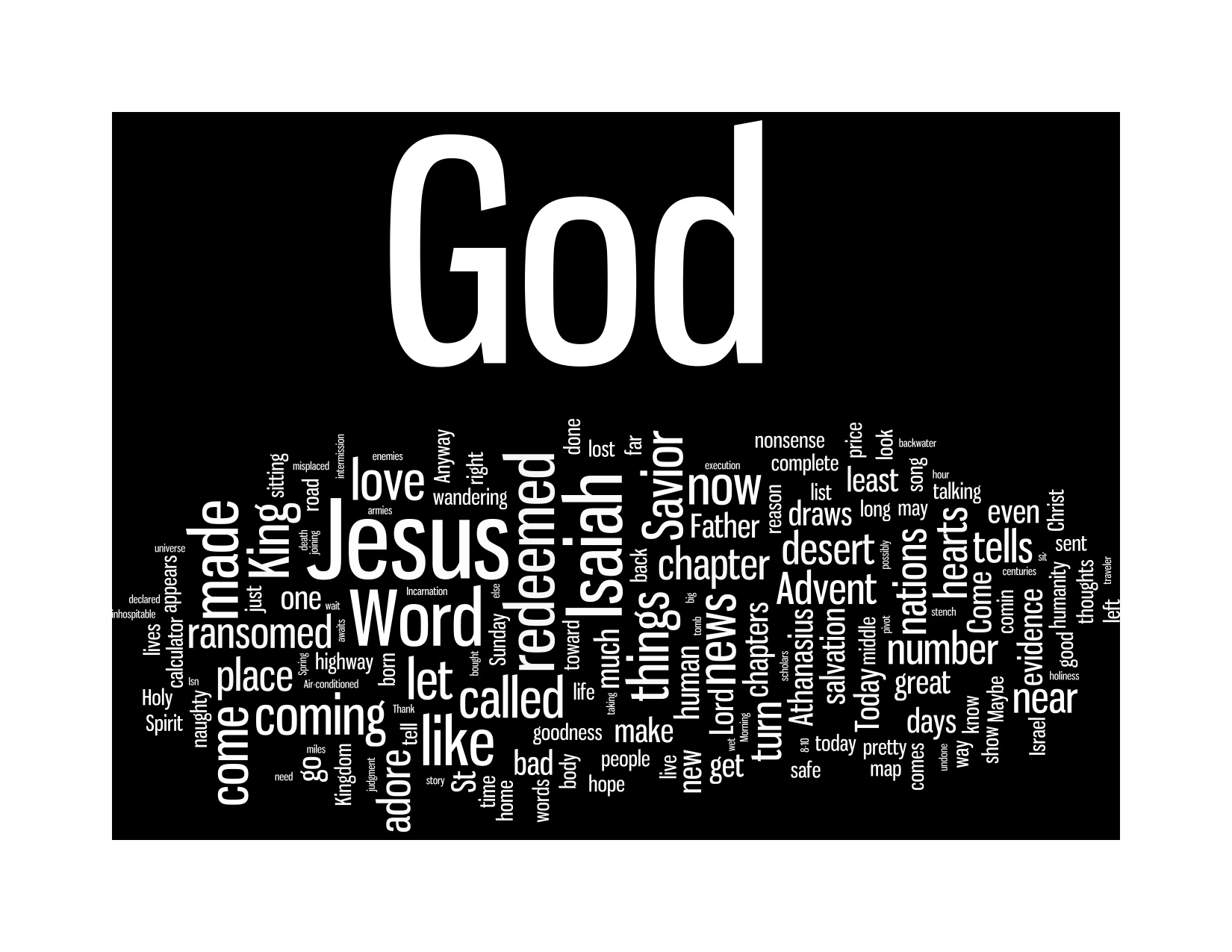
Father Robert Hendrickson, a bright light of a young priest working in a diocesan cathedral, recently made a tag cloud of our Presiding Bishop’s Christmas message. He compared the key words revealed by her cloud to those of Pope Francis’ recent Lumen Fideiand described her sermon as “bordering on gnosticism.” Last year he compared tag clouds of her Easter sermon to those of the Archbishop of Canterbury, the Presiding Bishop of the Evangelical Lutheran Church, the Pope, and even Ricky Gervais’ atheist Easter message. Let’s just say that, from the tag clouds, even the atheist’s message appears to have significantly more Christian content. In cloud format our Presiding Bishop’s sermons appear to be long on insider lingo and social engagement and low on Jesus…that there just isn’t much “there” there.

Pointing out your national leader’s theological shortcomings is a gutsy move for an up-and-comer…a move that caused friends outside of the Episcopal Church to ask, “What’s that guy thinking? ” Would I have criticized our national leader’s sermons online? My strategy in criticizing sermons that I don’t appreciate has generally been the same strategy I use when my wife tries on something that just doesn’t work for her at the department store and asks,  ”Do you love this as much as I do?” I will pretend to have a conversation with a mannequin if necessary to maintain, “If you can’t say something nice.”

But Father Robert’s tag clouds, for all the conversation they are creating, illustrate much more than sermon content…

For one, they reveal a very odd concept for those not of our tradition to grasp: That Episcopalians, as a rule, crucify neither our orthodox nor our gnostics. Our Presiding Bishop will not, as my evangelical friends would like, be charged with violating Christian orthodoxy, nor will her critic’s career be harmed, as many of my progressive friends would like. The ability to stomach dissent, although under fire, is a historic and endearing quality of Episcopalians, a group theoretically not together on theology as much as on the agreement to pray the same words.

However, the theory that “we need not agree” has limitations. I am no fan of Confessional statements, but if there is no real creedal and quadrilateral agreement binding us together as Episcopalians, around what will we orbit when we write the prayers we will pray in unison? There is a core to the faith that makes us recognizably Christian. Or not.

Father Robert’s tag clouds also reflect a growing awareness that our missional strategy – the Episcopal church as “Christianity lite,” a doubt embracing, culturally accommodating, theologically easy onramp for those wanting to consider a practice-based rather than a propositional faith, has not worked very well…in many places we appear to have a creeping universalism that seems lumpy and out of date. Like a microfiber sofa, public doubts about core teachings (resurrection anyone?) and “all roads lead to God” do not make an attractive invitation to come check us out. Our Sunday attendance numbers since our last national leader was selected bear this out: 765,000-640,000 from 2006-2012.

Finally, in Father Robert’s tag clouds we see a hint of what is for me, a person who has spent his adult life working with people from 18-35, a seismic and positive generational shift: Young Episcopal clergy and bishops are both more progressive politically and more traditional theologically. And they are not content to sit on the sidelines and wait for the boomer generation with its (and I do believe this is missionally-motivated) theological fuzziness to get out of their way.

Out of curiosity I made a tag cloud of my sermon for this weekend. I preached out of Isaiah 35 as part of an Advent series, so I expected its references to Jesus to be lowish. Also, my purpose was to sneak up on the Christian message: That just as the Holy Spirit had dropped Isaiah 35 as seemingly a word out of place in the middle of Isaiah’s judgments on Israel, Jesus is God’s Word out of place, dropped into history where least expected. Still, my references to God: Father, Son and Holy Spirit, were minimal enough in the key words that it caused me to cringe like a glance in a mirror at a look that just doesn’t work. Missing too was any indication of our need for a savior. I tore the sermon up and went back to the drawing board.

Tag Cloud

It is not my first rodeo. I know that people come to church quietly desperate for help. If I, as the proclaimer, hold up a fun-house distortion of the Gospel…one that merely reflects back at people what I think they want to see, well, shame on me. I know that the hungry do not need the illusion that we are spiritually well-fed, when in truth we are starving for a Savior. If I fail to hold up a mirror of our deep brokenness and need and then bring the true comfort of the transforming Good News that the Creator of the universe loved us too much to leave us alone, then why bother? God entered our world, not just to demonstrate how to live, but to finally redeem us on Calvary and rise in victory. Christ returned to the Father to intercede on our behalf as his Spirit makes us a people and sends us to extend his Good News in word and deed. Less than the whole Gospel is an unhelpful diet, white bread for the soul. Looking into a mirror that distorts an emaciated spiritual reality may comfort for a while, but eventually hungry people will go somewhere else, some place a meal is served.

I have too many shortcomings as a preacher to criticize another’s sermons. For me, Father Robert’s tag clouds sent me scurrying back to the drawing board to craft a message that better reflects The Message…one that is clear on the reality that, as fourth century bishop, Athanasius wrote,  “It was our sorry case that caused the Word to come down, our transgression that called out His love for us, so that He made haste to help us and to appear among us. It is we who were the cause of His taking human form, and for our salvation that, in His great love, He was born in a human body.”     (On the Incarnation)