Worship: How Reshaping Desires Redirects Destiny


confused guy.jpg

Snark MeterrealMID.003

Why are you here? Part two 

(In part one I made the case that we all worship and that it is the object of our worship that determines our destiny. In Part two I tell you how to tap into the transformative power of worship and why it works.)

Two kinds of worship: Personal and corporate.

Personal worship is humbly giving God glory and returning God’s love by joyously joining the Triune One’s dance in the interior of our own hearts. We ought to do that. It is the Communion with the Most High in personal worship that gives us songs in the night (Acts 16). But there is another kind of worship: Corporate worship. Corporate worship, which occurs in church, in a group, is an entirely different ballgame. While worship alone with God is about giving God glory and often involves powerful emotions, worshipping corporately is NOT about feelings at all. Worshipping corporately is the way God reshapes our love – the way God remolds us and re-habituates our desires. The way God helps us learn how to let go of the gods of our culture and worship the true and living God. Let me explain:

Our modernist educational system has sold us the incorrect vision that we are primarily thinking creatures (Descartes “I think therefore I am.”). But we experience our lives, not as decisions or commitments, but as story and longing. We experience our lives, not as thoughts, but as feelings. This is why when you had an Algebra test and a huge crush on someone, you had a hard time studying…even when you knew you really needed to focus on Algebra. Descartes was wrong: We are defined and shaped by what we love!

Our futures are determined by our desires. The pattern of historic Christian corporate worship was designed to allow God to remake our desires into God’s desires.

In the Gospel of John, Jesus first words are a question: “What do you want?” Jesus knows that our wants are the well from which our identity flows. That is why Jesus doesn’t ask “What do you think? Or What do you know? He asks “What do you want?”

His last words in John begin with the question: “Do you love me?” The simple truth is that we want what we love. We are first and foremost wanters. We are lovers. We are not defined by what we know or think, but by what we desire. This is why the secret to lasting change in our lives…learning a new instrument, or sport, or a work out plan, isn’t to make up our mind, but to have a greater desire for something that might be. We have to love the image of us dunking a basketball or having ripped abs more than the the social media that distracts us…or the image of being the spouse or parent or employee or leader we admire more than playing Stack on our phones. It is when our desires are reshaped that our destiny is changed.

In the corporate worship of historic Christianity we follow a pattern that, over years of repetition, reshapes our desires into God-shaped ones. The pattern of historic worship goes like this: We gather and read God’s word, the Bible. Then we sing the Bible, someone teaches from the Bible. Then we respond to the Good News of Jesus by stating our beliefs in creeds, praying for the world, confessing our sins, accepting God’s forgiveness, and being reconciled to each other in the passing of the peace. Finally, we bring a portion of God’s material blessings and offer them back to God and set them aside with bread and wine, asking God to make them the body and blood of Jesus. In this meal we are reminded of Jesus and his saving acts on our behalf. As Augustine said, “Eat what you are, become what you eat.” “Eat what you are” (the body of Christ), “become what you eat” (the body of Christ). This takes a lifetime of shaping in a community. On many Sundays worship might be, like many of Michael Phelps grueling, lengthy training sessions, going through the motions. But they are motions that groove the pattern of God into our souls like the grooves on an old record album. It is a grinding that uncovers who we were designed to be. It is a polishing that unleashes our inner beauty to the light. It is the repetition that builds strength and makes Phelps perfect stroke a habit.

But, you may ask, “What about when I am in a large group and we are all raising our hands and the hair on the back of my neck stands up?” My answer is that those times when you experience the worship heebie jeebies are mostly a private worship experience you are having in the midst of a group. The corporate rituals are where the transformative magic actually reside. The experience of “wow” is like topping out on a fourteener on a backpacking trip in Colorado. You get to say you did it, but the real distance happened in the valleys, with little ability to see above the trees and monotonously placing one foot in front of the other.

So why are you here? Answer: You were designed to worship. We will, all of us, bow before something. Who will you bow before? We will, all of us, dance with someone. Will you, as the old saying went, “dance with the one that brung you”? Bowing and dancing are grounded in God’s nature as holy yet merciful. Worship is always diminished when we emphasize one aspect of God’s nature at the expense of the other. We can never fully dance without bowing, and although one might bow without joyfully joining the dance, don’t.

So start your training. “It’s what you do in the dark”…what you do over and over when no one is looking, that brings clarity and performance in the race of life. It is engaging in the discipline of trained worship that will “put you in the light.”

Engage in a regular pattern of repetitive worship. Begin unleashing your destiny this Sunday.

*Photo credit: http://www.tripwire.com
Why are you here?

https://www.youtube.com/watch?v=Xh9jAD1ofm4

Snark MeterrealMID.003

Michael Phelps new commercial unlocks the secret of overcoming uncertainty.

 I watched Michael Phelps new Under Armour commercial today. A powerful testimony to the value of sacrifice, commitment, and repetition, it shows the most decorated Olympian in history preparing for his final Olympiad this summer in Rio. The tag line: “It’s what you do in the dark that puts you in the light.”

I have many meetings with people I refer to as “the uncertain.” Often the person will look up from their coffee or craft beer and say, “I guess the real reason I wanted to meet with you is that I don’t know what I should be doing with my life.” I listen and then politely ask them to back up and ask themselves a prior question, “Why are you here?” My question is generally met with a blank stare. So I gently push the issue, “Really. Why are you here? What were you made to do?” Confusion usually turns to frustration and the stammering of some version of, “I’ve got enough problems without you starting an existential crisis.”

The irony is that they already have the existential crisis. But the willingness to dig deeply enough to get at the root, like my desire to quick-weed my yard in Spring, prevents a true solution to that crisis.

Ultimate questions lurk beneath the question.

“What should I do” can only be answered in light of knowing why we are here, what we were made for.

In another bit of irony, we get at why we are here and what we are for backwards, by starting with what we do. Not our paying job, of course, but we we actually spend our private energy on. (To be clear, in the Christian worldview people are not valued based on human performance, but in the mercy of God based in the performance of Jesus, as seen in his life, death and resurrection for wandering humanity.) But what we spend our time doing points to why we are here and what we are to do.

That thing we do…

What is it we do? Answer: Worship. Uhmm, yes, our secular culture still spends most of its’ time and energy in worship. Worship is a contraction of the old English words “Worth-ship” – that which we value, that which we love, that which we long for. Isn’t most of what you spend your energy on love? We desire. We want. We long. We are worshipping creatures.

In the Old Testament the word that is translated “worship” means to “bow before.” Don’t we all bow before something? The question is, “Are we bowing before the right things?” Young people in American “achiever” culture face tremendous pressure to “bow” – to fit in…look “right,” get to the “right” school, have the “right” friends…act the part. Even among individualistic “meta-narrative rejecting” post-modern males, our “individualism” tends to look pretty uniform. I see a lot of plaid flannel, skinny jeans and untrimmed beards – a grown-up version of the eight junior high girls I once saw in a mall wearing matching “Dare to be different” t-shirts. Sure, we are individuals, as long as you hold to the correct politics and sensitivities of our age. But if what we “value,” what we “worship,” is indistinguishable from our culture, surely we will end up as nothing more than this generation’s shallow sellouts to the outward trappings of our culture’s vision of success.

So we are worshipping creatures, made to worship. And we need to worship beyond ourselves. Redirecting our worship outside of ourselves, at the one who made and redeemed us, gives one a center and a grounding that our culture alone cannot. This is because it is worship rightly directed that fulfills your design, fulfills God’s plan for you. Worshipping God is the first step in identifying what one should do with their life.

Wait a moment: You are telling me that going to church is going to help me figure out a career? Are you daft? But better than questioning my sanity would be the question, “How does one best worship beyond themselves?”

Worship in the Christian worldview has been grounded in a vision of God’s two-fold nature revealed in the Old and New Testaments. God has many more characteristics, but the two foundational ones in historic Christianity have been that God is both perfectly holy and perfectly loving.

Holy yet loving. …Transcendent yet immanent. Awesome and out there, yet intimate and desiring to indwell us by the Holy Spirit. Out of God’s nature comes our need to worship. (Col 1:16, Eph 1:11, 1 Pet 2:9, Is 43:6-7)

God’s holiness reveals God as the grandest being in the universe. A being who spoke the universe into existence. God is a worthy of worship in the glory of God’s being. A being we should bow before.

God’s love: The Greek Orthodox have the idea of “perichoresis” Greek for “rotation.” The idea is that in the Trinity we have the One God in a divine Three-Person dance. God in love and unity, created humanity to invite us into the dance of eternity. “For God so loved the world” that he breathed it into existence. Then, when we had wandered away into sin and death, he “he gave his only begotten son” as “an offering and a sacrifice unto God.” (Eph 5:2)

These two foundations to God’s nature are revealed time and again in Scripture. Yet, much to our shame, the church has had a difficult time holding these two truths in tension.

Up Next: Part 2: How Reshaping Our Desires Redirects Our Destiny

Smudgy Foreheads


ashes

Snark Meter.005

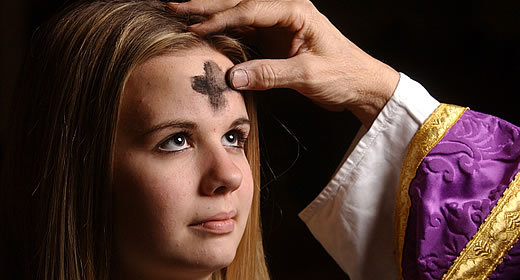
Wednesday you will notice people with smudgy foreheads. When you see this, resist your inner-parent urging you to dab at them with a moist napkin. They are not the victims of poor grooming habits, nor have they lost a dare. It is merely Ash Wednesday, the day in which Christians of the ancient traditions commemorate the beginning of the season of Lent by attending religious services in which they were charged to, “Remember that you are dust, and to dust you shall return.”  (Genesis 3:19)

What is Lent?

Lent, is the archaic word for “Spring.” It has come to refer to the 40 days of spiritual preparation preceding Easter. Christians traditionally spend the season before Easter in repentance, almsgiving, and self-denial in an effort to remember our need for God and God’s great saving acts in the passion and resurrection of Jesus. (40 is symbolic of Jesus’ 40 days fasting and temptation in the wilderness)

Where did it come from?

The tradition of ashes has its roots in the ancient Jewish prophets who urged “repent in sackcloth and ashes.” Among Christians, the imposition of ashes and the 40 day fast began in Europe in the 4th century.

What’s the point?

Ash Wednesday and Lent are not about spiritual brownie points, impressing God, nor making belated New Year’s resolutions, like dropping that last five pounds by cutting chocolate.  Rather, Lent is about mindfulness – Thinking more about God and others, and less of ourselves. Christians are penitent during Lent because we are grateful for God’s provision for humanity through Jesus.

We go to church on Ash Wednesday to be marked outwardly with ashes as we remind ourselves inwardly of our need for the unquenchable, fierce love of God to enliven us.

Christians of the ancient tradition spend 40 days in Lenten practices, either giving up something we enjoy and/or taking on a new spiritual activity. The mindfulness generated by self-denial and self-discipline prepare our hearts to be more fully present for the remembrance of the saving acts of Jesus during Holy Week.

What happens at an Ash Wednesday service?

They are usually brief. You will hear biblical passages calling people to repentance and have ashes imposed on your forehead with the words, “Remember you are dust and to dust you shall return.” (Gen 3:19) Holy Communion is then celebrated.

Checking out a service…

You do not need to be a member to attend. EVERYONE is welcome at an Ash Wednesday service. EVERYONE is invited to receive ashes. Although different churches have different rules for receiving communion, in the Episcopal church our canons ask you to be a baptized Christian to receive communion. (If you are not baptized you may simply stay in your seat or come forward with the congregation, arms crossed, to receive a blessing).

Tired of the noise?

In the midst of debates and news cycles and narcissism, when even America’s pastor urges us to be our own “I Am”, engaging in self-examination and the contemplating our own mortality is refreshingly against-the-grain. Ash Wednesday and Lent create space to become more aware of our need for reconciliation with God and others. Ash Wednesday is an active way to do that with the support of other seekers. This Wednesday, find a service and attend!

Larry Bird and the power of repetition (pt. 2)

Part 2 of a series on the Daily Office

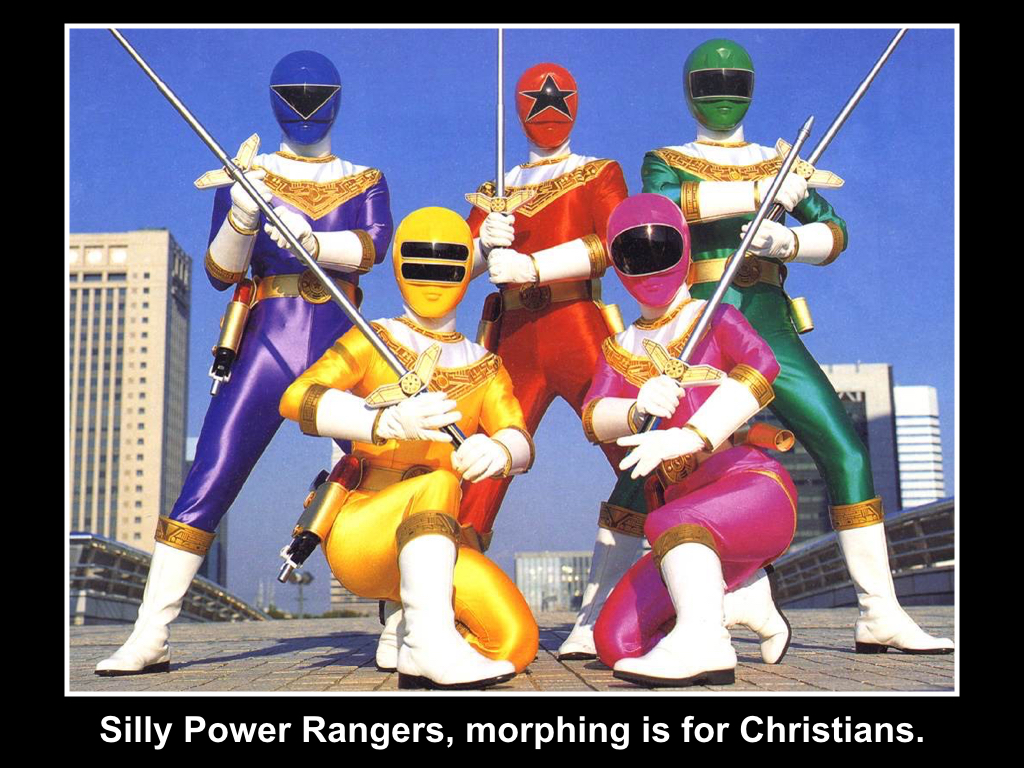
How is one “remolded” from within? How are people “transformed”? It helps to know a bit about the word we translate “remold” or “transformed.” The original Greek word is “metamorpho.” We get “metamorphosis” from it. “Morphing” entered the public consciousness in the 1990’s in the children’s show, “The Mighty Morphin’ Power Rangers,” in which teenagers had the power to transform, accessing super powers to save the world from alien invasion. There is also a DC Comics superhero by the named Metamorpho who is so transformed that, unlike most superheroes, he cannot return to his pre-changed state.

250px-Nolan_metamorpho

The problem with “morphin’” as a pop-culture phenomenon is that the Power Rangers gave us the silly idea that morphing is something that we could do ourselves and do in an instant…and a change that could be undone just as easily. Scripture paints a different picture. In the New Testament “Metamorpho” is only used three times: Once of Jesus who is “morphed” at the transfiguration. The second is in Romans 12:2. The third is in 2 Corinthians 3:18 “And we all, with unveiled face, beholding the glory of the Lord, are being transformed into the same image from one degree of glory to another.


Silly Power Rangers.001

In both places Paul uses “metamorpho” to refer to followers of Jesus the word is in the passive voice – the action of transformation does not happen by us rather it happens to us. In both places it is in the second person plural, “y’all” – In other words the “transformation” is for the whole church as a community, rather than merely for the rare super-hero or super-saint. In both places being “remolded” presumes a life-time of faithfulness rather than the instantaneous appearance of transformation, such as Jesus’ transfiguration or the Power Rangers. In 2 Corinthians 3:18, “metamorpho” is the process of becoming like Jesus: “being transformed(by the Holy Spirit) “into the same image (Jesus), from one degree of glory to another” (we become progressively more like Him). These two usages of “morphing” leave us with three principles: 1) Transformation is a work of God’s grace that happen to us rather than by us, 2) it is for the whole community, 3) it occurs over a lifetime…in other words, through repetition.

Interestingly enough, the power of repetition to change us is exactly the idea the Anglicanism was founded on. The concern driving Archbishop Cranmer, assembler of the first Book of Common Prayer, was how to make disciples of Jesus in a nation in which the king had just dissolved the monasteries and their communal life of prayer. Archbishop Cranmer, in the Preface to his first edition of the Book of Common Prayer (1549) set forth the following goals to course-adjust the worship of the English church, freeing it from medieval papal innovations:

  1. Combine the seven books necessary for communion, daily prayer services, and scripture readings into one book for use by all Christians (rather than just the clergy). That way the church would “need no other books for their public service, but this book and the Bible.” Worship, thereby, would be “by the book” – a book of shared prayers. That book would be…
  2. Understandable – rather than the “holy language” of Latin, the bible and the prayer book would be read in the language of the people so that “…they might understand and have profit by hearing.”
  3. Common: Everyone in the community would be united by this set of scripturally constructed prayers prayed together that “…the whole realm shall have but one use.”
  4. Scriptural: “The whole Bible (or the greatest pare thereof) should be read over once in the year.

Thomas Cranmer also articulated the idea that scripturally-immersive “common prayer” is the ancient and original method God had used to form the people of God and was “…agreeable to the mind and purpose of the old fathers”  

To the surprise of many Episcopalians, Archbishop Cranmer’s vision for the church and Christian life was not the weekly Eucharist, but the Daily Office: The services of Morning and Evening Prayer. Cranmer, imagined a life in which Christians would meet daily to read and pray the Word of God together as a community in order to live as God’s Word in the community. In the services of Morning and Evening Prayer we read the Bible every day, each year, for the rest of our lives with the result that we would live story-formed lives. As old record albums had grooves cut in them for the needle to follow, Christians lives deeply cut in the scriptures have grooves in our souls that make our lives sing Jesus to the world. The scriptures and the ancient prayers based upon those scriptures form a daily routine grooving the patterns of Jesus into our lives, transforming us into the image of Christ through a pattern that we surrender ourselves to – an immersion in the scriptures deeply permeates our souls s0 that when tough times come we go into layup mode-automatically channeling the stories, cadences, and rhythms of the presence of God.

What might we be like if Christians were so formed and immersed in the scriptures that we had the time in the scriptures that Larry Bird had in shooting jump shots? I have a feeling that we might be like Metamorpho-the super hero so transformed he could never return to his former state.

We are, each of us, being shaped by something…always being conformed into the image of something. What is it you are being formed into? What if we were shaped by daily immersion in the Bible? What if we read it, prayed it, and did it together, as a group? My guess is that we would be, as Paul described,transformed into the same image from one degree of glory to another.” A daily ritual such as the Daily Office is a chance to have a “warmup routine,” a familiar pattern that conforms us to Christ by immersing us in the scriptures. When embraced over time it gives us the ability to, like Larry Bird with a basketball, get to places spiritually we could never get another way.

Larry Bird and the Power of Repetition

59e8ccbb63ad4ff3a1b66252a5b83ccb

Snark MeterrealMID.003

How the Daily Office will change your life (Part 1)

Like most American Christians I have spent significant time looking for “fresh” Jesus experiences. Several years ago I decided that looking for “new” things was an unhelpful exercise in missing the point. That conviction struck me as I reflected on an experience I had years ago with Larry Bird…

My part-time job teenage job was Phoenix Suns ball-boy. While my friends worked the usual food service and retail gigs, I worked the visitor’s team bench and locker room. I wasn’t just paid better than my friends, I watched games from the floor and had the opportunity to rub shoulders with NBA Hall of Fame greats like Kareem, Dr. J, Magic Johnson, Larry Bird, and Michael Jordan. Well, maybe “rub shoulders” is overstating it. I tossed them towels and put their jerseys on their shoulders when they came out of the game. During those years I noticed something: The very best players, the really great ones, all had a consistent warm-up routine they followed identically, even superstitiously, before each game.

Game nights for me involved arriving three and a half hours before tipoff to set up the visitor’s locker room with towels and soda before the team bus pulled up an hour later. One afternoon in February of 1980 I entered the bowels of Veterans Memorial Coliseum to hear the echo of a basketball being dribbled. I craned my head toward the court and saw the arena lights already on through the tunnel.  The security guard, seeing my confused look informed, “Some Celtics rookie showed up early.” I set up the locker room and walked into to the court to see this curiosity for myself. Larry Bird had finished his layup cycle and was shooting his way “around the world.” I guess Larry had paid for a cab to arrive early and go through his routine. Seeing my ball boy jersey, he asked if I would shag balls as he shot his way farther and farther away from the basket. Fans of professional basketball may know that 1979-80 was not only Bird’s rookie season, it was also the first year of the three-point line, which at 23’9’’ is quite a distance to hurl a basketball with either form or accuracy. Larry continued to shoot his way further from the basket until he was at the 3-point line. Larry Bird was a forward. I had not seen a forward shoot from the still new and rarely used three-point line. What Larry did next I had never seen any player do: He continued to move beyond the arc until he was shooting a full 10’ behind it. I grew impatient chasing balls shot from a distance one could not possibly use in a game. I asked him why he was wasting his time. Larry responded in his Indiana drawl, “You never know,” he said winding up a shot from 12’ past the line on the right side of the arc near the scorer’s table sideline, “when I might need this shot to win a game.” I almost laughed out loud – an NBA coach was not going to give a game-winning shot to a rookie.

Five hours later, with time running out and the Suns holding a two-point lead, the Celtics broke their huddle and inbounded the ball to Larry Bird. The rookie dribbled into the front court where he launched a 30’ shot from within three feet of the spot he had told me he might need to shoot from in warmups. His shot caromed off the backboard and dropped through the net giving the Celtics a one-point lead over the Suns with half a minute left. How did Larry make impossible shots look easy? The answer: repetition – the thousands of shots Larry had launched in his practice routine.

By the time a basketball player reaches the NBA they have practiced tens of thousands of shots, but they still start their warmups with layups. Why do men who can dunk still practice layups? They know how to do a layup. Layups are boring. The truth is that greatness in both sports and the Christian walk is not about information, it is about formation. There is a difference. Information is knowledge. A good Jr. high player knows the mechanics of a proper jump shot. But it was the two decades of repetitive discipline, honed on an outdoor court in Indiana winters, shooting until his hands bled, that gave Larry Bird the freedom to do things others could not on a basketball court. The principle Larry Bird knew is that Repetition leads to transformation. We see this at work in scripture: Romans 12 opens with, “I appeal to you therefore, brothers, by the mercies of God, to present your bodies as a living sacrifice, holy and acceptable to God….” Then Paul explains how to present our bodies to God, “Do not be conformed to this world, but be transformed by the renewal of your mind.” The Phillips translation phrases it like this, “Don’t let the world squeeze you into it’s mold, but let God remold you from within.”

(Next Up: Part 2 How does God “remold us” spiritually, and the basis of Anglican spirituality.)


The True Cross

Church of the Holy Sepulcher at sunrise.

Church of the Holy Sepulcher at sunrise.

Snark Meter.005

Is the cross a sign of your life?

You probably missed it. It didn’t show up in most calendars and you would have to have been born under a lucky star to have heard it mentioned in the media. Monday marked the observation of the Feast of the Holy Cross. On September 14, 335 the Church of the Holy Sepulcher in Jerusalem was dedicated. On that day the “True cross,” discovered by Emperor Constantine’s mother, St. Helena, was brought into the church she had commissioned over the sites of Christ’s crucifixion and burial. But the Feast of the Holy Cross is much more than the celebration of a historically unverifiable artifact. Commemorating the instrument of Christ’s death is appropriate because the central focus of the Christian life is the Cross. The Cross is more than an event in history. It is the event in history.

The Cross is an eternally present reality for those allowing their lives to be hummed in the key of Jesus. The Cross is the unveiling of God in the world. It defines the proper shape of human existence. But what does a cross-shaped life look like?

Mainly it means that a truly meaningful life can’t be found in the self-centered life. We simply were not created to be self-fulfilled. We were not designed to be drinking bird contraptions, endlessly and mindlessly bouncing up and down after whatever fluid the world says we should peck at. Our lives, especially in the midst of trials, find our purpose as we give ourselves away. The way of the Cross, is the way of the other. And God is the ultimate “Other.” St. Paul says, “For you have died, and your life is hidden with Christ in God.” (Col. 3:3). The great truth of the Christian life is that we only find ourselves outside of ourselves. Orthodox priest, Fr. Stephen Freeman, offers helpful advice for living the cruciform life:

 Pray. Prayer is directing our hearts outside of ourselves towards God.

 Be kind. Kindness puts others ahead of ourselves.

 Give thanks always, in all things. Giving thanks acknowledges that our lives are not the products of our own efforts, but a gift from God.

 Forgive. Forgive everyone for everything. The refusal to forgive is the radical separation of ourselves from others.

– Give stuff away. The more, the better. We do not exist to consume. Satisfying our daily needs is enough. When our true life is found outside of ourselves, then sharing what we have with others is the most natural thing to do with our possessions.

 Do not lie. Do not participate in other’s lies. Lying is an act of selfishness – an attempt to create a false reality in order to duck the truth.

I would add: Receive God’s grace: In all of life, but especially in the Eucharist. We do not grab grace in the Eucharist. We make, as Cyprian said “A throne for God with our hands” and receive him.

The Cross is the way of life so, finally,

Embrace the practice of the Cross. Even Protestants can tangibly remind ourselves that we live in the shadow of the cross by making its’ sign frequently. In 250AD church Father Tertullian said that we Christians, “in all our coming in and going out, in putting on our shoes, at the bath, at the table, in lighting our candles, in lying down, in sitting down, whatever employment occupies us, we mark our foreheads with the sign of the cross” (De corona, 30).

The Cross is the remembrance of Christ and points to the great truth that our lives are not our own. They belong to the Crucified One – A Savior who bids His friends to join Him an act of pure love: self-sacrifice.

Did you miss the Feast of the Cross this year? Did it slip past you unawares? Despair not. You need not wait for September 14th to come back around. Simply live a cruciform life.

Because the True Cross is…you.

*This is a riff on Father Stephen’s post for a midweek sermon. If you do not read Father Stephen, you should. http://blogs.ancientfaith.com/glory2godforallthings And yes, I realize that the final sentence is narcissistic to the point of undoing the entire article. “You” just works so much better stylistically than “us”.  🙂

The roomy church: Uniting around what unites us.

Minolta DSC

photo credit: Oh My Apartment. http://tinyurl.com/o4ouzg2

Snark Meter Sorta Snarky.002

A somewhat sarcastic yet serious call to our GC78 delegates to under react.

This post might be the blogospheric equivalent of whistling in the dark. You are pretty sure it won’t really help, but you do it because it makes you feel as if you are at least doing something…

To those of you packing your bags for General Convention let me share a story: Last year I was at the gathering of province VIII ministry leaders. (For non-episcopalians “the province” is episco-speak for one of 9 geographical regions in the Episcopal Church.) At the meeting we were discussing how difficult it is to get folk from the 19 diocese’ and jurisdictions in our province to work together. There was a good deal of frustration at parishes lack of participation in collaborative efforts. We discovered the reason was a lack of understanding of what we were united on. “We aren’t sure other folk are the same kind of Episcopalians we are?” several said. I suggested, “It might help us get buy-in if we had a statement of what we do agree on.” The consensus in the room was that we were such a diverse church that it would be impossible to agree on any kind of a statement. I pushed, “Can the youth people give it a try?” It took one draft and three edits for two liberals, a conservative, and a moderate to hash out a statement of “shared values.” Task completed in one day.

As we showed it around a fascinating thing happened: Other provincial ministry areas saw it and asked if they could use it too. An even more fascinating thing happened when I showed it to two groups of friends. One a group of progressive youth ministers from a variety of traditions (including those the Episcopal Church is in full communion with), the other a group of senior youth directors who lead the group that left us…you know, the grumpy quitters who say we drove them out. Here is where it gets really interesting: Those we are in “full communion” with said, “Those don’t describe us at all.” One, a person with a PhD in theology, said, “I’m not sure I know what half of those points are even about.” The response from the group led by former Episcopalians? “Those are fabulous. Far more descriptive of us than what we wrote!” Now the punchline: The former Episcopalians asked, “Can we use your statement?”

Insert snark: Yes, the theologically pure schismatists asked to use the shared values from a liberal province of the heretic church, while our other pure and undefiled progressive partners, with whom we have so much in common, didn’t even understand the statement.

My point: What unites Anglicans as Great tradition formed, prayer book using, rejectors of the modern pattern of song and sermon for the ancient pattern of scripture and supper, is still far greater than what divides us.

Please remember that as you travel to Salt Lake City. For all of our lawsuits and counter-suits and leisure suits, what unites Episcopalians, even today, is greater than what divides us. That will not be true, though, if you over-define and over-canonicize us. When you go to general convention, do work hard to shrink our national structures to keep resources in the parish for evangelism and discipleship. But PLEASE resist the urge to over-define and consolidate progressive “wins.” Because, as the Reformed Episcopal Church who left us in the 1870’s over two candlesticks and one word (“regeneration” in the baptismal liturgy) show us, what we are arguing about today is not what we will be arguing about tomorrow. Just ask someone from the REC. They put “regeneration” back into their baptismal liturgy in the 1980s. They put the candlesticks back on the altars in the ’60s. No, we will not be arguing about these things in fifty years. Or even twenty. Time will sort out our sexuality stuff. Canonical over-definition and prayer book revision always peels off another 100,000 Episcopalians. And in case you haven’t checked recently, we don’t have them to peel off.

So please, deputies and bishops, as you meet and deliberate our future, please make the hard decisions to shrink our top heavy structures. But when it comes to theological and canonical decisions, especially decisions around marriage, remember that success strategy that you learned in your parish ministry: the power of the under-reaction. You have the votes. You can win. But you can win in a way that creates so many losers as to erase that win. To quote a bishop friend, “Anglicanism, at its’ best is tentative, nuanced and compromised.”

Delegates and bishops, I beg you, under react. Keep us roomy. In a roomy church everyone wins.

Shared Values.001

General Convention 2015 – Will history repeat itself?

photo credit Susan Snook

photo credit Susan Snook

Snark Meter Sorta Snarky.002

It is a business meeting that inspires either the deepest anxiety or absolute apathy: General Convention – the triennial business meeting of the Episcopal Church.* This July we will have another of these enormous shindigs in Salt Lake City. What happened at the last one encouraged me.

My perspective on General Convention 2012 was somewhat unique: I was not a member of any of the “usual suspects” at General Convention. I was not a “deputy” (elected lay and clergy representative), although I listened privately to the perspectives of many deputies. I was (obviously) not a bishop, although I spent a fair amount of time privately listening to the widely divergent viewpoints of four bishops and their spouses. Neither was I a member of one of the many lobbying groups that show up at these events to push the church toward greater “justice.” Why was I there? I manned a booth with several friends attempting to rally adults to take the Good News of Jesus to youth outside the walls of the church. In other words, I was about as dispassionate an observer as one can be as an insider in our institution.

What encouraged me at GC12? The legislation that summer fell into three basic groups that illustrated trends:

Group One: legislation for theological change

-Allow Communion for people who have not been baptized. (A no brainer for evangelicals, but a big deal theologically for the church historic.): No

-Remove Confirmation as a barrier to holding parish leadership positions. (i.e. some semblance of Christian commitment prior to church leadership.): No

-Updating the 1982 Hymnal (A political precursor to revising the prayer book): No

Trending down: Theological change.

Group Two: legislation for political change 

-The bishops voted to continue making statements on moral issues such as the plight of Palestinian Christians, the use of drones, world hunger, etc. (This is an attempt to “speak truth to power.” Not to be snarky, but it strikes me as somewhat humorous that we think anyone is listening when we, 1% of the countries’ Christians, tell the government to stop shooting cruise missiles.)

-We voted to include the word “transgendered” in the list of what will not prevent someone from seeking ordination.

-We voted to have same-sex blessing rite liturgies approved for use by those who choose to do so.

Trending up: progressive politics

Group Three: legislation for mission and overcoming organizational stasis

-Sell our church HQ building in Manhattan: Approved

-Establish a committee to restructure church governance: Besides our bicameral legislative body, the General Convention, we also have a large national church office and hundreds of national committees & commissions. This new committee to “restructure” was tasked with shrinking all of this.  Approved

-Remove the stipulation that the Presiding Bishop must give up their diocesan bishop role (An attempt to roll back the ever-increasing hierarchical structure of our church since setting up of the national office in 1947.) Approved

-Perhaps most interesting of all: The bishops re-established themselves as the fulcrum in our three part divided form of government by writing a letter to the courts in Fort Worth and Quincy. Skip bracketed paragraph if you are not a church geek. 

[How does a letter rebalance power? A group of conservative bishops had written a “friend of the court” letter (Amicus Brief) to the courts in Fort Worth and Illinois defending the ancient church practice and traditional Episcopal understanding that the diocesan bishop is our church’s highest authority. The majority of the bishops were very angry about this as it undermines our lawsuits in those diocese. However, in a stroke of brilliance they chose to write a letter supporting the new bishops and the churches that remained in the Episcopal Church in Fort Worth and Quincy, without mentioning the substance of the letter written by the conservative bishops. This is dense politics, even for Episcopalians, but our bishops, by affirming the new bishops and NOT addressing the substance of the letter, re-affirmed the traditional view that bishops are the highest authority in our church – rather than a metropolitan such as a Pope, prophet, Archbishop, or even our own Presiding Bishop.]

In one swoop the bishops appear to have re-established themselves as the locus of power in the church, rather than the other two groups (the national office/presiding bishop, and the House of Deputies/Executive Council) who each behave as if they are the prime authorities. Practically speaking, in an institution with balance of powers, someone always gets a vote with just a little more weight than the others. I think it is a good thing if our bishops, who are closer to the mission field than the national office, and in recurring collegial relationship with one another, unlike the deputies. It makes for a safer, more catholic church that the bishops would be the ones with tie-breaking power.

Trending up: The scent of a revolution to drive the church back toward mission.

Summary: We seemed to be becoming a more theologically conservative, more politically progressive church that is irritated at resources being siphoned away from mission to national structures.

Why is this important for this summer’s General Convention? Because this summer we will make decisions that strike at the heart of what many perceive as our orthodoxy: marriage in our prayer book and in our governing documents. These changes will be pushed for “consistency” sake. Indeed, we will be more consistent if we, a church where many are performing same-sex marriages has that practice canonically in place. We will also be a much smaller church if that happens. This will be a bridge too far for many of the 150,000 or so remaining social conservatives in our church. In 2003 823,000 people worshipped in Episcopal Churches on Sunday mornings. In 2013 that number was 623,000 people, numbers that do not include the loss of another 10,000 Episcopalians in South Carolina. Do we really have another 100,000 Episcopalians to peel off to make us, to quote one of our seminary professors, “a leaner, meaner church”?

Far better would be to resist the urge to over-define ourselves. As Nick Knisely, bishop of Rhode Island says, “Anglicanism is tentative, nuanced, and compromised.” The tendency to over-definition is characteristic of other traditions: fundamentalism with detailed statements of faith and Rome over-defining the Eucharist in the 11th century come to mind.

My hope this summer is that cooler heads will prevail. That we will continue our previous trends toward holding the line on matters theological, being open politically, and that the scent of revolution that wanted to drive mission from a national vortex back into thousands of local communities to proclaim the Good News of Jesus in word and deed would be the place our leaders will focus this summer.

Will history repeat itself? One can only hope.


*Bunny trail: Episcopalians will tell you, chests heaving with pride, that our General Convention is the second largest legislative body in the world. When one considers that Episcopalians now comprise less than 1% of the Christians sitting in American churches on any given Sunday morning (623,000 in 2013), it raises one’s eyebrows at the hubris necessary to think that we need a decision making body second only to the group representing the one billion people of India.

Holy Week for Newbies (Rebroadcast from last year)

Holy Week.001

Snark Meter.005

A primer for those wondering what all the hubbub is about.

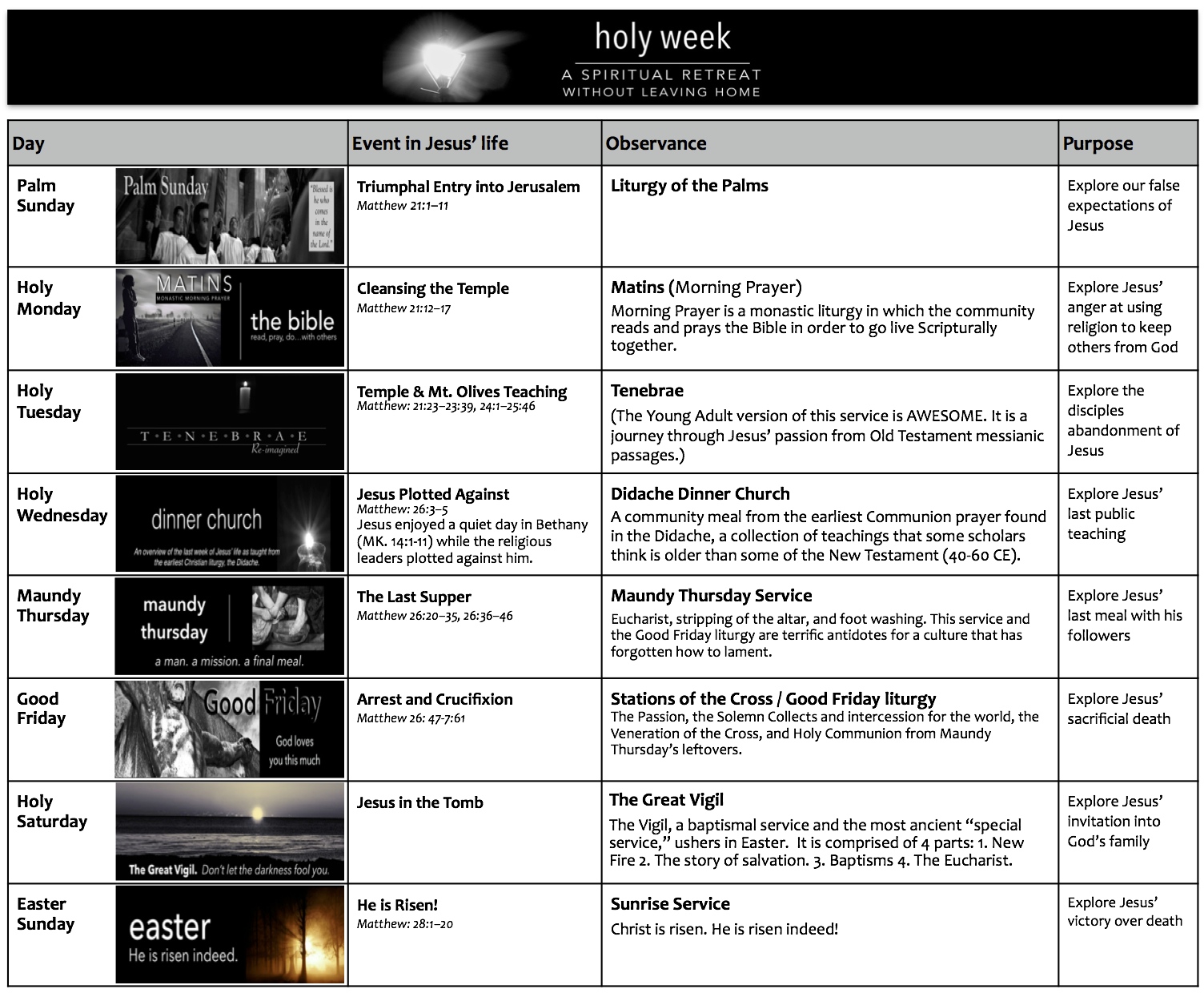
Holy Week, in a nutshell, is a spiritual retreat without leaving home. Remember summer youth camp? You had an authentic, transformative experience of God in a group of others having the same experience. You came home connected to those people and God in a new way. You thought, “That was fantastic. I am different and I can hardly wait to come back next year.” Holy Week is a lot like that.

Holy Week is series of liturgical experiences that walk us through the final week of Jesus’ life. We journey with Jesus, in the short span of a week, from His triumphal entry into Jerusalem, to the missing guard unit, neatly rolled grave clothes, and the shocking appearance of a risen Savior. In a symbol and story impoverished culture, Holy Week opens our hearts to the gift of Jesus’ victory over sin and death. This is more than a psychological remembrance, it is actively allowing ourselves to be in that final week, baptized (immersed) into his death…”Do you not know that all of us who have been baptized into Christ Jesus were baptized into his death? …in order that, just as Christ was raised from the dead by the glory of the Father, we too might walk in newness of life.”  (Romans 6:3-4)

Holy Week is sacramental

…and we are sacramental creatures. Regardless of any initial reaction you may have to that word, hear me out. A sacrament is a tangible symbol that creates what it signifies. Like kissing. When you first kissed that special someone on the doorstep at the end of the evening, it did more than represent thinking the girl was pretty and nice and that you enjoyed talking with her. It actually created and amplified those feelings. You walked back to your car more emotionally connected to her than you were when you opened her door a brief moment earlier.  And when her front door clicked shut, you fist pumped the air. “Heck, Yeah!” Because that kiss actually made more of what it signified.

So God gave us, fleshly, sacramental, critters that we are, a God who came in flesh. Who lived. Who breathed. Who touched us and was touched by us. Who walked willingly to a criminal’s cross, laid down, spread his arms wide for humanity, and waited for real nails to pierce his hands and feet. It is because you too are flesh and blood that you should engage in Holy Week…because Holy Week creates what it signifies: “That I may know Him and the power of His resurrection and the fellowship of His sufferings, being conformed to His death; in order that I may attain to the resurrection from the dead.” (Phil 3:10)

A current reality

The ancient prayers point us to the deep mystery in this: It isn’t “Christ rose.” It is “Christ isrisen!” Holy Week is a current reality. A more real reality. So we do more than meditate on these holy mysteries. We allow them to become true within us, as our baptism is true within us. We join him on Maundy Thursday in His Last Supper. We are with him on Friday in His death. We keep prayerful watch before His tomb on Saturday. With growing anticipation we mark His descent into Hades and His trampling of death by His death. Finally, with shouts of joy, we greet His resurrection on Sunday morning, knowing that one day it will be our resurrection too. In Holy Week, as Orthodox priest Fr. Steven Freeman says, “The life to come becomes the life we live.”

A “deep mystery,” it should be said, is not magic. We must surrender to the prayers and liturgy – faith must be lived. In the end, Holy Week isn’t something we do. It is something that does us.

So what is the hubbub? 

Holy Week is more than an emotionally powerful experience. It is an opportunity for a greater sanctification. As Paul said, “Now if we have died with Christ, we believe that we will also live with him.” (Romans 6:8) Or, as an Arnold Swarzenegger character once said, “Come with me if you want to live.”

Do yourself a favor, make time to engage in Holy Week, especially the three-day “Triduum”: The despair of Golgotha on Good Friday, the muted sorrow of Saturday, the joyful Baptisms at Saturday’s Great Vigil, and the surprise of a risen Savior on Easter morning.

Almighty God, who through your only‑begotten Son Jesus Christ, overcame death and opened to us the gate of everlasting life: Grant that we, who celebrate with joy the day of the Lord’s resurrection, may be raised from the death of sin by your life‑giving Spirit; through Jesus Christ our Lord, who lives and reigns with you and the Holy Spirit, one God, now and for ever.  Amen.

Holy Week Sched 2014 Blog

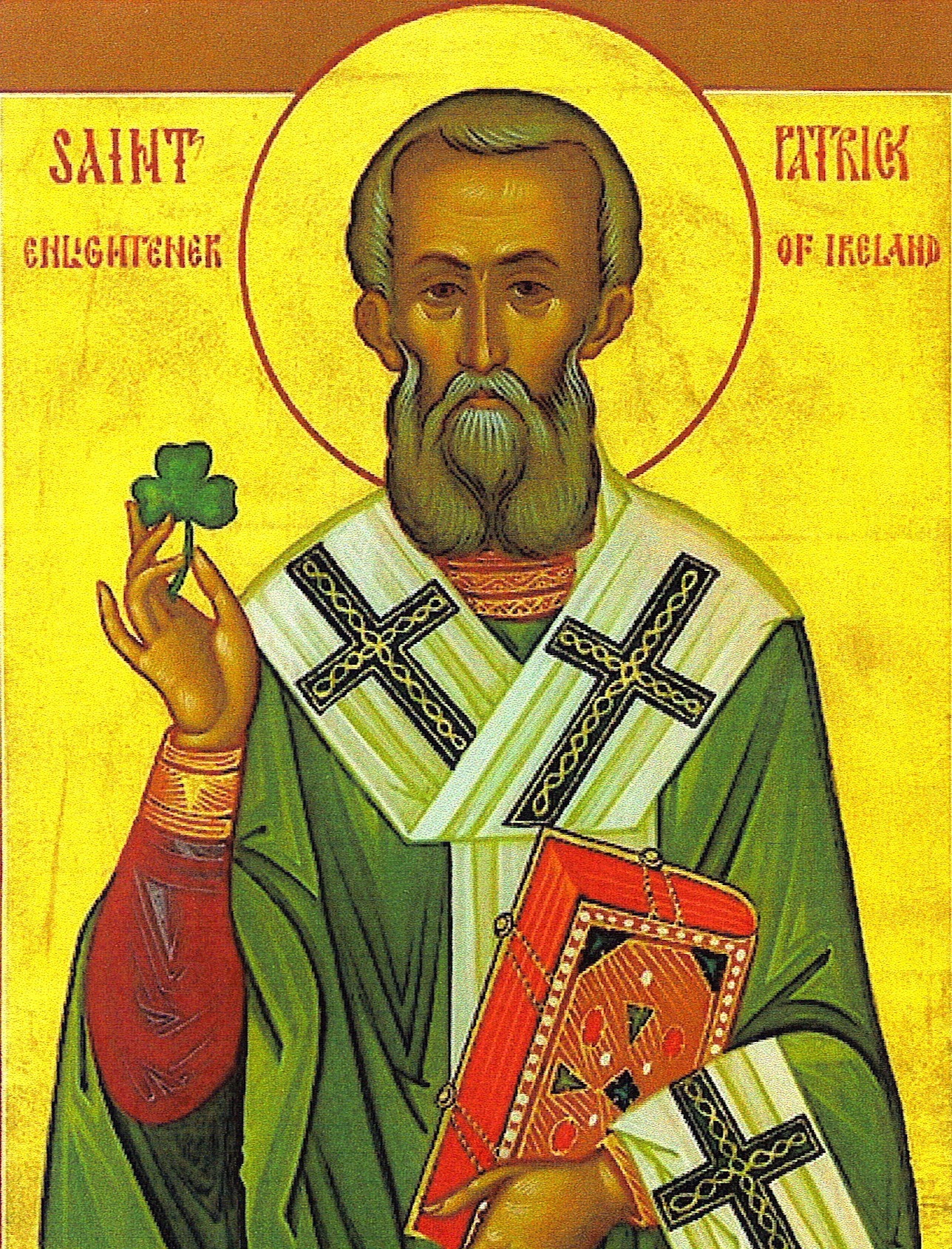
Will The Real St. Patrick Please Stand Up?

patrick_shamrock_0Snark Meter.005

Before you hoist a green one, what do you know of St. Patrick, patron saint of Ireland?

For starters, he was neither Irish nor a saint…at least never canonized as a saint by the Roman Catholic Church.

Born around 390, Patrick’s parents were Romans living on the Welsh coast. Patrick came from a family of both economic means and Christian faith: His father was a deacon and his uncle a priest. As a boy, Patrick was taught the faith, but it didn’t take.

At 15 he was stolen by raiders and sold into slavery in Ireland. Working as a shepherd, Patrick was often hungry and near freezing. One night, since Patrick would not come to God, God came to him, “The Lord opened my mind to an awareness of my unbelief, in order that…I might remember my transgressions and turn with all my heart to the Lord my God.” (Confession)

After 6 years God came to him again in a dream and told him, “Your boat is ready.” Patrick fled, successfully evaded capture for some 200 miles and stowed aboard a ship to England. Safely at home, he decided to repay God for his rescue by becoming a priest.

After years in “the forests and on the mountain…in the snow, in icy coldness…hunger,” and “attacks from Satan,” his family was glad to have him home. However, a safe ministry in Britain was not to be Patrick’s way. God interrupted Patrick with yet another dream in which the Irish people begged him, “Come walk among us again.

In 432 Patrick returned to minister to those who held him in servitude. As the result of this calling, and bolstered by a highly developed theology of evangelistic duty, Patrick went to the pagan northern and western regions of Ireland where there had been no previous Christian witness. He began by sharing the faith with kings and chieftains. His ministry was highly unorthodox for his time: Usually bishops were sent in response to existing Christian communities. Patrick, however, was the first to bring the Gospel to this land. Wildly successful, he remained in Ireland for the remaining 30 years of his life. Thousands were converted and many clergy ordained to extend his work.

It was not all fun and games either: Christian raiders from Britain killed a group of newly converted Irish men and stole their women into slavery while still in their baptismal robes. As a former slave, Patrick understood the evil of slavery and argued forcefully for their return, asking that the tithes on their ill-gotten gain be refused and his letter condemning the raiders be read in church every Sunday until they released the women.

Patrick was, arguably, the most significant pioneer missionary of the early Western church. By 400 AD, the West was already developing a Rome-centric clericalism. Clergy just did not run off to foreign lands in 430 AD. Not since the Apostle Paul, who said, “I aspired to preach the gospel, not where Christ was already named, so that I would not build on another man’s foundation,”[1] had there been a self-selecting missionary in the West. Patrick’s mission was also the first recorded effort to build Christianity outside of the wall of the Roman Empire without having first been invited.[2] Patrick built churches much closer to the New Testament model of engagement with the world, rather than the retreating church of the monastic model that would emerge in the rest of Europe to cope with the dark ages.

Patrick’s ministry, as revealed in his Confession, highlight many lessons for Christians today:

  1. He knew the Grace of God. Patrick knew that he was a sinner and that it was God’s grace that redeemed him and compelled him to ministry.
  2. He listened to God. We have five recorded dreams in which he heard God speak to him. God drew Patrick’s heart, and Patrick moved his feet in response.
  3. He relied on the powerful testimony of God’s action in his life to rally others.
  4. He knew the Scriptures well and either alluded to them or quoted from them overtly in nearly every verse of his Confession.

Patrick’s missionary methods are also instructive for the church today:

  1. Go: He felt compelled to “Go into all the earth” and focus on those who had previously not heard the Good News.
  2. Engage: Patrick learned the language and the culture- and adapted his methods to communicate to that culture without compromising the Christian message. (Using the shamrock to communicate the trinity…which might actually be apocryphal.)
  3. Stand: He stood up for justice and identified with the people he was called to serve. (The stolen women incident.)
  4. Reach: He intentionally and boldly evangelized kings and persons of influence.
  5. Reproduce: He called people to personal conversion and developed indigenous leaders. These are the hallmarks of effective missionaries throughout history.

We see in Patrick, much more than an excuse to drink green beer. Patrick was a man confident in the God who both called and used him mightily. He moved and ministered fearlessly in response to that call. Ironically, 150 years later it was the spiritual descendants of Patrick, Brendan, who saved Christianity in Europe, but that is another story for another post.

Surely Patrick’s life and ministry make March 17th, the anniversary of Patrick’s death, a day worth celebrating. He was a fearless lover of God who would go anywhere and do anything to reach people for Jesus.

Perhaps, as we lift a green one in Patrick’s honor, we would be challenged to follow his example.


[1] New American Standard Bible, (Chicago: Moody Bible Institute, 1995; reprint, 1995). Romans 15:20-21

[2] Justo Gonzales, The Story of Christianity, vol. One (Peabody, Mass: Prince Press, 1984). Ulfilas mission to the Goths in the 75 years earlier had come at the Goths invitation. Gonzales, 218.