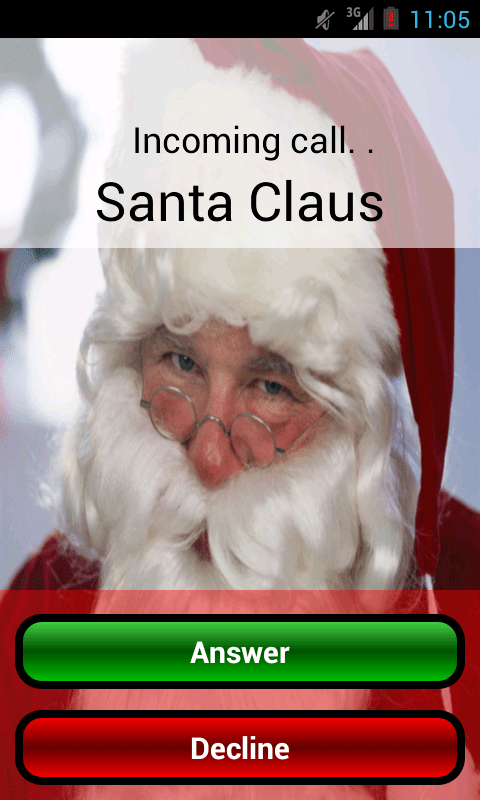
Photo credit: Google Store – Fake Call from Santa app.

I first realized the Santa story had holes in 1977. I was in the 6th grade, an embarrassing age not to be in on the gag. My friends, realizing my innocence, enlightened me with the subtlety one expects from 6th graders.
I would not let Santa go down without a fight, though. Pitying the skeptics, I would bring them back into the fold with facts. We gathered around our homeroom teacher’s shoebox sized desk calculator as I confidently pressed buttons. “The world’s population x the 20% who are kids (the machined hummed), divided by 10 hours of darkness (wheels whirled), divided by 60 minutes in an hour (gears spun). Equals.
Confident of victory, I tore the tape from the still cranking calculator…and gasped as the disappointing truth sank in: Santa was delivering 1.3 million presents per minute.
My friends howled. Our teacher, Mr. Fishleder, bit his lip in a passable attempt at maintaining a merciful decorum.
Although I learned what Christmas was not that year, it would be the better part of a decade before I learned of import of the infinitely more remarkable Christmas gift giver:
“For a child has been born for us, a son given to us the government shall be upon his shoulder, and his name shall be called Wonderful Counselor, Mighty God, Everlasting Father, Prince of Peace.”
-Isaiah 9:6, NRSV
Peel back for a moment our familiarity with the story…
A child whose names include “Mighty God”? Just to make sure we don’t miss the implications, in the next verse Isaiah circles back and tells us the predicted child would be a king whose rule would have “no end,” lasting “forevermore.” Yet kings don’t rule forevermore. Kings die. “Forevermore” and “no end” are code, code for God himself.
Let Isaiah’s sense-surpassing dichotomous claim sink in: God. Born. Religions generally have the deity lecture from a safe distance. Like Santa. “Hey, you people, straighten up down there. I’m making a list. I’m checking it twice. I’m going to find out who’s naughty or nice.” Other religions seem to me to be about helping people piously work their way to God. But God’s plan is shockingly intimate: “Immanuel.” Which St. Matthew tells us means, “God with us.” Christmas is nothing less than God. Born. The gift of God himself.
Our human inclination is to shrink Christmas to manageable proportions by making it an inspiring fable about being nicer. But if Christmas is only a warm fiction it isn’t inspiring at all. It’s desperately bleak – Our problem, after all, is not that we don’t know how we should live, but that we don’t live how we know we should. Given the havoc we have made of earth, is it possible to let us loose, as we are, in the cosmos for eternity? Let’s be real: Moral perfection for you and I is as likely as jumping the Grand Canyon on a bike “Santa” brought you for Christmas as a kid.
God’s answer, however, is much more heartening: A son is “given.” “Given,” not just “to us,” but “for us.” He was born for us, and he would die for us. Christmas is the beginning of God doing for us, out of love for you and I, what we cannot do for ourselves – forgive us and change us. God himself; born, living, dying, rising…both the perfect life we should live and the perfect sacrifice we cannot give. Jesus the king would pay our ransom and become our victor. In Christ, God made a way across that Canyon. Those two simple words, “For us” make Christmas the gift that fixes the mess humanity has made of things… a way has been made through the wall of our reality, clean across the chasm of our fallen-ness.
Christmas is God’s gift of Jesus.
Like any gift, though, God’s gift only blesses us when we receive it. And let’s be honest, receiving gifts is tricky. Anytime we receive a gift we wonder what accepting it will mean. When someone gives you a wedding ring, for example, accepting it has ramifications…
So what does receiving the gift of Jesus bring? I see four Christmas blessings in the names given the Christ child in Isaiah 9:6. Four gifts that have the potential to change everything:
First, in receiving Jesus, we receive the Wonderful Counselor. Why do people see a counselor? For help with relationships – healing in marriages, friendships, and families. The Wonderful Counselor, reminds us of our value. In light of our value, we are freed from emotionally over-investing in others because we need to be needed, or conversely, underinvesting out of fear of commitment. Jesus desires to fill us on the inside regardless of what is happening outside.
Second: He is Mighty God. Are you ever in over your head? In Christ, Mighty God himself is on your side. Jesus Christ does not peddle empty promises – You can count on him when the chips are down.
Third: When you receive Jesus, he becomes your Everlasting Father. Why father? Because through his Holy Spirit sent at Pentecost, God offers intimacy and acceptance, like a great father to his beloved children, by living within you. God came to us, so that we can come to him.
Fourth, Jesus is the Prince of Peace. Peace in Hebrew is the word shalom. More than internal contentment, shalom is society-wide flourishing. Shalom means that poverty, disease, brokenness, and death are replaced with prosperity, health, reconciliation, and life. Individual new birth and inner peace, are your blessings when you receive Christ, but so is systemic shalom – expressed in the here and now by connecting with one another, serving others in Jesus’ name, and confidence against the worst this world can throw at you. The world’s brokenness matters to God, and God has promised the ultimate renewal of the whole earth.
My friends, Christmas is the gift that can change everything. But much more than the Christmas bike of childhood now rusting in a landfill, Christmas is the lasting gift of Jesus Christ, God with us. And in receiving him, God’s offers four gifts: Healing in our relationships, his strength and sure defense, intimacy and acceptance with God, and reconciliation now and peace in the future. And so, I urge you, whether for the first or the thousand and first time, receive God’s gift of love: Jesus. When we receive him, we find we receive, with him, the four Christmas gifts that change everything.
 the gospel side