Years ago a Catholic priest from India told me, “Ghandi said, ‘I look at Jesus and I want to be a Christian. But then I look at the lives of Christians…and I don’t want to be a Christian.‘” The great scandal of the church, for Ghandi and for us, is the troubling lack of love shown by those of us who call ourselves “Christian.”
—
Having made pilgrimage to the Holy Land this spring, I was astonished at how small it is: The events in the Gospels can mostly be seen from each other: Bethphage, the village from which Jesus had the disciples borrow a donkey and her colt, is on the Mount of Olives. From this hill you can look across the narrow valley and over the Brook Kidron at the walls of Jerusalem and the gate Jesus rode through on the day we call Palm Sunday. The temple, from whose courts all four Gospel writers record Jesus casting the money-changers, was just inside the city wall. When Jesus entered the temple and focused on the failings of the religious establishment rather than shake his fist at the Roman occupiers whose Antonia fortress stared down into the Temple grounds, Jesus set the stage for the crowd’s turning on him when he stood before Pontius Pilate five days later. You can walk the Via Dolorosa, along which Jesus carried his cross to the place of crucifixion in minutes. The spot where Jesus was crucified and where he was buried are also remarkably close – so close that both the location of the crucifixion, Calvary, and Joseph of Arimathea’s tomb are under the same roof today. It is stunning how little geography God used in the great saving acts of his Son.
Scandalous also is how small the distance between, “Hosanna. Blessed is he who comes in the name of the Lord!” and “Crucify Him!”
In the Gospels this took five days. In the Episcopal Church our liturgy places both the Palm Sunday and Good Friday scripture readings on the same day. My guess is that this is, in part, an acknowledgment that many will not prioritize attendance at the commemorations of our Lord’s redeeming acts in the Paschal Triduum of Maundy Thursday, Good Friday, and the Easter Vigil. But it is also an acknowledgement of basic human nature: The distance between celebrating someone and demonizing them is also remarkably short – because, as humans, we have a remarkable capacity for…small.
Just a little dollop of disappointment and we can move from kindness to vitriol in an instant. We look for scapegoats, rush to judgments, and hold others in bondage with binary thinking. We litmus test and sort people into categories of our own devising. And we cast those short of wholehearted endorsement of the platforms we embrace into outer darkness. A few exhibits:[1]
- Several months ago at lunch I overhear the animated conversation between a socially active pastor of another mainline denomination and an atheist college professor sharing our table. The pastor labeled group after group, “Evil!” until the atheist professor finally asked him, “Where’s the love, man?”[2]
- A student asked me to breakfast the next morning and confessed (tearfully) that he was considering leaving the seminary. He was trying to grow in prayerfulness and was told that his pleas for his fellow students to act in love toward others was evidence of insufficient commitment to the social causes espoused by his peers. He was certain he would never gain their acceptance.
A friend posted on Facebook several weeks ago, “I am uncomfortable that my church’s stance on every issue seems to completely mirror the culture.” I think he is right…
…but I am not nearly so nervous about aping the culture as I am about the next exit on this highway: the justice-ification of the church.
Conflating church and culture is surely foolish, and I think, small. But church by focus group is something of a Protestant tradition. What I cringe at is the way Christians (progressive Christians in particular, but we are not alone in this), have managed to turn all social causes into “justice issues.” We do this with seemingly little self-awareness of the ramifications of our crusades. When we label an issue “justice” we stop working for sensible public solutions and begin brandishing swords. This is never so clear as on social media…
We call the press, issue positions, and forward polemics on our Facebook feeds.
But in a pluralistic society there will always be those who do not endorse our worldview. Can we make room for them? Can we “seek to understand before being understood”? Can we begin with the presumption that people are generally of good will and work toward solutions? What if, instead of playing the “justice” card we began with, “How do we find a ‘win’ for everyone?” What if we asked, “What will lead to human thriving?” Or better yet, what if we simply remember that the church is first and foremost a place to worship the Lord, Jesus Christ. How did the church become ground zero for the activism industry?
“But Matt,” you say, “justice is biblical. The Old Testament prophets spoke truth to power.” Yes, but you are not a biblical prophet, and this is not 2600 years ago. Are we not simply using “justice” as a way to avoid making room for others? The shaking of enraged fists and mobs with torches in the night – when we label an issue “justice” then someone is guilty…and they must be punished. “Justice” is not served until the evil is purged. This is especially true when justice is hyphenated.
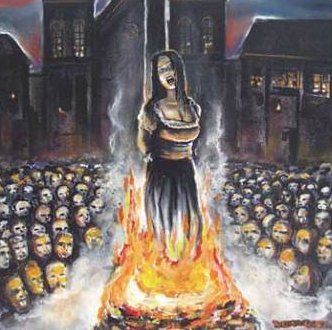
When we label a disagreement “justice” it generally ends one place: “Burn the witch!”
But I do see examples of hope in the emerging generation of leaders: Two weeks ago a friend who is active in LGBT politics asked me if I would organize a meet and greet between an LGBT political action group and evangelical pastors. Yesterday seventeen young evangelical pastors and thought leaders met with Matthew Vines and others engaged in promoting same-sex marriage. While there was clear theological disagreement, it was a really meaningful time of relationship building, healing, and mutual respect. Here is another: Next week I will be at a luncheon in the Roman Catholic bishop’s office to discuss spiritual unity between evangelicals and Catholics as brothers and sisters in Christ.
It is a short way down the hill to Jerusalem. It is a short way from the cross to the tomb. It is a short way from “Hosanna!” to “Crucify!”
But it is also a short way the other direction.
Going from “Crucify!” to “Hosanna!” is the exact same distance. While it does take more work, the Prince of Peace went up to Jerusalem and was crucified so that no one else need be.
Next week we will celebrate the forgiveness of both human and institutional sin on the cross. We could join Jesus in the way of that cross, extending our arms in love to all who are near. Perhaps if we did that, those who are far will see and notice. And the scandal of the modern church will be swallowed in the scandal of the historic cross.
—
As that old Indian priest said that day, “I implore you. Make Ghandi wrong. Be Easter people. May the love of our Lord Jesus Christ so shape and form you that all the world would see his mercy.”
[1] Out of politeness I will only use examples from my own tribe. Evangelicals and Catholics will be able to think of many of their own examples.
[2] These evils included fracking, pipeline building, driving petroleum based cars, failure to recycle, and the fact that Darren Wilson had not been lynched. (The pastor was white.)
 the gospel side
Further thoughts on Palm Sunday https://textsincontext.wordpress.com/2014/04/11/holy-week-beware-idle-conjecture/
Hi Michael.
Good clear post on your part, but I have a few questions about your premise since it is new to me:
First, I think it is safe to assume that you are right in saying the Sunday and Friday morning crowds were not the same “crowds” – at least not in their entirety. But it seems awfully strange to me to assume that none of the “whole crowd of disciples” (luke 19) would have shown up four days later.
Second, can’t one can logically assume that during a holiday in which the most popular preacher in the country has been taken illegally under cover of darkness and spent the night being shuttled between high priest’s homes and, in the morning, between Pilate and Herod, that the effect would not have been that of front page news in a small city? Many of Jesus’ followers would certainly have been in the crowd of Matthew 27.
Third, somehow no one in that crowd came to Jesus’ defense before Pilate. Again it seems an odd stretch to me to conclude that no one in the swollen group of Jesus’ followers at the gate was at the public decision to execute Jesus’ five days later. But if they were absent, wouldn’t that also be an indication that the crowds were so disenchanted with Jesus that they didn’t even bother to show up?
I am not trying to be feisty, but your argument is new to me. Help me understand why one would conclude logically that none of the first crowd was in the second? Or that none of those expecting Jesus’ political messiah-ship became disenchanted and fell into mob-think? Mob-mentality is a powerful beast.
Thanks!
Excellent post, Matt. It is such a short distance from lack of love and suspicion of “other-ness” to vilification. Even crucifixion. @chaplaineliza
Thank you, Elizabeth. Wishes for a blessed Holy Week.
Same to you! Many blessings as you minister, and as you worship and pray in private at this particularly holy time. I will try to set aside some time this week in silent prayer and meditation. God willing!
I loathe the hypocrisy of the phrase “speak truth to power”, particularly within the church. It is so baldly obvious that the church is viewed by these same people as a locus of power for implementing their political aims.
Word, Charles.