http://uywi.org/event/reload-lab-phoenix-2012/
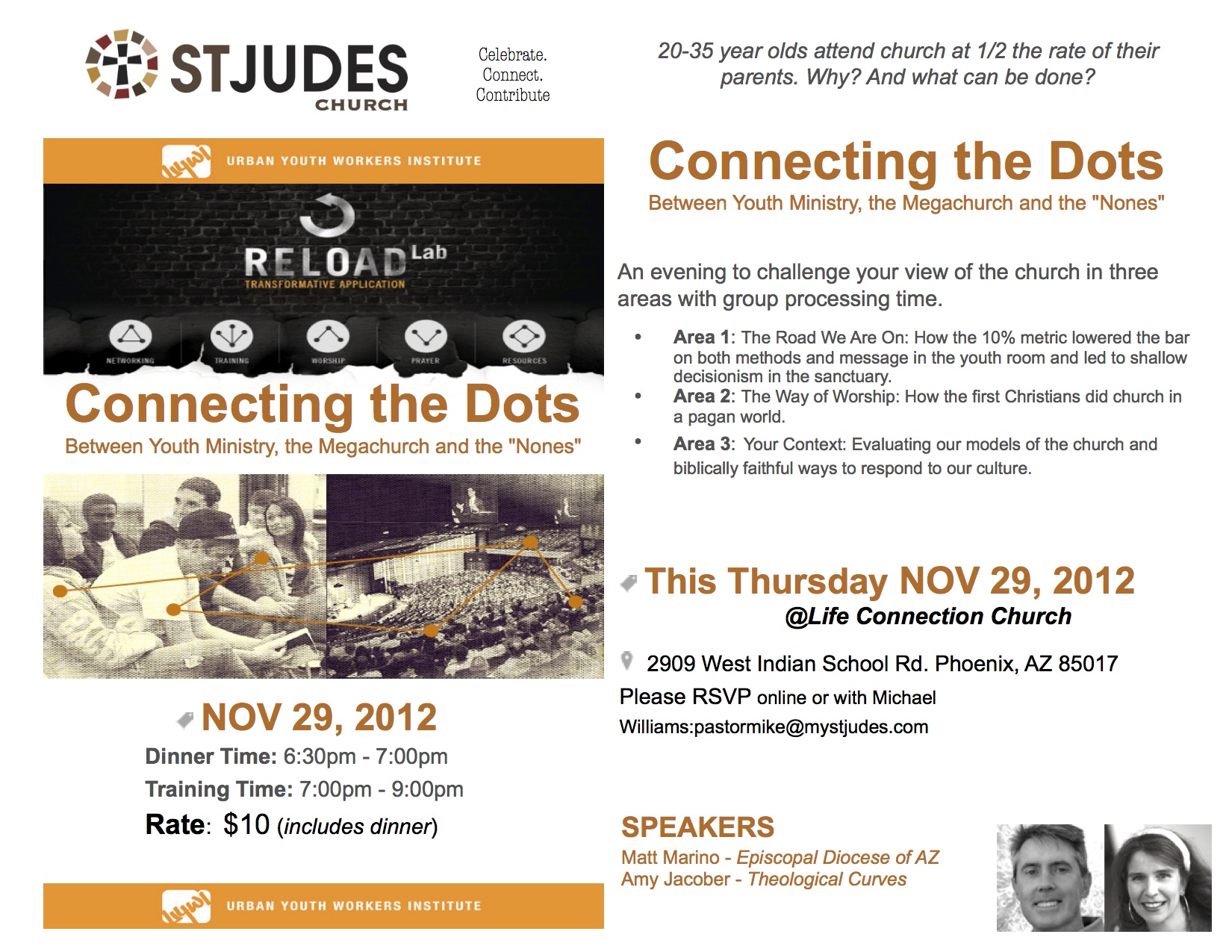
Why is church not working for the 19-35 year old? Why are high school students raised in the church increasingly dropping out now as well? What can be done?
http://uywi.org/event/reload-lab-phoenix-2012/
Why is church not working for the 19-35 year old? Why are high school students raised in the church increasingly dropping out now as well? What can be done?
They didn’t know what they were doing when they made John Archbishop of Constantinople. They learned not to give a captivating speaker a microphone if you don’t know what he is going to say. John Chrysostom or “golden-mouthed” had a promising career in Greek rhetoric that he dashed by becoming a Christian, then a hermit to memorize the Bible. When his health forced him back to civilization, he became a preacher of great fame. He taught the scriptures practical everyday application, including preaching against the hoarding of wealth (angering some of the wealthy), and that priests should serve where assigned rather than touring for honorariums (angering the priests). He was the first (that I am aware of anyway) since the biblical authors to treat intimate marital relations as a good thing.

Here is a sermon excerpt from the late 300’s. Homeboy could preach!
On the burial place and the Cross 2: Adam and Christ, Eve and Mary
Have you seen the wonderful victory? Have you seen the splendid deeds of the Cross? Shall I tell you something still more marvelous? Learn in what way the victory was gained, and you will be even more astonished. For by the very means by which the devil had conquered, by these Christ conquered him; and taking up the weapons with which he had fought, he defeated him. Listen to how it was done:
A virgin, a tree and a death were the symbols of our defeat. The virgin was Eve: She had not yet known man; the tree was the tree of the knowledge of good and evil; the death was Adam’s penalty. But behold again a Virgin and a tree and a death, those symbols of defeat, become the symbols of his victory. For in place of Eve there is Mary; in place of the tree of the knowledge of good and evil, the tree of the Cross; in place of the death of Adam, the death of Christ.
Do you see him defeated by the very things through which he had conquered? At the foot of the tree the devil overcame Adam; at the foot of the tree Christ vanquished the devil. And that first tree sent men to Hades; this second one calls back even those who had already gone down there. Again, the former tree concealed man already despoiled and stripped; the second tree shows a naked victor on high for all to see. And that earlier death condemned those who were born after it; this second death
gives life again to those who were born before it. Who can tell the Lord’s mighty deeds? By death we were made immortal: these are the glorious deeds of the Cross.
Have you understood the victory? Have you grasped how it was wrought? Learn now, how this victory was gained without any sweat or toil of ours. No weapons of ours were stained with blood; our feet did not stand in the front line of battle; we suffered no wounds; witnessed no tumults; and yet we obtained the victory. The battle was the Lord’s, the crown is ours. Since then victory is ours, let us imitate the soldiers, and with joyful voices sing the songs of victory. Let us praise the Lord and say, “Death is swallowed up in victory. O death, where is thy victory? O death, where is thy sting?”
The Cross did all these wonderful things for us: the Cross is a war memorial erected against the demons, a sword against sin, the sword with which Christ slew the serpent. The Cross is the Father’s will, the glory of the Only-begotten, the Spirit’s exultation, the beauty of the angels, the guardian of the Church. Paul glories in the Cross; it is the rampart of the saints, it is the light of the whole world.
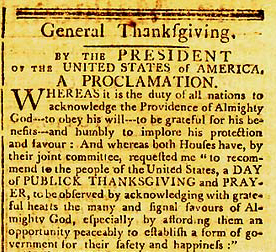
Note the perspective of our first President on the relationship between people of faith and civic responsibility, the idea that we, as a nation, would need the involvement and intervention of Almighty God, and in the final sentence, the idea that religion, virtue, science and prosperity are interconnected rather than opposed. Make of it what you will. Surely not all change is progress…
THANKSGIVING DAY 1789
BY THE PRESIDENT OF THE UNITED STATES OF AMERICA – A PROCLAMATION
Whereas it is the duty of all Nations to acknowledge the providence of almighty God, to obey his will, to be grateful for his benefits, and humbly to implore his protection and favor – and Whereas both Houses of Congress have by their joint Committee requested me “to recommend to the People of the United States a day of public thanksgiving and prayer to be observed by acknowledging with grateful hearts the many signal favors of Almighty God, especially by affording them an opportunity peaceably to establish a form of government for their safety and happiness.”
Now therefore I do recommend and assign Thursday the 26th day of November next to be devoted by the People of these States to the service of that great and glorious Being, who is the beneficent Author of all the good that was, that is, or that will be – That we may then all unite in rendering unto him our sincere and humble thanks – for his kind care and protection of the People of this country previous to their becoming a Nation – for the signal and manifold mercies, and the favorable interpositions of his providence, which we experienced in the course and conclusion of the late war –for the great degree of tranquillity, union, and plenty, which we have since enjoyed – for the peaceable and rational manner in which we have been enabled to establish constitutions of government for our safety and happiness, and particularly the national One now lately instituted, for the civil and religious liberty with which we are blessed, and the means we have of acquiring and diffusing useful knowledge; and in general for all the great and various favors which he hath been pleased to confer upon us.
And also that we may then unite in most humbly offering our prayers and supplications to the great Lord and Ruler of Nations and beseech him to pardon our national and other transgressions – to enable us all, whether in public or private stations, to perform our several and relative duties properly and punctually – to render our national government a blessing to all the People, by constantly being a government of wise, just, and constitutional laws, discreetly and faithfully executed and obeyed – to protect and guide all Sovereigns and Nations (especially such as have shewn kindness unto us) and to bless them with good government, peace, and concord – To promote the knowledge and practice of true religion and virtue, and the increase of science among them and Us – and generally to grant unto all mankind such a degree of temporal prosperity as he alone knows to be best.
Given under my hand at the City of New York the third day of October in the year of our Lord 1789.
GO. WASHINGTON.
 Youth leaders always want to know what theory looks like in practice. Here is an example of one component of a youth group meeting: the teaching time…
Our church plant has a small youth group (usually about 25 students) with 6 very committed young adult volunteer leaders. They recently began a semester of working through the Old Testament.
For Genesis 1 and 2, instead of a sermon or video, the group was divided into two groups by gender. In one room the boy group read Genesis 1 together several times. In the other the girls read Genesis 2. Each group took notes and discussed what the text said and emphasized for the hearers. Then they outlined the chapter. The leaders gave guidance in the form of questions to take the students back to the text when they started reading into it. On a large poster board with colorful markers, each group drew a graphical/artistic representation of their chapter. Then they came back together and the students taught their chapter to the other group from their poster. Having students teaching one another engaged students in the learning process in a way that was wonderful. By the end, each group knew the contents of both chapters.
Then one of the leaders did a wrap-up to help students get the “big picture” and think theologically about their lives – a 7 minute mini-message on “Have you noticed that the first two verses of Genesis One say exactly the same thing your biology teacher taught you?” After reading Genesis 1:1 and 1:2, the leader gave a message that went like this:
Did you notice that both Christians, who think God is the author of life and truth, and scientists, who observe life, have the same version of what happened in the very beginning of the universe? Does that surprise you? More subtle though is the enormous difference between the two narratives. Science, not as a discipline but as an “ism” (called materialism) follows a very different narrative. BTW, We are not anti-science here, but materialism is a philosophy of life that what you see explains everything that is. When you know what materialism teaches you might choose to reject it. For the materialist, time and chance explain everything. For the Christian, the hand of a loving Creator is the ultimate explanation. For the materialist, because they believe only in time and chance, all of life is an accident. For the materialist, you might be “unique,” but you are a unique accident.
On the other hand, for the Christian, all of life is a gift. Life was made on purpose, with a high and holy purpose. So, in the Christian narrative, you matter. What you do matters. What you don’t do matters. Everyone around you matters to God too.
Think of the difference the narrative you believe about your life makes: Can you see how what you do with your life gets shaped by the narrative you believe about who you are? What choices do you make with your life when life has no purpose? (Discussion)
How does it change your choices if you are absolutely convinced that you and everyone else was created on purpose, with a purpose? (Discussion)
If the materialist story is true, nothing you do matters. You don’t matter. If the Christian story is true then everything you do either spreads our Creator’s beauty and redeeming love or shuts it down.
Which narrative do you see being played out around you? What might life look like if everyone you know, new God’s love for them in Christ? You see, both the Christian and the materialist see the same events, they just interpret them differently.
Which narrative would you rather follow with your life? Thinking about what you said in our said in our discussion, why is it important that your friends know “the hope that is within you”?
As a result of the teaching time students left with the ability to tell us what Genesis 1 & 2 actually says…and what it doesn’t say. They learned something about exegesis: letting the text, rather than other’s ideas of the text speak. And more, they left with a powerful doctrine of Creation and can tell you why that doctrine is important. They went to small groups and prayed passionately that God would help them stay clear on who they are and whose they are…and that they would have boldness to share with their friends the Good News of God’s love in Christ-because of how desperately their friends need a different narrative on which to base their life.

I don’t do political rants. First, because I believe the most important races are for school board and town council and no one wants to read about those. Second, because political rants alienate half your friends. The good news is that I have found a way to alienate 100% of my friends, making it possible for me to put up the first, and probably only, political post you will ever read from me. How does one make everyone angry? First, to say I like Obama. Those are “fightin’ words” to half of America. Second, to say, “He duped me and everyone else on his email list.” Those are “fightin’ words” to the other half. How were we duped?
I received multiple emails like the one on top from the Obama campaign urging me to give immediately because of how badly the campaign was being out-fundraised by Romney. Tuesday night CNN ran this graphic revealing that the President not only wasn’t desperately behind in fundraising, but Obama actually outspent Romney 342 to 164 million dollars. Days before the end of the election and I was being told of an urgent need to “get on board” financially when in actuality the President was outspending his opponent by more than a 2:1 margin.
Hmmnnn.
We live in a great country. We listened to two good men campaign on different solutions for our problems. We went out and made our choice. I just wish telling the truth were held in higher regard in the process.
How does a group with so much in common: worships the same God, reads the same Bible, and orders its worship from the same Book of Common Prayer…how does that group end up in such an intractable conflict? Why did South Carolina have such a strong need to put “reactive” measures into place? Why has the national Episcopal Church been unable to tolerate their self-differentiation? The playground offers insight on why the relationship between South Carolina and the Episcopal Church soured…

If you follow the Episcopal blogosphere you have watched us catalogue South Carolina’s offenses and pile-on the snarky follow-up commentary. Harnessed to this finger pointing is a good deal of labeling – on both sides. We lampoon the “good ol’ boy network” in South Carolina…although we know they have women in leadership. In return, I have heard it said in South Carolina that, although men work in our Church Center, the Presiding Bishop, the President of the HOD, and 75% of our Church Center employees are women. But rather than engage in tit-for-tat, what if, for a moment, we give one another the benefit of the doubt and take the mutual critique at face value: Could gender-based ways of relating with one another be a contributing factor to the current situation?
We know from experience that, when under pressure, humans tend to make reactive decisions and default to old behavioral patterns. Institutionally, we are at such a point right now. But what if we rewind to an earlier time-a less polarized time…a time in which we may have learned the behavior patterns we use today? Lets, for a few moments, roll back the clock to elementary school and imagine we are in 4th grade and the bell has just rung for recess…

If you are a boy, you are running to the ballfield, heart filled with hope that you might play well in the game about to form. This is your ticket to social success. Distracting you from your quest is the ubiquitous bully boys must watch over their shoulder for: A larger, older, kid. This kid will eat your lunch, steal your cap, and find any excuse to harass you. What are your options? Avoidance is usually a bad strategy since a bully’s most highly developed sense is the ability to smell fear from across a schoolyard. The only real option is to act big: puff up your muscles, strut a little – out-rooster the rooster. When the fight comes, come back swinging. After you take a few punches the bully will respect you and move on to another target…usually someone who will not hit back. At least, that is what tends to happen on the playground if you are a boy.

The girl’s side of the playground usually had a completely different dynamic: Girls gather for complex and nuanced interpersonal activities. On the playground, girls tend to be collaborative, social, and aware of one another’s feelings. Being “in” the group is everything. Within those groups the turf wars are just as ruthless as on the kickball field – social Darwinism is at work here as well. But it tended to play out differently: The socially weak, rather than being targeted as they were on the boy’s playground, on the girl’s side, the socially weak were likely to be left alone. Who is the target? The ones who dares to be different: wear different clothes, talk differently, who stands out or stands up to the Alpha girls. If you are a girl, being “different” is at your own peril.

Where, on the boy side of the playground, weakness was the kiss of death; on the girl side strength through differentiation was punished, and the weak were usually given emotional support.
These playground dynamics are hauntingly familiar in the South Carolina debacle. One side, afraid of being bullied plays “look strong.” The other, valuing conformity, is incensed at the self-differentiation. Now, I am not saying that what is going on between TEC and South Carolina is a “battle of the sexes.” Surely this is not a male v. female argument. But it does feel as if a conflict between values with some basis in gender is playing out its script. Under pressure, when we are all most likely to do what we have previously learned, groups with a set of values is using the strategies they learned for self-defense in conflict. Under pressure the group with feminine values is using the collaborative, relational, “conformity” strategies that they learned on their side of the same playground. The other side with masculine values is using the “appear strong strategies they learned on their side of the playground.
To the national church, a group in which collaboration and social conformity are highly valued, differentiation and bluster are the ticket to sanction by the larger group. To South Carolina, defiance was just the opposite – their strategy to stay in. Could South Carolina have chosen a strategy that could have caused them to be seen in a worse light by the rest of us, a group whose highest value is playing well with others? Probably not!
But put yourself in the shoes of a priest, parish vestry, or diocesan Standing Committee member living in Charleston five years ago: They are nervous that the faith they have known is being redefined by us…afraid that we have an incrementalist strategy to push a creeping redefinition of both the faith and human relationships on them. (A fear they felt confirmed in, by the way, this summer at General Convention when we added the “transgendered” category to the clergy non-discrimination canon with surprisingly little controversy.) They are afraid that outsiders want to come in and force them to be someone they are not.
So time comes for them to elect a new bishop. And we tell them, “We don’t like your choice, pick another.”
Still walking your mile in their Southern moccasins, imagine the ways their deepest fears are being confirmed: They have theological fears. They have social-order fears. Now we give them a fear of a new “Northern aggression” to add into this volatile mix.
So they do what you might have done in their place: They re-elect the same person.
And that was just the beginning. From there the playground games of dare, re-dare, and “the vaunted double-dog dare,” to quote the classic movie, A Christmas Story, began in earnest.

1. In 2008, after the novelty of making them elect their choice for a bishop twice, Mark Lawrence was made to sign affidavits and theological statements by Diocesan Standing Committees…an unprecedented action to take when consenting to a bishop’s election.
2. At the 2009 General Convention we revised Title IV, the clergy disciplinary process. South Carolina saw it as aimed at giving us the legal cover to attack their bishop, so they change their clause acceding to the canons of the national church (but not the constitution)…putting them in the same boat as (what I have read is 12) other diocese’ – including, strangely enough, the diocese’ of several of those on the disciplinary board charging South Carolina with “abandonment” based on non-accession.
3. In 2010, TEC & SC together lost the Pawley’s Island lawsuit. South Carolina’s largest parish, St. Andrew’s, left on the heels of that decision. SC had other churches asking to leave. The bishop, in an action to respond to his own people (not us) in 2011 distributed quit-claim deeds saying, “Here, this is proof that we are together out of relationship rather than law.” Since no churches have left since that time, it is a strategy that seems to have worked.
4. In 2011 the Title IV Board went forward with nameless/faceless charges against their bishop – they responded with putting into their canons a disaffiliation clause to prevent more of what they saw as “meddling.”
5. In 2012 We tried their bishop on essentially the same charges as the previous year. They activated their disaffiliation clause.

As my brief chronology points out, the actions the diocese of South Carolina took were always in response to what they perceived as threats on our part. Did South Carolina “poke the bear”? Absolutely. Was it in order to quit? Who can say for certain. But as someone who has been in regular relationship with South Carolina-with their people, at their camp, in their diocesan offices, I too could see what was going on and asked the obvious “departure” question. I asked it a dozen different ways and dozens of times: I asked on the record, off the record, by phone, in person, via text, over beer. You name it, I asked it. And I never once heard, “We want to leave.” Every time I heard, “We have powerful voices who want to leave, but we are trying to do two things: hold ourselves together and remain in the church.” Should you believe them? Ask yourself why Mark Lawrence, the most notoriously traditionalist bishop did not have his name on this summer’s amicus brief’s filed in the departing diocese’ court cases defending the traditional view of the role of the national church. What other reason than he didn’t want to be involved in something to further irritate the national church? It was a perfect opportunity to goad the national church to attack South Carolina. Why not take it?
Sadly, we all acted in very predictable ways. In the end, we did what we know: asked people to prove they desire to be a part of the group by acting like part of the group. South Carolina did what they know: tried to out-rooster the rooster to keep their place on the playground.
It has all the makings of a Mars/Venus moment, doesn’t it?

Or as Strother Martin said in Cool Hand Luke, “What we have here is a failure to communicate.”

What can we do now? I would hope we could ask South Carolina to the ice-cream social and playground mediation before conventions start being held and lawsuits start flying. Any takers?
I double-dog dare someone.
 the gospel side