Why the big-box church works for the over 35 but not the under 25.

Last year the church that kicked off the California suburban-megachurch movement, the Crystal Cathedral, was sold to the local Catholic Diocese. The decline is being seen in an attendance drop off among 20-somethings in most suburban model churches…and many leaders in those churches report that they are nervous…

Church for the over 35.

Church leaders have spent a decade wondering why the Seeker-Relevant-Saddleback-Mega-church model that works so well for upwardly mobile people 35 and older, is not working for people under 30. I believe the answer is deceptively simple: The world changed.

Ask yourself, “What world-shaking event occurred when today’s 25 year olds were early teenagers?” The answer: 9/11.

On 9/11 our fundamental understanding of what life was like changed. Forever.911

Put yourself in the mind of an over 35 year-old: In the formative years of those over 35 the world was a pretty nice place. A safe place. We knew that if we worked hard and got an education we would have a good job, make money in the market, move up the social and economic ladder, and retire comfortably on our 401k, the appreciation of our homes and Social Security. We were confident. Our viewpoint: The world was our friend.

Take a 25 year old today: In their formative years the world was not a very nice place. They do not remember an America that was not at war. People they have never met want to bomb their buildings and crash their airplanes. If they work hard and get a good education, they may work at Starbucks and will spend 20 years paying off student loans. The market is a risk and home ownership might be a loser. How can they risk being tied to a home with fluctuating value when they will have to change careers and locales multiple times? There will not be a pension. Their 401k is a crap-shoot. Social Security will be bankrupt. Will they ever retire? Their viewpoint: The world is not their friend.

The “Seeker” movement works for the 35 year old specifically because it is based on the premise that the world was our friend. On that premise we built churches modeled on the best the world had to offer – it was the church as Christian subculture: a shinier, happier version of everything secular. Think of what we imitate in our “relevant” church models: coffeehouse, concert hall, comedy club. They are all based on the idea that the secular world is a friendly place. Since, for 20-somethings, the world is definitely NOT their friend, we really shouldn’t be surprised when that secular model is not a big winner for them as “church.”

Author Dan Kimball noticed the beginnings of this cultural shift ten years ago in “Emergent Church.” In an attempt to reach unchurched millennials in Santa Cruz, California he assembled focus groups. He took them to different church environments. He found consistently that young adults wanted a church that was “churchy”…Ancient. Quiet. Solid. Holy. A place unlike the world. A place of “otherness.” Do you notice how those things whisper stability in an unpredictable, ever-changing world? Kimball’s young adults were actually surprised that the older crowd preferred “relevant model” churches. Their take: “If I wanted to go to the mall, I’ll just go. I want church to be church.”

How can the church engage the post-modern 25 year old? Certainly it isn’t easy. This generation is conflicted. On one hand they distrust large events. On the other, they flock to things with momentum. The good news is that today’s millennials seek the things from the church that the church did well for most of her 2000 years: community, a chance to make a difference in the world, and, most importantly, offer a transforming connection with the creator and redeemer of the universe. Unfortunately, we lost these as they eroded invisibly out from under the evangelical suburban cultural veneer. It is not too late. But it will take a new kind of church that is much less like the one we know and much more like the one the early fathers knew.

The big question is not whether the millennials will engage, but will the previous generations, builders of a church that fit a set of cultural expectations that are rapidly fading away, listen and respond by opening leadership opportunities to the next generation? Will the church develop new leaders, give legitimate responsibility to the next generation, and take new chances on historic ways of being the church?
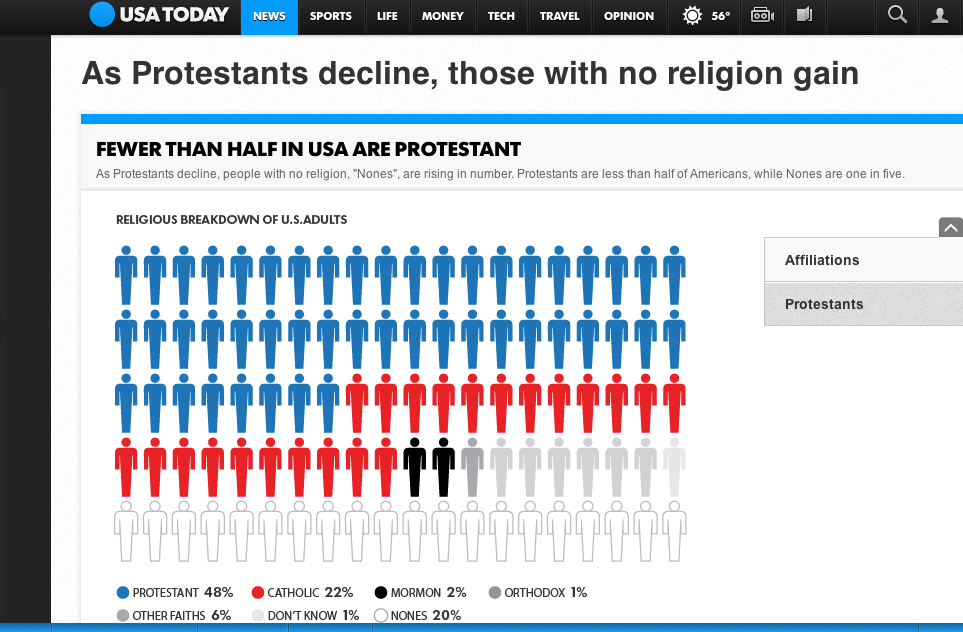
USA Today: More Confirmation That 20-Somethings Are Bailing On the Church.

Money quote: “One in three (32%) are under age 30 and unlikely to age into claiming a religion, says Pew Forum senior researcher Greg Smith. The new study points out that today’s Millennials are more unaffiliated than any young generation ever has been when they were younger.”

Read the article: http://www.usatoday.com/story/news/nation/2012/10/08/nones-protestant-religion-pew/1618445/

Nancy Going, Veteran Youth Minister and leader of Luther Seminary’s youth ministry program who blogs on First Third comments: http://www.firstthird.org/blog/default.aspx?m=3924&post=1378 

Lets just stop pretending that this is not happening and start doing things differently to change it for the next generation- i.e. the kids in our youth group right now!

Life After “Cool Church”? A New Vision for Youth Ministry, Part 1.

One of my assertions in the “cool church” post that went off last week is that the abandonment of the church by twenty-somethings is precisely the outcome that the youth ministry methods we have used the last twenty years should  have been expected to produce.

Many wrote to express the opinion that the problem lies with the “message” in youth ministry. It is too political or too weak or too strong. Since there are churches that have retained their youth whose message has been too strong, some that have had almost no message and some whose message was too off-topic, I do not think the message is the primary issue. I have a different take. As I see it, the issue, for the most part was not the message but the method. Many youth ministry’s had a clear, Christ-centered message and youth leaders that had great friendships with young people. The issue is that we had all of that in the youth room. We never bothered to connect the youth program with the parents and the larger body of Christ meeting in the main sanctuary. We created an affiliation bond with the youth program but not the church

Youth Leaders, pastors and parents, does that resonate with your experience at all?

It took me years to notice the results of what we were doing. I had to see the data to have the “aha!” It is a problem faced by both the parachurch and church youth programs: We created affiliation bonds with us, the church in mission, rather than the church local that would sustain their faith through life if they did not stay with us into leadership.

The data is undeniable: we can preach an uncompromising message, but if we do it ghettoized from the larger church we end up with students who never have a reason to cross the sidewalk into the sanctuary. As the Mormon bishop said in my “Mormon Bishop” post, “We make givers. You make takers.” He was so spot on it made me cringe.

What if instead of doing youth “services” at the same time the adults are meeting, evangelism based on getting students to come to our really cool thing rather than going to them and turning our youth program into Nickelodeon shows with a Jesus message attached – with far too much effort in the light shows and technology that no longer impress kids anyway. What if instead we gave our youth pastors a new job description:

1) Partner in ecumenical evangelism-taking teams of evangelists from our local church to the high school in partnership with the other churches in the community.

2) Train your people called to youth to make them phenomenal discipleship leaders-those ecumenical evangelism ministries are freed to stay in their sweet spot- evangelism, and the church goes back to what we used to be great at: Christ-centered disciple-making.  

3) Resource parents to help parents become the front line of spiritual formation in the home that Deuteronomy 6 and Psalm 78 say they should be.

4) Integrate students into the main service. …Students on the usher list, the music team, hospitality, greeting, reading scripture, leading congregational prayer, giving testimonies…for the right ones, even preaching. 

5) Organize multi-generational “soul friendships” where the older pray for, read the Bible with, and care for students.

6) Participate in multi-generational service projects with students and adults…not just youth leaders, the whole church.

Those things that foster students owning the church as their own. They happen by necessity in the tiny churches without youth programs…the ones who keep their kids at twice the rate of those of us with our expensive programs.

David Kinnaman is brilliant, but “You Lost Me” is about getting back the 20-somethings who left. As Kinnaman says, “We lost them.” They are gone. And we will keep losing more young people by perpetuating our errors on further generations of youth.

Now is the time to make important changes. The evangelical world has 35-50 year olds in church to connect with. In the mainline we have 70-90 year olds. That is a much harder gap to bridge. The evangelical church can start now…or you can wait twenty years until you are where the mainline is today.

Anybody up for a challenge?

Is the way we are doing youth ministry emptying the church?

My “Cool Church” post has become a love it/hate it item on the internet. One critique is that I am simply wrong in the premise students drop out of church when they leave our youth groups.

What does the data say? Back in 2009 Brett Kunkle gave a good summary of what is now undeniable: 7 separate studies say the same thing – Youth abandon the church after high school. http://www.conversantlife.com/theology/how-many-youth-are-leaving-the-church If you doubt him, how about David Kinnaman’s new book about 2o somethings abandoning church, “You Lost Me.”

Youth worker: Cowboy up! We have to face the facts. It is easy to blame the church, the parents, and the culture. But look at the data carefully:

-61% of churched high school students graduate and never go back. (Time Magazine, 2009)

-78%  to 88% of those in youth programs today will leave church. (Lifeway, 2010)

Think about it: All students leave church at 61%. Students in youth programs leave at 78-88%.  Implication: Students attending a church with NOTHING for them attend church at a 50% higher rate in their 20’s than if they went to a church with one of our youth programs!

Youth pastors, we might actually be harming the numbers for churches without youth programs. We are giving our lives to students and it turns out that NOTHING might have been better for their participation in the body of Christ as an adult. If that doesn’t make the hair on your neck stand up then nothing will.

Please hear me: I am NOT saying we should fire youth pastors and disband youth groups. We know from history and common sense that unled things die. I am also not one of those saying that youth ministry is “unbiblical.” Greg Stier wrote a good rationale for why YM is both biblical and vital; http://www.youthministry.com/articles/leadership/defense-youth-ministry.

However, if we have integrity we will look honestly at way students are leaving the church when they leave our ministries. We need to look at…

-The unproductive segregation of youth away from parents, the larger body of Christ and leadership in the main worship service-something most of us who are pastors would never risk because “excellence” would suffer. We need to help our students become participants, “givers” to the community of faith; not just “consumers” of religious services.

What we count. Do you count “decisions”? “Attendance?” When I was on Young Life staff I kept a copy of all of the numbers our national organization gathered from us: clubs, campers, and conversions. I noticed that there was a fourth number that actually accounted for the other three: the number of leaders we had that went into the world of students. I found a ratio in effect: For every leader that would go to the campus to meet students in September, we had 7 students in “club” by December, 4 campers in June and 1.5 “commitments” by July. Our stellar Regional Director, Marty Caldwell, looked at several years of this data and immediately pointed out a truth: We become what we count. We need to count disciples who make disciples. We need to count the right things if we wish to develop the right things.

Our failure to resource parents – the ones God has actually given “our” students to. Two resources: Steve Wright: ReThink and Rob Reinow: Visionary Parenting.

We can do better. We can teach our students to love doing the things Christians have spent 2000 years loving doing: To read the Bible, study it, live it. To love and serve their friends, and talk about their life and their faith…their convictions and even their doubts. We can model for them participating in and building real faith communities. We can build students who know how and why to pray…who worship and walk with God. We can make students who live grace-filled lives towards others and make different decisions for themselves than they would have because they are amazed at God’s goodness and mercy and love for them. There are good resources for this out there. Ken Moser’s, Programs to Go will give you 18 youth group meetings to get you started. http://www.effectiveyouthministry.com/programs-2-go.html. I have a “What we do in a discipleship group” that I can email you.

To quote Paul, there is “a still more excellent way.” It is an ancient way. A rooted way. A connected way. A way that resources parents and makes leaders “soul friends” to students and helps them live lives of faith and love as they walk with God and serve the church and the world.

Big changes take a great deal of courage and effort. But the fruit will be eternal. And that will be so worth it.

Mormon bishop to the Mega-Church: “Thank you!”

“You have no idea what a gift you are to us.”

Several years ago I overheard a conversation in a restaurant that was so provocative I could not help first listening in and then eventually horning in.

It was late on a Sunday morning. In the booth over my left shoulder was a man who said he was a LDS bishop and his friend. They were discussing the service they had just attended at the largest church in Arizona. Fascinated at his viewpoint, and being aware that the Mormon church is still growing while Protestant numbers are waning, I turned around and engaged him in conversation over coffee -mine, not his.

He said, “I think the mega-church will be the best thing to ever happen to the LDS. If that is the best you have to offer, you are in big, big trouble.”

I pointed out, “Tens of thousands are flocking to those types of churches. They seem to be very effective.”

His insights on the mega church stopped me cold:

“They may have a lot of people coming in the front door but they surely will have a big back door with people escaping out. People will eventually want more than they are offering.”

The biggest problems?  He said…

-You make takers. We make givers.

-You are entirely focused on the individual. We focus on building a community.

He then described our churches as market-driven and led by focus groups rather than convictions. He called out two things in particular: Segregating our age groups and catering to people’s preferences.

Segregating: “What are you thinking putting all of the youth in a separate building and not letting the parents in? 16-year old Jenny needs to be sitting next to 80-year old Mrs. Jones in church. When Jenny shows up in her modest clothes, Mrs. Jones tells her, “Good job!” When Mrs. Jones needs help getting groceries out of her car, she calls Jenny. We make communities. You make people whose whims are catered to. What are you doing to actually help families?”

Catering to preference: “And another thing. You do music people like, with bands. We do bad music, sometimes on an out of tune piano, led by a retired music teacher. Our music is weird. It teaches people that they are part of something different from the world.

We make people who give rather than take and who know they are different and are part of a set-apart community. You blur the line between the church and the world. We emphasize it. 

Finally he said, “In thirty years, you guys won’t exist. We will be the only game in town.”

Was he right?

Surely he had very little expectation that the gathering of Christians is to worship the triune God and bring him glory. But does the mega-church? Is there a back door wide-open filled with people inoculated against the very Gospel our mega churches work so hard to communicate? Have we created a cult of the individual rather than a community of givers?

Please do not read my critique as an indictment on motives or on size per se. There are large churches working hard to be about others (see: www.mission68.org). The mega-church people that I know want to honor God and reach people for Jesus Christ. However, I fear we have embraced an ethic of short-term pragmatism. The mega-church has embraced a biblical message divorced from biblical and historically Christian methods. This is dangerous territory.

Next up: Why the “Saddleback movement” works for the over 30 but not those under it. And, Potential ways forward for both the church and the youth program.

What I learned from worshipping with people who aren’t like me…

What I learned from the Black church: If it doesn’t make me want to dance…and shout and speak in unknown tongues and challenge my life it wasn’t church. Church should remind me that, no matter what is in the news or what my problems look like, God is for us not against us. It is the God who lifts up His people we are worshiping.

What I learned from the White church: If it doesn’t make me think and want to know more of God it wasn’t church. I should need a pen to write down something from the Scriptures and have an insight to apply to my life and want to share with friends…it is the God who revealed himself through His word and in the narrative of creation, fall, redemption, and homecoming we are worshiping.

What I learned from the Latino church: If it doesn’t make me use my entire body it wasn’t church. I should be called to his sacrifice on my knees with hands outstretched to receive. I should remember that God is both bigger than my brain yet as simple to appropriate as “Take. Eat. This is my body…” It is the God who is unspeakably huge and holy, yet intimately incarnate with us we are worshiping.

I could go to church with people who all look like me, but my spiritual life would be infinitely more bland if I did.

Mark DeYmaz of the Mosaic network tells us that 92% of American Protestants worship mono-ethnically. My neighborhood doesn’t look like that, so we started a multi-ethnic church plant several years ago. It is a tiny underfunded experiment in what we call “Black-catholi-gelicalism.” Lots of holy things happen among us every week. http://www.mystjudes.com

*No disrespect intended toward groups not included. In my neighborhood people under 35 are: 15% African American, 33% Anglo, 55% Latino, 7% all others.

Guest Blogger Followup: Owen Anderson, ASU Philosophy Professor

(Owen is a long-time friend, a former youth group kid who stayed committed to the church through his 20’s, and is a very smart guy…he just arrived home from presenting a paper on Charles Hodge at the 200th anniversary of Princeton.)


Hi Matt,

I greatly appreciated your blog and identification of the problem.  I have one item to add to your list, and a thought to add to an item already on your list:

The Biblical Worldview:  The Biblical Worldview teaches the themes of creation, fall, and redemption.  This teaches the reality of God the creator, that the creation was made very good, that sin is not seeking, not understanding, and not dong what is right, that death entered the world after sin, and that redemption is given through an atoning sacrifice.  We see these themes from Genesis 1 to the end of the Bible.  Getting this foundation in place in the lives of believers allows them to go on and bear fruit.  It shifts the focus from mere converts to making disciples, and from otherworldliness to the glory of God.

McDonaldization:  If we have the glory of God as our focus, and are grounded in the Biblical Worldview, this will take us a long way from self-centered “worship.”  One way this happens is in the use of divinely inspired songs in public worship.  The book of Psalms covers all aspects of a believer’s life before God.  However, this book is generally ignored or used very sparingly.  Rather than choosing songs based on how they make us feel, the Psalms re-orient our thinking so that we learn a more God-centered piety.  Like the McDonalds example, songs that make us feel good for a short time but have no nutritional content are unhealthy.  The focus is on how we feel, not in the truths we are singing about God and the Christian life.  While many songs contain either actual falsehoods or are very simple in what they express, no one can make this charge about the Psalms.

What’s so uncool about cool churches?

Unintended Consequences: How the “relevant” church and segregating youth is killing Christianity.

I recently spent six-months doing a rotation as a hospital chaplain. One day I received a page (Yes, hospitals actually still use pagers). Chaplains are generally called to the rooms of people who look ill: People gray with kidney disease, or yellow with liver failure, discouraged amputees, nervous cancer patients. In this room, however, was a strikingly attractive 23 year-old young lady sitting up cheerfully in the hospital bed, holding her infant daughter and chatting with family and friends.

Confused, I stepped outside and asked her nurse, “Why did I get paged to her room?”

“Oh, she looks fabulous. She also feels great and is asking to go home,” the nurse said.

“…And you are calling me because?” I asked in confusion.

The nurse looked me directly in the eye and said: “Because we will be disconnecting her from life support in three days and you will be doing her funeral in four.”

The young lady had taken too much Tylenol. She looked and acted fine. She even felt fine, but she was in full-blown liver failure. She was dying and couldn’t bring herself to accept the diagnosis.

Today I have the sense that we are at the same place in the church. The church may look healthy on the outside, but it has swallowed the fatal pills. The evidence is stacking up: the church is dying and, for the most part, we are refusing the diagnosis.

What evidence? Take a gander at these two shocking items:

1. 20-30 year olds attend church at 1/2 the rate of their parents and ¼ the rate of their grandparents. Think about the implication for those of us in youth ministry: Thousands of us have invested our lives in reproducing faith in the next generation and the group we were tasked with reaching left the church when they left us.

2. 61% of churched high school students graduate and never go back! (Time Magazine, 2009) Even worse: 78%  to 88% of those in youth programs today will leave church, most to never return. (Lifeway, 2010) Please read those last two statistics again. Ask yourself why attending a church with nothing seems to be more effective at retaining youth than our youth programs.

We look at our youth group now and we feel good. But the youth group of today is the church of tomorrow, and study after study after study suggests that what we are building for the future is…

…empty churches.

We build big groups and count “decisions for Christ,” but the Great Commission is not to get kids to make decisions for Jesus but to make disciples for Him. We all want to make Christians for life, not just for high school. We have invested heavily in youth ministry with our lives specifically in order engage youth in the church. Why do we have such a low return on our investment?

What are we doing in our Youth Ministries that might be making people less likely to attend church as an adult?

What is the “pill” we have overdosed on? I believe it is “preference.” We have embraced the idea of market-driven youth ministry. Unfortunately, giving people what they “prefer” is a road, that once you go down it, has no end. Tim Elmore in his 2010 book entitled Generation iY calls this “the overindulged Generation.” They ask for more and more, and we give it to them. And more and more the power of God is substituted for market-driven experience. In an effort to give people something “attractive” and “relevant” we embraced novel new methods in youth ministry, that 20 years later are having a powerful shaping effect on the entire church. Here are the marks of being market-driven; Which are hallmarks of your ministry?

  1. Segregation. We bought into the idea that youth should be segregated from the family and the rest of the church. It started with youth rooms, and then we moved to “youth services.” We ghettoized our children! (After all, we are cooler than the older people in “big church”. And parents? Who wants their parents in their youth group?) Be honest: Have you ever thought you know more than your your student’s parents? Have you ever thought your youth group was cooler than “big church”?
  2. Big = effective. Big is (by definition) program driven: Less personal, lower commitment; a cultural and social thing as much as a spiritual thing. Are those the values that we actually hold?
  3. More programs attended = stronger disciples. The inventers of this idea, Willow Creek, in suburban Chicago, publically repudiated this several years ago. They discovered that there was no correlation between the number of meetings attended and people’s spiritual maturity. They learned the lesson. Will we?
  4. Christian replacementism. We developed a Christian version of everything the world offers: Christian bands, novels, schools, soccer leagues, t-shirts. We created the perfect Christian bubble.
  5. Cultural “relevance” over transformation.We imitated our culture’s most successful gathering places in an effort to be “relevant.” Reflect on the Sunday “experience” at most Big-box churches:
    1. Concert hall (worship)
    2. Comedy club (sermon)
    3. Coffee house (foyer)

And what about Transformation? Is that not missing from these models? Where is a sense of the holy?

6. Professionalization. If we do know an unbeliever, we don’t need to share Christ with them, we have pastors to do that. We invite them to something… to an “inviter” event… we invite them to our “Christian” subculture.

7. “McDonald’s-ization” vs. Contextualization:  It is no longer our own vision and passion. We purchase it as a package from today’s biggest going mega-church. It is almost like a “franchise fee” from Saddleback or The Resurgence.

8. Attractional over missional. When our greatest value is butts in pews we embrace attractional models. Rather than embrace Paul’s Ephesians 4 model in which ministry gifts are given by God to “equip the saints” we have developed a top-down hierarchy aimed at filling buildings. This leaves us with Sunday “church” an experience for the unchurched, with God-centered worship of the Almighty relegated to the periphery and leading of the body of Christ to greater spiritual power and sanctification to untrained small group leaders.

Does not all of this work together as a package to leave us with churches full of empty people?

Here is an example: Your church. Does it look like this?

If you look closely, you will see the photo on the right is of a nightclub, rather than a church. Can you see what I mean about “relevance” and the clean Christian version of what the world offers? Your youth room is a pretty good indicator of what your church will look like 15 years from now. Because of the principle “What you win them with, you win them to,” your students today will expect their adult church to look like your youth room.

In summary, “Market Driven” youth ministry gave students a youth group that looks like them, does activities they prefer, sings songs they like, and preaches on subjects they are interested in. It is a ministry of preference. And, with their feet, young adults are saying…

…“Bye-bye.”

What might we do instead? The opposite of giving people what they want is to give them what they need. The beauty is that Christianity already knows how to do this.

Once upon a time our faith thrived in a non-Christian empire. It took less than 300 years for 11 scared dudes to take over the most powerful empire the world had ever seen. How did they do it? Where we have opted for a relevant, homogenously grouped, segregated, attractional professionalized model; the early church did it with a  multi-ethnic, multi-social class, seeker INsensitive church. Worship was filled with sacrament and symbol. It engaged the believing community in the Christian narrative. This worship was so God-directed and insider-shaping that in the early church non-Christians were asked to leave the building before communion! With what effect? From that fellowship of the transformed, the church went out to the highways and byways loving and serving the least, last and lost. In that body of Christ, Christians shared their faith with Romans 1:16 boldness, served the poor with abandon, fed widows and took orphans into their homes. The world noticed. We went to them in love rather than invited them to our event.

The beauty of where we are today is that, unlike the girl in the hospital bed, our fatal pill could still be rejected. It is not too late. We can leave the culture-centered models we have been following for more Christ-centered ones. More ancient ones. More rooted ones. And the most beautiful thing is that students actually enjoy them.

So many have commented on this post in the last month that I did a follow-up: O Yeah! And other things I wish I would have said on “Cool Church.”