Holy Week for Newbies

With Holy Week fast approaching I wanted to repost this as an invitation to my friends…

Matt Marino's avatarthe gospel side

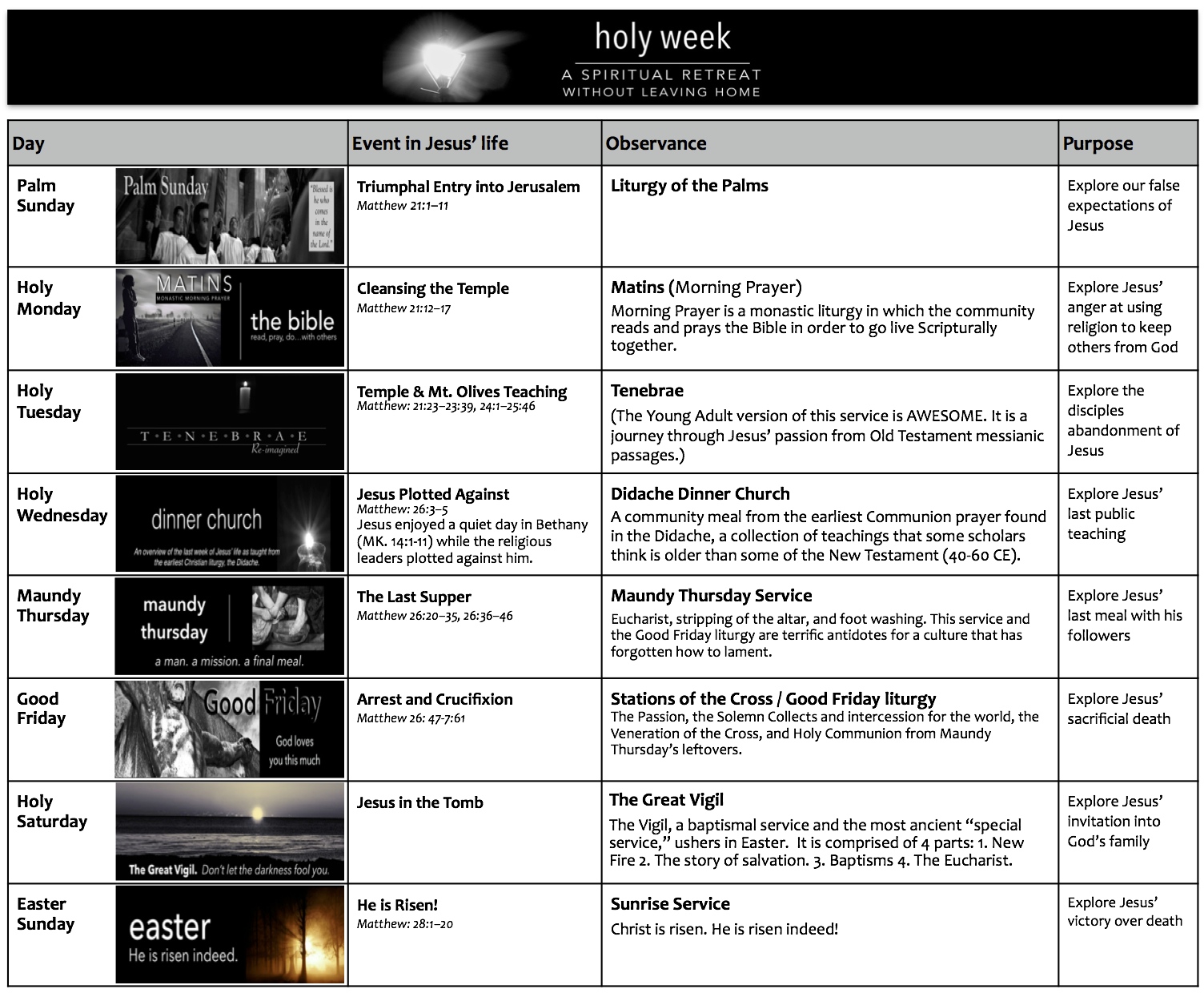
Holy Week.001

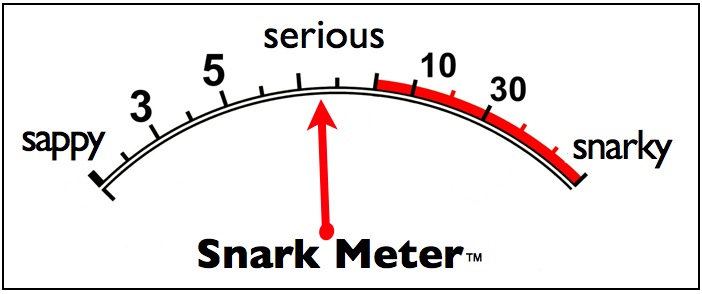
Snark Meter.005

A primer for those wondering what all the hubbub is about.

Holy Week, in a nutshell, is a spiritual retreat without leaving home. Remember summer youth camp? You had an authentic, transformative experience of God in a group of others having the same experience. You came home connected to those people and God in a new way. You thought, “That was fantastic. I am different and I can hardly wait to come back next year.” Holy Week is a lot like that.

Holy Week is series of liturgical experiences that walk us through the final week of Jesus’ life. We journey with Jesus, in the short span of a week, from His triumphal entry into Jerusalem, to the missing guard unit, neatly rolled grave clothes, and the shocking appearance of a risen Savior. In a symbol and story impoverished culture, Holy Week opens our hearts to the gift of Jesus’ victory over sin and death. This is more than a psychological…

View original post 621 more words

Holy Week for Newbies

Holy Week.001

Snark Meter.005

A primer for those wondering what all the hubbub is about.

Holy Week, in a nutshell, is a spiritual retreat without leaving home. Remember summer youth camp? You had an authentic, transformative experience of God in a group of others having the same experience. You came home connected to those people and God in a new way. You thought, “That was fantastic. I am different and I can hardly wait to come back next year.” Holy Week is a lot like that.

Holy Week is series of liturgical experiences that walk us through the final week of Jesus’ life. We journey with Jesus, in the short span of a week, from His triumphal entry into Jerusalem, to the missing guard unit, neatly rolled grave clothes, and the shocking appearance of a risen Savior. In a symbol and story impoverished culture, Holy Week opens our hearts to the gift of Jesus’ victory over sin and death. This is more than a psychological remembrance, it is actively allowing ourselves to be in that final week, baptized (immersed) into his death…”Do you not know that all of us who have been baptized into Christ Jesus were baptized into his death? …in order that, just as Christ was raised from the dead by the glory of the Father, we too might walk in newness of life.”  (Romans 6:3-4)

Holy Week is sacramental

…and we are sacramental creatures. Regardless of any initial reaction you may have to that word, hear me out. A sacrament is a tangible symbol that creates what it signifies. Like kissing. When you first kissed that special someone on the doorstep at the end of the evening, it did more than represent thinking the girl was pretty and nice and that you enjoyed talking with her. It actually created and amplified those feelings. You walked back to your car more emotionally connected to her than you were when you opened her door a brief moment earlier.  And when her front door clicked shut, you fist pumped the air. “Heck, Yeah!” Because that kiss actually made more of what it signified.

So God gave us, fleshly, sacramental, critters that we are, a God who came in flesh. Who lived. Who breathed. Who touched us and was touched by us. Who walked willingly to a criminal’s cross, laid down, spread his arms wide for humanity, and waited for real nails to pierce his hands and feet. It is because you too are flesh and blood that you should engage in Holy Week…because Holy Week creates what it signifies: “That I may know Him and the power of His resurrection and the fellowship of His sufferings, being conformed to His death; in order that I may attain to the resurrection from the dead.” (Phil 3:10)

A current reality

The ancient prayers point us to the deep mystery in this: It isn’t “Christ rose.” It is “Christ is risen!” Holy Week is a current reality. A more real reality. So we do more than meditate on these holy mysteries. We allow them to become true within us, as our baptism is true within us. We join him on Maundy Thursday in His Last Supper. We are with him on Friday in His death. We keep prayerful watch before His tomb on Saturday. With growing anticipation we mark His descent into Hades and His trampling of death by His death. Finally, with shouts of joy, we greet His resurrection on Sunday morning, knowing that one day it will be our resurrection too. In Holy Week, as Orthodox priest Fr. Steven Freeman says, “The life to come becomes the life we live.”

A “deep mystery,” it should be said, is not magic. We must surrender to the prayers and liturgy – faith must be lived. In the end, Holy Week isn’t something we do. It is something that does us.

So what is the hubbub?

Holy Week is more than an emotionally powerful experience. It is an opportunity for a greater sanctification. As Paul said, “Now if we have died with Christ, we believe that we will also live with him.” (Romans 6:8) Or, as an Arnold Swarzenegger character once said, “Come with me if you want to live.”

Do yourself a favor, make time to engage in Holy Week, especially the three-day “Triduum”: The despair of Golgotha on Good Friday, the muted sorrow of Saturday, the joyful Baptisms at Saturday’s Great Vigil, and the surprise of a risen Savior on Easter morning.

Almighty God, who through your only‑begotten Son Jesus Christ, overcame death and opened to us the gate of everlasting life: Grant that we, who celebrate with joy the day of the Lord’s resurrection, may be raised from the death of sin by your life‑giving Spirit; through Jesus Christ our Lord, who lives and reigns with you and the Holy Spirit, one God, now and for ever.  Amen.

Holy Week Sched 2014 Blog

Celebrity Jeopardy, Pastor’s Edition

Celebrity Jeopardy.001

Snark MeterHIGH.001

It is a game we find endlessly entertaining. It pays lavish cash gifts to the contestants – celebrity pastors long on speaking gifts and ego. Part of the appeal is that the game appears unscripted. In reality it is anything but: First come video-venue multi-sites…necessary because “our man” is “da man.” Then book deals complete with manipulated sales. 16,000′ homes? Of course. “An ox is worthy of its hire.” – That’s biblical. Financial transparency? Not in this game, Alex. And, as celebrity stature grows, church boards are re-filled, not with parishioners, but with the pastors of other megachurches. The final page of the script is to re-brand oneself from pastor to CEO. After all, a pastor can’t take three quarters of a million in “winnings” each year. For the IRS, however, “What is a CEO?” is the answer in the form of a question for the ambitious pastor.

Last summer, in a post entitled “When did evangelicals get popes?” I pointed out the ironic similarities between celebrity video-venue preachers and the papacy that Protestantism rose in protest against. Extending the irony has been Pope Francis’ humility this year in contrast to the growing list of celebrity pastor abuses…

This new generation of celebrity preachers do not disclose salaries. They play shady games with parishioner money. They plagiarize while exhorting others not to. They shamelessly teach even children to idolize them. They bully those who would question their bad behavior. This game turns people from parishioners to Svengali following fans and renders the faith foolishness to an increasingly unchurched culture.

Yes, any public figure draws criticism, and envy is an ever present human problem. However, when you have harmed so many through your teaching and lack of financial accountability that former staff and parishioners set up websites to warn others of you, perhaps it is time for us to change channels?

I am told that I should lay off – that celebrity turnstile church pastors are “making Jesus famous”? I say they are making themselves famous, Alex. Not to mention fabulously wealthy. And when someone viewing at home grumbles we are told by the studio audience that their success validates their ministry and that we should not dare to “raise a hand against God’s anointed” (1 Sam. 26:11).

I have also been told that this is a Philippians 1 issue of “whether their motives are false or genuine, the message about Christ is being preached…so I rejoice.” That, however, is Paul saying, “It doesn’t matter what happens to me.” This is much different. This is not a leader sacrificing his wellbeing for the extension of God’s Kingdom, it the systematic fleecing of the flock by celebrity CEOs. A more appropriate scripture would be the condemnation awaiting careless teachers (James 3:1).

I have my own answer in the form of a question: Did Jesus ask to be made famous or followed?

Like celebrity obsessed groupies, the flock willingly participates in their fleecing. They arrive at video-venues by the minivan full. Then stare like pre-teen girls waiting for a pay-per-view performance of “the Biebs” as they wait for the screen to tune in from across the continent…victims of sophisticated manipulations, emotionally steered to avoid the obvious questions.

Contestant: “I will take “idol worship” for $200, Alex?”

Host: “A big lie, a big secret, and a big bully.”

Contestant: “What are Mark Driscoll’s, Steven Furtick’s, and Perry Noble’s books, salary, and treatment of their critics?”

There are tens of thousands of humble servants of God ascending pulpits and standing behind the table of the Lord every Sunday in churches small, large, mega and super-mega. Do your soul a favor, instead of being a consumer of the “show,” join one those humble folk in their humble work. Be a part of something that exercises financially transparency. Give your time, talent and treasure to a community that is about serving and reaching the world rather than the pastor. Your faith life should contribute to more than the Nielson ratings and “winnings” of the latest celebrity “CEO.”

Cut to theme music while contestants appear to be thoughtfully crafting their latest scripted answers.

How long will we remain glued to this show? Because the kingdom of God is not a game.

A parent shares an unlikely secret to raising great teens

Studio Portrait Of Five Teenage Friends Standing In Line

Snark MeterrealMID.003

Do you have kids in those really enjoyable third through sixth grade years? If so, you are probably a bit nervous about the teen years you know are looming around the corner.

I am the parent of two teens…at least until my daughter turns twenty next month. For the most part, our kids thrived through high school. And without arresting beauty, stellar brains, or athletic prowess, our kids were both voted president of their classes all through their high school years and were pursued by quality universities…including my son being invited to the Naval Academy’s summer program. Our parenting secret? While my friends pushed their kids to learn second languages, play on club teams, and take etiquette courses, we charted another parenting course. We involved our kids in an innovative program for youth. A program that data told us is linked to:

  • Dramatically reduced rebelliousness and risk of committing a crime
  • Increased participation in high school
  • Lowered rate of premarital sex
  • Reduction in binge drinking in high school and college
  • Improved academic performance in high school and college
  • Improved odds of saying they have a “very happy life” as an adult
  • And is even linked to an 8 year increase in life expectancy!

What is the activity that gives parents these outcomes we want for our kids?

The answer may surprise you. It is active participation in a local church. No, I’m not kidding. The data comes from sources such as the Center from Disease Control, Indiana, Michigan and Duke Universities, and the Barna Research Group. The caveat, the student has to be “deeply involved” in the church. According to the National Survey of Youth and Religion, “occasional attendees” have virtually no behavioral difference from non-attenders. Research indicates that regular church participation is associated with a decrease in every risky behavior that parents want their children to avoid and an increase in the behaviors that parents want to encourage.

Sometimes it is an issue of not seeing the forest for the trees. What we really want for our kids isn’t to be a great soccer player or to have a specific friend group. What we really want for our children is to have a great life. We see those other things as means to the end of becoming great human beings; self-sufficient and making a contribution to the world we leave them. The church is your number one support in your deepest yearnings for your kids.

Which brings us back to my kids: Although I am a picky parent, I genuinely like and respect the people my kids have become. I am proud of the decisions they make and the motives behind them. I am proud of how they carry themselves, a strong young woman and young man who stick up for underdogs, refuse to push others around or allow others to push them around. They are kind. They work hard. They serve others. They have stuck to their sexual purity guns. They are deep and fun. They, especially my daughter, are admirably resilient. They are viewed as leaders by their peers.

Why does it work?

To a great degree the people they have become is the result of a deeply committed walk with God. And a deeply committed faith is almost always the fruit of deep commitment to a local faith community. Regardless of what you personally think of Christian commitment, a deeply committed faith is a gift that, unlike participation in a club team, will keep giving to your child over the arc of their life.

What is the secret sauce?

Deep immersion in a church almost always includes a relationship with an older Christian mentor, aka, a youth worker. Youth workers reinforce parent’s messages from home. They do this as an influential voice a step or two older and wiser than their peers. Youth workers are role models and visible pictures of what positive choices gain one in life. They are a gift to parents that cannot be under-estimated.

As a parent, you and I have more to do with our teen’s success than anything or anyone in their lives. One of the best things we did to leverage that parental influence was to involve them in the church. At church, great young adults who love God, loved my kids. These young people, both church workers and Young Life leaders, helped my kids have a bigger vision for their lives. They helped my kids see their gifts, gave them opportunities for leadership and encouraged them to develop those gifts. Malcolm Gladwell in his book “Outliers” tells us that highly successful people are the first ones to 10,000 hours in an activity. In a good church, leaders will spend a great amount of time teaching your child to serve others, speak in public, develop and articulate deeply held beliefs, discover musical gifts they didn’t know they have, and develop social skills that will bless them the rest of their lives. They will be busier, without a doubt, but they will develop new capacities, and the life skills that they need most for future life-success. And our kids are not unique in this. The kids in our small mission church’s youth program are a virtual Who’s Who of the student leaders in the four neighborhood high schools they attend.

So parents, take your kids to church. Get involved. Get your kids involved. In the end, it will do far more for them than the soccer league you miss on Sunday mornings. I promise.

Is Lent really 40 days long?

Father Brench in New England offers a nice tutorial on why Lent lasts 46 days, but even more, why a cycle of introspection is a spiritually helpful interruption to our usual praise-dominated worship.

For an idea of how biblical this is, take an afternoon and read all 150 songs in the Jewish hymnal (the Psalms) in one sitting. You will be amazed at how many would not be included in a modern hymnal as unsuitable for public worship.

Fr. Brench's avatarLeorningcnihtes boc

Every now and then someone goes through a calendar and counts the days in Lent and is shocked and annoyed (or at least confused) to discover that Lent is actually 46 days long.  (It’s six full weeks, which is 42 days, plus the days of Ash Wednesday through Saturday adds 4 more to make 46.)

Hey!  What gives?  Is this a conspiracy by the Church to trick people into a 40-day season of discipline when secretly it’s really 46, and we’ve just been tricked because we almost never bother to count?

The answer is going to sound a little weird to those who are not used to the tradition of the Church, but bear with me.  Lent is 46 days long as a season, but it’s only a 40-day fast.  How is this possible?  Because Sundays don’t count.

So, what, does this mean that Lent is a manic depressive season:…

View original post 826 more words

Game on. A sermon for Ash Wednesday

sermon

Snark MeterrealMID.003

Here is my Ash Wednesday sermon…not because I am convinced of it’s internet worthiness, but because friends have asked me to share it since I posted on the topic twice this week. 

Scripture: Joel 2:1-2, 12-17 •  Psalm 51:1-17  •  2 Corinthians 5:20b-6:10  •  Matthew 6:1-6, 16-21

Welcome to Spring Training! 

That is what Lent is: Spring Training for the Christian life.  You know Spring Training. It’s where players:

– Find out what they’ve got.

– Learn new skills.

– Figure out what they still need to work on.

Today, Ash Wednesday, is Opening Day.

Now that you are in the ballpark we are going to spend the next 40 disciplined days getting ready for the regular season- life.

I am not a baseball guy. I don’t know much about the game. But one thing I do know is that the person who throws out the first pitch is generally a pretty bad baseball player. Have you ever seen a first pitch? Sometimes it goes into the stands. Sometimes it drops off of the pitcher’s hand and rolls to a stop halfway to the plate.  It us usually thrown out by some famous non-baseballer: an elderly ex-Senator, an opera singer, or a guy who made millions inventing the home latte maker.

Unfortunately, our first liturgical “pitch” on Ash Wednesday, like most first pitches, is a bit off kilter. You should probably know that I am a HUGE prayer book fan. So much so that I am accused of having a crush on all things Anglican. My evangelical friends are adamant that I am a non-objective shill for the Episcopal Church. I can’t help it though. The wisdom and care and catholicity of our prayer book is legendary. But, in an effort to prove them wrong, I have scoured the prayer book and found two things that I wish were not there: One of them is the opening prayer from tonight’s service. I suspect that whoever wrote the opening prayer for Ash Wednesday must be famous – It’s that bad. The theology umpire in me calls, “Foul.”

Here it is again: “Almighty and everlasting God, you hate nothing you have made (We are looking good through the windup) and forgive the sins of all who are penitent: (still not bad) Create and make in us new and contrite hearts, that we, worthily lamenting our sins (Oops. Problems on the release.) and acknowledging our wretchedness, may obtain of you, the God of all mercy, perfect remission and forgiveness;  (And the ball is in the dirt.)

The idea that we are somehow “worthy” in our lamenting or forgiven BECAUSE we are penitent is a theological “Swing and a miss.” We are not rendered worthy through our repentance and we aren’t forgiven through a perfected penitence. That prayer makes it sound as if we are cute and cuddly- as if God is lucky to have such holy creatures as us on his team.

The truth is that we are forgiven because God is so forgiving. It is God’s nature to reconcile fallen humans to himself. It is God’s nature to make all things right…satisfying both his holiness and love in Jesus Christ and giving a new nature freely to humans. It is our nature to jack things up. Give me a relationship: I’ll mess that up. Children: I’ll mess them up. A political system: Oops. A planet: Our track record there isn’t so good either.

Forgiveness, you see, is given not earned… given to humans at the Father’s initiation and the Son’s expense…and that we are drawn to by the Holy Spirit’s wooing – The entirety of the trinity is involved in human salvation. Given the mess we have made of things, the basis for our forgiveness can hardly be our penitence.

We ARE forgiven because we WERE forgiven…on Calvary. That forgiveness was proven three days later as a risen Lord strode from the mouth of an empty tomb. And that is why we are penitent: We have seen the great acts of God on our behalf and we walk in gratitude of God’s love lavished upon us. Obedience is the response to God’s favor, not the price of it. God’s provision provokes our response.

And so, in anticipation of celebrating those holy mysteries at Easter, we begin tonight Lenten disciplines, either giving up something that we enjoy and/or taking on a new spiritual activity: self-denial and self-discipline to remind us of the greatness of our God.

Luckily our liturgy pivots rapidly from the off target opening pitch as we move quickly to the Old Testament prophet Joel. Joel reminds us that God has a right to be ticked at our forgetfulness of God. Joel asks us to “rend our hearts and not our garments.”  God desires an internal brokenness – for brokenness allows God’s love to seep through the cracks in our hard outer shells of self-reliance and transform us from the inside out.

Then we have Psalm 103 in which, just as a good dad “has compassion on his children, so the Lord has compassion on those who fear him – he remembers that we are dust.”   He remembers. Do we?

Then comes our Gospel passage: “Beware of practicing your piety before others.”  Jesus says, in effect, “Don’t trust in your very religious religiosity.”  Can you think of a single time Jesus had something positive to say to those very religious Pharisees who trusted in their religiosity? Neither can I.

Finally, in 2nd Corinthians, chronologically the last of tonight’s passages to be composed, Paul entreats us, “on behalf of Christ, be reconciled to God. For our sake he made him to be sin who knew no sin, so that in him we might become the righteousness of God.”- Paul spells it out: the righteousness of God comes, not from us: It is “of GOD.” The relationship between our repentance and God’s forgiveness is “because of” not “in order to.”

This passage, by the way, is finishing a sentence in which Paul is exhorting the Church, us, to be “Ambassadors for Christ,” bearers of the message of reconciliation…So “You be reconciled,” Paul says, “because for our sake he made (Jesus) to be sin”…the one who had never known sin, “so that” (because of, in order, with the result) “that in Him, we might become the righteousness of God. “

Let that sink in:

-The holy God of creation, whose moral perfection was such that the greatest of his servants, Moses, could only see God’s back as he passed by.

-Whose holiness was so terrifying that, when Moses went up the mountain, the Israelites could only stand at a distance gazing up at that terrifying cloud.

-A God so pure that the ark representing his presence couldn’t be touched with human hands, even to protect it, without them being struck down…

THAT God has declared us to be THAT “righteousness” in his sight.

…and, then, even further, he longs to give us the ministry of reconciling others to his holiness and love.

A high and holy calling awaits us. That is why our humility before God is not just a nice ashy experience for ourselves – We are to be a light to others. We are to increase in love and mercy as we seek Christ. And that increase in love is supposed to be public. Public in order to help to others come to know the love of our Savior, Jesus.

Lent is God calling us deeper into deep – to remold us into the image of his Son and to send us to gather our friends, families, neighbors, and co-workers to his love.

And so we come tonight to be marked outwardly with ashes to remind ourselves inwardly that we are dust.

But we are redeemed dust.  Grateful dust. Dust with a purpose.

And then we will come again to the table with hands outstretched to receive the grace of God anew.

It is a slow process, this becoming like Christ – A long obedience in the same direction. Consuming Jesus and being consumed by him. So, this evening, I exhort you, engage and cooperate. Engage with the prayers. Cooperate with the symbols. Surrender afresh to the Lord of the prayers and symbols, and come, kneel, reach out your hands and receive, and, as the Psalmist said, “taste and see that the Lord is good.”

Game on!

Screen Shot 2014-03-05 at 11.16.47 PM

Ash Wednesday for Newbies

ash-wednesday

Snark Meter.005

Do not be surprised this week when your co-workers and neighbors appear with smudgy foreheads. You will be tempted to grab a Kleenex and help them rub out the vaguely cross-shapen smears. Resist this urge. They have not become hygienically challenged – It is Ash Wednesday!

What is Ash Wednesday?

Ash Wednesday is the first day of Lent. Lent, an archaic word for “spring,” came to refer to a season of spiritual “training” in the Christian year preceding Easter – Sort of a “spring training” for the spiritual life. Christians in the ancient traditions spend the 6 weeks before Holy Week in repentance, almsgiving, and self-denial in an effort to remember the greatness of God at Easter. Ash Wednesday kicks it all off.

Where did it come from?

The tradition of ashes has its roots in the ancient Jewish prophets (“repent in sackcloth and ashes“). Among Christians, the imposition of ashes associated with a 40 day fast began in the 4th century. Most likely this fast was the Lenten fast, but the evidence is a bit spotty. By the end of the 10th century, though, it was a long-standing custom in Western Europe for the faithful to receive ashes on the first day of the Lent. In 1091, Pope Urban II extended the practice to Rome.

What do you do?

If you attend an Ash Wednesday service you will hear Holy Scriptures calling us to repentance read, have ashes imposed on your forehead with the counter-cultural words, “Remember you are dust and to dust you shall return” (Gen 3:19), and then go forward, empty handed, to receive the Lord’s Supper.

Afterward people go forth to spend 40 days in Lenten practices, either giving up something we enjoy and/or taking on a new spiritual activity. Self-denial and self-discipline prepare our hearts to recall the saving acts of Jesus during Holy Week.

Why?

Contrary to common opinion, Ash Wednesday and Lent are not about spiritual brownie points, impressing God, nor  making belated New Year’s resolutions – like dropping that last five pounds by cutting chocolate.  It is instead about mindfulness. When we think about God, well that is a good thing. By the way, Christians are penitent during Lent because we are grateful for God’s provision in his Son, Jesus. We go to church on Ash Wednesday to be marked outwardly with ashes as we remind ourselves inwardly of our need for the unquenchable, fierce love of God to enliven us.

Can I come?

Yes! You can find an Ash Wednesday service at any Episcopal/Anglican or Roman Catholic Church. Services are usually offered multiple times per day. You do not need to be a member. Everyone is welcome. Although in Roman Catholic churches there are requirements for receiving communion, and Episcopal churches ask you to be baptized for communion, everyone can receive ashes.

I invite you, come to church this Ash Wednesday!

Lent: Spring Training for Christians

Lent Spring Training.001
Snark Meter.005

Wednesday is the Opening Day of Spring Training.

“Lent” is the Dutch and archaic English word for “Spring.” It came to refer to the season of spiritual “training” in the Christian year – hence, “Spring Training.” Play along with the analogy for a moment: Spring Training is where baseball players find out what they’ve got, where they learn and experiment with new skills, and where they figure out what they still need to hone for the regular season. Lent is the Church’s 40-day preparation for the regular season-the rest of life.

And Opening Day, Ash Wednesday, is this week.

Spiritual preparation

Lent is a spiritual practice. Spiritual practices, or disciplines prepare and free us, much the way a great hitter’s thousands of swings, day in and day out, give him the freedom to hit pitches a lesser batter wouldn’t dare swing at, or the way the apostle John’s years in prayer wore out his knees but shaped him into the apostle of love. Lenten practices, over time, produce a freedom, and open us for the grace of God to more fully shape and captivate us.

No “brownie points” are given

Contrary to a common opinion, Ash Wednesday and Lent are not about spiritual brownie points, merit-earning, or God impressing. Neither is it a way to make belated New Year’s resolutions – like dropping that last five pounds by cutting chocolate. No human is rendered worthy through repentance. Worry not, theological policeman: ashes, penitence, and Lenten disciplines are not works to earn God’s forgiveness.

Forgiveness is earned

Forgiveness is earned though…just not by us. Forgiveness was earned by God at God’s initiation and God’s expense. We ARE forgiven because we WERE forgiven – on Calvary. Our forgiveness was proven three days later as a risen Lord walked victorious from the mouth of an empty tomb. That is why we are penitent – We have seen the great acts of God on humanity’s behalf. Our efforts are merely “training” in walking in gratitude of that gift.

And so, in anticipation of celebrating anew the Easter event, we spend 40 days in Lenten practices, either giving up something we enjoy and/or taking on a new spiritual activity. Self-denial and self-discipline remind us of the greatness of our God and Savior.

What happens at an Ash Wednesday service?

If you attend an Ash Wednesday service (you can find one at any Episcopal/Anglican or Roman Catholic Church) you will listen to Holy Scriptures calling us to repentance, have ashes imposed on your forehead to remind you, “remember you are dust and to dust you shall return” (Gen 3:19), and then we will go forward, empty handed, to receive the Lord’s Supper.

The tradition of the ashes began as early as the 4th century, associated with a 40 day fast. Most likely this fast was the Lenten fast, but the evidence is spotty. It is clear that by the end of the 10th century it was a longstanding custom in Western Europe for the faithful to receive ashes on the first day of the Lenten fast. In 1091, Pope Urban II extended the tradition to the church in Rome.

The Scripture readings point us toward our need for humility before God. We will read from the prophet Joel who reminds us that God is rightfully upset at our forgetfulness of both him and the least of his creatures. Joel implores us to, “Rend your hearts and not your garments.”  – It is an internal brokenness God desires, for it is through brokenness that God’s love seeps through the cracks of our hard outer shells of self-reliance and idolatry and transforms us from the inside out.

We will also read 2nd Corinthians 5:20b-6:10, in which Paul entreats us “be reconciled to God. For our sake he made him to be sin who knew no sin, so that in him we might become the righteousness of God.” – A righteousness not from us: It is “of God.” This passage begins with the completion of a sentence in which Paul is exhorting the Church to be “Christ’s Ambassadors,” bearers of the message of reconciliation.

Seriously?

Did the gravity of that sink in? The holy Lord of all creation…the God whom the Israelites in the wilderness trembled at a distance as he hid his holiness in a terrifying cloud atop a mountain…the God whose moral perfection and purity was such that Moses could only see God’s back as he passed by…the God whose ark representing his presence couldn’t be touched, even in its defense, without the offender being struck down…THAT holy God makes us to be THAT righteousness in his sight.

…Even more, that same God calls us to the high and holy calling of reconciling other broken humans to himself.

So the reason Christians are penitent at Lent is that our spiritual life isn’t just a nice experience for ourselves. We acknowledge a calling far beyond human reason or human capacity. Our hope is that, by being increased in love and mercy as we pursue Christ, we would be a help to others in their journey toward the Savior. Lent is an opportunity for God to call us deeper into himself and his high and holy purpose of pointing our friends, families, neighbors, and co-workers to the great mercy of the Triune One.

And so we will go to church on Ash Wednesday to be marked outwardly with ashes as we remind ourselves inwardly that, “We are dust.” But we are redeemed dust.  Grateful dust. Dust with a purpose.

Spring Training is upon us!

Come find out what you’ve got. Learn and experiment with new skills. Figure out what you still need to hone. Every once in a while a professional athlete, for one reason or another misses Spring Training. It almost always shows. Would you like to be more serious about your spiritual “game”? Ash Wednesday is a great place to start.

Mean people suck. But that’s not why millennials dropped the church.

angry-man.jpg

Snark Meter Sorta Snarky.002

An open letter to Lead Pastors.

Do you hear that sucking sound? It’s the sound of young adults walking out the back door so fast that you can feel the breeze from the pulpit way down at the front of the sanctuary.

Young adults have always been a bit shaky in their church attendance during college. But then a new trend emerged: They stopped coming back. No one worried much about it at first. But as the return rate continued to plummet, the Millennial abandonment of the church became the stuff that keeps pastors up late at night. Millennials are, after all, the ones whose attractive fresh young faces make people say, “Oh, this place is doing really well!”

A few churches are still doing really well with young adults, of course. But multiple studies, such as this one from Pew Research, show that young adults now attend church at 1/2 the rate of their parents at their age. One in three young adults now characterize themselves as  “nones” – religiously unaffiliated.  If you haven’t noticed your church greying yet: fear not, you will.

What is going on with those Millennials? 

According to the narrative, the church is full of narrow, nasty, fearful, bigots. If you are smart, hip, or have a pulse, you should drop the church like a hot rock for something more helpful to your life…like spending Sunday morning playing games on your iPhone at Starbucks, or puttering in your garden, or just pulling your covers up over your head and grabbing another hour of shuteye.

David Kinnaman, in his interesting book, “You Lost Me,” provides a stark articulation of this meme. His team conducted research with more than 1200 young adults. According to the compelling stories he recounts, young adults dropped out because they found the Church to be:

Shallow, with easy platitudes, proof texting, and formulaic slogans.

-Overprotective and repressive: Sexual mores feel stifling to young adults.

Exclusive. Christian claims to exclusivity are a hard sell in a pluralistic culture.

Doubtless. The church is fearful and dare not risk allowing them to express doubts.

Antiscience.

In other words, the church is mean. 

If you talk to folks between the age of 20 and 35 about the church you have probably heard all of the above statements. However, these don’t necessarily paint a complete picture as to why Millennials left. They tell us why they SAY they left – how they have interpreted their experience. So, although Kinnaman’s book has become the “Bible” on Millennials, there is…

Another piece of the puzzle…

It appeared in last April’s edition of Atlantic Monthly: “Listening to Young Atheists.” Alex Taunton interviewed college students who self-identify as atheists and asked them to “tell the story of your journey into atheism.” What he heard was not what he expected – which always makes my ears perk up. To his surprise, young atheists did not wax eloquent about their intellectual difficulties with Christianity – the anti-science, anti-gay, theologically rigid, “easy believe-ism” stuff we all hear about (apologies to my more progressive friends). Neither did they talk about a desire to engage in sinful, frowned upon by the church, lifestyles (apologies to my more conservative friends). Here is what young atheists told Taunton…

1. They had attended church The number one source of college atheists is, wait for it, Christianity…as it was modeled to them.

2. The mission and message of their churches was vague – rather than too much catechesis, they received too little. They were not given an intellectual frame for their faith.

3. They felt their churches offered superficial answers to life’s difficult questions.

4. They expressed their respect for those ministers who took the Bible seriously.

5. Ages 14-17 were decisive  In the middle of forty years of enormous investment in youth ministry, high school is when atheist millennials embraced their unbelief!

6. The decision to embrace unbelief was often an emotional oneusually involving the loss of a trusted youth leader

Did you notice the seedbed that hatched young atheists? It was specifically a reaction AGAINST their experience of the church. Second, they didn’t become atheists in those evil, conspiratorially faith-stealing secular universities. We lost the Millennials when they were in high school – In our youth groups!

One student said, “Christianity is something that if you really believed it, it would change your life and you would want to change [the lives] of others. I haven’t seen too much of that.”

Our big fail?

“Meanness” is style. And apparently a style fail is the least of our issues. According to atheist millennials, we also have a theology fail, a program fail, and a leader fail. The atheists who grew up in our churches tell us that we didn’t:

1) Model love and authenticity during their critical adolescent years.

2) Disciple them. Not downloading information, but the time-intensive task of walking with them, life on life…teaching them Christian practices in a context of friendship.

3) Catechize: Provide historic answers to the historic questions.

4) Allow them to engage their doubts. Talking through doubts is how one gets through them.

5) Integrate them thoroughly into the life of the church. We gave them a soteriology without an ecclesiology:  A personal Jesus without a Body of Christ. We professionalized student ministry and segregated kids away in youth rooms. We let parents, the older generation, and anyone in the church staff not titled, “youth pastor” off the hook.

Students needed a web of relationships and an affiliation bond with the larger church.

But we shuttled them off into “youth services,” creating in-effect parachurch student ministries on church campuses with trendy grow-out-of-it-when-you-graduate names. And, often, by the time they get back from college, their pastor, the student pastor, is gone as well. In a “youth service” model, Millennials have never been in the sanctuary and don’t know those leading in there either. Add in the fact that the sanctuary reflects a ministry model developed for their parent’s generation and, for many, you have strike three, and the Millennials are walking off the field and hanging up their bats.

6. Give them a mission in the world. The doctrine of creation tells us that we were made on purpose for a high and holy purpose. When they were in high school did we give them something epic to do? Something unreachably heroic that they could only see and do with eyes of faith?

Will we listen to them?

Young adult atheists are telling us that we failed to give them a robust faith in the triune God…a faith they were asking us for. And this isn’t just a problem facing “liberal” or “conservative” churches.  While the Left gave them Social Justice Jesus, the Right gave them a truncated, topical Jesus who promises, “Your Best Life Now.” A Fuller seminary friend told me that in a recent survey of graduating youth group seniors the most common thing students, across denominations, wished they had been given more of in youth group wasn’t games, skits, or worship. It was “Bible Study.”

Lead pastors, you have served your mission field of busy 35-55 year olds nervous about cultural change by giving them practical content from fewer, trusted voices on video-venues. What might missionally engaging students in there changing context look like? After all, like you once said to your senior pastor when you were working with youth, “We cannot expect today’s youth ministry to use the models we designed for a previous generation.”

When you and I started in ministry, students came to the church hungry to be entertained. Today they come expecting a sense of the transcendent. Study after study tells us that Millennials long for spiritual practices, meaningful service in the church, and a mission to the world. They seek peer groups to support their faith. They desire older Christian mentors and multi-generational relationships. They come for Scriptural knowledge and, gasp, theology. They come to learn about the God who made them, redeems them, and has a purpose for the world. They come seeking God’s plan and calling on their lives to do something of true and lasting significance.

Yes, the world changed. But while that change occurred we kept giving them a simple Gospel message with fog machines, light shows, and games in which they stuffed their faces with marshmallows.

So they left. But not when we thought. Not why we thought. And not how we thought.

A way forward?

It should be obvious that what I am pointing toward is not less youth ministry but a redirecting of it toward a more robust form. A form more tied to the greater church. The solution to all of this will involve Lead Pastors – You are the source of vision, direction, permission and covering. Nothing changes without your endorsement. Will you allow your Student Ministry leaders to change your student ministry today so that tomorrow’s students don’t bail too? You were an innovator in reaching your mission field. Will you free your student ministers to innovate to a new generation? We all want Christians for life, not just for high school. Will you unravel programs when the data demonstrates that filling youth services today leads to empty sanctuaries tomorrow? 

The truth is staring us in the face. The stakes are too high to throw away another generation with sincere but ultimately unhelpful youth ministry.

To Donald Miller and anyone else considering dumping church: The church works best when you like it least

starbuckschurchSnark MeterrealMID.003

I do not know Donald Miller. He writes great books though…books I read, recommend, and give away. Miller made a big splash in the blogosphere this week when he posted, “I don’t worship by singing.” In it he confesses that singing is “not his worship language” (I’m with him, it isn’t mine either).  He goes on to admit, “So, do I attend church? Not often, to be honest.” His reasons boil down to: 1) It is not how he learns. 2) It is not how he finds “intimacy with God.”

A Christian thought leader saying that he has “dropped church,” naturally creates a stir. Those ripples became waves yesterday with the followup he posted to clear things up. In that one he goes on to tell everyone why he was right. He said, and I am paraphrasing here, “The church is a mess,” “your reasons for wanting me to attend are rooted in fear,” “there are other ways to connect with God,” and, my personal favorite, “I’m just not feelin’ it.” As someone who disliked church intensely for my first twenty-five years in Christ, I am willing to stipulate that Miller is correct on all of his critiques. I am just not willing to embrace his conclusion.

The interesting part is that, even though Don calls himself a “post-evangelical,” he still thinks of church through the individualistic lens of the modern American turnstile church (not that other views of the church don’t have flaws, they do, just different ones). Basically Miller defines down the purpose of the public gathering for worship as “how I feel” and “what I get out of this?” Every Christian has had those two thoughts, whether spoken aloud or not.

If you have not articulated those thoughts it was because your next thought was, “Gee, that sounds a bit narcissistic.” Creeping narcissism is pretty difficult to avoid in the big-box church. It is, after all, the fruit of the preference based, target audience specific, focus group tested, “Just you and Jesus” message that modern mega-evangelicalism produces (See “What’s so uncool about cool churches“). If church is about “feelings of intimacy” and “getting something out of it,” then Christians would have given up on church 2000 years ago.

I understand the frustration: Constantly reinventing “relevance” leaves us captive to our own experience. It  becomes like a dog chasing its tail. The reason the church has been clung to for 2000 years is that, unlike the much imitated “seeker model” of the last thirty years, Word and Sacrament are not about “getting” or “feeling” but about being conformed to a Jesus-centered pattern set long ago. As Episcopal priest and former baseball coach, Gil Stafford, once said to me, “The liturgy is like a rock falling into a stream. It rubs the rough edges off of us week after week, year after year. It is an infinitely slow and quiet transformation that is about being with other rocks in the stream as the Spirit works through the years, the prayers, the Sacraments and the community of faith.” It is a long obedience in the same direction. It is about consuming Jesus and being consumed by him. And, I am convinced, the church works specifically best when we do not like it! When we choose to engage and to cooperate with the prayers, and surrender to the Lord of the prayers, and come, kneel, reach out our hands and receive, and “taste and see that the Lord is good,” then we truly worship.

Don Miller is a fantastic writer. He has and will continue to produce works that are well worth the investment of our time and money. And everyone with a keyboard writes things we later regret. The most regrettable line in his post was this one, “I literally feel an intimacy with God when I build my company.” Which was literally when I decided to comment. Of course, all men feel a sense of purpose when they are engaged in meaningful labor. It is an inherent part of maleness given in creation (Genesis 2). That an author with as much wisdom as Don Miller has shown in his books doesn’t see the idolatrous leanings in that statement, is a big yellow warning sign that he has been out of church just a little too long.

Our relationship with the Church should not be about feelings (even if we are feeling creatures), or learning (although learning is nice), or other people, or avoiding spiritual shipwreck. It should be because the Redeeming Lord of all Creation has used the pattern of Word and Sacrament to call out and shape a remnant into his image to participate with him in the redemption of the world.

It is an odd thing we Christians of the Great Tradition (Catholic, Orthodox, Anglican, many Lutherans) do on Sundays. Oddly dressed people stand before us in garments that seem to say, “I have so lashed my life to the mast of word and sacrament that I am willing to dress like an idiot and drape myself with even more foolishness.” One of these awkwardly attired souls stands up and joyfully announces a message out of place and thoroughly irrelevant to a culture obsessed with its own relevance: “Blessed be God: Father, Son and Holy Spirit.” This opening acclamation declares that we have entered another realm, one in which our culture and our preferences are not the measure of our meaning. The congregation responds hopefully, “And blessed be God’s kingdom, now and for ever.” It is a bit of wisdom that we might never come to on our own…that we get through the collective wisdom of the Church, the body of Christ, across space and back through time.

Like Don Miller, I too would like the church to be something I might find meaningful.  The liturgy, developed over two thousand years, and assembled by worshippers who did not fit within their own cultures, makes no such attempt. It is simply about God. And not about the God-who-fulfills-all-my-desires, but about the one who is God-as-he-is-not-as-I-would-like-him-to-be. Every word of the liturgy is about God’s blessedness, not ours. In the words of Mark Galli, “The liturgy immediately signals that our needs are not as relevant as we imagine. There is something infinitely more worthy of our attention-something, someone who lies outside the self.”

The ancient prayers go deep into our pre-rational selves, into our subconscious and mythic selves and transforms our all. As we learn to cooperate with God, the prayers honor and respect and take us. They lift us beyond ourselves to, as friend and priest Jim Clark says, “The Ultimate Mystery who is more than my experience, but who is also in my experience.” As we cooperate, God lifts and transforms our beings, imparting the Gracegiver until every aspect of our being is transformed. In the end, church isn’t about feeling differently or learning stuff. It is about being changed through Sacramental rhythm. And that only happens through time and repetition. Which is why you can’t get it at your company, while hiking, or in Starbucks.

All of which is to say, “Donald, Please come back.”