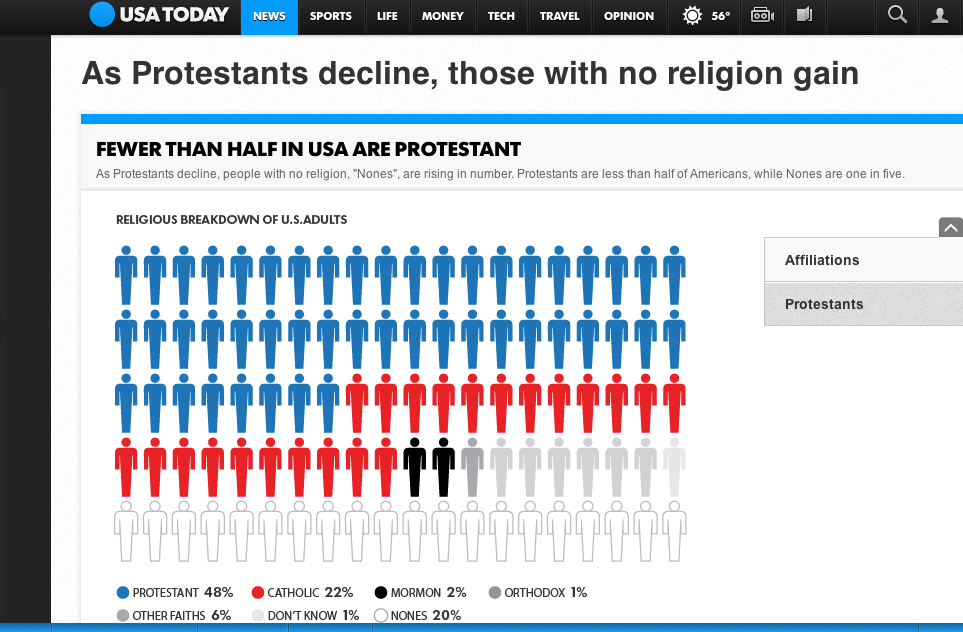
USA Today: More Confirmation That 20-Somethings Are Bailing On the Church.

Money quote: “One in three (32%) are under age 30 and unlikely to age into claiming a religion, says Pew Forum senior researcher Greg Smith. The new study points out that today’s Millennials are more unaffiliated than any young generation ever has been when they were younger.”

Read the article: http://www.usatoday.com/story/news/nation/2012/10/08/nones-protestant-religion-pew/1618445/

Nancy Going, Veteran Youth Minister and leader of Luther Seminary’s youth ministry program who blogs on First Third comments: http://www.firstthird.org/blog/default.aspx?m=3924&post=1378 

Lets just stop pretending that this is not happening and start doing things differently to change it for the next generation- i.e. the kids in our youth group right now!

Life After “Cool Church”? A New Vision for Youth Ministry, Part 1.

One of my assertions in the “cool church” post that went off last week is that the abandonment of the church by twenty-somethings is precisely the outcome that the youth ministry methods we have used the last twenty years should  have been expected to produce.

Many wrote to express the opinion that the problem lies with the “message” in youth ministry. It is too political or too weak or too strong. Since there are churches that have retained their youth whose message has been too strong, some that have had almost no message and some whose message was too off-topic, I do not think the message is the primary issue. I have a different take. As I see it, the issue, for the most part was not the message but the method. Many youth ministry’s had a clear, Christ-centered message and youth leaders that had great friendships with young people. The issue is that we had all of that in the youth room. We never bothered to connect the youth program with the parents and the larger body of Christ meeting in the main sanctuary. We created an affiliation bond with the youth program but not the church

Youth Leaders, pastors and parents, does that resonate with your experience at all?

It took me years to notice the results of what we were doing. I had to see the data to have the “aha!” It is a problem faced by both the parachurch and church youth programs: We created affiliation bonds with us, the church in mission, rather than the church local that would sustain their faith through life if they did not stay with us into leadership.

The data is undeniable: we can preach an uncompromising message, but if we do it ghettoized from the larger church we end up with students who never have a reason to cross the sidewalk into the sanctuary. As the Mormon bishop said in my “Mormon Bishop” post, “We make givers. You make takers.” He was so spot on it made me cringe.

What if instead of doing youth “services” at the same time the adults are meeting, evangelism based on getting students to come to our really cool thing rather than going to them and turning our youth program into Nickelodeon shows with a Jesus message attached – with far too much effort in the light shows and technology that no longer impress kids anyway. What if instead we gave our youth pastors a new job description:

1) Partner in ecumenical evangelism-taking teams of evangelists from our local church to the high school in partnership with the other churches in the community.

2) Train your people called to youth to make them phenomenal discipleship leaders-those ecumenical evangelism ministries are freed to stay in their sweet spot- evangelism, and the church goes back to what we used to be great at: Christ-centered disciple-making.  

3) Resource parents to help parents become the front line of spiritual formation in the home that Deuteronomy 6 and Psalm 78 say they should be.

4) Integrate students into the main service. …Students on the usher list, the music team, hospitality, greeting, reading scripture, leading congregational prayer, giving testimonies…for the right ones, even preaching. 

5) Organize multi-generational “soul friendships” where the older pray for, read the Bible with, and care for students.

6) Participate in multi-generational service projects with students and adults…not just youth leaders, the whole church.

Those things that foster students owning the church as their own. They happen by necessity in the tiny churches without youth programs…the ones who keep their kids at twice the rate of those of us with our expensive programs.

David Kinnaman is brilliant, but “You Lost Me” is about getting back the 20-somethings who left. As Kinnaman says, “We lost them.” They are gone. And we will keep losing more young people by perpetuating our errors on further generations of youth.

Now is the time to make important changes. The evangelical world has 35-50 year olds in church to connect with. In the mainline we have 70-90 year olds. That is a much harder gap to bridge. The evangelical church can start now…or you can wait twenty years until you are where the mainline is today.

Anybody up for a challenge?
Is the way we are doing youth ministry emptying the church?

My “Cool Church” post has become a love it/hate it item on the internet. One critique is that I am simply wrong in the premise students drop out of church when they leave our youth groups.

What does the data say? Back in 2009 Brett Kunkle gave a good summary of what is now undeniable: 7 separate studies say the same thing – Youth abandon the church after high school. http://www.conversantlife.com/theology/how-many-youth-are-leaving-the-church If you doubt him, how about David Kinnaman’s new book about 2o somethings abandoning church, “You Lost Me.”

Youth worker: Cowboy up! We have to face the facts. It is easy to blame the church, the parents, and the culture. But look at the data carefully:

-61% of churched high school students graduate and never go back. (Time Magazine, 2009)

-78%  to 88% of those in youth programs today will leave church. (Lifeway, 2010)

Think about it: All students leave church at 61%. Students in youth programs leave at 78-88%.  Implication: Students attending a church with NOTHING for them attend church at a 50% higher rate in their 20’s than if they went to a church with one of our youth programs!

Youth pastors, we might actually be harming the numbers for churches without youth programs. We are giving our lives to students and it turns out that NOTHING might have been better for their participation in the body of Christ as an adult. If that doesn’t make the hair on your neck stand up then nothing will.

Please hear me: I am NOT saying we should fire youth pastors and disband youth groups. We know from history and common sense that unled things die. I am also not one of those saying that youth ministry is “unbiblical.” Greg Stier wrote a good rationale for why YM is both biblical and vital; http://www.youthministry.com/articles/leadership/defense-youth-ministry.

However, if we have integrity we will look honestly at way students are leaving the church when they leave our ministries. We need to look at…

-The unproductive segregation of youth away from parents, the larger body of Christ and leadership in the main worship service-something most of us who are pastors would never risk because “excellence” would suffer. We need to help our students become participants, “givers” to the community of faith; not just “consumers” of religious services.

What we count. Do you count “decisions”? “Attendance?” When I was on Young Life staff I kept a copy of all of the numbers our national organization gathered from us: clubs, campers, and conversions. I noticed that there was a fourth number that actually accounted for the other three: the number of leaders we had that went into the world of students. I found a ratio in effect: For every leader that would go to the campus to meet students in September, we had 7 students in “club” by December, 4 campers in June and 1.5 “commitments” by July. Our stellar Regional Director, Marty Caldwell, looked at several years of this data and immediately pointed out a truth: We become what we count. We need to count disciples who make disciples. We need to count the right things if we wish to develop the right things.

Our failure to resource parents – the ones God has actually given “our” students to. Two resources: Steve Wright: ReThink and Rob Reinow: Visionary Parenting.

We can do better. We can teach our students to love doing the things Christians have spent 2000 years loving doing: To read the Bible, study it, live it. To love and serve their friends, and talk about their life and their faith…their convictions and even their doubts. We can model for them participating in and building real faith communities. We can build students who know how and why to pray…who worship and walk with God. We can make students who live grace-filled lives towards others and make different decisions for themselves than they would have because they are amazed at God’s goodness and mercy and love for them. There are good resources for this out there. Ken Moser’s, Programs to Go will give you 18 youth group meetings to get you started. http://www.effectiveyouthministry.com/programs-2-go.html. I have a “What we do in a discipleship group” that I can email you.

To quote Paul, there is “a still more excellent way.” It is an ancient way. A rooted way. A connected way. A way that resources parents and makes leaders “soul friends” to students and helps them live lives of faith and love as they walk with God and serve the church and the world.

Big changes take a great deal of courage and effort. But the fruit will be eternal. And that will be so worth it.