Politics: Hunger Games for a Dreadful America

                                     …and what we could do differently.

What is my issue with today’s political climate? The negative, fear-based motivation of it all. The “other side” is invariably characterized as demons conspiring to rob our children of their oxygen, education and leave us eating Soylent Green. In fear-based politics there is always a winner and a loser. We are given a choice to root for or against. We are held hostage by twisters of our emotions in a media driven, two-party Hunger Game. Is there not a better way?

What if instead we tried to “Find the Win”? This isn’t a new idea. Win-Win wasn’t new when Steven Covey made it one of the 7 Habits of Highly Effective People. But it is an idea that would take us out of the polarization and demonization of the other half of America.

How could “Find the Win” could help a complex situation? Let’s take one hot button issue as an illustration: Illegal immigration:

We are told that we will either let ourselves be over-run by brown hordes stealing our jobs and ruining our hospitals and schools, or we are heartless hate-mongers causing those who are doing exactly what we did (come for a better life) die agonizing deaths in the desert after being raped and exploited by coyotes. These words have power because there is a kernel of truth to them…it has all happened and is all happening. But what if instead of looking at illegal immigration through the lenses of fear politics and winners and losers we looked at what everyone needs to gain through immigration? What if we found “wins” for everyone?

We know what some group’s wins are:

Mexican government: Needs to export an overabundance of underemployed males. Underemployed males create all sorts of trouble in a culture.

Mexican families: A chance to find a better life…and the ability to live free of fear as they do so.

But what about some of the other groups?

American business: Like it or not, American business needs immigrant labor. There are jobs that second generation people do not want. I have a college friend who packed fish 100 hours a week this summer in Alaska. The crew was ½ American, ½ from around the world. Why? Because not enough Americans applied so they had to pay to transport labor from other countries.

The U.S. Government: The U.S. Government spends scads of money patrolling the border, funding training and equipment for the Mexican Army and says that they are only spending a small percentage of what they need. The American government needs to keep Mexican criminals – who prey on Mexican nationals out. Why do Mexican criminals want to come to the U.S.? Because illegal immigrants will not call law enforcement when their homes are invaded for the money from their cash paying jobs. Our border policy has this un-anticipated, neighborhood devastating consequence.

The American John Q. Public: It is true that there are entire swaths of Phoenix where you could spend a month on the street and never hear English spoken. It is true that public school education is being watered down by overwhelming numbers of non-English speaking children whose parents do not understand the system and move when progress is being made. It is true that our medical system is being overwhelmed by non-paying patients, many of whom are immigrants. However, those of us who are John Q. Public also need the cheap products and cheap food that cheap labor provides. Like it or not, our economy runs on Walmart diminished labor costs. I bought a leather basketball last week. It cost half of what a leather ball cost when I was in college-with no accounting for inflation!

So how do we help everyone get their’ win?

Americans want people who speak English and understand American culture (the way they did when they came to the U.S). John Q. Public’s win is people who understand living in the U.S., like how the school system will bless their family with college education available to all, and that the quickest path to wealth is home ownership in an appreciating neighborhood.

Those things could be taught in English language/Life in America night schools all over Mexico. Three nights a week people could take English classes and one night a week “Life in America” class. When they demonstrate mastery of the language they have a graduation where students get a work permit, chance to apply for a drivers license, a job, a bus ticket and an apartment. When Mexican workers get to America they would understand the educational system’s value to their family, they would have access to the information to be invested in their children’s academic success. Immigrants would understand that growing a lawn and (this will sound offensive, but it bugs White America) trucks parked in the driveway rather than the front yard help their home values and make their neighborhood a safer place to live. (Broken Windows Theory)

Who would pay for this? The Mexican government would allow free use of elementary schools after hours (since they benefit from direct renumerations from workers Western Unioning money to Mexico). American businesses, with contribution from those desiring immigration, would pay to fund teachers and line-up apartments & bus tickets. Apartment deposits & tickets would be repaid from first month’s salaries. Workers would be free to bring families after four months and apply for dual citizenship after three years of a clean record.

The border would become a place where no law-abiding citizen ever needed to tread. Therefore enforcement would become much simpler: The only people out there would be criminals and cartel members.

Everyone would get what they need: the Mexican government, Mexican immigrants, American citizens, American business, and the American government. Both political parties would accomplish the values that they say they uphold.

Look for the win: Language & Culture School with a job and dual-citizenship onramp. It is simple, logical and meets everyone’s needs. Everyone wins. The solution seems so obvious when you start with the assumption of helping people get what they need rather than what will go wrong if someone else gets what they need. Why has no one suggested this? I think the answer is simple: There are no losers.

Augustine: Big Man Meets Bigger God. 354-430 C.E.

Yesterday was the feast of St. Augustine of Hippo, Great Doctor of the Western church. Long considered the greatest ancient mind in the Western world, Augustine is out of favor right now in Christian circles.

Being asked to sum up Augustine’s life, teaching, theology and ministry in 5 minutes is a bit like being told that I need to drive a semi through my cat door…it won’t fit and the attempt is liable to make a mess of things.

I will start the way Mark starts his Gospel-by skipping the first 30 years. We pick up Augustine’s story mid-stream: Augustine is 30 years of age and already has the most prestigious academic job in the Roman world: Professor of rhetoric for the imperial court in Milan. It was a position that brought with it a sure career of prominence in Roman politics.

Being a prominent up-and-comer has never been good for one’s sense of spiritual need, and as such, Augustine came resistantly to faith. He was having too much fame and fortune and enjoying all of the “fun” that comes with. However, he had a praying mother and a friend of faith, Ambrose, who was a challenge to his intellect. They were God’s tools to break his defenses. Who is God using to break yours?

So eventually the Big man met He-who-will-not-be-avoided.

Augustine had his familiar conversion experience alone in his backyard at 33, after much influence by St. Ambrose (another rhetorician and Archbishop of Milan). At 37 Augustine was ordained to the priesthood. At 41 he was made bishop of Hippo, an African backwater and a diocese considered far beneath a person of his aptitude and potential. Far from being buried in obscurity, however, over the next 29 years Augustine would become the most towering Latin writer, extraordinary in both scope and depth. Brilliant preachers and teachers are always asked to write their stuff down. He did. We have 350 of his authentic sermons and around 100 books/booklets. They include apologetic works to debunk various heresies, commentaries on books of the Bible, texts on Christian doctrine, one of which was called “On Christian Doctrine.” His work, “On the Trinity,” is considered by many theologians to be the masterpiece that forever defined “Great theological writing.” Augustine is best known for his (Confessions), the personal account of his early life and conversion, and the City of God which he wrote to explain to Christians, badly shaken by the sack of Rome by the Visigoths in 410 that “our citizenship is not on earth.” The Confession, addressed to God as prayers is the first autobiography. Augustine introduced the concept of the “self” in the Confessions and of “history” in the City of God. He was held in such high regard that years after his death, when Hippo was sacked by the Vandals, who held to the Arian heresy that Augustine had so powerfully written against, they burned every building in Hippo except his cathedral and library.

And yet, he is held in wide contempt in the church today. Augustine is blamed for “oppressive doctrines” such as original sin, the sovereignty of God, just war, and abortion as a sin. The current movement in the Episcopal Church to “restore” the heretic Pelagius is a direct repudiation of Augustine. And yet…

Several weeks ago I was taking summer courses at our seminary in Berkeley. The seminary president hosted a dialogue, in the fancy historic mansion on the grounds. This dialogue was between former presiding bishop Frank Griswold and Mark Jordan, a professor who has left Harvard for the Danforth Center on Politics. I didn’t know Jordan, but quickly came to realize that this guy, in a room full of super-bright people, was super, super-bright. Jordan was the Reinhold Niebuhr Divinity professor and a professor of women, gender and sexuality. He was originally an expert on medieval philosophy…especially Aquinas and is published dozens and dozens of times-mostly on Aquinas and human sexuality issues. By the middle of the conversation everyone in the room  was waiting to hear how Jordan would respond to whatever question was being fielded. In a room full of heavyweights, he was the weightiest. At one point he made a comment about St. Augustine, and added the throw away line, “I cannot get enough of Augustine. I have spent 30 years immersed in him. To this day I can not come to his writings without feeling like the proverbial man drinking from the fire hose.”

A good place to start with Augustine is The Confessions: they are Augustine on Augustine…or more accurately, Augustine on the experience of being chased by God. What comes out when reading the words of this “greatest intellect of the western world” is his humility-his sense of gratitude toward God…his sense that God pursued and chased and wooed and won his heart when he was in love with the pursuits of his own flesh- as Paul says, “While we were yet sinners Christ died for you.” While the early fathers focused on the mind and the body as the seat of God’s saving action, Augustine was the first writer to articulate the heart as the seat of God’s saving work the human soul. Here is how Augustine describes God’s pursuit of him, while he was lost in hedonistic pursuits:

“Thou didst cast away (my sins), and in their place thou didst enter in thyself–sweeter than all pleasure, though not to flesh and blood; brighter than all light, but more veiled than all mystery; more exalted than all honor, though not to them that are exalted in their own eyes. Now was my soul free from the gnawing cares of seeking and getting, of wallowing in the mire and scratching the itch of lust. And I prattled like a child to thee, O Lord my God–my light, my riches, and my salvation…

Late have I loved Thee, O Lord; and behold, you were within and I without, and there I sought you. 
You were with me when I was not with Thee. 
You did call, and cry, and burst my deafness. 
You did gleam, and glow, and dispel my blindness. 
You did touch me, and I burned for Thy peace. 
You have formed us for yourself, 
and our hearts are restless until in they find their rest in you. 
Late have I loved Thee, Your Beauty ever old and ever new. 
You have burst my bonds asunder; 
unto Thee will I offer up an offering of praise.

Hear the wisdom of this wise man: “O Lord, You have formed us for yourself, 
and our hearts are restless until in they find their rest in Thee.”

Amen.

Memo to Senior Pastors: What to do about these Youth?

Sr. High youth are the church’s best bellwether. They have just learned to think critically and have neither the patience nor the filter to be very kind in their critique. Help your parish both listen to their voice and lead those young people toward adulthood as committed Christians in the Anglican tradition. Here is how:

I. Love and like the youth and children – the same way you love and like the adults. Talk to them like adults. Smile at them. Ask them how they are doing. Be their friend. After you are their friend, ask them about their faith. The more connected they are to you, the more the more connected they will be to the church…and the more other adults will imitate what you model. Bill Rhodes in Phoenix used to do “pizza with the rector” after church to discuss the sermon. A pile of kids loved their little Anglo-Catholic high church as a result. It wasn’t that they loved chant. It was that Father Bill loved them and took them seriously.

II. Help the adults to be aware of the “messages” we are sending. Students believe what they see. When students don’t like church it might be because they are picking up the messages we are sending and believing them. When we act like worship isn’t important they believe us. When we treat them like they are not important- they believe us. When we invest in leadership for every group but them- they believe us. When we don’t teach them how to worship or engage them in the planning and leadership of worship- they get the message. When we segregate them into another room and have a low-bar for spiritual and life-expectations, they get the message.

III. Have students in big-church. We are not against age-appropriate groupings, but we do not want to segregate students during worship and give them “their own service.” If we do that we will turn them into consumers. Consumers never come to church to give. They only come to get. The outcome data on the mega-church is that youth groups that “give kids what they want” develop students who always want to be served and drop out of church when asked for adult commitment. So we want students in church, but we have to make it accessible to them. See below:

IV. Worship with excellence- We are not merely putting on a good show, we are worshiping Almighty God. Youth want us to treat worship with joyful reverence.

A.    Teach the historic faith in word and ritual. Robust, energized faith is on display at our fastest growing churches. We are about something greater and grander than ourselves – and worship reminds us of that!  We have to explain our rituals…and not just to the youth. Our traditions are deep and detailed. When students know the “why”, the “what” has meaning and power. Many adults have forgotten why we do what we do to. Vision is leaky- we have to keep repeating it.

B.    Make worship family friendly. Episcopal Church researcher Kirk Hadaway, in his report “Facts on Growth” said that one of the factors that growing churches have in common is drums. One can be family friendly without drums…but don’t rule them out either.

C.     Have youth participate. Have them serve in every way canonically possible. Make sure you explain and train without talking down.

D.    Preach your socks off-and theirs. Stephen Cady, whose Ph.D. project is on “Engaging youth in the church,” was quoted in a recent ChurchNext interview. In his research among Methodist youth groups, he found that 100% of the youth disliked the sermon. The ten largest churches in America are all led by former youth pastors. That is no an accident. Speaking to youth made them good speakers. Nick Knisely, bishop of Rhode Island and an effective preacher to young people said, “I learned to preach at youth camps. Three things are important: Be their friend first, be conversational but energetic, and if you believe the Scriptures it gives them permission to believe the Scriptures.” One great source for youth friendly preaching is Andy Stanley’s book “Communicating for a Change” – I would never go to the guy’s church, but 15k people a Sunday go to hear him preach because he is good at it.

E.     Music?

  • Quality over genre. I have heard people argue, “Youth want bands!” and the opposite, “Youth want contemplative!” We keep camp data on what high school and junior high students like liturgically. Excellence is the key more than genre. People like Chad Sundin (folk liturgist) for the same reason people like Joel Joa (hip/hop contemporary): Both genuinely love God, genuinely care about others and genuinely do their craft with excellence. We get all hung up on “we need someone who can do Taize” or “We need someone who can do rap.” The genre of music is not as important as doing it well. The excellence of the music, the musician’s walk of faith and their care for people are the critical pieces. Passion, excellence and genuine relationship are the keys to students!
  • Hymn’s rock. Contrary to popular belief, almost all students like the great hymns – because they are deep. Similarly, lame praise music is lame and good praise music is good. Consider using hymns with modern instruments and arrangements.
  • Blend genres. Done well, this is the Holy Grail! Most youth have at least 10 different genres of music on their iPods. For the most part, they don’t listen to too much of any one style. I have seen urban kids love excellent classical music and chant in Episcopal Churches (although most can not take too much of it) and kids raised on classical Anglican music loving Christian hip/hop (although they probably can not take too much of that either).
  • Music should be missional. Offer music selections from the musical genres listened to by those you want to have in church.

V.  Help parents understand their need for a Christian education. In Soul Searching, Duke researcher and Episcopalian Christian Smith, tells us that the weak faith of our students is a direct reflection, not of the theology of the church, but the parents. We need to resource parents to be the primary spiritual influencers of their children.

Bonus tool: “A Lasting Faith” – the mission and vision for youth ministry in our diocese, is a research-based outline for building a youth program that reproduces Christian leadership.

What if you knew that one single factor was responsible for social disaster?

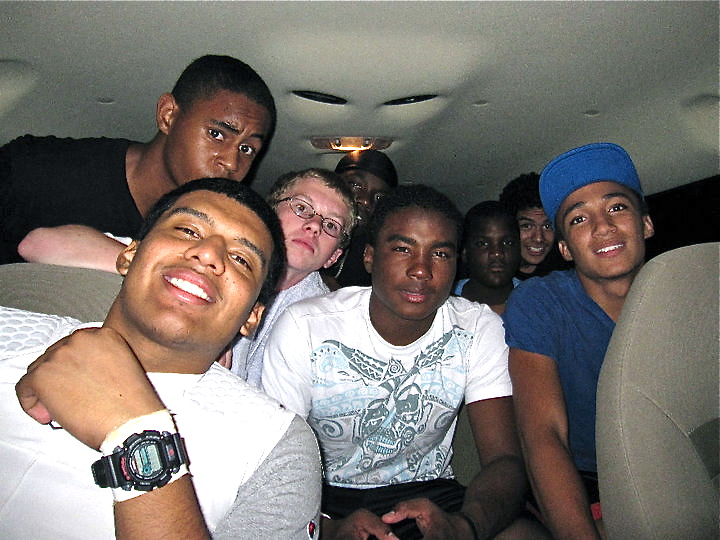
St. Jude’s fellas on their way to Bible study.

One single factor is responsible for these results:

  • 5x more likely to commit suicide
  • 32x more likely to be runaways or homeless
  • 14x more likely to rape someone
  • 20x more likely to have behavioral problems
  • 9x more likely to drop out of school
  • 10x more likely to have inpatients chemical abuse treatment
  • 20x more likely to go to prison
  • 711% more likely to have a teen pregnancy
  • 92% more likely to end up divorced

The factor: Not having a father involved in a child’s life. In our church’s youth group 15% have a dad living in the home. Ask yourself what happens when we disenfranchise the urban male. Then ask yourself if our society can afford the results. 

I have a photograph in my office of seven young men from our neighborhood sitting on boulders in Oak Creek. None of them had dads engaged in their lives. We were on a discipleship weekend-so these were young men who had chosen a life of faith instead of a life on the streets. Four years later two of them are men of amazing positive impact, serving God by mentoring other urban young men. Two were in prison serving hard time for violent crimes.

Consider this: In high crime neighborhoods, 90% of children from stable 2 parent homes where the Father is involved do not become delinquents.

What can you do? Amare Stoudemire started a charity called “Each One, Teach One.” I don’t know anything about his charity, but the concept is right. Men, find a young man to come alongside of for the next decade.

Just one.

(Statistics Retrieved from: http://thefatherlessgeneration.wordpress.com/statistics/)


Not another blog.

Actually, yes.

What will this be about? These are the ruminations of a post-Young Life Episcopal priest who helps people think about walking with the triune God. I will deal with various topics such as youth ministry, multi-ethnic church planting, and the Anglican Communion/Episcopal Church.  I will post rants, resources, and things that make me smile. My name is Matt Marino. I am married to Kari and have two children, Ellie and Luke. I like the Phoenix Suns and sailing. My paying gig is “Canon for Youth and Young Adults” for the Episcopal Diocese of Arizona, which is a catch-all for getting to do about ten things, at least nine of which are really fun. I am also one of the founders of St. Jude’s Church in the I-17 Corridor of Phoenix (www.mystjudes.com) and lead the Youth Ministry Apprenticeship training program (www.youthministryapprentice.com).

“The Gospel side,” for my low-church friends, is the side of a traditional 2-pulpit church from which the Gospel is read…as opposed to “the Epistle side” from which the Epistles are read. The Anglican tradition is to balance the size of the pulpits with the altar to architecturally demonstrate the value of both Word and Sacrament in worship. Assuming the sanctuary faces east (towards the rising sun and the returning Son), the “Gospel side” is the north, or left side when looking from inside the church. It is from “the Gospel side” that we hear Jesus proclaimed, and from whence the people of God hear the implications of the Good News expounded upon. The people then are tasked with extending the glory of God by carrying His message to the world. Currently the gospel is proclaimed from the center of the church, among the people. Jesus was often in the midst of the people, rather than off to the sides. I seek to live my life the same way.

People want to know up front where their bloggers are coming from. My brief answer: Orthodoxy. There is a term in radical feminist theology: kyriarchy. It is a word with highly negative connotations, somewhat of a catch-all for power inequities. It is a combination of the Greek words: “Kyrios” (Lord) and “archy” (rule). It is literally the “rule of the Lord.” The first creed among the followers of Jesus was, “Jesus is Lord.” It was a response to the cry “Caesar is Lord,” mandated to be shouted by the crowds as Roman rulers would pass through towns. It was also insisted that the followers of Jesus sign statements “Caesar is Lord” during persecutions. To say, “Jesus is Lord” was to defy all illegitimate human authority and systems of the world for another, higher obedience. I have decided to reclaim the word kyriarchy and claim myself as an unrepentant Kyriarchist- someone seeking to right wrongs by placing my own life under the gracious leadership of the Lord, Jesus Christ, and inviting others to know the freedom of the reign of God in their lives.

Matt Marino+  August 24, 2012